Expert Secrets by Russell Brunson: Summary and Notes
The full book, section by section, with Deven's notes on how he'd use it.
Start hereThe short version
- 1Expertise does not sell itself; a movement does, and every movement has the same three parts: a leader people are drawn to, a cause bigger than the product, and a genuinely new opportunity rather than an improvement on the old one. Section One assembles all three, and twenty-two secrets follow across five sections, in order.The claim
- 2Get a result for a small free beta group first, then build belief with stories, then sell with one script, delivered live every week for a year before you automate a single piece of it. That belief work is Section Two, built with stories rather than arguments. That script is Section Three, the Perfect Webinar, taught slide by slide.The order of operations
- 3The mechanism is one belief, the Big Domino, knocked down by Epiphany Bridge stories aimed at three false beliefs about the vehicle, the buyer, and the outside world, then an offer presented as a stack the buyer sees re-totaled after every line. Section Four is the funnels that carry the mechanism, and Section Five is distribution, the hundred people who already hold the attention you want.The mechanism
Before you readWho this book is for, by stage
Every entrepreneur is at one of four income stages, and the same book does different work at each one. Find yours below, then read the way that stage says to.
Find your stage in ten seconds
Move the slider or flip a switch. Your stage lights up and this book's advice for it opens below.
Expert Secrets on four pages
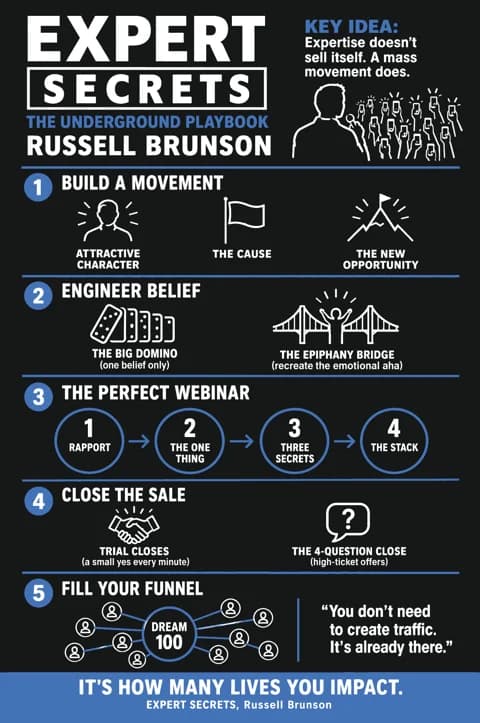
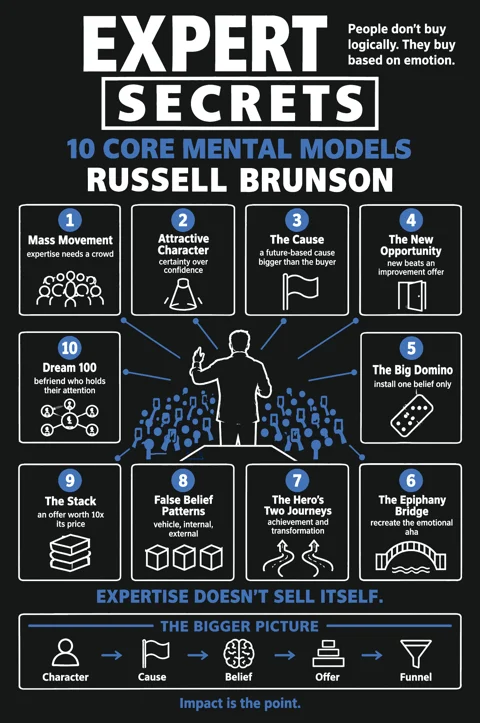
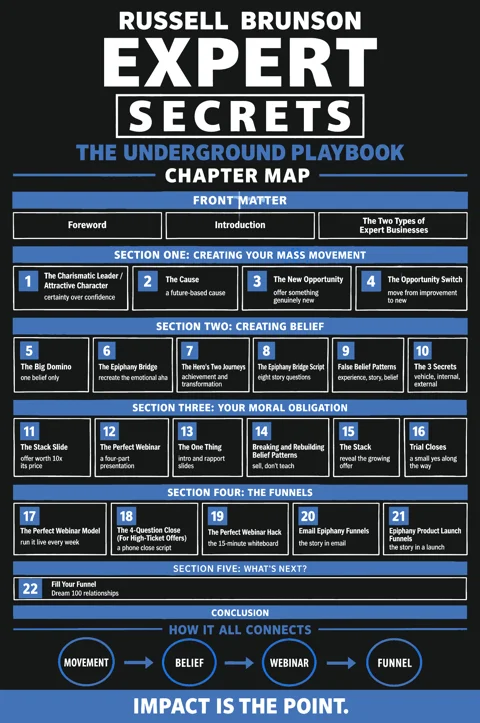
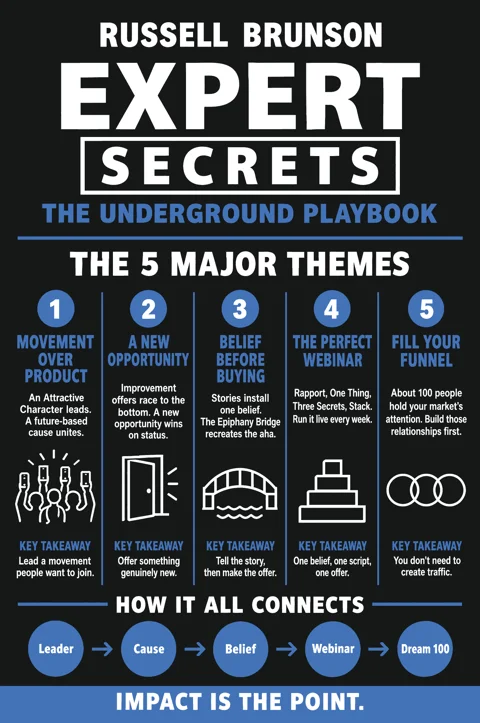
Four printable posters in the cover's colors: big ideas, mental models, a chapter map, and major themes.
Free. You'll also get each new summary by email.
The summaryForeword, Introduction, and the Two Types of Expert Businesses
Robert Kiyosaki's foreword frames the book with his Cash Flow Quadrant: employee, self-employed, business owner, investor. An expert business, he says, is the fastest route from the left side of that quadrant to the right, and his own Rich Dad company grew from a board game into books, lectures, and coaching without a plan. Brunson, he argues, supplies the plan he never had. His sharpest point is for owners of ordinary businesses: attach an information business to the front of what you already sell and your cost to acquire a customer falls toward zero.
Brunson's introduction is the potato-gun story. Newly married, broke, a sophomore at Boise State, he and a friend spent spring break building a potato gun and learning about barrel-to-chamber ratios and safe propellants. A keyword tool showed more than 18,000 monthly searches for "potato gun plans" and nothing for sale, so they filmed a DVD, got thrown out of one Home Depot mid-shoot, snuck a camera into another, and started making $20 to $30 a day. He uses the story to state the book's governing belief early: the value of an expert business is the lives it changes, and the money is a byproduct. His proof is a recovery product he later partnered on, OvercomePornography.com, and the marriages he says it saved.
"I believe the true value of an expert business isn't the money you make, but the people's lives you're able to change through your message."
Then the split that organizes the book. There are two types of expert businesses: selling information products built from your own life lessons, which needs no capital, and using information products to grow a company you already have, which is how ClickFunnels itself launched. He lists four things that happen when an existing company adds the information front end: complicated sales get easy, you are positioned as an expert instead of a commodity so price resistance fades, customer acquisition becomes free and back-end sales become pure profit, and growth speeds up. The examples are people who got obsessed with one thing and taught it: Jacob Hiller on vertical jump, Jermaine Griggs on playing piano by ear, Liz Benny on social media management, and his own experience coaching wrestling camps, where teaching a move forced him to understand it.
"Being an expert and selling information products is, in my opinion, the greatest startup in the world."
Section OneCreating Your Mass Movement
Brunson says he had to learn to build an audience before he could sell a message, and that he studied how mass movements form, citing both Adolf Hitler's party and Jesus Christ's church as research subjects, to find what they share. He found three elements, and the section is built on them. He frames the goal with Kevin Kelly's 2008 essay "1,000 True Fans," and his Inner Circle's joke about building a "cult-ture": a deliberate culture of true fans, not a cult.
Section One · Three elements of every mass movement
"the world is filled with experts who are broke people with advice and opinions and no one listening to them."
Secret 1The Charismatic Leader, or Attractive Character
Leadership is learned, Brunson argues: you master something for yourself, then contribute what you learned. He admits to recurring self-doubt after coaching thousands of people and answers it with the chapter's line, that results are the credential. Tony Robbins helped people with NLP the same night he learned it and was thrown out of the certification program for it. Frank Abagnale taught a college class as a fraud by staying one chapter ahead.
"Your results are your certification."
Then market selection. There are three core markets, health, wealth, and relationships, each with sub-markets, and your job is to go one level deeper than the sub-market into a niche you create, a blue ocean in the Kim and Mauborgne sense, rather than fighting in a crowded red one. He gives three validation questions: would people in the sub-market be excited about your niche, are they irrationally passionate (communities, vocabulary, events, other experts), and are they both willing and able to spend money. A friend's video-game product failed on the last test because kids were willing but not able, and Joel Erway's engineers were able but not willing until Erway changed markets.
| Level | Example | What it is |
|---|---|---|
| Core market | Wealth | Health, wealth, or relationships. Too broad to own. |
| Sub-market | Real estate investing | The red ocean. Crowded with established experts. |
| Niche | A specific approach nobody else teaches | The blue ocean you create one level down, then test with the three questions. |
The chapter closes with six rules for the leader: become an attractive character who lives the life the audience wants (from DotCom Secrets); keep absolute certainty by publishing daily; do not be boring, which he draws as the Prolific Index; use persuasion, borrowing Blair Warren's sentence about encouraging dreams, justifying failures, allaying fears, confirming suspicions, and throwing rocks at enemies; care a lot, because those who pay, pay attention; and offer value as the audience defines it, a rule he credits to Bill Glazer. He expects polarization and quotes Dan Kennedy on offending someone by noon, adding his own ratio that roughly one person in a hundred true fans will dislike you.
Secret 1 · The Prolific Index
Secret 2The Cause
The second element is a future-based cause, a vision bigger than any product. Brunson leans on Eric Hoffer's observation that fear of the future makes people cling to the present while faith in the future makes them open to change, and shows it with presidential slogans and the Rogue One line that rebellions are built on hope. His own slogan, "You're just one funnel away," went through dozens of rewrites before he deleted the ending so each person could finish the sentence themselves, an idea he credits to Gary Halbert's "one sales letter away."
He gives four ways to build the cause. Give people somewhere to place hope and faith, an open-ended vision. Help them break their four-minute mile, the way Roger Bannister did in 1954 and the way John Reese's million-dollar launch day in 2004 reset what a young Brunson believed was possible; ClickFunnels' Two Comma Club plays that role for his own community. Let them self-identify, the way his customers named themselves funnel hackers and Brandon and Kaylin Poulin's clients rallied to "Lady Boss" after a rebrand he says dropped churn by 10 percent. And create a title of liberty, a rallying symbol borrowed from the Book of Mormon story of Captain Moroni, in one of three forms: a mini-manifesto short enough for a phone background, a full manifesto, or a video title sequence with a six-part script covering the leader, the movement, us versus them, why it is different, who you are fighting, and who you are.
Secret 2 · Four ways to build the cause
"You're just one funnel away."
- Where can they place their hope and faith?
- Help them break their four-minute mile.
- Let them self-identify.
- Create a title of liberty.
Secret 3The New Opportunity
The third element is the one Brunson calls least understood: a movement offers a new opportunity, never an improvement offer. Again through Hoffer, he argues that the movements that won replaced a paradigm instead of improving it, and his business example is Steve Jobs in 2001 reframing every existing music player as an improvement before introducing the iPod as something else entirely. Improvement offers fail for three reasons: improvement is hard and painful, most people have desire but very few have ambition (he guesses under 2 percent), and buying an improvement means admitting the last decision failed, which is why improvement markets race to the bottom on price. Dan Kennedy's line applies: if you cannot be the lowest price leader there is no advantage in being the second lowest.
Secret 3 · Improvement offer or new opportunity
Underneath all three, he says, is status, an idea he credits to Perry Belcher. Every purchase is a subconscious calculation: does this raise my status or risk lowering it, measured in intelligence, wealth and power, appearance, or style. A new opportunity wins because discovering something new raises status, there is no pain of admitting failure, it replaces a stalled dream, and the grass is greener. He closes by naming two positions: opportunity switching, moving someone from an old vehicle to yours, and opportunity stacking, offering further opportunities inside the one they have already joined.
"Status is the only thing that causes people to move toward you or not move at all."
Secret 4The Opportunity Switch
Nothing is real until someone pays, Brunson says, and he warns against starting with a book: his took almost 18 months and had to be earned by years of client work first. The chapter is four steps. Get a result for free with a beta group, the way Alec Jetzel folded clothes unasked at his dream store for two days and was hired, and the way Brunson worked for free for a day fixing Drew Canole's funnels and built the Organifi launch, which he says did $20,000 to $30,000 a day and more than $25 million in three years. Design the vehicle as a six-week Opportunity Switch Masterclass, written with a who/what statement, "I am going to teach [sub-market] how to [niche]," a headline in the form "How to [result] without [thing feared]," and one of Jason Fladlien's five curiosity hooks. Run an Ask campaign, credited to Frank Kern and Ed Dale: a simple page that asks a hot market what they want, run until about 100 responses, whose top eight to ten questions become your modules and later your marketing bullets. Deliver the masterclass free in a private Facebook group with weekly lives, and let the results it produces become the proof for everything that follows.
Secret 4 · The Opportunity Switch, step by step
"you have to earn a book."
 Deven's insight
This chapter is the reason my entry tools cost a dollar.
I started my first business at 21, selling supplements out of my trunk in...
This chapter is the reason my entry tools cost a dollar.
I started my first business at 21, selling supplements out of my trunk in...
I started my first business at 21, selling supplements out of my trunk in college, with posters on telephone poles and flyers all over campus. I made some money and lost more than I ever made, and nobody had paid me for anything I actually knew. What I can teach now came out of the years after the basement, and the first person to hand over money for it was a bigger deal than the first million ever was.
My rule is give away the information and sell the implementation. Brunson's version is the free beta group, and it is the same rule from the other side: nobody owes you a course until you have a result with a name on it.
Section TwoCreating Belief
Section One covered who the expert becomes and what to create. Section Two is about how to create belief in a follower's mind, and Brunson's premise is that belief creates the customer and belief creates the results, so persuasion means mastering story.
"Belief creates the customer. Belief creates the results."

"Look, at Ivystone we run every deal through four questions: purpose, opportunity, leverage, model. Same four, just on a page you fill in yourself. A dollar. Go do it this afternoon."
One dollar, backed by the Dollar-Back Promise, and done in 47 minutes on average.
Secret 5The Big Domino
The chapter opens with Tim Ferriss describing his slow daily routine, meditation, tea, walks, reading, to a room of about 120 entrepreneurs, and the lesson Brunson took from it: find the one domino that, knocked down, takes everything else with it. Applied to selling, the first job is to find the one thing a prospect must believe that makes every other objection irrelevant. His friend Perry Belcher had analyzed a decade of his own companies' offers and found that asking a prospect to believe more than one thing roughly halved conversion.
He builds the statement on modus ponens, if A then B, A, therefore B, and gives a template: If I can make people believe that [new opportunity] is the key to what they desire most and is only attainable through my specific vehicle, then all other objections become irrelevant and they have to give me money. The ClickFunnels version: funnels are the key to online business success and are only attainable through ClickFunnels. A weight-loss version built on "cut calories and exercise" fails the test three ways: it is mainstream, it is not a new opportunity, and it is a red ocean where a hundred products already satisfy it.
Secret 5 · The Big Domino
"look at how many things a prospect has to believe in order to buy what you're selling. If it's more than one, you need to rework your sales presentation."
Secret 6The Epiphany Bridge
An Epiphany Bridge is a story that recreates the emotional experience that got you excited about a new opportunity, so the listener has the same epiphany and sells themselves. Brunson's opening scene is an email to a colleague whose launch script tried to sell a new opportunity with logic; the story-based rewrite, he says, helped that company reach 1.5 million users in three months. People buy on emotion and justify with logic afterward, the Ferrari buyer being the standing example, and status sits on both sides of that transaction.
Secret 6 · The Epiphany Bridge
"People don't buy logically. They buy based on emotion, then they use logic to justify the purchase decision they've already made."
Two techniques carry the chapter. The first is avoiding technobabble, the jargon that only lands after someone has had the epiphany you had, a concept he credits to Kim Klaver's book on why great products do not sell themselves. The fix is the Kinda Like Bridge: explain anything at about a third-grade level by saying it is kinda like something the listener already knows, so ketones become millions of little motivational speakers running through your body and ketosis becomes Pac-Man's power pellet. He cites a reading-level study of the 2016 primary speeches, unsourced in the book, in which the winner spoke at a third-to-fourth grade level. The second is how it feels: describe the physical sensation and emotional state instead of summarizing events. His example is the young Magneto scene in X-Men: First Class, and his own memory of sitting at home knowing the bills were due, the stomach pain, the chest pressure, the sweat.
Secret 7The Hero's Two Journeys
Brunson learned story structure from Michael Hauge and Christopher Vogler's audiobook The Hero's Two Journeys, passed to him by his friend Dagan Smith, and later hired Hauge to teach his events. Every good story has character, desire, and conflict. Little Red Riding Hood wants to bring cookies to grandma and there is a wolf; Brunson wants to support his family without a job and Google's ad costs triple. Rapport comes from connecting on at least two of five identities (a victim of an outside force, in jeopardy, likable, funny, powerful) and then showing flaws, because no one cares about Superman until Kryptonite shows up. Desire runs along four lines, to win, to retrieve, to escape, to stop.
The heart of the chapter is that every hero travels two journeys: the visible journey of achievement, and a hidden, more important journey of transformation, in which an old identity dies and a new essence is born. Lightning McQueen brakes short of the Piston Cup to push the injured King across the line, and the cup turns out to be empty. Hauge's five turning points give the plot its shape.
Secret 7 · The Hero's Two Journeys
"no one cares about Superman until we introduce Kryptonite."
Secret 8The Epiphany Bridge Script
Brunson turns the two journeys into an eight-question script and walks his own potato-gun story through it. The key move is question two: the external struggle is the surface, the internal struggle is the root, and you find the root by asking why five or six times until you hit love or status. His external struggle was barely making money; his internal struggle was feeling like a failed provider. The wall was Google raising ad costs; the epiphany was a friend's upsell strategy that revealed funnels; the plan was building funnels in new markets; the conflict was that each one took six to eight weeks, about eight people, and about $30,000, and one in ten paid it back; the achievement was ClickFunnels, which he says reached 30,000 users in two years; the transformation was his wife becoming a full-time mom.
| # | Question | What it does |
|---|---|---|
| 1 | Backstory | Where you were, and why the listener should care. |
| 2 | Desires | 2A the external struggle, 2B the internal struggle. Ask why until you reach love or status. |
| 3 | The wall | The problem that stopped the old vehicle. |
| 4 | The epiphany | The moment the new opportunity appeared. |
| 5 | The plan | What you decided to do about it. |
| 6 | The conflict | What went wrong on the way. |
| 7 | The achievement | The visible result. |
| 8 | The transformation | Who you became. The hidden journey resolves here. |
Secret 8 · Ask why until you hit love or status
"This is when the desire shifts from a should to a must."
Secret 9False Belief Patterns
Belief forms in a chain: an experience, then a story the mind tells about it, then a hardened belief. Two people share an experience and walk away with opposite beliefs because they told themselves different stories. A prospect's false beliefs are the stories you have to replace, and an Epiphany Bridge story is the replacement. The exercise is four steps, repeated until you have an inventory of ten to twenty or more: identify a false chain of belief, identify the experience that likely caused it, identify the story they now tell themselves, then find the story from your own life where that belief was replaced by a true one. His examples are a network marketer who believes "I will lose my friends" because his parents got angry when he pitched them, and a dieter who believes "I will be miserable" because cutting carbs once was. A friend once counted more than fifty stories in one of his hour-long presentations.
Secret 9 · How a false belief forms and how a story replaces it
| Step | Ask | Example from the book |
|---|---|---|
| 1 False belief | What do they believe that stops them? | "I could lose my friends." |
| 2 Experience | What probably happened to them? | They pitched their parents, who got mad. |
| 3 Story | What do they now tell themselves? | "Selling to people I know costs me the relationship." |
| 4 New story | Where did you see that belief replaced? | Leads generated online, so friends were never the market. |
"The stories lead people to the right belief, and they sell themselves."
Secret 10The 3 Secrets
Even after the Big Domino falls, three kinds of doubt surface, especially on expensive offers. Brunson sorts every false belief from the Secret 9 inventory into three columns, the vehicle (does this work), internal (can I do it), and external (will the world let me), and ranks the single core belief at the top of each. Then he walks his ClickFunnels presentation end to end: a curiosity headline, the domino statement, the origin story, and the three surfaced beliefs, "I don't understand how it would work for me," "I'm not technically inclined," and "I don't know how to drive traffic," each answered by a story and then rewritten as a curiosity-driven secret: Funnel Hacking, Funnel Cloning, and his number one traffic hack.
Secret 10 · The 3 Secrets
| Column | The doubt | ClickFunnels example | Becomes the secret |
|---|---|---|---|
| Vehicle | Does this thing work? | "I don't understand how it would work for me." | Funnel Hacking |
| Internal | Can I do it? | "I'm not technically inclined." | Funnel Cloning |
| External | Will outside forces let me? | "I don't know how to drive traffic." | The number one traffic hack |
"When all three of the core false beliefs have been knocked down, the big domino tumbles."
Deven's insightRun the three columns on the last thing you tried to sell.
When I was 21 and my flyers were not working, every objection I heard...
Run the three columns on the last thing you tried to sell.
When I was 21 and my flyers were not working, every objection I heard...
When I was 21 and my flyers were not working, every objection I heard went in one bucket: they do not want it. Sort them the way this chapter does and they come apart. Some did not believe the thing worked. Others believed it worked but doubted they could pull it off. A few believed both and still had a spouse or a bank balance standing in the way.
Three different doubts need three different stories. One pitch that argues harder answers none of them.
Section ThreeYour Moral Obligation
The section title comes from Jay Abraham: if you believe in what you sell, you have a moral obligation to sell it. Brunson opens with Justin and Tara Williams, who flipped more than a hundred houses a year, built a course nobody bought for a year, joined his Inner Circle, and grew a coaching company past a million dollars in eight months once they had a script. Then his own story: watching a speaker's 90-minute talk end in a stampede to the back of the room and calculating six figures in an hour and a half, followed by his own first stage pitch, which he thought was excellent and which produced crickets, and a weekend hiding in a hotel room with Haagen-Dazs and coconut shrimp. The script that came out of the years after took, he says, more than a decade to build, and its central discovery was uncomfortable.
"teaching the best content actually hurt sales"
Secret 11The Stack Slide
The offer you sell at the end is built on a whiteboard: everything you could deliver, then what you are willing to deliver at your target price. Each element gets a value that reflects what the buyer gets from it, not what you would sell it for alone, and the total should reach about ten times the price: a $97 product wants a stack worth at least $997, a $997 product wants $9,997. The six recurring elements are the masterclass itself (the recordings of the beta class), the tools (templates, checklists, software, often the highest perceived value), three tangibles aimed at the three doubts from Secret 10, and an exclusive bonus limited by count or deadline. Liz Benny gives away her own legal contracts as the tools element so students skip the lawyer.
Secret 11 · The Stack Slide adds up to ten times the price
"Think of it not as the value you'd sell it for, but the value they get from it."
Secret 12The Perfect Webinar
The script has one goal, to get the audience to believe one thing, and it works on a stage, a teleseminar, a video sales letter, or an email sequence as well as on a webinar. Brunson credits Jason Fladlien with the framing of a single belief attacked over and over from different angles, and lays out the four parts the next three chapters script slide by slide.
Secret 12 · The Perfect Webinar in 90 minutes
"the idea is to have a single point of belief that your message is built around and is emphasized over and over and over again from a variety of different angles"
Secret 13The One Thing
Brunson recommends a word-for-word script even for natural improvisers, and scripts the first nine slides. A title slide with the curiosity headline. Rapport, built on Blair Warren's sentence. The ruler: two goals stated up front so people can self-select, the first inclusive of every sub-audience and the second the Big Domino restated as a goal. A short qualification, external result then internal result, no long bio. Then the origin story from Secret 8, the first attempt to knock the domino over. Liken the story to them: what people traditionally do, why it is hard, why the new way is easier. A quick case study of someone else's result. Then the transition into the three secrets, introduced by their curiosity titles.
Secret 13 · The One Thing: the opening slides
"I don't want people wondering during the whole presentation is this for me"
Secret 14Breaking and Rebuilding Belief Patterns
This is the chapter about teacher mode. Brunson taught his best material for years and watched people praise it and change nothing, and he says the friends he let into his events free never built the businesses while the paying attendees almost all did. Bill Glazer told him he was keeping people from success by teaching them. The content section of the webinar is therefore not a class; it is a loop, run three times: state the secret, tell the Epiphany Bridge story that kills the top false belief about it, show other people's results, break the remaining related beliefs in rapid fire ("you're probably thinking X, right?"), and restate the new belief as truth. Then a recap question that earns an internal yes, and the transition he credits to Armand Morin: "let me ask you a question," followed by permission to share the offer. Jason Fladlien once tracked every objection from a live audience and busted about fifty of them in a final 90 minutes, tripling that stretch's sales. Brandon and Kaylin Poulin, already selling about $200,000 a month, shortened their webinar and doubled it.
Secret 14 · Breaking and rebuilding belief patterns
"This is not a teaching presentation, this is a presentation to inspire people and cause them to actually take action to change their lives."
Deven's insightTeach everything, except for the ninety minutes you are asking someone to decide.
I already told you my rule: give away the information, sell the implementation. Everything...
Teach everything, except for the ninety minutes you are asking someone to decide.
I already told you my rule: give away the information, sell the implementation. Everything...
I already told you my rule: give away the information, sell the implementation. Everything I know that is worth knowing, I will tell you for free, because the trust that builds is the whole business. So when Brunson says teaching hurts sales, my first reaction is to argue.
Read the chapter and he is narrower than his own headline: he is talking about the ninety minutes in which you are asking someone to decide. In that room, a lesson gives people a reason to feel finished. I have watched it happen, and here's the line I draw: teach everywhere else, but in the pitch, tell the story and ask.
"Here's the one page: purpose, opportunity, leverage, model. One sitting, and you have something an investor can actually read. It costs a dollar."
One dollar, backed by the Dollar-Back Promise, and done in 47 minutes on average.
Secret 15The Stack
Brunson credits the stack to Armand Morin, whom he watched close nearly half of a thousand-person room and then asked how. The principle is memory: prospects remember only the last thing they saw before the price, so if you list the bonuses and then name the price, they anchor on the last bonus. Instead, reveal one element, show the stack slide with its value, reveal the next, show the stack again with the running total, and keep going until the full stack, totaled to about ten times the price, is the last thing on screen. He says it took his live close rate from 5 to 10 percent to a consistent 40 percent or more.
Secret 15 · The Stack
The full sequence runs from slide 27 to 66: a thirty-second deliverables recap, case studies and a blanket "this works for you too," destroying the number one reason people do not start, then the stack itself element by element, each introduced with what it cost to build and what it saves the buyer. Then Dave VanHoose's if-all statements three times ("if all this did was X, would it be worth the price?"), the "I had two choices" framing that justifies pricing high enough to stack in value, the price reveal with a comparison to full price, the buyer's two choices against a thirty-day guarantee, the full stack once more, an urgency or scarcity bonus for live attendees or a deadline, and a closing slide with the price and a countdown that stays up through Q&A.
"the only thing prospects remember when you sell is the last thing you showed them"
Secret 16Trial Closes
Ted Thomas, the real estate trainer, ran trial closes on Brunson over lunch without Brunson noticing until Ted asked what his head was doing. It was nodding. A trial close is a small question that earns a small yes, about once a minute: is this making sense, can you imagine that happening to you, am I right. Brunson tested adding recorded trial closes to an existing automated webinar and reports revenue per registrant rising from $9.45 to $16.50. Then he lists his sixteen favorite larger closes for the stack section, several credited to Jason Fladlien's Webinar Pitch Secrets, among them Money Is Good, Money Replenishes, Information Alone, Money or Excuses, Their Two Choices, Us Versus Them, The Handhold, Say Goodbye, Reluctant Hero, and If You Only Got.
Secret 16 · Trial Closes
"What's your head doing right now?"
Section FourThe Funnels
A short bridge: the reader has a character, a cause, a new opportunity, belief built through stories, and a stack-based presentation. The section covers the funnels that deliver it and, in Brunson's phrase, the fuel for the fire.
Secret 17The Perfect Webinar Model
For years Brunson launched a new product to the same list every month and capped out around one to three million dollars a year. Mary Ellen Tribby told him he was writing, casting, and opening a new Broadway show in Boise every month instead of taking one hit show on the road, and that she had taken Weiss Research from $11 million to $67 million in a year on the other approach. The model is one webinar, run live every week for a year: promote Monday through Thursday, present live Thursday night, replay and follow up with urgency Friday through Sunday, close the cart Sunday at midnight, start again Monday. He credits it with taking his company from zero to $10 million in twelve months and $30 million in the next twelve.
Secret 17 · The Perfect Webinar Model: one show, every week
The funnel has seven steps: a registration page with a "how to X without Y" headline; a thank-you page carrying a self-liquidating offer, a $37 to $47 product or a free trial (he says the ClickFunnels trial on that one page produced more than 15,000 trials, 4,500 still active, and about $450,000 a month in recurring revenue in its first year); indoctrination emails tied to the three secrets, which he calls an amplifier rather than essential; reminders starting Wednesday and running to "we're live"; the ninety-minute presentation, sixty minutes of belief and thirty of offer, then questions with a close between each; the replay and follow-up sequence, where sales typically double; and the Sunday close. He aims at $3 to $5 per registrant and says $7 or $8 gets hard to hold profitable on the front end. About a quarter of registrants show up.
| Close rate at the pitch | What Brunson says it means |
|---|---|
| 5% | A good webinar, likely profitable on the front end. |
| 10% | "A million-dollar-a-year webinar." |
| 15% | The rate his Funnel Hacks webinar ran at when it did just under $10 million in its first year. |
The insistence is on iteration before automation. His Funnel Hacks presentation closed 33 percent of its first live room; a webinar to 600 people made about $30,000; he exported the audience's questions, revised, and a webinar to 500 people four hours later made $120,000. He says he ran it live more than sixty times before automating. Liz Benny's first live webinar had zero attendees after months of preparation and a few hundred registrants, and she kept going to just over a million dollars in her first year.
"This is a huge mistake people make, automating too soon."
Deven's insightFifty-two live runs is the most honest number in the book.
Every room I have ever taught in rewrote the next one. The version you...
Fifty-two live runs is the most honest number in the book.
Every room I have ever taught in rewrote the next one. The version you...
Every room I have ever taught in rewrote the next one. The version you record on day one is the version that has never met an objection, and the automation just plays your worst draft on a loop.
If you are Full-Time, this is the chapter to act on. Pick a night. Run it live. Keep the questions people asked and fix the presentation before the next one. Do not touch the record button until the room stops surprising you.
Secret 18The 4-Question Close
Above roughly $2,997, and up to $100,000, Brunson moves from an order form to an application and a thirty-minute phone call, both because high prices sell better live and because the expert should screen for fit. The frame is set up front: four questions, and depending on the answers and how well we get along, we decide together. The four questions, based on Dan Sullivan's book The Question: imagine we are sitting in a coffee shop a year from now, what has happened for you to be happy with your progress (then dig past the external answer to respect, inclusion, or purpose); you clearly know what you want, so why don't you have it yet, listening for people who own their obstacle rather than blame others; what resources, connections, and skills do you have that you are not using at full strength, followed by "what else" until the list is real and a recap of goal, obstacle, and resources; and then the only question left.
Secret 18 · The 4-Question Close
"So I only have one more question. Do you want me to help you? Then I stop talking."
Secret 19The Perfect Webinar Hack
With days left in a $50,000 affiliate contest and a hundred affiliates ahead of him, Brunson skipped the slides, wrote five questions on a whiteboard in about fifteen minutes, and went live on Facebook and Periscope at once. The presentation ran 26 minutes and 32 seconds, he says more than 100,000 people saw it over three days, it produced more than $250,000 in sales, and he won the prize. Brandon and Kaylin Poulin copied the whiteboard approach the same day, made more than $100,000 on their first attempt, and later did more than $650,000 from one Facebook Live. The point is that the structure sells, not the production. When the script fails, he says, it is for one of three reasons: a bad market, an improvement offer, or slipping into teaching mode.
Secret 19 · The Perfect Webinar Hack
The cheat sheet, when you have fifteen minutes
| # | Question | Your answer |
|---|---|---|
| 1 | What is the new opportunity I am offering? | |
| 2 | What is the one big domino for this offer? | |
| 3 | What special offer can I create for those who buy? (the stack) | |
| 4 | What is my Epiphany Bridge origin story? | |
| 5 | What are the three false beliefs (vehicle, internal, external), and which story breaks each one? |
"Not bad for only 15 minutes of preparation."
Secrets 20 and 21Email and Product Launch Epiphany Funnels
Two short chapters port the same four stories and the stack into other containers. The email version follows Andre Chaperon's soap opera sequence from DotCom Secrets, each email ending on a hook that pulls the reader to the next, with the webinar's stories split one per email or one per linked video; Brunson says the format matters less than keeping the story structure. The product launch version was built for ClickFunnels' first anniversary, when affiliates who had already promoted the webinar needed something new to send: an origin-story intro video as the opt-in, then three videos for the three secrets, then a fourth video for the stack. He also recommends sending webinar no-shows through the launch sequence as a second chance in a different format.
Secrets 20 and 21 · The same stories in two more funnels
Section FiveWhat's Next
Secret 22Fill Your Funnel
Traffic already exists; the expert's job is to find where dream customers already gather and pull them over. The foundation for every traffic strategy Brunson uses is the Dream 100, from his mentor Chet Holmes. Holmes, selling ads for a struggling legal magazine in Charlie Munger's portfolio, found that 167 of 2,000 advertisers controlled 90 percent of the spend going to competitors, hit only those 167 with direct mail every two weeks and calls, heard nothing for four months, landed Xerox in month four, had 29 of them by month six, and took the magazine from sixteenth to first in its category in about a year. He later sold a screenplay to a studio the same way, with a list of a hundred producers, actors, and directors.
Secret 22 · Fill Your Funnel with the Dream 100
Build the list by stepping back from your niche to the sub-market and finding the four kinds of people who control attention there: list owners, bloggers, podcasters, and social media influencers, twenty-five of each. Then dig the well before you are thirsty, a line he credits to Harvey Mackay: follow them, subscribe, buy their products, give them a platform by interviewing them for thirty to sixty minutes, and ask what project matters most to them right now, a technique from Sean Stevenson, so you can add value toward it. Once the relationship exists there are three plays: they promote you directly (his own Dream 100 has grown to nearly 600 people, kept warm with a monthly mailed package and a call, and he says one yes netted more than a million dollars in three months), you run paid ads at their followers, and you integrate into their funnel, on their thank-you pages, in a P.S., or in a product built together.
"You want to dig your well before you're thirsty."
Deven's insightWrite the hundred names before you buy one more ad.
We start ads at five dollars a day on purpose and scale them by...
Write the hundred names before you buy one more ad.
We start ads at five dollars a day on purpose and scale them by...
We start ads at five dollars a day on purpose and scale them by a system, because I want something duplicatable that begins at low or no cost. The Dream 100 is the same idea with people instead of money. A hundred names, a monthly touch, and patience you can measure in months. Holmes heard nothing for four of them.
Start with twenty-five, not a hundred, and actually work them.
ConclusionWhere to start
Brunson closes with four starting points: get very clear about who you serve and what new opportunity you will create; get results for a beta group, because those results are the foundation of everything after; become a master storyteller, which he calls the most important skill in the book; and use the message to change lives. He admits he struggled for almost two years because he was too afraid to invest in himself, and that paying coaches and mentors was what finally made it congruent to ask others to invest in him. The book took him more than 18 months to write and, he says, more than a decade to learn. The core method, he repeats, is the weekly live Perfect Webinar, and the scoreboard is not the money.
Conclusion · Four starting points
- Become very clear about who you want to serve and what new opportunity you will create.
- Get results from your beta group. Those results are the foundation your expert business grows from.
- Become a master storyteller.
- Change the world with the message.
"It's how many lives you impact. The money is just a cool way to keep track of what's happening."
Every figure on this page is Brunson's own account inside the book, or a claim he attributes to a named person. None carries an outside citation. Treat them as directional, not as audited results.
Deven's insightsHow I'd use this book
Everything above is the book. Everything in the green blocks is me.
Let me tell you what this book is really about, because the cover says webinars and that is the least of it. I made my first million before I was 25, millions by 27, and I was broke in my in-laws' basement by 30, with Kim and four little kids, and in the basement years I learned more that was worth teaching than in the years when everything worked. Nobody was asking me to teach it. I lived in that gap for a long time, the gap between knowing something and having anyone care that you know it, and that is the problem this book solves. It solves it in the right order: earn a result for a few people, tell the story of it honestly, then ask.
Here's how I use it. The Epiphany Bridge Script under Secret 8 is an interview, and I would run it on yourself before you write a word of a sales page or a bio. Eight questions, and the only one that matters is 2B, the internal struggle. Ask yourself why until you hit something you do not want to say out loud. Mine was the basement, not the money. Whatever yours is, that is the sentence a stranger will believe, and the rest of the presentation is scaffolding around it.
By stage: if you are at Idea, stop at the end of Secret 4 and go get a result for three people for free. At Side Income, you have the result, so the story chapters are your work now, and the Big Domino test is the one to run on everything you write: how many things does someone have to believe to buy this? At Full-Time, run the script live every week and let the room rewrite it. At Scale, the Dream 100 is your chapter, and so is the honesty about your own numbers, because his close-rate benchmarks are his, in his market, and yours will be different.
Where I disagree. Two places, and I want to be fair about both. He tells you to pick an enemy, quoting Kennedy on offending someone by noon, and I understand why it works. The enemy I pick is never a competitor: sometimes it is the pain someone feels that your product answers, and more often it is the frustration of not knowing what to do, which the product answers too. I do not operate on the competitive plane, and that is a different thing from what Russell teaches. Then there are the numbers. The $9.45 to $16.50 lift, the 40 percent close rate, the $67 million year: every one of them is his memory or a friend's, with nothing outside the book to check it against, and the book is honest that they are his. Use the structure. Hold the figures loosely.
So here's my challenge. Before your next sales conversation, whatever shape it takes, answer question 2B in one sentence and read it to somebody who loves you. If they wince, you found it. Then build the rest around that.
"Before you build the movement, get the business on one page. You just read twenty-two secrets about the movement. This is the page underneath it. A dollar, and 47 minutes."
One dollar, backed by the Dollar-Back Promise, and done in 47 minutes on average.
Expert Secrets on four pages
Four printable posters in the cover's colors: big ideas, mental models, a chapter map, and major themes.
Free. You'll also get each new summary by email.