$100M Offers by Alex Hormozi: Summary and Notes
The full book, section by section, with Deven's notes on how he'd use it.
Start hereThe short version
- 1Business comes down to one skill: making an offer so good the person would feel stupid saying no. He calls it a Grand Slam Offer. Sixteen chapters build toward it. Chapter 16 closes on his own first hundred thousand dollars.The claim
- 2The right market matters more than the offer, and the offer matters more than how well you sell, so pick a starving crowd first and build for it. That is Section II, three chapters on the market you sell into and the price you charge.The order of operations
- 3The mechanism is the Value Equation: raise the dream outcome and the buyer's belief they will get it, cut the time and effort it costs them, price it high, then wrap it in scarcity, urgency, bonuses, a guarantee, and a name. It arrives in Chapter 6. Section III builds the offer around it, and Section IV is five chapters on the wrapper.The mechanism
Before you readWho this book is for, by stage
Every entrepreneur is at one of four income stages, and the same book does different work at each one. The stages are about your income, not your industry: if nothing is running right now, you are at Idea, whatever you tried before; a day job plus any sales at all, even messy ones, is Side Income; a business that pays all your bills while you do most of the work is Full-Time, whether it is a course or a five-truck landscaping crew. Not sure? The free 8-question quiz places you in about two minutes.
Find your stage in ten seconds
Move the slider or flip a switch. Your stage lights up and this book's advice for it opens below.
$100M Offers on four pages
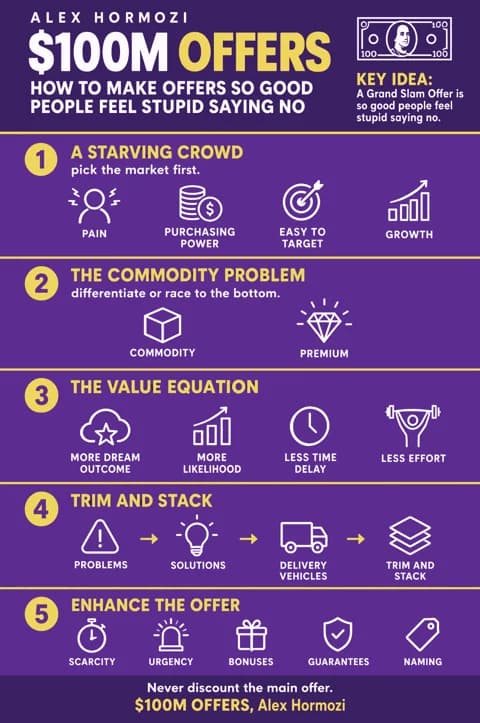
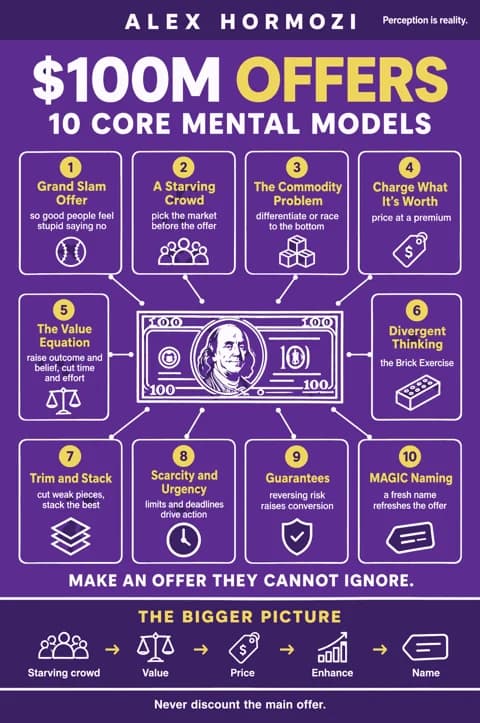
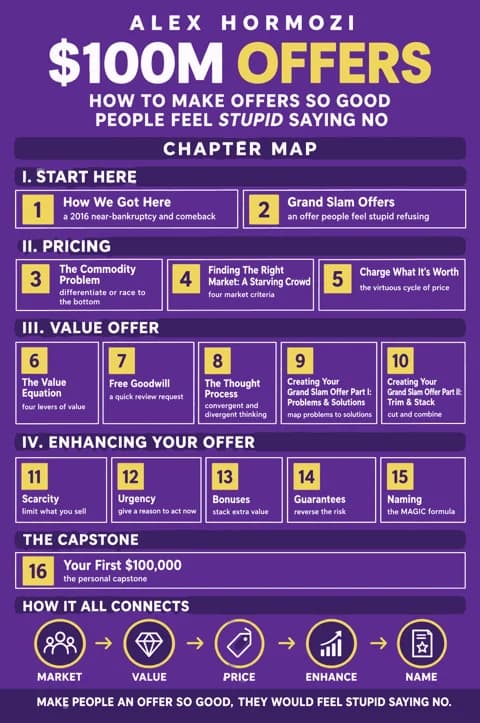
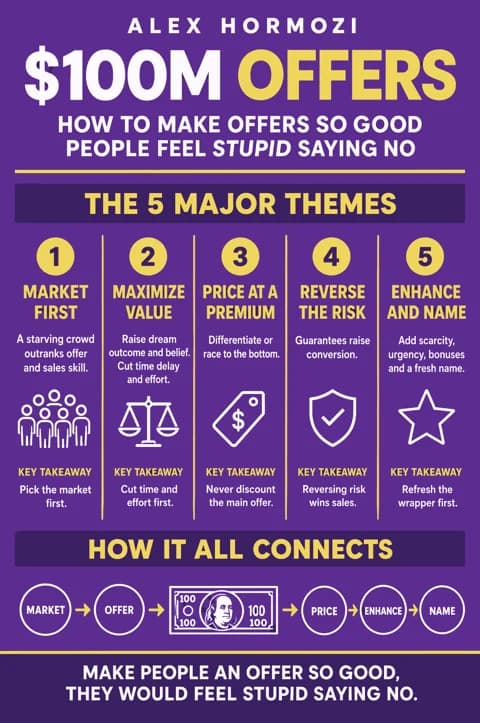
Four printable posters in the cover's colors: big ideas, mental models, a chapter map, and major themes.
Free. You'll also get each new summary by email.
The summaryStart Here
Hormozi opens with a case for boldness. Outsized returns come from betting against conventional wisdom, and business, unlike baseball, has no cap on what one swing can score. He compares entrepreneurs to gamblers with one difference: skill moves the odds until you become the house. A bet with a 10 percent chance of paying 100 times is worth taking every time.
He planned a series on customer acquisition and realized he had to write about the offer first, because the offer starts every transaction. He names the ideal combination of pricing, value, guarantee, and naming a Grand Slam Offer, partly after a Jeff Bezos line on long-tail returns and partly because a grand slam is both good and rare. He reports a lifetime return of 36 to 1 on advertising spend across eight years and says he has hit a true Grand Slam Offer four or five times in his life.
"Outsized returns often come from betting against conventional wisdom, and conventional wisdom is usually right."
Section IHow We Got Here
Chapter 1How We Got Here
Christmas Eve 2016. Hormozi is in a movie theater with his pulse near 100, and his girlfriend Leila notices. Thirty days earlier he had sold five of his six gyms and put the proceeds with a new partner for a new business; the partner drained the account, leaving $300 of $46,000. A payment processor froze $120,000 of sales for six months. He wired his last money to pay a salesman's $22,000 commission and watched the balance fall to $1,036. His mother had a near-fatal accident. He was in a head-on collision.
What he had left was an old business credit card and a Grand Slam Offer. He and Leila launched six gym relaunches at once, going into debt at $3,300 a day. January 2017 brought in $100,117, barely covering the spend. By the end of the year the company was doing $1.5 million a month, then $4.4 million a month, then more than $120 million in cumulative sales within 24 months. The chapter ends on the line he credits it all to.
Chapter 1 · From $100,117 to $4.4 million a month
"All of this was because of a girl who believed in me, a credit card, and a grand slam offer."
Chapter 2Grand Slam Offers
At 23 he pays $3,000 for a Las Vegas mastermind where a mentor named TJ hands him the secret to sales in one sentence. That sentence organizes the whole book.
"Make people an offer so good, they would feel stupid saying no."
An offer is the value exchange that starts a transaction. Hormozi ranks them on a ladder: no offer means no business; a bad offer means negative profit; a decent offer means you compete on price with everyone selling the same decent thing; a good offer means real profit; a Grand Slam Offer means fantastic profit and freedom, because nothing on the market compares to it. Every entrepreneur has two root problems: not enough clients and not enough cash. This book exists to solve both by fixing the offer.
Chapter 2 · The offer ladder
Section IIPricing
Chapter 3Pricing: The Commodity Problem
"Grow or die." Maintenance is a myth because the market itself grows about 9 percent a year, so standing still is falling behind. Growth has three levers: more customers, a higher average purchase, and more repeat purchases. He simplifies to two: more customers and more value per customer, and defines gross profit and lifetime value with worked examples (a $10 lotion that costs $2 has $8 of gross profit; a $1,000 a month client at 90 percent margin for five months is worth $4,500).
Then the chapter's real subject. A commoditized offer can be compared, so it will be compared, and the comparison ends at the lowest price. A Grand Slam Offer cannot be compared, which puts you in a category of one. The proof is a before-and-after case from a lead-generation agency.
| Same $10,000 ad spend | Old commoditized way | Grand Slam Offer way |
|---|---|---|
| Offer | $1,000 down plus a retainer | Pay for performance, one time |
| Response rate | 0.13% | 0.33% (2.5x) |
| Appointments booked / shown | 40 / 30 | 100 / 75 |
| Closing rate | 16% | 37% (2.3x) |
| Clients closed | 5 | 28 |
| Price | $1,000 | 4x higher |
| Cash collected | $5,000 | $112,000 (22.4x) |
| Return on ad spend | 0.5 to 1 | 11.2 to 1 |
The arithmetic is the point: 2.5 times 2.5 times 4 is 22.4 times the cash, from the same traffic. A Grand Slam Offer given to the wrong market still fails, which sets up the next chapter.
Chapter 3 · Same ads, 22.4 times the cash
"Commoditized equals price-driven purchases, aka a race to the bottom."
 Deven's insight
This chapter is where the book caught me.
I started my first business at 21, selling supplements out of my trunk while...
This chapter is where the book caught me.
I started my first business at 21, selling supplements out of my trunk while...
I started my first business at 21, selling supplements out of my trunk while I was in college. I nailed posters to telephone poles with my number on them and put flyers all over campus. I made some money and lost more than I ever made, and if you had asked me what was wrong, I would have told you it was the marketing. So I rewrote the flyer, changed the headline, and moved the phone number to the top. I never asked whether the thing on the flyer was worth saying yes to.
I needed a system, and what I had was a flyer. That flyer was a commodity, and the market priced it like one. Hormozi would have looked at it for about four seconds and asked me what the offer was.
Chapter 4Pricing: Finding the Right Market, A Starving Crowd
A professor asks his marketing class what single advantage they would want for a hot dog stand. Better buns, a better location, the lowest price. His answer: a starving crowd. Toilet paper sold for $100 in 2020 with no offer at all. Then the story of Lloyd, whose good product and real sales skill could not beat a newspaper market shrinking 25 percent a year, and who was doing millions a month within five months of pivoting the same skills into mask manufacturing.
Hormozi's four indicators of a market: massive pain, purchasing power, easy to target, and growing. Health, wealth, and relationships are the three markets that always exist. Then the ranking the whole section hangs on: a great market beats a great offer, which beats great persuasion skill. Two named ideas follow. Niche slap is the warning against jumping markets before you have figured one out. Riches are in the niches is the pricing argument, told through a Dan Kennedy example.
Chapter 4 · A starving crowd comes first
| The same time-management product, named for a narrower buyer | Price it justifies |
|---|---|
| Time management | $19 |
| Time management for sales professionals | $99 |
| Time management for outbound B2B sales reps | $499 |
| Time management for outbound B2B power-tool and gardening sales reps | $1,997 |
Niching down is the right move below $10 million a year; broadening only matters once the total addressable market becomes the constraint.
- Do not pick bad markets. Normal markets are fine, and great markets are great.
- Once you pick a market, commit until you figure it out. Most people quit too soon.
- Stop personalizing failure. If the offer does not work, the offer sucks, not you.
- If you find a great market, ride it hard. Paired with a Grand Slam Offer, you may never need to work again.
"Don't be romantic about your audience. Serve the people who can pay you what you're worth."

"Look, most founders guess where they stand. Ten questions, ten minutes, and you come out with a score on four parts of your business and the first thing to fix. It's free with your email. Go find out."
Free with your email, and about ten minutes of your time.
Chapter 5Pricing: Charge What It's Worth
The chapter opens with Hormozi explaining to his skeptical father why gym owners happily pay $42,000 a year for his program, and walking the math of value received against price paid. Buffett's line frames it: price is what you pay, value is what you get. He calls the space between them the price to value discrepancy, and argues lowering price is almost always the wrong move, because price can only fall to zero while value can rise without limit.
Then the virtuous cycle of price. Raising price increases the client's emotional investment, their perceived value, their actual results, the quality of client you attract, and the margin you can reinvest in delivering more. Lowering price runs the whole cycle backward. He cites a blind wine tasting where the same wine scored higher with a higher price tag, and argues the client who feels the sting of paying shows up and does the work.
Chapter 5 · The virtuous cycle of price
His own history makes the case. He flew to 33 gyms in 18 months for full turnarounds, then moved to a done-with-you program priced at $16,000 for 16 weeks against competitors charging $500 to $5,000 a month, with 35 percent of clients upgrading to a $42,000 a year agreement. An outcomes survey of 158 gyms after 11 months reported top-line revenue up $239,000 a year, churn down from 10.7 percent to 6.8 percent, and revenue per member up from $129 to $167 a month.
- Charge a premium. It lets you do things for clients that no one else can.
- Charging more funds providing more value, which keeps the cycle spinning.
- Ninety-nine percent of businesses need to raise their prices to grow, not lower them.
- Profit is oxygen. It fuels the fire of growth.
Deven's insightWhere I part with him, a little.
Raise the price, yes. But "never discount the main offer" reads as an absolute...
Where I part with him, a little.
Raise the price, yes. But "never discount the main offer" reads as an absolute...
Raise the price, yes. But "never discount the main offer" reads as an absolute, and Hormozi means it that way. Then his next book spends two chapters on feature downsells and payment-plan downsells.
Read closely, he is cutting features and terms, never price. A fast read hears a contradiction anyway, and I would rather you hear the explanation from me now than feel tricked halfway through Money Models.
Section IIIValue: Create Your Offer
Chapter 6Value Offer: The Value Equation
The chapter the book is known for. It opens with a portfolio photography client whose average ticket went from $300 to $1,500 and whose weekly profit went from $1,000 to $38,000, then states the goal plainly: charge as much as you can, up to 100 times your fulfillment cost, not two or three. Value has four drivers. Two you want as large as possible, two as close to zero as possible.
Chapter 6 · The Value Equation
Each driver gets its own treatment. Dream outcome is tied to status. Perceived likelihood of achievement is why a surgeon's ten-thousandth patient pays more than the first would; people pay for certainty. Time delay is the gap between buying and benefiting, and "fast beats free." Effort and sacrifice is what the buyer has to give up or do, which is why done-for-you beats do-it-yourself. His example of a psychological fix beating a logical one: the London Underground raised rider satisfaction more cheaply with a dotted wait-time display than with faster trains.
The chapter closes by scoring meditation against Xanax. Same dream outcome, relaxation and less anxiety. Xanax wins every other line.
| Driver | Meditation | Xanax |
|---|---|---|
| Dream outcome | Relaxation, less anxiety | Relaxation, less anxiety |
| Perceived likelihood of achievement | Uncertain, takes practice | Almost every time |
| Time delay | Months of practice | Minutes |
| Effort and sacrifice | Daily discipline | Swallow a pill |
| Hormozi's score | 1.5 of 4 | 4 of 4 |
That, he says, is why a $123 billion supplement industry sits next to a $62 billion health club industry: the products that win on the bottom of the equation outsell the ones that are better for you.
"You can either be right or you can be rich. This book is for getting rich."
Score your own offer the same way
Hormozi scores each driver on a simple scale. Do it for the thing you sell today, before you touch a word of copy. Print this or copy it onto one sheet of paper.
| Driver | The question to ask | 0 | 1 | 2 | 3 | 4 |
|---|---|---|---|---|---|---|
| Dream outcome | How big and how specific is the result the buyer actually wants? | o | o | o | o | o |
| Perceived likelihood | How sure is the buyer, from your proof, that they will get it? | o | o | o | o | o |
| Time delay | How long from paying to the first felt win? (4 means almost none) | o | o | o | o | o |
| Effort and sacrifice | What does the buyer have to do or give up? (4 means almost nothing) | o | o | o | o | o |
Score the two bottom rows so that a higher number means less delay and less effort. Your lowest row is the first thing to fix.
Deven's insightIn our jewelry business, almost everyone buys for herself.
Most of our customers are self-buyers, and nobody buys more dream outcome from a...
In our jewelry business, almost everyone buys for herself.
Most of our customers are self-buyers, and nobody buys more dream outcome from a...
Most of our customers are self-buyers, and nobody buys more dream outcome from a necklace. She buys because one adjustable chain replaces four, and because at 24 inches and up she can slip it over her head and set the length herself. We did not see coming how much that would matter to older women with arthritis and dexterity issues. That is the bottom of the Value Equation doing the work: less effort, no fuss, and it fits the first time.
That is what I mean when I say the Value Equation is a scorecard. Score your own four rows before you touch a word of copy.
Chapter 8Value Offer: The Thought Process
Chapter 7 is a two-minute request for an honest review, so the teaching resumes here. Hormozi contrasts convergent thinking, many known variables converging on one right answer the way school taught you, with divergent thinking, where the variables are dynamic, several answers are right, and one is far more right than the others. Life and offers reward the second kind. The exercise is a brick: set a timer for 120 seconds and write down every possible use for one, then notice how changing its size, material, and shape multiplies the list. Every offer is made of building blocks like that brick, and the job is to find as many ways as possible to combine them into value.
Chapter 8 · Convergent and divergent thinking
"With divergent thinking, you can have multiple right answers, and one answer that is way more right than the others."
Chapter 9Creating Your Grand Slam Offer, Part I: Problems and Solutions
Hormozi could not sell a $99 a month bootcamp against LA Fitness at $29 until Dan Kennedy's writing on irresistible offers made him stop selling membership and sell the outcome. The build is a numbered process, and the first three steps live here.
- Identify the dream outcome. His was "lose 20 pounds in 6 weeks."
- List every problem the buyer will hit on the way, in the order they hit them: buying healthy food, cooking it, eating it, exercising. Each problem maps back to one of the four value drivers. He ends up with about 16 core problems and 32 to 64 sub-problems.
- Turn each problem into a solution by reversing it into "how to" language. "Buying healthy food is hard and confusing" becomes "how to make buying healthy food easy and enjoyable."
Chapter 9 · Problems in the order buyers hit them
A second worked example comes from Brooke Castillo, who ran the same three steps on a 90-day relationship course: "no chemistry" becomes "how to create chemistry like you've never known."
- We went through this whole process for one objective: a valuable offer that is differentiated and cannot be compared to anything else in the marketplace.
- We are selling something unique.
- We are no longer bound by the normal pricing forces of commoditization.
- Prospects now make a value-based decision, not a price-based one, on whether to buy from us.
"No one wants membership. They want to lose weight."
Chapter 10Creating Your Grand Slam Offer, Part II: Trim and Stack
First a principle: the sales to fulfillment continuum. Offers that are easy to sell tend to be hard to fulfill, and the reverse. His mantra is "create flow, monetize flow, then add friction," meaning get people saying yes before you optimize delivery. Gym Launch began with him flying to a gym for 21 days and doing everything himself for a refundable $500 deposit, selling about $100,000 a month alone before building a team of eight; only later did he teach owners to do it themselves at a third of the price.
Then steps four and five.
- Choose the delivery vehicle for each solution. Brainstorm every way you could deliver it, using the Delivery Cube below.
- Trim and stack. Cut anything that costs you a lot and the buyer values little. Keep what costs you little and the buyer values a lot, plus what costs a lot but the buyer values enormously. Stack what survives into one offer at one price.
| Delivery Cube dimension | The options to run each solution through |
|---|---|
| Personal attention | One to one, small group, one to many |
| Effort expected of the buyer | Do it yourself, done with you, done for you |
| Medium | In person, phone, email, text, Zoom, chat |
| Format of anything recorded | Audio, video, written |
| Response speed | How fast you get back to them, and what support is included |
| The 10x and one-tenth test | What would this look like at ten times the price? At a tenth? |
Chapter 10 · Trim and stack
He insists on solving every perceived problem, not most of them, with a story about nearly losing a client over a refusal to stop eating out until he built an eating-out guide. The chapter ends with a full weight-loss stack: grocery system, cooking guide, meal plans (built once in Excel over about 100 hours, then 15 minutes per plan, later used by more than 4,000 gyms), workouts, travel guide, accountability, and the eating-out system, totaling $4,351 in named value and sold for $599.
- It solves all the perceived problems, not just some.
- It gives you the conviction that what you are selling is one of a kind.
- It makes it impossible to compare or confuse your business with the one down the street.
Deven's insightIf you are at the Side Income stage, you are me with the flyer.
Before you change one more headline, run the trim and stack on the thing...
If you are at the Side Income stage, you are me with the flyer.
Before you change one more headline, run the trim and stack on the thing...
Before you change one more headline, run the trim and stack on the thing you already sell, then score it again with the worksheet under Chapter 6.
Section IVEnhancing Your Offer
The section opens at a charity fundraiser where the organizer, on a jewelry entrepreneur's advice, raised the ticket from $15,000 to $25,000 and cut the seats to 100 as demand rose. That alone added $1 million before the doors opened, and the night's auction brought the total to about $5.4 million from those 100 people. That is the whole section in one scene: when demand goes up, cut supply. Hormozi names the four enhancers that belong to the offer itself, scarcity, urgency, bonuses, and guarantees, plus naming, and frames them with a supply and demand curve. Marketing shifts demand right; the enhancers shift it further, so the same offer sells more units at a higher price. He adds a rule of his own: the longer you delay the ask, the bigger the ask you can make.
Section IV · Shifting the demand curve
"Ten minutes on a Tuesday and you'll know what to work on next. That's the whole thing. It's free, and the worksheet is yours to keep."
Free with your email, and about ten minutes of your time.
Chapter 11Enhancing the Offer: Scarcity
Why can Oprah charge what she charges? Implied demand against a perceived supply of one. Hormozi turned down $50,000 for a day of consulting because his own business already paid more, and learned that the person who needs the exchange less holds the upper hand. Three types of scarcity: a limited supply of seats or slots over a period, a limited supply of bonuses, and things that will never be available again. For physical products, limited releases, sell out, and publicize the sellout (Chanel ships one or two of each item per store). For services, three caps: a total business cap on clients, a growth rate cap on new clients per week, and a cohort cap per class. Always offer fewer spots than you could sell. His preferred version is honest scarcity: publicly state how close you are to your own capacity ("81 percent full"), which doubles as social proof.
Chapter 11 · Honest scarcity
- Employ one or several methods of scarcity in your business.
- You will drive faster purchasing decisions, at higher prices.
- Just let them know your limits and let psychology do the rest.
"Fear of loss is stronger than desire for gain."
Chapter 12Enhancing the Offer: Urgency
Scarcity is about quantity; urgency is about time. Four methods. Cohort-based rolling urgency: start new clients on a fixed cadence, so waiting means waiting for the next kickoff. Rolling seasonal urgency: a real countdown on the page, the same core promotion renamed by season, which he calls his top strategy for local businesses. Pricing or bonus-based urgency: tie the deadline to the promotion or the bonus rather than the service, so a business that serves people year-round can still be honest about it; announce price increases in advance to clean the pipeline. Exploding opportunity: an arbitrage that loses value the longer you wait. The number behind the chapter is that the last few hours of a launch, roughly the last 3 percent of the time, produce 50 to 60 percent of the sales.
Chapter 12 · Deadlines drive decisions
"Deadlines drive decisions."
Chapter 13Enhancing the Offer: Bonuses
One offer is worth less than the same offer broken into parts and stacked, the way infomercials anchor a price and then keep adding. Never discount the core offer; add bonuses instead. In one-on-one selling, ask for the sale first and reveal bonuses after the yes, or match a bonus to an objection before asking again. His eleven bonus rules: always offer them; give each a benefit-driven name; explain how it relates to the buyer's problem, what it is, how it was made, and how it improves their life; provide proof; paint the picture of life with it; assign and justify a price; prefer tools and checklists over trainings; address a specific obstacle; anticipate the buyer's next problem; and let the bonus value eclipse the core offer.
The lever most people miss is other companies' products as bonuses, negotiated as group discounts or referral commissions. A pain clinic bundles chiropractic, food, orthotics, gym, and pharmacy savings against a $400 core offer, and the commissions can add $350 of profit to the same sale.
Chapter 13 · Bonuses that pay you back
- Create checklists, tools, swipe files, scripts, and templates: time-consuming to make once, easy to reuse endlessly.
- Record every workshop, webinar, event, and interview to use as bonuses that crush a perceived obstacle.
- Proactively negotiate group discounts and referral commissions with adjacent businesses that solve your customers' next needs.
Chapter 14Enhancing the Offer: Guarantees
Risk is the single biggest objection, and changing only the guarantee can lift conversion two to four times. Four types: unconditional, conditional, anti-guarantee ("all sales final," for exclusive or easily copied work, always with a stated reason), and implied (performance, revenue share, or pay-on-results structures). The chapter's spine is the math.
Chapter 14 · The refund math
Under conditional guarantees he catalogs more than a dozen named forms: no-questions-asked refunds (full, half, ad spend, a competitor's program, refund plus a bonus); the outsized refund, where a $2,997 course offered to buy back a failed store for $25,000 and generated about $3 million in extra sales against ten payouts; the service guarantee, his favorite, keep working until the result lands; the modified service guarantee (double the duration free); credit-based, personal-service, hotel-plus-airfare, wage-payment, release-of-contract, delayed second payment (no second bill until the first five pounds are gone), and first-outcome guarantees (ad spend covered until the first sale). The closing advice is a ladder: start with service-based guarantees or performance partnerships, then move to less restrictive guarantees as trust and volume grow. A guarantee enhances an offer; it cannot rescue a bad product or a bad sales team.
"Reversing risk is the number one way to increase conversion of an offer."
Deven's insightMost of us decide a bigger guarantee would sink us without ever doing the arithmetic.
Run his refund math on your own numbers before you decide. Put your current...
Most of us decide a bigger guarantee would sink us without ever doing the arithmetic.
Run his refund math on your own numbers before you decide. Put your current...
Run his refund math on your own numbers before you decide. Put your current refund rate in one column, double it, and ask what sales lift pays for it. Then decide with the number in front of you.
Chapter 15Enhancing the Offer: Naming
People respond more to things that resemble themselves, and a Grand Slam Offer is worthless if nobody hears about it or responds to its name. Offers fatigue, faster in local markets where cheap reach saturates a small population, though slower than most owners fear. The MAGIC formula names an offer so the right person recognizes it as theirs. Three to five of the five elements is typical; shorter beats complete.
| Letter | Stands for | What it does | Examples from the chapter |
|---|---|---|---|
| M | Magnet | The reason why now | Free, discount, season, grand opening |
| A | Avatar | Calls out the specific buyer, hyper-local when possible | "Bee Cave dentists," not "Austin dentists" |
| G | Goal | Their dream outcome | "Pain-free," "seven figure" |
| I | Interval | A time frame (platform rules often bar pairing it with a claimed result) | "6-week," "21-day" |
| C | Container | A word that signals a bundled system | Bootcamp, Blueprint, Sprint, Challenge |
Chapter 15 · The MAGIC formula
When an offer goes stale, he gives an order for what to change, cheapest first: the ad creative, then the body copy, then the headline and name, then the duration, then the free-or-discount enhancer, and only as a last resort the whole monetization structure and price.
- We must appropriately name our offer to attract the right avatar to our business.
- People do judge a book by its cover. Half-hearted naming can ruin conversions.
- Follow the MAGIC steps and watch the same offer get two, three, or ten times the response.
Section VExecution
Chapter 16Your First $100,000
March 2017. Hormozi and Leila check their personal accounts and see $101,018. He describes the feeling as relief rather than happiness: about three years of runway at $33,000 a year, the end of a long stretch of financial fear. Then the book's own back-of-the-napkin recap, which is the best one-screen summary of it anywhere.
Chapter 16 · Your first $100,000
- Why you must not be a commodity in this marketplace.
- Why you should pick a normal or growing market, and why niches get you riches.
- Why you should charge a lot of money.
- How to charge a lot of money using the four core value drivers.
- How to create your value offer in five steps.
- How to stack the value, deliver it, and make it profitable.
- How to shift the demand curve in your favor using scarcity.
- How to use urgency to decrease the action threshold of buyers.
- How to strategically use bonuses to increase the demand of your offer.
- How to completely reverse buyer risk with a creative guarantee.
- How to name it in a way that resonates with your avatar.
A finished Grand Slam Offer, he says, should be enough to get you to your first $100,000. The book closes by pointing to the next volume, $100M Leads, on getting customers profitably, and with his own view of the work: entrepreneurship is the acquisition of skills, beliefs, and character traits, and no one is coming to save us.
Deven's insightAt Scale, do not skip this book to get to the next one.
Fill in the four rows for the thing you sell, fix the lowest one...
At Scale, do not skip this book to get to the next one.
Fill in the four rows for the thing you sell, fix the lowest one...
Fill in the four rows for the thing you sell, fix the lowest one this week, then go sell it. My full notes are in the green block below.
Every figure on this page is Hormozi's own account inside the book. None carries an outside citation. Treat them as directional, not as audited results.
Deven's insightsHow I'd use this book
Everything above is the book. Everything in the green blocks is me.
Let me tell you where this book caught me. I started my first business at 21, selling supplements out of my trunk while I was in college. I nailed posters to telephone poles with my number on them and put flyers all over campus. I had no idea what I was doing and no system, so I made some money and lost more than I ever made, and if you had asked me what was wrong, I would have told you it was the marketing. So I rewrote the flyer, changed the headline, and moved the phone number to the top. Not once did I ask whether the thing on the flyer was worth saying yes to. Hormozi would have looked at that flyer for about four seconds and asked me what the offer was, and I would not have had an answer.
Here's the way I use it now. Take the thing you sell today and give it a 0 to 4 on each of the four sides, using the worksheet under Chapter 6. Do the math out loud. In our jewelry business, most customers buy for themselves, and nobody buys more dream outcome from a necklace. She buys because one adjustable chain replaces four and because at 24 inches and up she can slip it over her head and set the length herself, which turned out to matter most to older women with arthritis and dexterity issues. That is the bottom two rows of the equation, effort and time, doing all the selling. That is the whole trick: the Value Equation is a scorecard, and I mean that literally.
If you are at the Side Income stage, you are me with the flyer. Before you change one more headline, score the offer. At Full-Time, most of us decide a bigger guarantee would sink us without ever doing the arithmetic, so run his refund math from Chapter 14 on your own numbers before you decide. At Scale, do not skip this book to get to the next one. Money Models assumes the offer is already good and never goes back to check.
Where I disagree. This next part might sound like nitpicking, so let me say it anyway. "Never discount the main offer" reads as an absolute, and Hormozi means it that way. Then his next book spends two chapters on feature downsells and payment-plan downsells. Both are true once you read closely: he is cutting features and terms, never price. A fast read hears a contradiction anyway, and I would rather you hear the explanation from me now than feel tricked halfway through Money Models. I'd hold the survey numbers loosely too. They are his numbers from a voluntary survey of 158 gyms, and nobody outside checked them.
So here's my challenge. Tonight, before you touch a word of copy, fill in the four rows of that worksheet for the thing you sell. Fix the lowest one this week. Then go sell it.
"One more thing before you go. That worksheet back in Chapter 6 scores your offer. This scores the business behind it. The stage quiz up top tells you where you are. This one tells you what to fix first. Ten minutes, and it's free."
Free with your email, and about ten minutes of your time.
$100M Offers on four pages
Four printable posters in the cover's colors: big ideas, mental models, a chapter map, and major themes.
Free. You'll also get each new summary by email.