$100M Money Models by Alex Hormozi: Summary and Notes
The full book, section by section, with Deven's notes on how he'd use it.
Start hereThe short version
- 1A money model is a deliberate sequence of offers, and the reason most businesses starve is that they only ever make one. The third book in Hormozi's Acquisition.com series runs six sections and fifteen plays, and Section I defines the term.The claim
- 2The sequence runs in a fixed order: attraction, upsell, downsell, continuity, and you build one stage at a time, never all at once. Sections II through V are the plays themselves, one group per offer type. Section VI is the build order, with the Gym Launch timeline as its worked example.The order of operations
- 3The mechanism is speed of cash: when one customer pays back what it cost to get them, and then pays for the next two, all inside 30 days, advertising stops being a cost and becomes a machine. That is Section I's thirty-day rule. The book closes on an essay about where confidence comes from.The mechanism
Before you readWho should read it, by stage
Find your stage in ten seconds
Move the slider or flip a switch. Your stage lights up and this book's advice for it opens below.
$100M Money Models on four pages
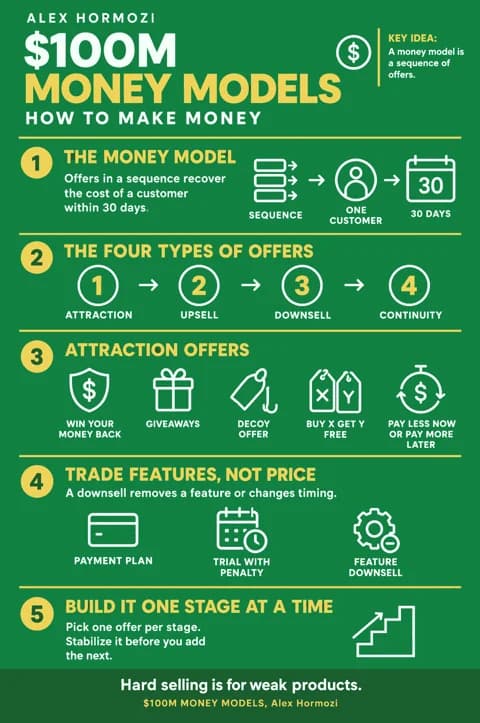
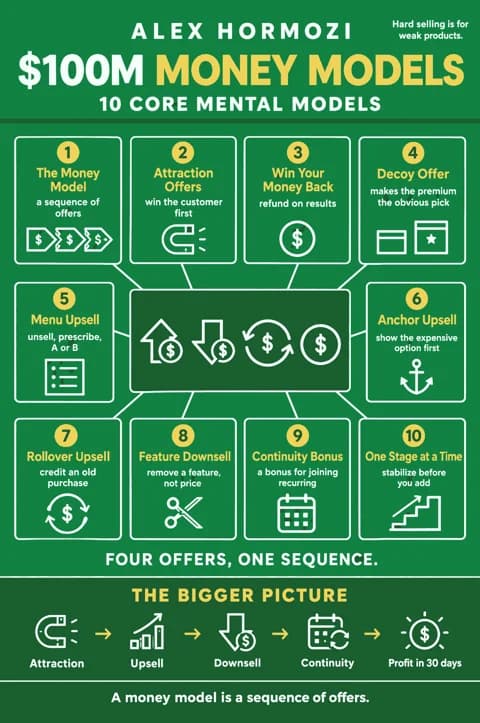
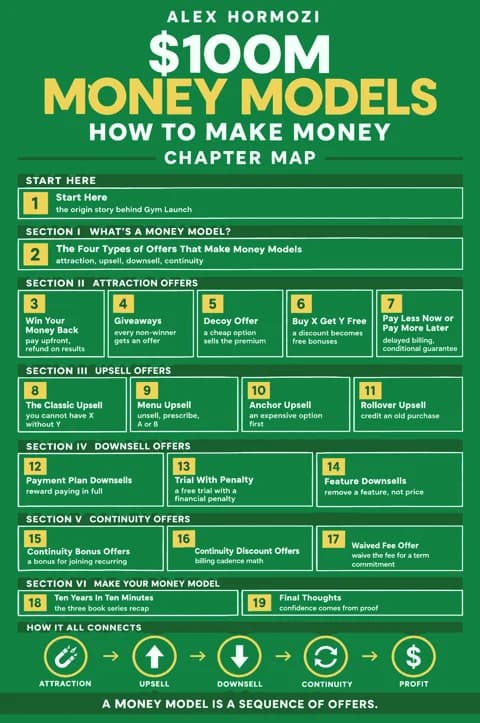
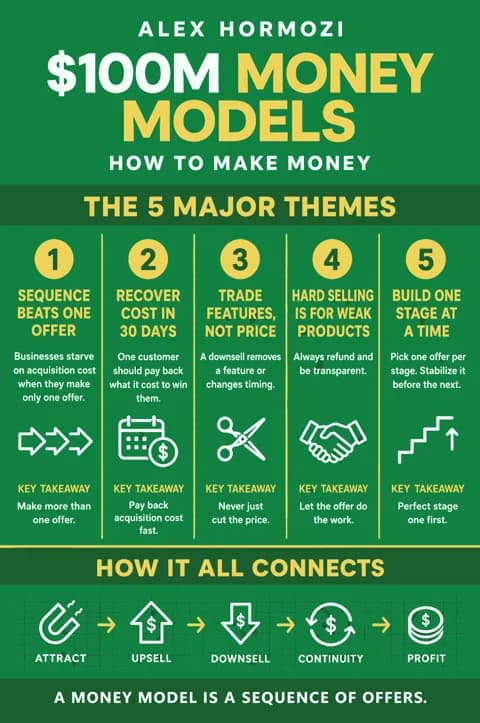
Four printable posters in the cover's colors: big ideas, mental models, a chapter map, and major themes.
Free. You'll also get each new summary by email.
The summaryStart Here
Hormozi is sleeping on the concrete floor of his gym, broke, having quit business school against his father's wishes. A member who owns storage units takes him to breakfast and walks him through his own money model. The "free month of storage" on the sign actually costs $127 once you buy the $47 lock, the boxes and tape, the moving company that pays him a kickback, and the insurance upgrade for $10 a month, and then the move into a bigger unit. Nothing about it is dishonest. Every step solves the next problem the customer has.
Two and a half years later, with six gyms, he pays $25,000 for an hour with a marketer who shows him how gyms open at full capacity: a free six-week challenge, 20 leads a day at $5 each, half show up, a quarter buy a $600 program, plus $80 a head in supplements, a 34 times return in 48 hours, and a $600 credit toward an annual membership that two thirds take. Then the marketer says the sentence that redirects his life.
"You have a level 10 skill set and a level 2 opportunity."
He sells the gyms, founds Gym Launch, does more than 30 in-person turnarounds, then licenses the system. The reported results: $43 million in owner distributions over five years, a sale of 66 percent of the company for $46.2 million, a $100 million net worth at 31, and Acquisition.com. A $100 Million Money Model, he says, is one that makes enough in the first 30 days that the cost of getting a customer stops being a constraint on growth.
Section IWhat's a Money Model?
December 2019, a rental car counter. Hormozi is offered a vehicle upgrade, a late return, premium insurance, then, when he declines, the minimum insurance, then prepaid gas. A $19 a day car becomes about $100 a day, five times the price, and he leaves happy. That counter is the definition.
"A money model is a sequence of offers."
The opposite is the business that spends more to get a customer than the customer pays back, then cuts its advertising, borrows, sells equity, and dies slowly. Even a profitable offer can starve you if the profit arrives too slowly: $100 of ads that returns $500 over two years is a choice between waiting and running out of cash. His rule is to recover the cost of a customer within 30 days, because that is the interest-free window on a credit card, which lets you run the cycle again immediately. The math that follows is the book's engine: double what a customer is worth and the business grows eight times faster; triple it and the business grows 27 times faster.
Section I, continuedThe Four Types of Offers That Make Money Models
Four offer types, each solving a different constraint, in order. Attraction offers get strangers to become customers. Upsell offers get more cash from the people who said yes. Downsell offers turn a no into a yes. Continuity offers keep them paying. Every chapter that follows uses the same five-part shape: origin story, the mechanic, examples across industries, notes and tactics, a recap.
Section I · The four types of offers
Seven ground rules come before any play. Every business already has a money model, so the question is how to make one work, not whether it can. Design your own; copying someone else's fails. Refund without a fight and fix your mistakes. Hard selling is for weak products. Obey advertising law, especially around the word "free," and check with a lawyer. Never lie; reputation is permanent. Any one offer works alone, but the sequence is what builds a $100 million model.
"Hard selling is for weak products."
Section IIAttraction Offers
Attraction offers get leads and turn them into customers by offering something free or discounted, because strangers understand price before they can be shown value. Free and discount are interchangeable, all the way down to a $1 offer. Two free things conditioned on one purchase beat one free thing. Five plays follow.
Section IIWin Your Money Back
June 2013. A gym owner named Danny sells a client eight weeks of training for $500 with a deal: hit your goal and get the money back. The client hits it, reinvests the refund instead of taking it, and his public before-and-after brings in 13 referrals. The play: the customer puts money down and gets it back, as cash or credit, by getting a result, taking the required actions, or both. Volvo's old "drive a million miles, get a free car" was the same play; Hormozi says it generated $1 billion in sales.
Section II · Win your money back
Rules he attaches: it works best on things people start and quit; about 10 percent of customers ask for refunds in his gym data, and store credit performs the same as cash; never resist a refund; make the criteria easy to track, tied to the real result, and useful to the business (advertise it); spread the credit across a longer, pricier package ($600 over 12 months is $50 a month against a $200 a month product); and treat every check-in as an upsell. Two closers: make the next-tier upsell mid-program as if they have already won, and let the people who fall short "win" anyway, privately, by reframing finishing as the victory.
- Suits businesses that need continuous customer effort toward a goal.
- Brings upfront cash, more yeses, stronger results, more long-term customers, and free advertising.
- Meetings tied to the deposit create chances to make more offers.
- The profit comes from customers who succeed and have something else to buy, not from failures.
- Make refund criteria easy to track, aligned with the goal, and helpful to the business.
- Only use it if the current refund rate is below 5 percent; otherwise fix the product first.
- Put store credit toward a more expensive offer to keep customers.
- Make everyone a winner privately so the upsell lands.
"We don't get customers to make a sale. We make sales to get customers."
Section IIGiveaways
A fitness-certification business gives away one full-ride scholarship, and every other applicant with a compelling story gets a partial one and joins on the spot. The play: advertise a big prize for contact information, pick one winner, then sell everyone else a discounted "promotional offer." Six steps: choose a grand prize with a stated value (it anchors the price); choose the promotional offer, a discounted or bonused version of the core offer; collect contact details plus a qualifying question; set an entry deadline of three to seven days with daily hype; announce the winner publicly and message everyone else privately; set a second claim deadline of about seven days.
Section II · Giveaways
His discount rule of thumb is 10 to 30 percent off gross margin, framed against the prize's value: a $5,000-value item retailing at $2,000, sold at $1,800 (a 10 percent discount), reads as a 64 percent gap from the prize's value. Give away two prizes, one to the winner and one to whoever referred them, and leads double. The prize has to be genuinely grand; a portfolio company's failed event-ticket giveaway was rescued with a $50,000 equipment bundle. Get a lawyer; sweepstakes are regulated.
- Ask an audience to apply for something high-value for free; one wins, the rest qualify for discounts.
- Pick a grand prize people want.
- Give away two prizes to get more referrals.
- Every entrant qualifies for the core offer at a discount.
- Entry answers give data for future offers.
- Run it about seven days, or until entries hit your call capacity.
- Book everyone else to claim their offer, with an expiration date.
- Have a backup discount ready if someone declines.
Section IIDecoy Offer
June 2014. A mentor's tanning salon sells a $5 five-day VIP pass; customers discover they cannot safely tan fast enough in five days and credit the pass toward a $19.99 a month membership. Five years later, with lead costs rising, Hormozi adapts it for gyms: a free option with one session a week sits beside a $399 "ultimate" option with unlimited sessions, coaching, and a guarantee. Seventy to eighty percent choose the paid tier. The play: advertise the cheap or free thing, then present the premium thing right next to it, and let the contrast sell.
Section II · Decoy offer
Strip the decoy of guarantees and components. Advertise benefits. Maximize the distance between decoy and premium. Discounted offers draw fewer leads, but a higher share of them show up than for free offers, which matters when a no-show costs you. Present the premium first when you can, with one question.
"Are you here for free stuff or lasting results?"
- Advertise something free or discounted, then present a more valuable premium option when leads engage.
- Make the premium far more valuable; strip the decoy down.
- Present the premium right next to the decoy when asked.
- Ask "free stuff or lasting results" for permission to lead with premium.
- You can still profit from and upsell decoy-takers.
- If money is not coming fast enough, widen the contrast.
Section IIBuy X Get Y Free
Nashville, 2020. A boot shop's sign reads "buy one pair, get two pair free." A $200 boot has become a $600 sale that feels like a gift. The play is a repricing: three $10 shirts for $30, or one $30 shirt with two free, is the same money and a different feeling. He shows three structures for the same $1,800 eighteen-month agreement.
| Same 18 months, same $1,800 | How it reads |
|---|---|
| Buy 12 months, get 6 free | A discount |
| Buy 6 months, get 6 free | Half free |
| Buy 6 months, get 12 free | Twice as much free as paid. The one he uses. |
Raise prices honestly before adding free things so the margin survives. Give more free than paid. The free item can differ from the paid one if the value holds. Never run it without the cash management and delivery capacity for the whole committed period. It works on existing customers for a fast cash pop, capped near 10 percent of the base.
Section II · Buy X get Y free
- Customers get other stuff free when they buy.
- Works for things worth buying more of, or getting longer access to.
- It is a repricing: buy one get two free is buying three at the reframed price, and it reads as more valuable.
- Always give more free things than paid things.
- Some versions genuinely discount per unit too.
- It can extend how long customers stay.
- If used for fast cash, manage the money and deliver the full commitment.
- Existing prepaying customers are strong candidates, capped to protect cash flow.

"Look, most founders guess where they stand. Ten questions, ten minutes, and you come out with a score on four parts of your business and the first thing to fix. It's free with your email. Go find out."
Free with your email, and about ten minutes of your time.
Section IIPay Less Now or Pay More Later
June 2016. Hormozi registers for a "double your reading speed in three hours or it's free" webinar, chooses $0 now with a $297 charge later unless he cancels, gets the result, and pays. The play offers two doors: full price later, risk-free with a card on file and a conditional guarantee, or a discount of 20 to 50 percent now, plus bonuses. Present the pay-now option only after pay-later is accepted. The promise has to be measurable, deliverable inside the window, and answerable with a clear yes or no. More than 10 percent cancellations means the promise, the conditions, or the price needs fixing. It works for recurring businesses too: a higher rate in 30 days, or a locked lower rate now.
Section II · Pay less now or pay more later
- A choice between full price later or a discount now with bonuses.
- Pay-later carries a delayed payment and a conditional, trackable guarantee.
- Pay-now offers 20 to 50 percent off plus bonuses.
- Present pay-now only after pay-later is accepted.
- Promises must be easy to track, hard to dispute, and clearly yes or no.
- Cancellations above 10 percent mean the promise, guarantee, or price needs adjusting.
The section closes with a short chapter of reader testimonials and a request for an honest review, then a one-paragraph wrap: five attraction offers, all of which he says he has run, credited with turning $1,000 into $10 million in ten months through reinvested returns.
Section IIIUpsell Offers
"Do you want fries with that?" Once the attraction offer has produced customers and covered its costs, the job is 30-day profit, and the upsell is simply whatever you offer next. Every offer that solves one problem reveals another. A burger shop makes 25 cents on a $2 burger and would need to sell 10,000 a day to survive on that; a fries and drink upsell takes profit to $2 (eight times), and a supersize takes it to $3 (nearly twelve times). Upsells fail when the offer is unwanted, badly timed (offered before the customer feels the problem), or not believed. Four plays.
"When an offer solves a problem another appears. You upsell the solution to the problem your offer reveals."
Section IIIThe Classic Upsell
A fourth-generation fur dealer's son gives away free earmuffs with coat storage, then asks to store everything else you are carrying for $30. The classic upsell solves the customer's next problem the moment it appears, in the shape "you cannot have X without Y": a car needs insurance, a bike needs a helmet, an exercise course needs a nutrition course. Current customers convert better than strangers. Offer the more profitable option first. Ask "you don't want anything else, do you?" so a no becomes a yes. Catch people in a hyper buying cycle (weddings, babies, moves). Deliver the upsell fast, because delayed value is worth less. Name the bundle. Book a meeting from a meeting, which he calls BAM FAM. Guarantees, warranties, and insurance can be sold at 5 to 50 percent of the price instead of given away.
Section III · The classic upsell
The magnetic middle is the pricing trick inside the chapter. A theater that prices small, medium, and large at $5, $8, and $9 pushes buyers to large. Price them $6, $7, and $9 and buyers land on medium. The middle moves to wherever you put it.
- Your attraction offer reveals a problem; the upsell is whatever you offer next to solve it.
- Use the classic upsell for the immediate problem the previous offer revealed.
- "You don't want anything else, do you?" gets people to agree by saying no.
- Give access as soon as possible to raise the chance they take it.
- Give away bonuses that create an upsell opportunity.
- Make BAM FAM, book a meeting from a meeting, a way of life.
- You can have as many upsells as you have problems to solve.
- Charge for guarantees, warranties, or insurance rather than giving them away.
Section IIIMenu Upsell
Nineteen nutrition consults in one day and zero supplement sales, with $5,000 of inventory on the shelf. Then a nervous, well-dressed client, and instead of a pitch, one question: "chocolate or vanilla?" She buys. Then "can I use the card on file?" She says yes. Later he writes step-by-step instructions on the order form, and sales rise again. Later still he learns to cross out the things a customer does not need before prescribing what she does. Those four moves, in order, are the menu upsell.
- Unsell. Tell them what they do not need, which buys trust for everything after.
- Prescribe. Tell them exactly what they do need, how it fits what they already bought, and how to use it.
- A or B. Ask which they prefer, never yes or no. Any variable works: flavor, quantity, timing, delivery speed.
- Card on file. Ask to use the card you already have instead of asking them to pay.
Section III · Menu upsell
Employees enjoy unselling and should be encouraged to. The chapter's proof from outside his own business is the Economist pricing test: with only $59 digital and $125 digital plus print on the table, print sales collapsed, and adding a $125 print-only decoy sent buyers to the $125 bundle.
- Menu upsells work best when you have several offers available.
- They combine up to four tactics: unselling, prescribing, an A or B choice, and card on file.
- Unselling lower-margin items where appropriate encourages the higher-margin upsell.
- Encourage employees to unsell and game the system on purpose.
- Nudge new customers toward what makes sense for them.
Section IIIAnchor Upsell
He walks in with a $500 budget for a suit. The salesman shows him a $16,000 suit first. He gasps. The $2,200 suit that follows feels like a relief, and $300 of accessories follow that. The anchor upsell presents a premium option first, priced five to ten times the main offer; when the customer gasps, the seller comes to the rescue with the main offer, which now looks like a deal. Two side effects: anchored customers spend more than they planned, and some buy the premium. The premium and the main offer must share the same core function and differ only in secondary features, and the anchor must be genuinely for sale; a fake one is felt, and trust goes with it.
Section III · Anchor upsell
- Presenting a more expensive offer before a less expensive one increases how many buy the less expensive one.
- Steps: present the anchor, get the gasp, come to the rescue, present the core offer, ask for payment.
- Price the premium five to ten times the core offer.
- Anchored customers spend a bit more than planned.
- Never treat the anchor as fake; customers sense it and trust is lost.
- Some customers buy the premium; even a few add outsized profit.
- Main and premium share the same primary features and differ in secondary ones.
- After the anchor, the main offer at one fifth the price looks like a great deal.
Section IIIRollover Upsell
His $600 win-your-money-back gym offer produced members and no recurring revenue: winners spent their $600 credit on three months and left. A friend running the same offer rolled the winnings forward instead, $50 a month off a twelve-month membership, so customers kept paying the day they "won." The rollover upsell credits some or all of a prior purchase toward a bigger new offer. Three decisions: who (lapsed customers, upset customers instead of a refund, a competitor's upset customers, or current ones), what (more, better, new, or different, as long as it is profitable after the credit), and how (up front or spread over time). Price the next offer at least four times the credit so the effective discount never passes 25 percent, and make it a one-time offer. A win-back campaign of 200 personalized videos drew a 20 percent response and $1.9 million in added annual revenue. The gift card play sells $200 gift cards for $20, two per customer, then rolls the $200 into a purchase of $1,000 or more.
Section III · Rollover upsell
- Credit some or all of a customer's previous purchase toward your next offer.
- Decide who to upsell, what to upsell, and how to roll the credit.
- Price the next offer at least four times the credit; keep the effective discount at 25 percent or lower.
- Add urgency by making the rollover a one-time offer.
Section IVDownsell Offers
What you offer when they say no. A downsell changes how much they pay, how they pay, or what they get, to find the highest-value solution inside their budget. The cautionary tale is a car salesman who drops an insurance add-on from $5,000 to $400 through five refusals and loses the customer's trust in the car itself. You can offer something different for less. You cannot offer the same thing for less; that is discounting, and customers compare notes.
"Downsells are trades. When downselling you work with the customer to find combinations of giving and getting until you get a match."
Section IVPayment Plan Downsells
His first month in business, a lead cannot afford the program, and he improvises a payment plan timed to her paycheck. Payment plans spread cost by charging some up front and scheduling the rest. They are a gamble: profitable when customers finish paying, costly when a would-be full-pay customer takes the plan and cancels early. Up to seven steps: reward paying in full with a discount (framed as a discount, never as interest added); offer third-party financing, then a credit card, then layaway; split in two, timed to paydays; check they still want it: an 8 out of 10 or better, before continuing; split in three; spread even payments across the term; offer a free trial. Align schedules with paydays to cut declines. Offer the original discount back if they pay off the balance early. The churn data he cites, from a subscription company's study of 14,000 businesses: monthly billing loses 10.7 percent a month, quarterly 5 percent, annual 2 percent.
Section IV · Payment plan downsells
- Payment plans spread cost by charging some up front and scheduling the rest.
- They win more buyers through a smaller upfront cost, and profit rises because customers still pay full price over time.
- They only grow the business if they add customers who actually pay.
- Seesaw downselling shifts gradually from paid-in-full toward equal payments.
- Offer the original discount if the balance is paid off early.
- Align payment schedules with paycheck dates.
Section IVTrial With Penalty
An HR software vendor takes Leila's card, delivers three onboarding calls, and waives the $500 onboarding fee only if she attends all three. She does, and the company is locked in. Win-your-money-back pays customers for meeting terms; trial with penalty charges them only if they fail to. It is a downsell, used after a no, and the terms should mirror the actions a money-back offer would track. Five steps: offer the trial only after the first offer is declined; always get a card on file; sell the long-term commitment before the trial starts; explain the fees after the card, matter-of-factly; attach mandatory check-ins, which are upsell opportunities. Call it a free trial. Use payment plans for one-time and physical offers, and trial with penalty for recurring services that need the customer to do work. Even $1 instead of $0 gets the card on file.
Section IV · Trial with penalty
- Customers try the product free as long as they meet your terms.
- It converts people who would have said no.
- Get the card, get the commitment, explain what they must do, design the criteria around what makes a great long-term customer.
- Fees can be split by criterion or charged as a lump; he prefers splitting.
- The money is in getting people results and converting them, not in fees.
- Use mid-trial check-ins.
Section IVFeature Downsells
A peer triples his close rate, 25 percent to 75 percent, by downselling with one move: removing the money-back guarantee instead of cutting the price. The guarantee was a feature all along; its value only showed when it left. Feature downsells lower the price by changing what the customer gets: less quantity, lower quality, a cheaper alternative, or a component removed. Remove from highest value to lowest, because taking away something the customer loves and cutting the price a little pushes them back to the full offer, which is the point of the first downsell. The dials he lists: quantity, materials, location, cancellation terms, response speed, delivery speed, group versus one-on-one, communication channel, provider seniority, live versus recorded, do-it-yourself versus done-with-you versus done-for-you, expiration, personalization, and the guarantee's length and conditions. Never negotiate price on the same offer. After two downsells, take a temperature check: 8 out of 10 or better, or stop. Current customers who are not using paid features can be downsold before they cancel, and he says these become the second-highest lifetime value customers he has.
Section IV · Feature downsells
- Take something away, lower the price, and ask "how about now."
- Offer less quantity, lower quality, a cheaper alternative, or remove a feature.
- People see the value of what was removed only after seeing the price difference, which pushes many back to the original offer.
- Remove what they hate and cut a lot to move them to the downsell; remove what they love and cut a little to keep them on the original.
- The first downsell exists to make them reconsider the original; later ones find their best deal.
- After several rejections, confirm they still want the thing.
- If they like the features but not the price, switch to payment plans.
- Discount current customers before they cancel, in exchange for reviews or referrals.
"Ten minutes on a Tuesday and you'll know what to work on next. That's the whole thing. It's free, and the worksheet is yours to keep."
Free with your email, and about ten minutes of your time.
Section VContinuity Offers
You can shear a sheep for a lifetime and skin it once. Sell a $1,000 thing once to 10 of 100 people and you have $10,000 today and nothing tomorrow. Sell it as $50 a month to 40 of the 100 and you have $2,000 today, $40,000 over twenty months, and four times as many customers to upsell. Continuity alone starves a business of cash today, which is why it comes last in the sequence, after the offers that bring cash now. Not everything belongs on a subscription: a one-day workshop is a payment plan, not continuity. Ongoing value earns ongoing payment. Three plays.
Section VContinuity Bonus Offers
A gym owner outperforms his peers by giving the six-week challenge away free as the bonus for joining the membership, adding member-only perks, then upselling a discounted prepaid block. His funnel: 15 of 100 take the challenge, 40 of 100 join continuity directly, and 8 of those 40 prepay six months. The play: give an awesome bonus, worth more than the first month's payment, if the customer joins now. Advertise the bonus, not the membership. Keep it related to the core offer and made of things you already have. Then the table the chapter is built around, which he says was tested across thousands of gyms.
| Standalone price of the bonus, relative to the first month of continuity plus bonus | Share who choose continuity |
|---|---|
| 1.33 times | about 50% |
| 1.66 times | about 60% |
| 2 times | about 70% |
| 2.33 times | about 80% |
| 2.66 times | about 90% |
Section V · Continuity bonus offers
The standalone option stays on the menu for the people who want cash-now simplicity, and its price is the reference point for the continuity path. Then sell bulk time: buy five months, get one free, needs only one taker in eight to raise 30-day profit by half.
- Give the customer an awesome thing if they sign up today; the bonus is worth more than the first payment.
- If continuity is your attraction offer, advertise what you give away, not what you sell.
- Make the bonus related to the core offer, from things you already have and do.
- More bonuses and discounts mean more people start continuity.
- Sell the value of the bonus before telling them how to get it free.
- Offer the bonus standalone for more upfront cash; price it 33 percent above continuity to split takers in half.
- Discount continuity bought in bulk to boost upfront cash further.
Section VContinuity Discount Offers
A neighbor in the trash business fronts a free year of commercial pickup to win five-year contracts. The play gives product or service free in exchange for a commitment to keep buying. Four places to put the discount: up front (converts most, churns most, needs enforceable contracts), at the end (earned after full on-time payment), spread across the term ($600 off over twelve months is $50 a month off a $200 rate), or after the first payments. Then the operational rules that fill the chapter. Bill every four weeks instead of monthly: that is 13 cycles a year instead of 12, an 8.3 percent lift in revenue that he says is a 41 percent lift in profit on a 20 percent margin business. Extend terms with discounts rather than shorten them. Add a 3 percent processing fee, worth 30 percent more profit at 10 percent margins. Collect a second payment method. Let customers earn a lifetime discount at the month most people quit. Make the cancellation fee equal to the discount given. And offer to waive it for an exit interview, which he says saves a third to half of the people who take it.
Section V · Continuity discount offers
- Give continuity time free if the customer signs up today.
- Front-loaded discounts convert more and churn more; back-loaded discounts convert fewer and churn less.
- Spreading the discount keeps cash flowing while delivering the full discount.
- Let customers earn a lifetime discount at the month of greatest churn.
- Lighter cancellation terms mean more signups and more departures; harsher terms, the reverse.
- Prefer cancellation by paying back the discount received.
- Make sure customers know how to cancel.
- Waive the cancellation fee for an exit interview; it often saves or upsells the customer.
Section VWaived Fee Offer
Two doors. Go month to month and pay a startup fee, typically three to five times the monthly rate. Or commit to a year and the fee is waived, owed only if you leave early. At $1,000 a month with a $5,000 fee, option A is $6,000 today and cancel anytime; option B is $1,000 today and twelve months. People join to avoid the fee and stay to avoid the fee. Justify it as setup cost. If cancellations pass 5 percent, look at the product rather than the pricing. A smaller fee, 1.5 to 3 times the rate, raises upfront cash. Best for year-plus commitments and services whose results are slow to show: SEO, investing, weight loss.
Section V · Waived fee offer
"Customers will stay longer if leaving costs more than staying."
- A month-to-month option with a fee, or the fee waived for a commitment.
- The fee is typically three to five times the monthly rate.
- Minimum commitment: a year.
- The larger the fee, the more buyers choose the commitment.
- The smaller the fee, the more upfront cash.
- Meet the commitment and the fee goes away for good.
His own preference, stated in the section's wrap: reward-based continuity over punishment-based. Two of the three plays are rewards; the waived fee is for situations where a traditional contract fits better.
Section VIMake Your Money Model
The section is the Gym Launch case history, one stage added at a time.
The upsell was Gym Lords at $42,000 a year with a $6,000 prepay discount, sold with payment-plan downsells ($10,000 down and the balance over 52 weeks, or $800 a week, or start free) and a continuity discount that front-loaded free time until the prior purchase was paid off. The menu upsell that followed offered done-for-you advertising at $300 a week, sales training at $200, monthly releases at $500, licensed materials at $100, and a $100 a week minimum package, against the $800 a week full package. Then the supplement line. He shows three more full models, a microgym, a newsletter, and a dog food company, each laid out stage by stage.
Then the build rules. Start with an attraction offer. When it produces customers and cash reliably, add an upsell. Then downsells. Then continuity. Perfect one stage before funding the next. Prefer a hundred ways to sell one product over a hundred products. Use affiliate relationships to fill gaps without taking on delivery. Price new offers low enough to get many yeses, improve the product on the feedback, then raise the price until it stops making more money.
- A money model is a deliberate sequence of offers.
- Three stages: get cash (attraction), get more cash (upsells and downsells), get the most cash (continuity).
- Build in order: attraction, then upsell, then downsell, then continuity.
- Do not implement a full money model at once; it will break the business.
- It is less about having 100 products and more about 100 ways to offer one product.
- Use affiliate relationships to add offers without the headache of delivery.
- Price new offers low, improve on feedback, then raise the price until it stops making more money.
- A $100 million money model eliminates cash as a bottleneck for growth.
Map your own money model
Four rows, one per stage. Most businesses can fill the first row and nothing else. That is the point of the exercise. If you want to see the four rows filled in before you try your own, the green block at the end of this page walks through them for this site's offers.
| Stage | The play you run today | The play from this book you would add next | Cash it brings inside 30 days |
|---|---|---|---|
| Attraction | |||
| Upsell | |||
| Downsell | |||
| Continuity |
Section VITen Years in Ten Minutes
The trilogy in one line each: $100M Offers answers what to sell, $100M Leads answers how to find the people who buy it, and this book answers how to get them to buy. Then the nine-point recap of the book, which is the best one-screen version of it.
Section VI · Ten years in ten minutes
- A money model is a series of offers designed to increase how many customers you get, how much they pay, and how fast they pay it.
- A good money model makes more profit from a customer than it costs to get and serve them in the first 30 days.
- A $100 million money model makes more profit from one customer than it costs to get and serve many, in the first 30 days.
- Four offer types: attraction, upsell, downsell, continuity.
- Five attraction offers: win your money back, giveaways, decoy offers, buy X get Y free, pay less now or pay more later.
- Four upsells: classic, menu, anchor, rollover.
- Three downsells: payment plan, trial with penalty, feature downsell.
- Three continuity offers: bonus, discount, waived fee.
- Build one stage at a time: get customers reliably, have them pay for themselves, then pay for other customers, then maximize long-term value.
Section VIFinal Thoughts
The book ends on confidence. It is not built by affirmations in a mirror; it is built by stacking undeniable proof that you are who you say you are, and by outworking your doubt. A July 2020 post pairs a photo of him sleeping on a gym floor with one of him on a private jet seven years later, taken by Leila without his noticing. Confidence and doubt, he says, can both run at full volume at the same time.
Section VI · Final thoughts
"You cannot lose if you do not quit."
Every figure on this page is Hormozi's own account inside the book, including the churn study and the pricing-ratio table. None carries an outside citation. Treat them as directional, not as audited results.
Deven's insightsHow I'd use this book
Everything above is the book. Everything in this green block is me.
Let me tell you what this book did to me the first time through. I went and counted my own offers. On my site, the first thing you can buy costs a dollar. Say yes to that and you are offered a second dollar item, then a seven-dollar guide, then a seventeen-dollar one. I built that ladder before I read a word of this book, and I was a little proud of it, right up until I laid it over Hormozi's four rows. An attraction offer and upsells, yes, and one downsell. But nothing at all for continuity, no subscription, no membership, no reason to come back next month except goodwill. I had built the first two and a half stages and called it a money model.
Here's the way I use it now. Draw the four rows on paper, the worksheet is right above this, and be honest about which ones are empty. Then pick one play, not five. The book gives you fifteen, and the whole point of Section VI is that people who install all fifteen at once break their business. In our jewelry business, a necklace is a one-time purchase unless we make it something else, so the row I am staring at is the same one: continuity. Hormozi would tell me to look at buy X get Y free for the customers we already have, and a continuity bonus for the ones who keep coming back for gifts, before I touch anything upstream. The empty row is where the money is.
If you are at Full-Time, this is the book. You have an offer and customers, and the next thirty days after each yes are where your business either funds itself or asks you to. If you are at Scale, read the Gym Launch timeline twice, and notice how boring it is: one stage, wait, one stage, wait. If you are earlier than that, put this down and read $100M Offers first. Sequencing offers that were never good on their own is the fastest way I know to look busy.
Where I disagree. This might sound picky, so let me say it plainly. Almost every play in Sections III and IV assumes a human being is in the room. Unselling, prescribing, the gasp, the temperature check, "chocolate or vanilla": those are conversations. Most of us at Side Income and Full-Time are running a website and an ad account, and nobody is there to gasp. The book never quite says which plays survive automation. My read is that the decoy offer, buy X get Y free, payment plans, and the continuity bonus travel fine. The menu upsell and the anchor lose most of their power without a person delivering them. Pick from the first group unless you sell on the phone. And, same note as on the last book, the numbers here are his own account. The 14,000-business churn study and the pricing-ratio table are not cited, and the book does not pretend otherwise.
So here's my challenge. Fill in the four rows tonight. Circle the empty one. Pick one play from that row and write the offer in one sentence before you go to bed. That sentence is worth more than the rest of this page.
"One more thing before you close this out. The worksheet up above maps your four rows. This scores the business behind them, which is a different question. Same ten minutes. Free."
Free with your email, and about ten minutes of your time.
$100M Money Models on four pages
Four printable posters in the cover's colors: big ideas, mental models, a chapter map, and major themes.
Free. You'll also get each new summary by email.