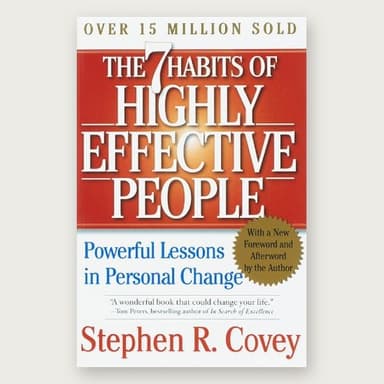
The 7 Habits of Highly Effective People by Stephen R. Covey: Summary and Notes
The full book, section by section.
Start hereThe short version
- 1The way we see the problem is the problem. Part One contrasts the Character Ethic with the Personality Ethic that followed World War I, explains paradigms and principles, and defines effectiveness as the balance of production and production capability, the goose and the golden egg.The claim
- 2Part Two is the private victory of self-mastery: Habit 1, Be Proactive; Habit 2, Begin with the End in Mind; Habit 3, Put First Things First. It moves a person from dependence to independence.Private victory
- 3Part Three is the public victory of interdependence, built on the Emotional Bank Account: Think Win-Win, Seek First to Understand, Then to Be Understood, and Synergize. Part Four's Habit 7, Sharpen the Saw, renews all of them in four dimensions.Public victory
The summaryForeword
The audio edition opens by noting that 15 years after first publication the book had sold more than 15 million copies in 28 languages. In his foreword, Stephen R. Covey takes up the question he is asked most often: are the seven habits still relevant in a changed world, and will they be in 10, 20, 50, 100 years? His answer is that the habits rest on principles, which he did not invent and takes no credit for, and principles do not change.
He then walks through nine common human challenges, in order: fear and insecurity, "I want it now," blame and victimism, hopelessness, lack of life balance, "What's in it for me?", the hunger to be understood, conflict and differences, and personal stagnation. For each he contrasts the cultural response with the principle behind a better one. He closes on his family: his 19-year-old granddaughter Shannon, serving orphans in Romania, wrote that she did not want to live a selfish life anymore, and 76 readers shared their stories in the book Living the Seven Habits.
"Deep, respectful listening and serving others brings the greatest fulfillment and joy."
Part OneParadigms and Principles
Part One lays the groundwork for the whole book: how people see the world, why the way they see a problem is often the problem, and why lasting change starts inside the person. It ends with the shape of the seven habits and the definition of effectiveness they rest on.
Part OneInside-Out
Covey begins with a family problem. One of his sons was struggling in school and socially, and he and his wife, Sandra, kept trying to fix it with encouragement and technique. While preparing programs on perception for IBM's executive development program, Covey realized that despite their words, they were communicating to their son that he was not capable, so they had to change themselves before anything could change for him. When they stopped trying to clone him in their own image and saw him in terms of his own uniqueness, he blossomed at his own pace.
At the same time, Covey studied the success literature published in the United States since 1776. For roughly the first 150 years it focused on the Character Ethic, the integration of principles such as integrity, humility, courage and the Golden Rule, of which Benjamin Franklin's autobiography is representative. Shortly after World War I, it shifted to the Personality Ethic: public image, attitudes, human relations techniques and positive mental attitude. Covey calls secondary greatness, social recognition for talents, a poor substitute for primary greatness, which is goodness of character.
He explains paradigms as maps. A map of Detroit labeled Chicago will get you to the wrong place faster no matter how hard you try. In a perception exercise, people who first saw a picture of a young woman or an old woman then saw the same ambiguous drawing very differently. On a New York subway one Sunday, Covey asked a father to control his unruly children, and the man said softly that they had just come from the hospital, where their mother had died about an hour ago. Covey's paradigm shifted in an instant. In a story from Proceedings, a battleship captain orders an approaching light to change course 20 degrees, and the reply comes back that it is a lighthouse. Principles, Covey argues, are like that lighthouse: natural laws that do not move. Growth follows a sequence, like learning tennis or piano, and quick fixes do not work. He tells of trying every tactic to make his daughter share her presents at her third birthday party and finally forcing her, borrowing strength from his position.
The chapter closes on a line Covey attributes to Albert Einstein, that the significant problems we face cannot be solved at the level of thinking that created them. Inside-out means starting with self: to have a trusting relationship, first be trustworthy.
Part One · Inside-Out
"The inside-out approach says that private victories precede public victories."
Part OneThe Seven Habits: An Overview
Breaking a deeply rooted habit takes effort, like the Apollo 11 astronauts, who spent more energy in the first few minutes of liftoff than over the next several days traveling half a million miles. Covey defines a habit as the intersection of knowledge (what to do and why), skill (how to do it) and desire (wanting to do it).
The habits follow the Maturity Continuum, from dependence (the paradigm of you) to independence (the paradigm of I) to interdependence (the paradigm of we). Habits 1, 2 and 3 move a person from dependence to independence; these are the private victories, and private victories precede public victories. Habits 4, 5 and 6 are the public victories of teamwork, cooperation and communication. Habit 7 renews the others.
Effectiveness itself rests on the P/PC Balance, illustrated by Aesop's goose that laid golden eggs: the farmer who kills the goose to get all the eggs at once loses both. P is production of desired results; PC is the production capability that creates them. Covey applies it to physical assets (a lawn mower he never maintained), financial assets, and people, including a daughter whose surprise request to see Star Wars led him to understand the training of a Jedi Knight, the unplanned fruit of a PC investment. He suggests reading the book with the intent to teach what you learn to someone else within 48 hours.
Part One · The Maturity Continuum
"The P-PC balance is the very essence of effectiveness."
Part TwoPrivate Victory
Part Two covers the three habits of self-mastery. Habit 1 says you are the creator. Habit 2 is the first, mental creation. Habit 3 is the second, physical creation. Covey later compares them to a computer: Habit 1 says you are the programmer, Habit 2 says write the program, and Habit 3 says run the program.
Habit 1Be Proactive: Principles of Personal Vision
The social mirror and three kinds of determinism, genetic, psychic and environmental, tell people they are the product of conditions. Covey answers with Viktor Frankl, the psychiatrist imprisoned in the Nazi death camps, whose parents, brother and wife died there. Alone in a small room, Frankl became aware of what he later called the last of human freedoms, the freedom his Nazi captors could not take away. Between stimulus and response lie four uniquely human endowments: self-awareness, imagination, conscience and independent will.
Proactivity means taking responsibility, response-ability, for our own lives. Reactive people are driven by feelings, circumstances and conditions; proactive people are driven by values. Covey cites Eleanor Roosevelt's line that no one can hurt you without your consent. A nurse at a seminar in Sacramento realized she had chosen to be miserable, and so could choose otherwise. Language reveals the paradigm: "There's nothing I can do" and "I have to" are reactive, while "Let's look at the alternatives" and "I can choose a different approach" are proactive. When a man said he no longer loved his wife, Covey told him to love her, because love is a verb. Proactive people, he says, make love a verb.
He draws two circles. The Circle of Concern holds everything we care about; the Circle of Influence holds what we can do something about. Proactive people focus on the second, and it grows. Problems are of direct control, indirect control or no control, and the first step in solving each lies in our own circle. One executive under a brilliant but dictatorial president compensated for the president's weaknesses instead of criticizing them, until no significant move was made without him. Gandhi expanded his circle of influence with field laborers until he broke political domination of 300 million people. Joseph, sold into slavery at 17, ran Potiphar's household, then the prison, then Egypt. The heart of the circle is the ability to make and keep commitments. Covey closes with a 30-day test: work only in your circle of influence and watch what happens.
Chapter 3 · Circle of Influence
"Between stimulus and response, man has the freedom to choose."
Habit 2Begin with the End in Mind: Principles of Personal Leadership
Covey asks readers to imagine their own funeral three years from today, with four speakers: one from family, a friend, a colleague from work, and someone from church or a community organization. What would you want each to say? Beginning with the end in mind means using that picture as the frame of reference for everything else, so you do not climb the ladder of success only to find it leaning against the wrong wall.
- You're Already an Impact Business22 to 30
- You're Closer Than You Think14 to 21
- You Have the Foundation7 to 13
- The Starting Line0 to 6
 Printable PDF
"Covey says everything is created twice, first mentally, then physically. Before the second creation, you want an honest picture of where your business stands, right? Ten questions, a score out of 30 and your tier's next steps. It's free with your email. Go find out."
 Deven Davis, devendavis.com
- Ten questions about where your business is right now
- A score out of 30
- A four-part breakdown: Impact Clarity, Traction Proof, Model Strength, Founder Credibility
- The part to fix first
- Your tier's next steps
- A printable PDF
Free with your email. Your score and a printable PDF open right on the page.
All things are created twice: a mental first creation and a physical second creation, as with a blueprint before a house. Leadership is the first creation and management the second. In a line Covey attributes to Peter Drucker and Warren Bennis, management is doing things right; leadership is doing the right things. His image is a crew hacking through the jungle while the leader climbs the tallest tree and yells, "Wrong jungle!" Anwar Sadat, who rescripted himself in cell 54 of Cairo Central Prison, later rescripted his stance toward Israel, visited the Knesset and opened the way to the Camp David Accord.
The tool is a personal mission statement, a personal constitution that works like the United States Constitution, which has had only 26 amendments in over 200 years. To write it, start at the center. Covey describes alternative centers, spouse, family, money, work, possessions, pleasure, friend or enemy, church and self, and shows how each one shapes four life-support factors: security, guidance, wisdom and power. A principle center gives the most stable version of all four. He walks one decision, a boss's request to work late on concert night, through each center. Imagination and conscience are mostly right-brain functions, so he recommends expanding perspective and using affirmations that are personal, positive, present tense, visual and emotional. He also recommends writing the statement around your roles and goals, and creating family and organizational mission statements, citing IBM's three commitments: the dignity of the individual, excellence and service.
Habit 2 · Wrong jungle
"Begin with the end in mind is based on the principle that all things are created twice."
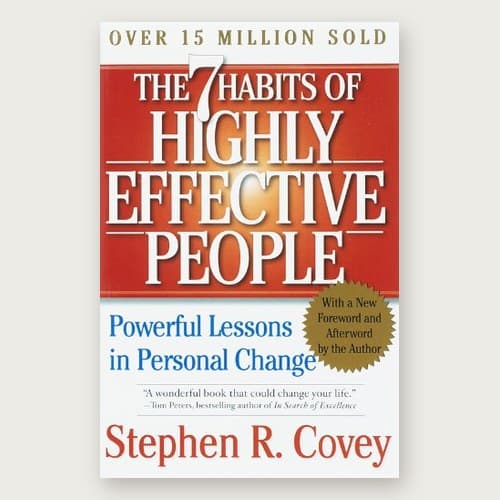
A note on editions: the print and Audible links go to the edition summarized here, with Covey's own foreword and afterword. The Kindle link goes to the later 30th Anniversary Edition, which adds a foreword by Jim Collins and takeaways by Sean Covey.
Habit 3Put First Things First: Principles of Personal Management
Habit 3 is the second creation, and it depends on independent will. Covey cites E.M. Gray's essay The Common Denominator of Success: successful people form the habit of doing what failures do not like to do. He traces four generations of time management: notes and checklists, calendars and appointment books, daily prioritization and value clarification, and a fourth generation that focuses on preserving relationships and accomplishing results.
His central tool is the Time Management Matrix. Quadrant I is urgent and important (crises, deadline-driven projects). Quadrant II is important but not urgent (prevention, relationship building, planning, recreation). Quadrant III is urgent but not important (interruptions, some calls and meetings). Quadrant IV is neither (trivia, time wasters). People consumed by Quadrant I escape to Quadrant IV; Covey describes some whose time is 90% in Quadrant I and most of the remaining 10% in Quadrant IV. Effective people shrink Quadrant I by spending more time in Quadrant II, and the time comes out of III and IV. Shopping center managers who spent less than 5% of their time building relationships with tenants raised it to about 20% over a year and a half, a more than fourfold increase. Saying no takes a bigger yes burning inside; Sandra wished she could decline a committee as graciously as a friend had declined her.
A Quadrant II organizer has six criteria: coherence, balance, a Quadrant II focus, a people dimension, flexibility and portability. Organizing weekly gives more context than planning daily, in four activities: identify roles, select two or three goals for each role, schedule them, and adapt daily. The key is not to prioritize what's on your schedule, but to schedule your priorities. The chapter ends with delegation. Gopher delegation, as when Covey supervised Sandra's every move with a camera, manages methods. Stewardship delegation manages results through five clear agreements: desired results, guidelines, resources, accountability and consequences. His seven-year-old son Stephen took the yard with the standard "green and clean," did nothing for days, asked for help, and then kept it greener and cleaner than it had ever been. Every one of the seven habits, Covey notes, lies in Quadrant II.
Habit 3 · The Time Management Matrix
"The key is not to prioritize what's on your schedule, but to schedule your priorities."
Part ThreePublic Victory
Part Three moves from independence to interdependence. It opens with the paradigm that underlies every relationship, then gives three habits for working with others: Think Win-Win, Seek First to Understand, and Synergize.
Part ThreeParadigms of Interdependence
Covey quotes Samuel Johnson: there can be no friendship without confidence, and no confidence without integrity. Effective interdependence can only be built on true independence, and techniques that are not rooted in character eventually show. The core metaphor is the Emotional Bank Account, the amount of trust built up in a relationship. Deposits make communication easy; withdrawals make every word measured.
The Founder Brain Kit
He names six major deposits. Understanding the individual: one friend, uninterested in baseball, took his son to see every major league team play one game over six weeks. Attending to the little things: after a father and son outing, six-year-old Stephen turned to the wall, hurt that his father had given more attention to his sleeping brother. Keeping commitments: Covey tries never to make a promise he doesn't keep. Clarifying expectations. Showing personal integrity, including loyalty to those who are not present, because how you treat the one reveals how you regard the 99. And apologizing sincerely, with the caveat that repeated apologies read as insincere, as his son David told him after Covey misjudged him at the bathroom door. Dag Hammarskjöld's line frames the chapter's last section: it is more noble to give yourself completely to one individual than to labor diligently for the salvation of the masses. Every P problem, Covey concludes, is a PC opportunity.
Part Three · The Emotional Bank Account
"An emotional bank account is a metaphor that describes the amount of trust that's been built up in a relationship."
Habit 4Think Win-Win: Principles of Interpersonal Leadership
A company president complained his managers would not cooperate, while a chart in his office showed them racing horses toward a trip to Bermuda that only one could win. He was trying to get the fruits of cooperation from a paradigm of competition. Covey describes six paradigms of human interaction: Win-Win, Win-Lose, Lose-Win, Lose-Lose, Win, and Win-Win or No Deal. Win-Lose is scripted by comparison, the bell curve and athletics; Lose-Win buries feelings; Lose-Lose is the philosophy of war. In most interdependent situations Win-Win is the only viable choice, and when no Win-Win can be found, No Deal keeps the relationship intact. One software executive walked away from an $84,000 contract with a bank whose new president did not want it; three months later the president signed a contract for $240,000.
Win-Win has five dimensions. Character means integrity, maturity (a balance of courage and consideration) and an abundance mentality, the belief that there is plenty for everybody, in place of a scarcity mentality. Relationships carry the trust. Agreements make five elements explicit: desired results, guidelines, resources, accountability and consequences. A bank's six-month management training program, with a budget of $750,000, was rebuilt around 39 behavioral objectives the trainees could meet on their own, and the program shrank to five weeks with better results. Systems have to reward cooperation: a real estate firm that once gave awards to about 40 of 800 sales associates later gave about 800 awards at a rally of over 1,000. Processes follow four steps: see the problem from the other point of view, identify the key issues, determine what results would be acceptable, and identify new options to achieve them.
Habit 4 · Win-Win or No Deal
"Win-win is a frame of mind and heart that constantly seeks mutual benefit in all human interactions."
Habit 5Seek First to Understand, Then to Be Understood: Principles of Empathic Communication
An optometrist who hands you his own glasses because they have worked for him is not helping. People diagnose before they prescribe in medicine and almost never in communication. Covey notes that people spend years learning to read, write and speak, and that when he asks audiences how many have had more than two weeks of training in listening, no more than 1% raise their hands.
Most people listen at one of four levels: ignoring, pretending, selective listening or attentive listening. Empathic listening is a fifth level: listening with intent to understand, within the other person's frame of reference. Covey reports that communication experts estimate only 10% of our communication is represented by the words we say, another 30% by our sounds and 60% by our body language. Next to physical survival, the greatest human need is psychological survival, to be understood and appreciated, and empathic listening gives people psychological air. A seminar participant in Chicago, about to lose a commercial real estate deal he had worked on for over six months, listened instead of pitching and saved it.
Because we listen autobiographically, we tend to evaluate, probe, advise or interpret. Covey replays a father and son conversation that starts with "Boy, Dad, I've had it" twice: once full of autobiographical responses, once with the four developmental stages of empathic listening, from mimicking content to rephrasing content to reflecting feeling to rephrasing content and reflecting feeling. In the second version the son opens up about the real problem: a reading test placed him at a fourth grade level, and he is a junior in high school. Being understood is the other half, and Covey uses the Greek sequence of ethos (personal credibility), pathos (feeling) and logos (logic). A small company that asked a large bank to write the contract the way it wanted, so it could understand the bank's needs, won the deal.
Habit 5 · More than words
"Next to physical survival I suggest the greatest need of a human being is psychological survival."
"Covey says private victory comes before public victory, and effectiveness works inside-out. That's identity work. The Identity Shift is 30 days of it: a prompt, a reflection and an intention every day, built on Wattles. Seven bucks, and the first shift shows up in Week 1. Start your private victory tonight."
Deven Davis, devendavis.com- 30 days of guided identity reprogramming, rooted in Wattles' Impression of Increase principle
- Each day has a prompt, a reflection and an intention
- Bonus: The Quick Win Guide, your first identity shift result in under 1 hour
- Bonus: a 5-minute video from Deven on why identity precedes strategy
Seven dollars, with the No-Brainer Guarantee: if it doesn't change how you think about yourself and money within the first week, full refund.
Habit 6Synergize: Principles of Creative Cooperation
Synergy means the whole is greater than the sum of its parts. Two plants grown close together improve the soil for both, and two pieces of wood together hold more than each separately: one plus one equals three or more. Covey describes a university class that threw out its syllabus three weeks in and wrote a book together on principles of leadership, and the meeting where his company drafted its mission statement through a spontaneous piggybacking of ideas.
He places communication on a ladder from defensive, to respectful, where compromise means one plus one equals one and a half, to synergistic. David Lilienthal built such trust on the new Atomic Energy Commission after World War II that disagreement became a reason to understand. The tool is the third alternative. A husband who has planned a fishing trip and a wife who wants to visit her ailing mother some 250 miles away can find a solution better than either plan. Valuing the differences is the essence of synergy, as the Animal School fable shows, in which a duck, a rabbit and a squirrel are all made mediocre by a uniform curriculum. Kurt Lewin's force field analysis explains why synergy works on the restraining forces that driving forces only push against. In one negotiation, a land developer and bank officers who began at 8 a.m. left by 12:45 p.m. with a plan to present together to the homeowners association and the city.
Habit 6 · Levels of communication
"Valuing the differences is the essence of synergy."
Part FourRenewal
Part Four contains Habit 7, which surrounds the other six because it renews them, and a closing chapter in which Covey returns to the inside-out theme through his own marriage and family.
Habit 7Sharpen the Saw: Principles of Balanced Self-Renewal
A man sawing a tree for over five hours insists he is too busy sawing to stop and sharpen the saw. Habit 7 is personal PC: renewing the four dimensions of your nature, physical, spiritual, mental and social/emotional. It is a Quadrant II activity, so it has to be acted on.
Physical renewal means exercise for endurance, flexibility and strength, three to six hours a week, or a minimum of 30 minutes a day every other day. Covey explains the training range using a maximum heart rate of 220 less your age. Spiritual renewal draws on what is at the center of your life; Arthur Gordon's story The Turn of the Tide describes a day at a childhood beach with four prescriptions to open at 9, 12, 3 and 6 o'clock. Mental renewal means reading (start with a book a month), writing, organizing and planning, and managing television, which Covey's family limited to about seven hours a week. He commends the daily private victory, at least one hour a day spent renewing the physical, spiritual and mental dimensions. Social and emotional renewal comes through Habits 4, 5 and 6 and through service; Covey quotes N. Eldon Tanner that service is the rent we pay for the privilege of living on this earth.
Renewing others means affirming their potential, as Don Quixote renames a prostitute Dulcinea in Man of La Mancha. In a story Covey tells of a computer in England mislabeling bright and slow classes, the children's results followed the teachers' expectations. Balance matters because neglecting any one dimension affects the rest, in organizations as well as individuals. Renewal moves a person along an upward spiral, which requires educating and obeying conscience.
Habit 7 · Sharpen the saw
"This is the single most powerful investment we can ever make in life."
Part FourInside-Out Again
During a year on the north shore of Oahu, Covey found a book in a college library whose idea he could not shake: there is a space between stimulus and response, and in that space lie our growth and happiness. He and Sandra began riding an old red Honda 90 into the cane fields and to a secluded beach, talking at least two hours a day, every day, for a full year. The deepest moments came when their vulnerabilities touched. Sandra's attachment to Frigidaire appliances, which had puzzled Covey for years, turned out to be rooted in her father, whose business survived hard times because Frigidaire financed his inventory.
Covey describes intergenerational living and the idea, from his friend Terry Warner, of a transition person: someone who stops passing a destructive script from one generation to the next. Sadat was one. Covey closes with a personal note: he believes correct principles are natural laws and that God is their source and the source of conscience.
Part Four · The transition person
"Change, real change, comes from the inside out."
A note on editions: the print and Audible links go to the edition summarized here, with Covey's own foreword and afterword. The Kindle link goes to the later 30th Anniversary Edition, which adds a foreword by Jim Collins and takeaways by Sean Covey.
AfterwordQuestions I Am Often Asked
Covey answers readers' questions. Since publication in 1989 he has applied the framework in later books, among them First Things First, published in 1996 after over 250,000 individuals were profiled and Habit 3 emerged as the most neglected habit, along with books on families and, by his son Sean, on teens. He lists learnings since the book's release: the difference between values and principles; that the habits hold across cultures and world religions; that they apply to organizations; that any one habit can lead into the other six; that interdependence is ten times more difficult than independence; that the first three habits can be summarized as making and keeping a promise and the next three as involving others in the problem and working out the solution together; and that living the habits is a constant struggle for everyone, including him. There are seven, he says, because three private victory habits, freedom to choose, the nature of the choice and the action based on it, precede three public victory habits, and one renews the rest. He previews The 8th Habit and says that, given another chance, he would do more strategic recruiting in business and less lose-win indulging as a parent.
"Values govern people's behavior, but principles govern the consequences of those behaviors."