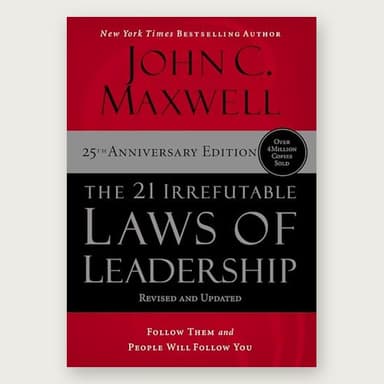
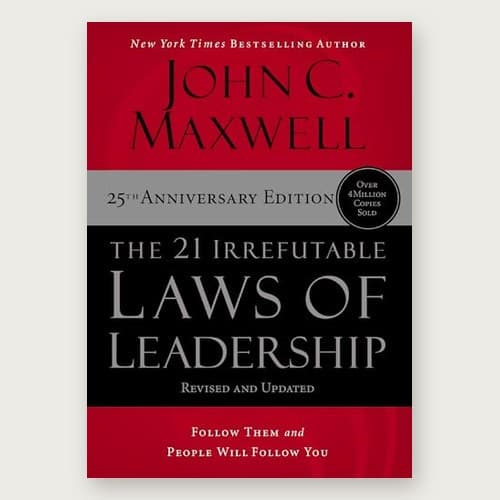
The 21 Irrefutable Laws of Leadership by John C. Maxwell: Summary and Notes
The full book, section by section.
Start hereThe short version
- 1How well you lead determines how well you succeed, and leadership is influence, nothing more, nothing less. Laws 1 to 5 set the base: the lid, influence, process, navigation and addition, where leaders add value by serving others.The claim
- 2Laws 6 to 14 cover how influence is earned and kept: trust, respect, intuition, magnetism, connection, the inner circle, empowerment, the example people copy, and buy-in, where people buy into the leader before the vision.The relationships
- 3Laws 15 to 21 turn to results and succession: victory, momentum, priorities, sacrifice, timing, explosive growth through leading leaders, and legacy, measured by succession. No one does all 21 well, so leaders build a team to cover their weak laws.The results
The summaryForeword and Introduction
Stephen R. Covey's foreword, written for the 10th anniversary edition, introduces Maxwell to readers who know Covey's work and praises the book for giving each law a clear definition and specific steps for applying it in an office, community, family or church. He notes that the 21 Laws was first published in 1998.
In the introduction, Maxwell explains that this is the 25th anniversary edition. For the 10th anniversary he added two new laws and folded two old ones into others; for this edition he replaced dated stories with newer ones, such as those of Angela Ahrendts, Ed Bastian, Jamie Kern Lima and Mark Cole, and estimates he revised 30% of the book. Two convictions have been confirmed over decades of teaching the laws. First, leadership requires more than one thing: when a college student asked him for the one thing to know about leadership, Maxwell answered that there is more than one thing. Second, no one does all 21 well. Maxwell says he is average or below average in five of them, which is why a leader needs a team. He adds that the laws can be learned, that each stands alone, and that they apply regardless of gender, age, experience or environment.
"To lead well, we must do 21 things well."
The lawsThe 21 Irrefutable Laws
Each chapter states one law in a single line, tells a story that shows it at work, explains how it operates, and, in the audio edition, closes with a short personal reflection from Maxwell.
Law 1The Law of the Lid
Leadership ability determines a person's level of effectiveness. Maxwell's illustration: if your leadership operates at an 8 out of 10, your effectiveness can never be greater than a 7; if it is a 4, your effectiveness will be no higher than a 3.
The story is the McDonald brothers, Dick and Maurice, who moved from New Hampshire to California in 1930, opened a drive-in in Pasadena in 1937 and moved it to San Bernardino in 1940. Their Speedy Service System aimed to fill each order in 30 seconds or less, and by the mid-1950s annual revenue hit $350,000 and they split about $100,000 in profit a year. When they tried to franchise, they sold the concept to just 15 buyers, only 10 of whom opened restaurants. Ray Kroc, a supplier, saw the potential, formed McDonald's Systems in 1955, opened 100 restaurants by 1959, took no salary for his first eight years, and in 1961 bought the exclusive rights for $2.7 million. Maxwell reports that McDonald's has since opened more than 38,000 restaurants in 120 countries. The brothers' leadership was the lid; Kroc blew it off. Maxwell adds the contrast of Steve Wozniak and Steve Jobs, and notes that when a company is losing money, it hires a new CEO.
Chapter 1 · The Law of the Lid
"How well you lead determines how well you succeed."
Law 2The Law of Influence
The true measure of leadership is influence, nothing more, nothing less. Mother Teresa looked frail, yet her Missionaries of Charity grew to more than 4,000 members serving in 25 countries, and when she spoke at the National Prayer Breakfast in 1994 and offended nearly everyone in the room, people still listened.
Maxwell lists five myths about leadership: the management myth (managing systems differs from influencing people), the entrepreneur myth, the knowledge myth, the pioneer myth (Sir Edmund Hillary reached the summit of Everest in 1953, but John Hunt led the expedition), and the position myth. He describes being given a pastorate with all the credentials and finding at his first board meeting that the real leader was a farmer named Claude. To spot real leaders, he advises having candidates lead in a volunteer organization for six months. Abraham Lincoln, made captain of a militia company in 1832 for the Black Hawk War, could not remember the command to march his men through a gate, dismissed them for two minutes to regroup on the other side, and ended his service as a private. Influence, Maxwell writes, has to be earned, which is why he created the five levels of leadership, with position as the lowest level.
Law 2 · The Law of Influence
"True leadership cannot be awarded, appointed, or assigned."
Law 3The Law of Process
Leadership develops daily, not in a day. Anne Scheiber retired from the IRS in 1943 earning $3,150 a year, with $5,000 in savings. She invested it, bought 1,000 shares of Schering-Plough by 1950, held them, and died at 101 with an estate worth $22 million that she left to Yeshiva University. She built it one day at a time.
Maxwell compares leadership growth to water cooling one degree at a time, with nothing visible until it hits 32 degrees and freezes, and quotes Bruce Lee that long-term consistency trumps short-term intensity. Theodore Roosevelt, told by his father at 12 that he had the mind but not the body, built himself into one of the toughest leaders the country has had: he gave 673 speeches and traveled 20,000 miles as a vice-presidential candidate in 1900, and later delivered a one-hour speech with a bullet in his chest. Maxwell wishes readers could see him at 24 or 25 instead of in his 70s, and credits Earl Nightingale's advice that one hour a day on the same subject for five years makes a person an expert. His phrase for the law is consistency compounds.
Law 3 · The Law of Process
"The secret of our success is found in our daily agenda."
Law 4The Law of Navigation
Anyone can steer the ship, but it takes a leader to chart the course. In 1911, Roald Amundsen planned his South Pole expedition around dog sleds, expert skiers and 15 to 20 miles a day, and his worst problem was one man's infected tooth. Robert Falcon Scott chose motorized sledges and ponies; the motors failed five days in, his men hauled 200-pound sledges, and he added a fifth man to supplies meant for four. They reached the pole on January 17, 1912, found Amundsen's flag, and died 150 miles from base camp.
Navigators keep emotions from clouding their vision, draw on past experience, examine conditions before committing, listen to others and balance fact and faith, which Jim Collins calls the Stockdale Paradox. Maxwell gives his acronym PLAN AHEAD. His example is Mark Cole in February 2020: with more than 3,000 people from 64 nations registered for the International Maxwell Certification event and a deadline to pay an additional $1 million for food, Cole canceled before the country shut down because the company's number one value is valuing people. Two weeks later Disney World closed, Cole renegotiated with the hotel, and a virtual event that August certified more than 6,000 coaches.
Law 4 · The Law of Navigation
"One thing all leaders have in common is the ability to see more and before."
Law 5The Law of Addition
Leaders add value by serving others. Jim Sinegal, co-founder and former CEO of Costco, met visitors in the lobby himself, answered his own phone, took a salary about a third of the average CEO's, wore a name tag and visited every store at least once a year. Wall Street called him too generous to employees; he answered that Wall Street thinks about next Thursday while he wanted a company that would still be here 50 and 60 years from now.
Maxwell argues that every leader-follower relationship either adds to or subtracts from a person's life. He says that, in his estimate, 90% of people who take more than they give do so unintentionally, while 90% of those who add value do so intentionally. His four guidelines: truly value others, make yourself more valuable to others, know and relate to what others value, and do things God values. He tells of asking Chris Hodges on a golf course how he could serve him; Maxwell spoke at donor events for Highlands College, and Hodges has since raised a hundred million dollars for scholarships.
Law 5 · The Law of Addition
"Someday I will no longer be leading others, but I will never stop serving them."
Law 6The Law of Solid Ground
Trust is the foundation of leadership. Maxwell reports that nearly 80% of Americans once trusted the federal government to do the right thing most of the time and only 24% do today, and he traces the decline to Vietnam, where Robert McNamara later admitted he had told the public half-truths about the war and that the administration had been wrong, terribly wrong.
He compares trust to coins in a leader's pocket: good decisions add coins, poor ones pay them out, and one day the pocket is empty, whether the last blunder was big or small. Character and competence always go hand in hand, and character means consistency, as in Billy Graham's life. Rick Hendrick, who built more than 130 dealerships and a racing team with 13 NASCAR titles, enters stores through the back door to greet technicians and lives by people before profits. In March 2020, when peers let go 20% of their employees, he told his 11,000 employees no one would be let go, and 2020 became the most profitable year in the company's history.
Law 6 · The Law of Solid Ground
"Character and good values make trust possible, and trust makes leadership possible."
Law 7The Law of Respect
People naturally follow leaders stronger than themselves. Harriet Tubman, a little over five feet tall and missing her two front teeth, escaped slavery in 1849 and between 1850 and 1860 made 19 trips south, guiding out more than 300 people without losing one. Southern whites put a $12,000 price on her head, and John Brown called her General Tubman.
On Maxwell's scale of 1 to 10, an 8 does not look for a 6 to follow but for a 9 or a 10. He lists seven ways leaders gain respect: natural leadership ability, respect for others, difficulties overcome, courage, success, loyalty and value added to others. Dean Smith won 879 games in 32 years at North Carolina, and more than 10,000 people attended his memorial in 2015. A few weeks after his death, every letterman who played for him received a $200 check to enjoy a dinner out. Michael Jordan, one of his players, later wanted to play for only one coach, Phil Jackson.
Law 7 · The Law of Respect
"Usually, the more leadership ability a person has, the more quickly he recognizes leadership or its lack in others."
- You're Already an Impact Business22 to 30
- You're Closer Than You Think14 to 21
- You Have the Foundation7 to 13
- The Starting Line0 to 6
 Printable PDF
"Maxwell says nobody is strong in all 21 laws, so the real skill is knowing your weak ones. Same goes for your business, right? Ten questions, a score on four parts of it and the part to fix first. It's free with your email. Go find out."
 Deven Davis, devendavis.com
- Ten questions about where your business is right now
- A score out of 30
- A four-part breakdown: Impact Clarity, Traction Proof, Model Strength, Founder Credibility
- The part to fix first
- Your tier's next steps
- A printable PDF
Free with your email. Your score and a printable PDF open right on the page.
Law 8The Law of Intuition
Leaders evaluate everything with a leadership bias. Maxwell calls this the hardest law to teach. Jamie Kern Lima built IT Cosmetics in 2008 to cover her own rosacea, spent two years being turned down by retailers, and then put nearly everything she had into 6,000 units for one QVC appearance. Against expert advice, she showed her own bare face on air. It took less than six minutes to sell all 6,000 units, and 3,000 more people joined a waiting list. She went on to appear on QVC more than 1,000 times, and in 2016 L'Oréal bought the company for $1.2 billion.
Maxwell notes that Colin Powell made decisions with 40 to 60 percent of the available information. Intuition comes from natural ability and learned skills, and Maxwell reads it with four questions: what do I feel, what do I know, what do I think, and what should I do. A naturally gifted leader can lean about 80 percent on feeling; someone without the gifting should put 80% of their trust in what they know and think. His example of intuition at scale is Steve Jobs returning to Apple in 1997, cutting more than 70% of projects, and launching the iPod in 2001 and the iPhone in 2007.
Law 8 · The Law of Intuition
"It's easier for a bad leader to damage an organization than it is for a good leader to build one."
Law 9The Law of Magnetism
Who you are is who you attract. Maxwell asks readers to list the qualities they want in their people and check whether they have them. In 2011 he co-founded the John Maxwell Team to train coaches, trainers and speakers; a skeptic predicted a couple hundred people, and in 10 years it has trained 40,000 entrepreneurs. People are drawn to leaders who share their generation, attitude, background, values, energy and leadership ability, so a 7 tends to draw fives and sixes.
Angela Ahrendts took over Burberry in 2006, a brand founded in 1856 that had licensed its plaid to dozens of non-luxury products. At an off-site with 200 top executives, she told them to walk out believing 100% in the strategy or leave. She put younger members on the board, and Maxwell reports that during her eight years as CEO the stock price doubled. As a pastor in San Diego, Maxwell followed a gifted musician who had led the church for 34 years and watched the congregation change over six or seven years to match a leader who was no musician.
Law 9 · The Law of Magnetism
"Attitude is one of the most contagious qualities a human being possesses."
Law 10The Law of Connection
Leaders touch a heart before they ask for a hand. George W. Bush connected with the country at Ground Zero, four days after the towers fell, with his arm around firefighter Bob Beckwith. After Hurricane Katrina, flying over New Orleans in Air Force One looked like indifference, and he never regained the people's trust there.
Connection is the leader's responsibility. Maxwell cites Frederick Douglass and Ronald Reagan, whose staff would say "Daddy's home" when his helicopter landed. Even in stadiums with more than 60,000 people, Maxwell speaks to one person. Leaders connect by believing in people, offering hope and being authentic. Norman Schwarzkopf spent Christmas 1990 in the mess halls during Operation Desert Storm and shook 4,000 hands in four hours, which Maxwell calls walking slowly through the crowd. On Bosses Day in 1994, Southwest Airlines employees bought a full-page ad thanking Herb Kelleher, signed by 16,000 employees.
Law 10 · The Law of Connection
"One of the most precious gifts a leader can give people is belief in them."
Law 11The Law of the Inner Circle
Those closest to you determine the level of your success. Maxwell names his own: his brother Larry on business, his executive assistant Linda Eggers for more than 35 years, his writing partner Charlie Wetzel, with whom he has produced more than 100 books, and Mark Cole, hired into the stockroom and now CEO, co-owner and his successor.
No leader does all 21 laws well, so leaders surround themselves with people who cover their gaps. Before drawing someone in, Maxwell checks who they are (character and values) and what they do (competence and strengths he lacks), looks for team chemistry, and wants people who lift rather than lean, after an Ella Wheeler Wilcox poem his mother recited. Inner circle members either extend his influence, supply skills he lacks or help him grow. He has also built an outer circle, which includes John Vereecken, his interpreter in every Spanish-speaking country. At 40, Maxwell decided to invest in the people closest to him, which he calls the most important business decision he ever made.
Law 11 · The Law of the Inner Circle
"Think of any highly effective leader, and you will find someone who surrounded himself with a strong inner circle."
Law 12The Law of Empowerment
Only secure leaders give power to others. Henry Ford's Model T made Ford nearly 50% of U.S. auto production by 1914, but Ford would not let anyone improve it. When designers showed him an improved prototype, he ripped its doors off and destroyed it with his bare hands. The company offered only the Model T for almost 20 years, its share fell to 28% by 1931, and Ford undermined his son Edsel and every rising executive. Henry Ford II, taking over a company losing $1 million a day, repeated the pattern.
The Profit + Purpose Playbook
Abraham Lincoln did the opposite: he filled his cabinet with rivals and, when generals won, gave them credit; when they lost, he took the blame. Maxwell names three reasons leaders fail to empower: desire for job security, resistance to change and lack of self-worth. He teaches a five-step equipping process: I do it; I do it and you are with me; you do it and I am with you; you do it; you do it and someone else is with you. Mark Cole's thank-you note describes going from selling event tickets in a converted broom closet to owner, CEO and president.
Law 12 · The Law of Empowerment
"The greatest enemy of empowerment is the fear of losing what we have."
Law 13The Law of the Picture
People do what people see. In Band of Brothers, Herbert Sobel, Easy Company's training commander, once stole nearly 50 rifles from what he thought were his own sleeping men to shame them, only to learn they belonged to Fox Company. Dick Winters led from the front; on the road to Carentan, with his men frozen under machine-gun fire, he ran into the middle of the road and they rose and moved forward as one.
Leaders hold both vision and modeling. They see the future and communicate it clearly, creatively and continually, and they set the example people actually copy. Maxwell cites a survey in which American workers ranked leading by example as the most important trait in a leader. He says he caught encouragement from Ken Blanchard and vision from Bill Bright, and he teaches values at every International Maxwell Certification event. He also recalls reading Stanford research that 89% of what we do, we saw visually first.
Law 13 · The Law of the Picture
"Followers may doubt what their leaders say, but they usually believe what their leaders do, and they imitate it."
Law 14The Law of Buy-In
People buy into the leader, then the vision. Gandhi returned to India in 1914 after 20 years in South Africa, was elected president of the All India Home Rule League in 1920, and persuaded a nation to pursue freedom through nonviolence, leading the march of 200 miles to the sea against the Salt Act. India gained home rule in 1947 because the people had first bought into him.
Software entrepreneur Judith Estrin needed six months to fund her first company, and only two short phone calls to raise $5 million for a later one. Buy-in comes in three steps: people buy into your character, then your competence, then your commitment. When a vision changes, buy-in may need to be re-earned; Maxwell says it took 20 years for some people to buy back into him after one change. Ed Bastian, CEO of Delta, called employees back to headquarters in 2021 at a time when 81% of U.S. workers did not want to return full-time, and all of them came back on the strength of his 22-year record.
Law 14 · The Law of Buy-In
"People buy into the leader, then the vision."
Law 15The Law of Victory
Leaders find a way for the team to win. Winston Churchill warned about Hitler as early as 1932 and, as prime minister at 65, answered his own question about the goal in one word, victory. He allied with Stalin despite hating communism and courted Franklin Roosevelt until Pearl Harbor brought the United States in. Nelson Mandela spent 27 years in prison on the road to becoming president of South Africa in 1994.
Victory needs three things: unity of vision, diversity of skills, and a leader dedicated to winning and raising players to their potential. Michael Jordan's coach would move him from the white team to the red team in practice, and the red team would then win. Under Jordan the Bulls won six NBA championships, and Bill Russell's Celtics won 11 titles. Maxwell adds a broader kind of victory, the win within, recalling Truett Cathy telling executives who wanted Chick-fil-A to grow faster that the company needed to get better first.
Law 15 · The Law of Victory
"Teams succeed only when the players have a unified vision."
Law 16The Law of the Big Mo
Momentum is a leader's best friend. Ed Catmull's computer graphics group at Lucasfilm struggled for years and was sold to Steve Jobs in 1986 for $5 million. As Pixar it made short films and commercials to survive, nearly lost Toy Story when Disney said it was not working, and then opened it in November 1995 to $394 million worldwide. A Bug's Life and Toy Story 2 followed, Pixar's films earned $14.7 billion, and Disney bought the company in 2006.
Maxwell's seven truths about momentum: it is the great exaggerator; it makes leaders look better than they are; it helps followers perform better than they are; it is easier to steer than to start; it is the most powerful change agent; it is the leader's responsibility; and it begins inside the leader. Jaime Escalante started a calculus class at Garfield High School in 1978 with 14 students, and only two passed the AP exam the first year. The numbers grew each year until 85 of his students received college credit in 1987, and Garfield became one of the top three inner-city schools in the nation.
Law 16 · The Law of the Big Mo
"Momentum is a leader's best friend."
Law 17The Law of Priorities
Leaders understand that activity is not necessarily accomplishment. Living in San Diego, Maxwell found he had spent the equivalent of 27 full days in a year traveling through connection hubs, so he moved himself and his companies to Atlanta, within two hours by plane of 80% of the U.S. population. Over 25 years, he calculates, that has given him back 675 days.
"Maxwell says leadership is influence, earned through character and daily practice. People follow a leader who can say where the business is going, right? Put it on one page: purpose, opportunity, leverage, model. The same four questions Ivystone uses to evaluate deals. A dollar, and 47 minutes on average. Go do it."
Deven Davis, devendavis.com- The P-O-L-M framework (Purpose, Opportunity, Leverage, Model) used by institutional investors to evaluate early-stage deals
- A fill-in-the-blank worksheet that produces a one-page business gameplan in one sitting
- Bonus: The 48-Hour Quick Start, the exact first 3 steps to take today
One dollar, backed by the Dollar-Back Promise, and done in 47 minutes on average.
Each December he spends about two weeks reevaluating priorities with two tools. The Pareto principle says the top 20% of activities give an 80% return. The three R's ask what is required, what gives the greatest return and what brings the greatest reward; if someone else can do a task 80% as well, he delegates it. Logging his own time, he found 19% in leadership, 38% in communication, 31% in creating and 12% in networking, and he sold one of his companies. John Wooden planned every practice to the minute, never scouted opponents, and won a record 10 NCAA championships.
Law 17 · The Law of Priorities
"Once again, I had to recognize that activity is not necessarily accomplishment."
Law 18The Law of Sacrifice
A leader must give up to go up. Martin Luther King Jr. was elected president of the Montgomery Improvement Association after Rosa Parks's arrest and led the bus boycott until the Supreme Court struck down segregated seating in 1956. The higher he rose, the more he paid: arrests, threats, stabbing, and finally his life. He led 250,000 people in the March on Washington.
Maxwell's four points: there is no success without sacrifice; leaders are often asked to give up more than others; you must keep giving up to stay up; and the higher the level of leadership, the greater the sacrifice. Condoleezza Rice, the granddaughter of a man who saved his cotton for college tuition, rose at 4:30 to fit in school, skating and piano, and later gave up secure positions at Stanford again and again to serve on the National Security Council and as Secretary of State. Maxwell's father taught him to pay now so he could play later.
Law 18 · The Law of Sacrifice
"Life is a series of trades, one thing for another."
Law 19The Law of Timing
When to lead is as important as what to do and where to go. As Hurricane Katrina approached in 2005, surrounding parishes ordered mandatory evacuations on Saturday, but New Orleans, on average six feet below sea level, waited until Sunday at nine o'clock, fewer than 24 hours before landfall. Maxwell reports that 1,577 people from Louisiana died.
Every leadership move has four possible outcomes: the wrong action at the wrong time leads to disaster; the right action at the wrong time brings resistance; the wrong action at the right time is a mistake; and the right action at the right time results in success. At Gettysburg in 1863, General Ewell declined to take Cemetery Hill when it was open, and afterward General Meade let Lee's army escape despite Lincoln's urging, and the war continued for almost two more years.
Law 19 · The Law of Timing
"When to lead is as important as what to do and where to go."
Law 20The Law of Explosive Growth
To add growth, lead followers. To multiply, lead leaders. Maxwell did not learn this until he was 40. In 1996 he founded EQUIP, and its Million Leader Mandate set out to train one million leaders by 2008, asking each trained leader to develop 25 more. It reached that goal two years early and went on to train leaders from all 198 countries the United Nations recognizes.
Leaders who lead followers focus on weaknesses, spend time with the bottom 20% and grow by addition; leaders who lead leaders develop the top 20% and grow by multiplication. In an informal poll at his conferences, 10% said they became leaders through natural gifting, 5% through a crisis and 85% through the influence of another leader. Then came a correction. EQUIP had trained more than 10,000 leaders in Guatemala over nine years, yet only 275 people showed up ready to talk about leading. Maxwell sent John Maxwell Team coaches to train facilitators for transformation roundtables, and he reports that over 2 million people in Guatemala now take part.
Law 20 · The Law of Explosive Growth
"Only one leader in 10 is able to blossom without the help of another leader."
Law 21The Law of Legacy
A leader's lasting value is measured by succession. Visiting Mother Teresa's Mother House in Kolkata in 1997, Maxwell watched about 40 to 50 nuns seated for a ceremony and was told the order was taking in 45 new members that day. Her work continued without her.
Maxwell describes how his life sentence changed over the decades and settled at 60 on adding value to people so they can add value to others. He offers three pictures of legacy, a clock, a compass and companions, and four steps: know the legacy you want to leave, live it, choose who will carry it on, and make sure you pass the baton. The John Maxwell Team now has more than 40,000 coaches in more than 150 countries. At 70, he became intentional about succession and chose Mark Cole, and at his 75th birthday party Cole spoke about the move from founder to foundation.
Law 21 · The Law of Legacy
"A leader's lasting value is measured by succession."
ConclusionEverything Rises and Falls on Leadership
Maxwell, teaching leadership for more than 50 years, closes with a five-part diagnostic for any organization: personnel determines its potential, relationships determine its morale, structure determines its size, vision determines its direction, and leadership determines its success. He asks readers to share the laws with their teams and evaluate themselves on each one.
"Any endeavor you can undertake that involves other people will live or die depending on the leadership."
Audio editionBonus Material
The audiobook adds three keynotes. Jamie Kern Lima speaks on the Law of the Big Mo: she planted seeds of positive momentum through years of rejection, says every no from retailers eventually turned into a yes, though Sephora took six years, and describes slowing momentum on purpose so execution could catch up. Jeff Henderson speaks on the Law of Timing, walking through a filter he used before launching a second building campaign months after the first: define reality, meet with the influencers, take time and communicate the vision, citing Truett Cathy's years of repeating "my pleasure" at Chick-fil-A. Mark Cole speaks on the Law of Legacy and compares an individual 400-meter world record of 43.03 seconds with a 4x100 relay record of 36.84, faster despite every handoff.
"It took 10 years for two little words to stick."