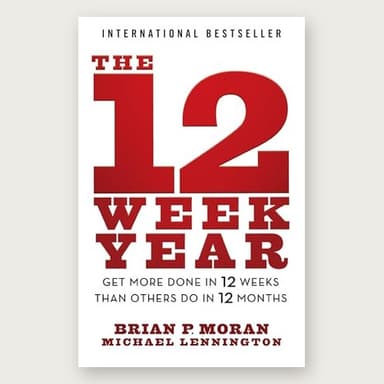
The 12 Week Year by Brian P. Moran and Michael Lennington: Summary and Notes
The full book, section by section.
Start hereThe short version
- 1The number one factor holding people back is a lack of execution, and annualized thinking makes it worse: in January, December looks a long way off. Chapter 1 sets the challenge, and Chapter 2 redefines the year as 12 weeks so the deadline is always near.The claim
- 2Part I, Chapters 3 to 11, builds the thinking: a personal vision first, a 12-week plan in place of the annual plan, one week at a time, an honest weekly score, and three principles of accountability as ownership, commitment and greatness in the moment.The thinking
- 3Part II, Chapters 12 to 21, is the execution system: three principles and five disciplines (vision, planning, process control, measurement, time use), an 85% weekly execution target, a Weekly Accountability Meeting, Performance Time blocks and a 13th week to review.The system
The summaryThe Challenge
Brian P. Moran and Michael Lennington open the book with a single chapter that stands ahead of its two parts. It sets the problem the rest of the book answers: why some people accomplish so much while most never reach what they are capable of. Part I then challenges what readers think they know about performance, and Part II supplies the tools, templates and tips for applying the system.
Chapter 1The Challenge
The authors borrow a line from Steven Pressfield, author of The War of Art: most of us have two lives, the life we live and the life we are capable of living. They promise to show readers how to increase their current results by four times or more in a very short period, and they argue that the number one factor holding people back is a lack of execution. Knowledge, talent and information all play a part, they write, and none of them makes the difference on its own.
Chapter 1 · Two lives
Their examples point the same way. One client, a large insurance company with more than 2,000 agents, has a perennial top producer who now refuses to share his approach because no one follows through on it. Moran notes that 65% of Americans are overweight or obese, that diet and fitness is a $60 billion industry, and that his search for diet books returned 45,915 results. People keep chasing the next idea. Anne Laufman, a financial advisor with MassMutual in Houston, took the opposite route when her managing partner introduced the 12 Week Year. She kept the same clients, case sizes and target market, executed more steadily, and saw a 400% increase in production, becoming the first female Associate of the Year in the 103-year history of MassMutual Houston.
"Knowledge alone benefits no one unless the person acquiring it does something with it."
Part IThings You Think You Know
Part I offers fresh insights into what it takes to perform at your best. Across ten chapters it questions the annual plan, ties business goals to a personal vision, moves the unit of action down to the week and the day, and introduces the three principles of accountability, commitment and greatness in the moment.
Chapter 2Redefining the Year
The authors argue that the annual planning process is one of the things that gets in the way of high performance. They call the problem annualized thinking. In January, December looks a long way off, so a slow start feels harmless, and people assume a late surge will make up the gap. Year-end is where the surge actually happens: for many agents and firms December is the best month, and the fourth quarter often represents 30 to 40 percent of annual sales. The difference comes from a deadline. December 31 is arbitrary, yet everyone buys into it, and the last 60 days of the year turn into crunch time.
Chapter 2 · A year is 12 weeks
The fix comes from periodization, an athletic training technique in which an athlete concentrates on one skill for four to six weeks before moving to the next, first applied by Eastern European athletes in Olympic training in the 1970s. The authors adapted it into a 12-week cycle. They report that successful organizations have increased results by 50% in just 12 weeks and that they helped a billion-dollar brokerage operation double its sales productivity in six months.
The core idea is that 12 weeks equals a year. Each 12-week period stands on its own, and the year-end push now happens continuously. Because no one can afford more than one or two bad weeks in a 12-week year, every day matters more, and every 12 weeks brings a fresh start. At the end of each cycle the reader takes a break, celebrates and reloads, which gives at least four times as many chances to recognize progress.
"The great thing about having a 12-week year is that the deadline is always near enough that you never lose sight of it."
Chapter 3The Emotional Connection
Effective execution isn't complicated, the authors write, but it isn't easy either, and the number one thing a person has to sacrifice to be great is comfort. What makes the sacrifice worth it is a vision. They treat vision as the starting point of all high performance and insist on building the personal vision first, covering spiritual life, relationships, family, income, lifestyle, health and community. The business vision comes second and is shaped to enable the personal one, so that the reader can define exactly what level of income or production the business must deliver to support the whole life.
Chapter 3 · Personal vision first
A section on the brain explains why. The authors write that researchers have found the amygdala reacts negatively to uncertainty and risk, which wires people to resist change, while the prefrontal cortex acts as a counterbalance and lights up when people imagine a compelling future for themselves. Because the brain can change over time, they argue, what you think about shapes it, and an inspiring vision is the way to engage the side that pulls toward growth.
"The secret to living your life to its potential is to value the important stuff above your own comfort."
Chapter 4Throw Out the Annual Plan
Once a person has a vision, a plan is the map. The authors list three benefits of working from a plan: it reduces mistakes, it saves time and it provides focus. Most people, they observe, spend more time planning a trip than planning their business.
Chapter 4 · The top 1 to 3 things
12-week planning differs from annual planning in three ways. It is more predictable, since nobody can say what daily actions should happen 11 or 12 months out, while 12 weeks can be laid out with confidence. It is more focused, identifying the top 1 to 3 things with the greatest impact instead of the long lists that fill annual plans. And its structure is built around action. The plan starts with goals for the 12 weeks, then breaks each goal into tactics; a goal to earn $10,000 and lose 10 pounds gets separate tactics for income and for weight. The 12-week plan is aligned with the long-term vision and is never treated as a slice of an annual plan.
"A vision without a plan is a pipe dream."
Chapter 5One Week at a Time
Sir William Osler, founder of Johns Hopkins School of Medicine, credited his success to living in day-tight compartments, and the authors use him to argue that long-term results come from daily action. The tool for this is the weekly plan, a derivative of the 12-week plan that holds only the strategic tactics due that week. In essence it is a 1-12th slice of the 12-week plan.
Chapter 5 · A week is now a day
They recommend spending the first 15 or 20 minutes of each week reviewing the past week and planning the next, and the first five minutes of each day reviewing the weekly plan. Inside a 12-week year, a year is now equivalent to twelve weeks, a month is now a week, and a week is now a day, which raises the importance of each day.
"Long-term results are created by the actions you take every day."
Chapter 6Confronting the Truth
Sports are motivating because people keep score. The authors cite Frederick Herzberg, an industrial psychologist who in the 1960s identified achievement and recognition as the top two workplace motivators, and argue that the only way to know you are achieving is to measure. Effective measurement captures lag indicators, the end results such as income or pounds lost, and lead indicators, the activities that produce them, such as sales calls or referrals. The most important lead indicator is a measure of your own execution. When a goal is missed, the reader needs to know whether the plan or the execution failed, and the authors report that more than 60% of the time the breakdown is in execution.
Chapter 6 · The 85% line
Their tool is the Weekly Scorecard: score the percentage of planned tactics completed each week. They have found that completing 85% of the weekly plan means a person will most likely hit their objectives. Falling short creates what they call productive tension, the discomfort of not doing what you know you need to do. The easy way out is to stop scoring. The better response is to execute, and even a weekly score of 65 to 70% does well for someone who stays in the game.
- You're Already an Impact Business22 to 30
- You're Closer Than You Think14 to 21
- You Have the Foundation7 to 13
- The Starting Line0 to 6
 Printable PDF
"Moran and Lennington say the gap between goals and results is almost always an execution problem. So where do you execute first? Ten questions, a score out of 30 and the part of your business to fix first. It's free with your email. Go find out."
 Deven Davis, devendavis.com
- Ten questions about where your business is right now
- A score out of 30
- A four-part breakdown: Impact Clarity, Traction Proof, Model Strength, Founder Credibility
- The part to fix first
- Your tier's next steps
- A printable PDF
Free with your email. Your score and a printable PDF open right on the page.
"Measurement builds self-esteem and confidence because it documents progress and achievement."
Chapter 7Intentionality
Everything a person wants requires an investment of time. The authors cite a Salary.com study finding that the average person wastes nearly two hours of every working day. Being intentional means saying yes to the strategic and no to much of the rest, and letting the 12-week plan set the day's goals instead of letting the day direct you.
Chapter 7 · Performance Time
Their time system is Performance Time, built from three blocks. A strategic block is a three-hour block of uninterrupted time each week for the work that produces breakthrough results; one per week is usually sufficient. Buffer blocks group the unplanned, low-value activity such as most email and voicemail; for some, one 30-minute buffer block a day is enough, for others two one-hour blocks. A breakout block is at least three hours spent on things other than work, because a lack of free time feeds performance plateaus. Chapter 17 turns these into a model week.
"To realize your potential, you must learn to be more mindful about how you spend your time."
Chapter 8Accountability as Ownership
The authors call accountability perhaps the most misunderstood concept in business and life. Managers talk about holding people accountable, which in practice means consequences. Drawing on Peter Koestenbaum and Peter Block's Freedom and Accountability at Work, they define it instead as ownership, rooted in each person's freedom of choice. There are no have-tos in life, only choices, and realizing that changes how a person relates to every task. In this view, a manager cannot hold someone accountable; only the person can take ownership.
Chapter 8 · Ownership, not consequences
How someone views accountability, and how fully they embrace it, affects everything from relationships to the ability to execute.
"Accountability is not consequences. It's ownership."
Chapter 9Interest Versus Commitment
The chapter opens with the old anecdote of the chicken and the pig at breakfast: the chicken contributes the egg and is merely interested, while the pig contributes the bacon and is completely committed. Moran then tells his own story. After a freshman year that put him on academic probation, he promised his father straight A's, with $500 riding on the result either way. He got straight A's. The $500 is long gone, he writes, but the commitment changed his life.
Chapter 9 · The chicken and the pig
Commitment means the question of if goes away and only how remains. The authors give four keys to successful commitments: a strong desire, a personally compelling reason to follow through; keystone actions, the one or two core actions that produce the result; counting the costs in time, money, risk, uncertainty and comfort; and acting on commitments instead of feelings. The 12 Week Year asks for 12-week commitments, which are much more feasible to keep than commitments for 12 months.
"Keeping your promises to others builds trust and strong relationships, and keeping promises to yourself builds character, esteem, and success."
Chapter 10Greatness in the Moment
Moran describes a world of phones and texting in which people are in one place physically and another mentally, and he mentions that he and his wife, Judy, are both cancer survivors. The only moment anyone can act in is the present, so the authors locate greatness there.
Chapter 10 · The slim daily gap
Their example is Michael Phelps. He did not achieve greatness when he won his 18th gold medal, or his first. He achieved it years earlier, each time he chose to put in the hours in the pool and the gym and to eat what his body needed. Results only confirm greatness. The daily gap between greatness and mediocrity is slim: for a salesperson, two or three extra appointments a week or five or ten more calls a day; for a manager, recognizing the good work of one more person each day or spending three hours a week on strategic priorities. Over time the difference in results is tremendous.
"Each and every one of us has the God-given ability to be great."
Chapter 11Intentional Imbalance
The authors take on work-life balance. Taken literally, they argue, balance is a misnomer, because spending equal time in each area of life is unproductive. At different times a person will focus on one area over others, and that is fine as long as it is intentional. The 12 Week Year becomes a tool for intentional imbalance: every 12 weeks, pick a few key areas and make significant progress.
Chapter 11 · Intentional imbalance
There are two ways to do it. One is a full 12-week goal and tactical plan, as in a fitness example with 20 minutes of cardio three times a week, weights three times a week, six glasses of water a day and a 1200 calorie limit. The other is a single keystone commitment, such as one date night or family night a week. To choose, readers start with their vision and rate their satisfaction from 1 to 10 in seven areas: spiritual, spouse-partner, family, community, physical, personal and business. The authors write that the system can increase income two, three or even fourfold and applies to every area of life.
The Founder Brain Kit
"Trying to spend equal time in each area is unproductive and often frustrating."
Part IIPutting It All Together
Part II captures more than a decade of learning about applying the fundamentals of execution. It names the system, then gives one chapter each to vision, planning, process control, scorekeeping, time use, ownership and commitments, and closes with a path through the first 12 weeks. Most of these chapters end with a Thinking Shift, a Team Application for managers, and Common Pitfalls and Success Tips.
Chapter 12The Execution System
The authors name eight elements they consider fundamental to high performance in any endeavor and organize them into three principles and five disciplines. The principles are accountability, which is ownership; commitment, a personal promise and in a sense accountability projected into the future; and greatness in the moment. The disciplines are vision, planning, process control, measurement and time use. Process control is the set of tools and events that align daily actions with the plan. Each discipline leans on the others: a vision and plan without process control produce frustration, and without the courage to keep score there is no way to know what is working.
Chapter 12 · Three principles, five disciplines
Change is uncomfortable, so the chapter introduces the Emotional Cycle of Change from psychologists Don Kelley and Daryl Conner, with five stages: uninformed optimism, informed pessimism, the valley of despair, informed optimism, and success and fulfillment. The valley of despair is where most people quit and rationalize that it wasn't so bad before. Passion for the vision, commitment and process control are the way through it. The authors call the 12 Week Year a closed system: when workshop participants list everything it takes to excel, typically more than 20 items, every one is covered by the principles and disciplines.
"The 12-week year is not one more thing you do, it is how you get things done."
Chapter 13Establish Your Vision
Sal Derso, a longtime client, tells of a trying period at his firm, a business approaching 50 years of profitable operation. On a summer rafting trip down the Kennecott River in Alaska, a guide pointed out a mountainside of purple fireweed, the first plant to return after a forest fire. The image gave Derso the vision that guided his firm's recovery, its "fireweed field."
Chapter 13 · Impossible to given
The authors describe a progression in how people think about a big vision: impossible, possible, probable, given. Asking how too early shuts the process down, so they suggest asking what if first. Once the vision seems possible, the question how might I moves it to probable, and given is the state where doubt is gone. They recommend crafting a vision on three time horizons: long-term aspirations 5, 10, 15 years out, a three-year vision, and the 12 weeks covered in the next chapter. Pitfalls include treating vision as fluff, writing what you think you are supposed to want, and making the vision too small. Success tips: share it, review it every morning, and live with intention. Managers are urged to start one-on-one coaching with each person's vision at least monthly.
"Vision is the starting point of all high performance."
Chapter 14Develop Your 12 Week Plan
George Patton's line that a good plan today beats a perfect plan tomorrow sets the tone. Many people skip planning because they have a bias for action or believe they already know what to do. J.K. McAndrews taught the system to his son Kevin, a senior at LSU, who began sending him a weekly plan every Sunday night and saw his grades improve. Patrick Morin, after using it to drop 38 pounds, applied it to a company that had to finish a private placement memorandum and raise money within 12 weeks. With the battle cry "Every day is a week," his team finished a 100-page PPM in the first week and closed the first round on October 10th.
Chapter 14 · A plan for twelve weeks
A good plan, the authors write, works like turn-by-turn directions, with no missing steps or lumped tactics. Every plan should drive results in the current 12 weeks while also building long-term capacity. Goals and tactics should meet five criteria: specific and measurable, stated positively (a 98% accuracy rate instead of a 2% error rate), a realistic stretch, assigned to one accountable person, and time-bound. Tactics start with a verb, and each is assigned to the week, 1 to 12, when it will be done. The authors add that taking time to plan before a complex task can reduce the total time required by as much as 20%. For teams, a shared tactic such as 20 prospecting meetings a week across four members becomes five meetings each.
"Writing an effective 12-week plan is key to accomplishing great things in only 12 weeks."
Chapter 15Installing Process Control
The chapter opens with Mike Tyson's observation that everyone has a plan until they get hit in the mouth. Willpower has a fatigue factor, so the authors build support structures in its place. The first is the weekly plan. The second is peer support. They cite a Fast Company article from May 2005, "Change or Die," on patients who needed lifestyle changes to live: after only 12 months, 90% had reverted to their old lifestyles, while patients in peer support sessions had a success rate of nearly 80%, against 10% for those without.
Chapter 15 · Peer support
Their answer is the WAM, the Weekly Accountability Meeting: a group of two to four committed people, usually on Monday morning, for approximately 15 to 30 minutes. Each member reports results and execution scores, the group shares successful techniques, and the meeting ends with encouragement. These pieces form the weekly routine: score your week, plan your week, and participate in a WAM, which takes about 15 minutes for the first two steps. Approximately 70% of the authors' clients do it first thing Monday morning. They also report that people are 60-80% more likely to execute a written weekly plan than one kept in their head. Lee Iacocca's line that the speed of the leader is the speed of the team frames the advice to managers.
"Moran and Lennington say a 12-week year creates the urgency most people only feel in November and December. The Part-Time Startup System gives you 30 days and six modules toward $1K of side income, without quitting your job. That's about $33 a day. Seven bucks at the launch price. Start this week."
Deven Davis, devendavis.com- 6 modules: Operator Reset, Validation Gate, 90-Minute Block, Pre-Sale Protocol, Outcome-Anchored Offer, First 10
- The System Map, printable and digital: the six-sprint sequence on one page
- The Stranger Test Diagnostic: a one-page protocol to run on yourself every Sunday
- The Daily 60-Second Sermon: a daily inbox prompt for your first 30 days
- Bonuses: How To Tell Your Own Way (the Hero's Journey Workshop) and The Science of Becoming (Audio)
Seven dollars at the launch price. Finish the six modules with no first customer and you get a refund and keep the materials.
"Your chances of success are seven times greater if you employ peer support."
Chapter 16Keeping Score
Adam Black built a simple 12-week calendar that tracked two key daily lead and lag metrics and saw an increase of 65% in unit and dollar volume in 2012. The authors use him to show that measurement has to be timely. Annual measures give feedback once a year; the 12-week goal is a success measure no longer than 12 weeks, and the weekly score is faster still.
Chapter 16 · Keeping score
The weekly score measures the execution of planned tactics, separately from results. In the authors' example, a goal to lose 10 pounds has four tactics; completing three out of four is a 75% week, even if two pounds came off. Executing a minimum of 85% of the weekly plan makes hitting the 12-week goal very likely. A direct report who scores less than 60% in a given week may need help. Tips: block 10 to 15 minutes a week to score, keep going after two bad weeks in a row, and improve in steps, from 45 to 55 or 60% if 85% is out of reach. Even at 65%, most people will see an improvement in their results.
"Measurement is not accountability. It's simply feedback."
Chapter 17Take Back Control of Your Day
Annette Batista, an outreach counselor who educates clients about their medical benefits, has to complete 650 phone calls and 100 home visits each month while homeschooling her child. With a buffer block from 7:30 a.m. to 8:30 a.m. and a long morning block for calls, she often finished her weekly call lists one or two weeks early. She won the Outreach Counselor of the Year Award in 2011 and again in 2012, something never done before, and she and her husband set out to clear their debt in 12 months instead of the typical 18 to 36.
Chapter 17 · The interrupted day
The authors cite research on distraction: a study by Eric Horvitz of Microsoft Research and Shamsi Iqbal of the University of Illinois found workers took an average of 15 minutes to return to a task after an interruption, and a 2005 Basex study found 28% of a professional's day lost to interruptions and recovery. They also note that in 2011 the average American spent 2.8 hours a day watching TV. The detailed Performance Time rules: one three-hour strategic block a week, scheduled early; buffer blocks of 30 minutes to 1 hour, 1 to 2 times a day; and a three-hour breakout block, starting at one per month. A model work week puts it on paper in five steps, beginning with 15 minutes Monday morning to review and plan. A sample strategic block agenda runs from reconnecting with the vision for 5-10 minutes to 2 to 2.5 hours of work on plan tactics. Citing David E. Meyer of the University of Michigan, they warn that switching away from a primary task adds 25% on average to the time it takes.
"The number one thing you will need to sacrifice is your comfort."
Chapter 18Taking Ownership
The authors argue that the culture rewards a victim mindset and that victims let external circumstances limit their success. Danny Fuentes came home from a seminar enthusiastic, slipped back into looking for excuses over the holidays, and then decided to stop, after 23 years of telling himself he deserved not to do the hard things. Dustin Carter lost both arms and both legs to a rare blood disease as a boy and chose to become a wrestler.
Chapter 18 · Four actions toward ownership
Four actions build accountability: resolve never to be the victim again, learn to manage your thinking and attitude, take action, and associate with accountable people. For managers, the advice is to stop trying to hold people accountable and build a culture where ownership is expected and safe, starting with clear expectations and learning from mistakes.
"I have no one to blame but myself for my failure or success."
Chapter 1912 Week Commitments
Mick White wrote to Moran on his 36th birthday. At a 12 Week Year workshop he had committed to calling his mother every weekday, and from September 30, 2009 to June 11, 2011 he did, at least 440 times over 88 weeks. She died unexpectedly two days after their last call.
Chapter 19 · The iceberg of intentions
The authors split commitments into two kinds. Personal commitments are promises to yourself, and they fail when hidden intentions, such as comfort or not wanting to get out of a warm bed, are stronger than stated ones. Using an iceberg, they place stated intentions in the 10% above the waterline and hidden ones in the 90% below. A commitment exercise applies the four keys: write a breakthrough goal, pick its keystone action, list the costs, and commit. Commitments to others include explicit and implicit promises, and broken ones destroy trust. One client, Jim, a financial services CEO, discovered two months late that he had broken a promise to a direct report who had never mentioned it. The tips: two or three personal commitments are usually plenty, and tell someone you trust.
"Twelve-week commitments can truly be life-changing."
Chapter 20Your First 12 Weeks
The authors name four resistance monsters that block change. The need for immediate gratification is countered by bringing the vision into the present through the 12-week goal. Big change and multiple goals: a study by Amy N. Dalton and Stephen A. Spiller found that the benefits of planning diminish rapidly with more than one goal, and the authors answer with turn-by-turn weekly actions and one goal at a time in strategic blocks, drawing on Switch by Chip and Dan Heath. Old habits are replaced by working from a plan, as Charles Duhigg describes in The Power of Habit. Victim thinking is answered by Chapters 8 and 18.
Chapter 20 · Your first 12 weeks
Casey Johnson first dabbled, convinced there was nothing to learn. When he fully engaged, with a coach, a weekly WAM, a referral request in every meeting and six openers each week, he closed more business by the end of his second 12 weeks than in the previous year and a half and became the number four agent in the country for delivered first-year commissions at his experience level. The authors frame the first 12 weeks as three four-week periods: install the weekly routine and score from week two on; push weekly scores toward 85% as the newness wears off; then finish strong, as the cross-country team Jim Collins describes in Good to Great did. Week 13 is for review and celebration, and managers close each cycle with an after-action review.
"I tell everybody that will listen, that if you are thinking about the 12-week year, don't dabble."
Chapter 21Final Thoughts and the 13th Week
The closing chapter works as the book's own 13th week, a pause to review and to launch the next cycle. The authors restate that the 12 Week Year is a complete system for improving results in almost any area of life, and that tens of thousands of clients have used it. They return to the two lives from Chapter 1, the one we live and the one we are capable of, and to Thomas Edison's claim that if we did what we are capable of doing, we would literally astound ourselves.
Chapter 21 · The 13th week
"The power of the 12-week year is only realized through application."