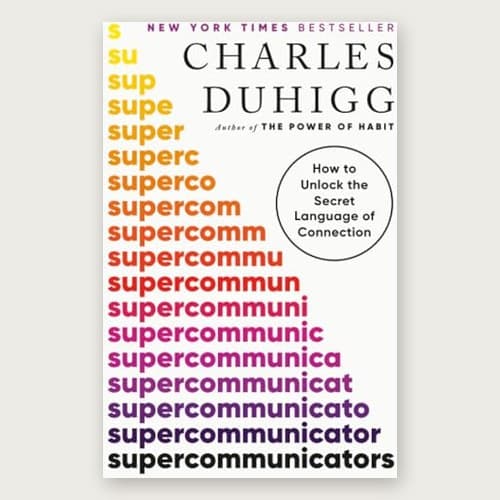
Supercommunicators by Charles Duhigg: Summary and Notes
The full book, section by section.
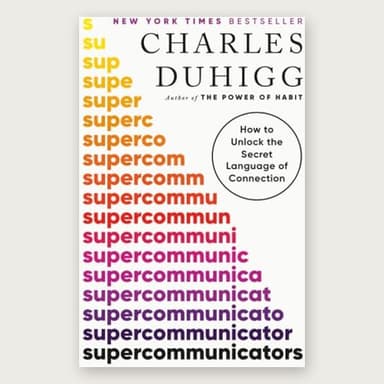
Start hereThe short version
- 1Most discussions are one of three conversations: what's this really about, how do we feel, and who are we. The Prologue and Chapter 1 argue that connecting means noticing which one is happening and matching it, the matching principle.The claim
- 2Practical conversations are quiet negotiations over what everyone wants, as in the Leroy Reed jury of Chapter 2. Emotional ones run on deep questions, mood and energy, and looping for understanding, covered in Chapters 3 to 5.Practical and emotional
- 3Social conversations turn on identity. Chapters 6 and 7 show how to draw out multiple identities and set guidelines that make the hardest talks safer, and four guides between the parts turn it into four rules for a learning conversation.Who are we
The summaryPrologue
Felix Sigala spent two decades at the FBI and became the negotiator colleagues called when things got complicated. He once persuaded a man who had barricaded himself in a room with six cobras, 19 rattlesnakes and an iguana to come out peacefully and name his accomplices in an animal smuggling ring. In 2014, researchers working for the Department of Defense on how to teach persuasion and negotiation sought him out, because officials kept naming him as the best negotiator they had worked with. He did not look the part: a middle-aged dad with a mustache and a soft voice.
When they asked how he thinks about communication, he offered to demonstrate. He asked one scientist for a favorite memory, followed up, and shared memories of his own, including his sister's wedding before she died of cancer. For 45 minutes he asked questions and reciprocated whenever someone revealed something personal. When a psychologist said she still did not understand what he did, he asked what she would tell someone getting a divorce, and she began to answer before he pointed out that she was willing to discuss one of the most intimate parts of her life with near strangers. He had listened closely, asked questions that drew out vulnerabilities and matched emotion with emotion, and that had built trust.
Duhigg sets out the book's question: what are the people we call on a bad day doing that makes us feel so good? When two people truly connect, their brains begin to align, which researchers call neural entrainment. The people who achieve it consistently are supercommunicators.
"Put differently, anyone can learn to be a super communicator."
OverviewThe Three Kinds of Conversation
Duhigg calls conversation the communal air we breathe and notes that meaningful ones can feel wonderful or awful. Simplifying greatly, he writes, three kinds of conversation dominate most discussions, each captured by a question: What's this really about? for practical decision-making, How do we feel? for emotions, and Who are we? for identity. Each draws on a different mindset, and connection requires being in the same kind of conversation at the same time. Supercommunicators, he writes, have simply thought harder about how conversations unfold.
Chapter 1The Matching Principle: How to Fail at Recruiting Spies
In 1982, Jim Lawler, a 30-year-old CIA case officer two years into the job, was terrible at recruiting spies. A Chinese clerk turned him down because his bosses executed people for that, and a Soviet receptionist he courted turned out to be KGB trying to recruit him. Then he met Yasmin, a lonely foreign ministry employee from the Middle East on vacation in Europe, and offered her consulting work as a supposed oil speculator. When his boss required him to reveal he was CIA, she cried, said no and fled.
At a final dinner, with nothing left to pitch, Lawler remembered a lesson from his days selling steel components for his father in Dallas, when a client in West Texas had talked about juggling work and motherhood and he had answered honestly about his own struggles. He told Yasmin about his own disappointments. She changed her mind that night and became, Lawler said, one of the best sources in the region. By the time he retired in 2005, he had convinced dozens of foreign officials to participate in sensitive conversations.
Chapter 1 · The matching principle
Duhigg explains why with neuroscience. A 2010 paper in the Proceedings of the National Academy of Sciences found that the extent of speaker-listener neural coupling predicts the success of communication. At the Dartmouth Social Systems Lab, Beau Sievers, a former musician who joined in 2012, put groups in a scanner while they discussed ambiguous film clips and tried to agree on what was happening. A confident, talkative leader often made it harder for his group to sync. The members he calls high centrality participants asked 10 to 20 times as many questions as others and matched the gravity of what others shared, which helped the group align. The idea that communication comes from connection and alignment is known as the matching principle: recognize what kind of conversation is occurring and match it. Matching, he notes, is different from mimicry. He cites a 1997 study finding that 70% of our conversations are social in nature.
"I learned that if you listen for someone's truth and you put your truth next to it, you might reach them."
Guide, Part IThe Four Rules for a Meaningful Conversation
The best communicators follow four rules that create a learning conversation: pay attention to what kind of conversation is occurring; share your goals and ask what others are seeking; ask about others' feelings and share your own; and explore if identities are important to the discussion. For the first rule, Duhigg suggests pausing before you speak to ask why you are opening your mouth. In one study of investment bankers who often ended up in screaming matches, writing one sentence of goals before each meeting made verbal arguments decline significantly. Some schools train teachers to ask upset students whether they want to be helped, hugged or heard, which maps onto the three kinds of conversation.
Guide, Part I · Four rules for a learning conversation
"Rule one is pay attention to what kind of conversation is occurring."
Part IThe What's This Really About? Conversation
The what's this really about conversation has two goals: determine what everyone wants to discuss, and figure out how the discussion will unfold and how decisions will be made. It often happens at the start of a conversation, and when it is skipped, what follows can feel frustrating and directionless.
Chapter 2Every Conversation Is a Negotiation: The Trial of Leroy Reed
In November 1985, a Wisconsin jury of seven men and five women deliberated over Leroy Reed, a 42-year-old ex-convict with serious mental disabilities who had answered a magazine ad for a private detective course, mailed in $20, and followed its instructions to buy a pistol, which he left in its box in his closet. As a felon, he faced up to 10 years under statute 941.29, and the judge told jurors not to be swayed by sympathy. Duhigg follows the deliberation as a quiet negotiation over what the conversation is about. Carl, a fireman who respected rules, leaned toward conviction. A juror named John Boley added a new option: acquitting Reed would send a message to police and prosecutors to focus on real criminals, so finding him innocent would help public safety. After about two and a half hours, the vote was unanimous. Not guilty.
Chapter 2 · The juror who changed the question
The chapter draws on the Harvard Negotiation Project, founded in 1979, and its idea of interest-based bargaining, which looks past positions to what people actually want. Deepak Malhotra's work on negotiations from a hockey lockout to a peace deal shows the same pattern. Duhigg tells of a surgeon at Memorial Sloan Kettering, Dr. Behfar Ehdaie, who showed prostate cancer patients data that for 97% of men active surveillance carried about the same risk, only to have them fixate on the other 3%. Duhigg writes that studies estimate 40% of prostate cancer patients opt for unnecessary surgeries, more than 50,000 people a year. Once Ehdaie began asking open-ended questions about what mattered to each patient, the share opting for surgery fell by 30% within six months. Duhigg also describes two kinds of logic people bring to a decision, a logic of costs and benefits and a logic of similarities.
"This is a negotiation we all participate in whenever a conversation begins, whether we realize it or not."
Guide, Part IIAsking Questions and Noticing Clues
In 2018, Harvard researchers recorded hundreds of conversations and found people constantly signaled what they wanted to talk about while their partners missed the clues. Laughing at something that is not funny, back-channeling with sounds like uh-huh, and follow-up questions signal engagement; changing the subject signals readiness to move on. The second rule is met in four ways: prepare, by jotting down two topics, one thing you hope to say and one question to ask, which in one study took about 30 seconds and made conversations go better; ask open-ended questions about beliefs, values and experiences; notice clues such as leaning in or going quiet; and, when an invitation is declined, experiment by adding new items to the table.
Guide, Part II · Thirty seconds of preparation
"Interruptions, contrary to expectations, usually mean people want to add something."
Part IIThe How Do We Feel? Conversation
Emotions shape every conversation, often without our noticing. The next three chapters cover how to listen more deeply, how to hear emotions that go unspoken in voices, gestures and expressions, and how emotions can fuel conflicts or help resolve them, both online and off.
- You're Already an Impact Business22 to 30
- You're Closer Than You Think14 to 21
- You Have the Foundation7 to 13
- The Starting Line0 to 6
 Printable PDF
"Duhigg says every conversation is practical, emotional or social, and we connect when both people are in the same one. Here's the practical one about your business: ten questions, a score on four parts of it and the part to fix first. It's free with your email. Go find out."
 Deven Davis, devendavis.com
- Ten questions about where your business is right now
- A score out of 30
- A four-part breakdown: Impact Clarity, Traction Proof, Model Strength, Founder Credibility
- The part to fix first
- Your tier's next steps
- A printable PDF
Free with your email. Your score and a printable PDF open right on the page.
Chapter 3The Listening Cure: Touchy-Feely Hedge Funders
Nicholas Epley, a 43-year-old University of Chicago psychologist who has spent his career studying why we mishear one another, was invited to teach listening to a room of hedge fund investors, one of whom had lost $20 million in an afternoon after missing the signs that a broker's firm was failing. Epley's research suggested forced tactics like constant nodding undermine real communication, and that people listen naturally when a conversation is interesting, especially when it turns to feelings. He paired strangers for 10 minutes with three questions, the last being whether they could describe a time they cried in front of another person. The room, which started with dread, was hard to quiet afterward. In a 2021 paper, Epley reported that participants consistently expected such conversations to be more awkward and less connecting than they turned out to be.
Duhigg traces the method to Elaine and Arthur Aron's 1995 Stony Brook experiment, in which more than 300 strangers took turns asking a list of 36 questions in 60-minute sessions that escalated from light to intimate. The questions climbed from light ones toward questions like whether you have a secret hunch about how you will die, how you feel about your relationship with your mother, and whose death in your family would be most disturbing. Seven weeks later, 57% had sought out their partner and 35% had gotten together to socialize. The Arons say they tested about 200 questions to find the ones that worked. The questions became famous as the Fast Friends procedure. They work, he argues, through emotional contagion and reciprocity: deep questions that ask about values, beliefs, judgments and experiences invite vulnerability, and vulnerability returned builds trust.
Chapter 3 · The ladder of 36 questions
"When we discuss our feelings, something magical happens."
Chapter 4How Do You Hear Emotions No One Says Aloud?: The Big Bang Theory
Bill Prady and Chuck Lorre conceived The Big Bang Theory in 2005 as a show about brilliant physicists who are bad at emotions, and the first pilot failed because audiences could not tell how to feel about anyone. As Prady put it, people perform their emotions. The reworked pilot added Penny, light and bubbly and smart about people, whose clear emotional reactions let the audience read the physicists. The show premiered in 2007 with more than 9 million viewers, reached 20 million by season nine, earned 55 Emmy nominations, and drew 25 million people to its final episode in 2019.
The science comes from NASA psychiatrist Terence McGuire, who screened astronaut candidates for 20 years and, after the 1984 order to build a space station, looked for people who could hear unspoken emotions. Researchers came to describe emotional expression along two dimensions, mood, positive or negative, and energy, high or low, which the brain reads almost instantly. Robert Provine's study of 1,200 instances of laughter found less than 20% followed anything resembling a formal effort at humor; laughter mostly signals connection, and in a 2016 study listeners hearing one-second recordings could tell friends laughing together from strangers. NASA had reason to care: a 1976 Soviet mission was canceled midway after the crew shared delusions, and the Apollo 7 crew of 1968 argued with mission control. McGuire listened for candidates who noticed and matched others' mood and energy, and by 1990 he had worked out what he was looking for.
Chapter 4 · Mood and energy
"Emotions are everything in television."
Chapter 5Connecting Amid Conflict: Talking to the Enemy About Guns
Melanie Jeffcoat survived a 1982 school shooting in Las Vegas, and in 2014 her 11-year-old daughter texted during a lockdown that all she had was a golf club. Jeffcoat became a national gun control advocate. In March 2018, as 2 million people marched in more than 800 cities, she joined a structured conversation at the Newseum in Washington with gun rights advocates, including a former police officer who owned between 30 and 40 guns. Duhigg notes that almost 70% of the electorate now says it is deeply angry at the other party and that over 80% of U.S. workers report workplace conflicts.
The Founder Brain Kit
The organizers taught specific skills. Participants told personal stories, and listeners asked only open, curious questions. Above all they practiced looping for understanding: ask questions, summarize what you heard in your own words, ask if you got it right, and repeat until the other person agrees. Duhigg cites a 2020 study finding that looping early in a conversation forestalls conflict escalation at the end. David Preston, a gun rights advocate whose mother committed suicide when he was 11 months old, was looped by a gun control advocate and told her the line below. The organizers later moved the conversation into a private Facebook group of about 150 people, which produced 15,000 posts in four weeks and soon turned hostile. When the group moved online, the former cop said it took maybe 45 minutes for someone to call him a jackbooted Nazi. Duhigg links this to research on couples, including John Gottman's, which found that happy couples ask each other more questions and repeat what the other person said.
Chapter 5 · Looping for understanding
"Thank you for hearing me."
Guide, Part IIIEmotional Conversations, in Life and Online
The third rule is to ask about others' feelings and share your own. Deep questions have three traits: they ask about values, beliefs, judgments or experiences; they invite people to say how they feel; and asking one should feel a little like sharing. One 2021 study found a simple way to generate them: imagine you are talking to a close friend. Listen for mood and energy, and when matching would escalate anger, acknowledge it. Reciprocate vulnerability by looping, asking permission and giving something in return. In a conflict, acknowledge understanding, find specific points of agreement and temper your claims. Online, where people have only been communicating since 1983, he writes that a bit more care and thought can yield outsized rewards.
Guide, Part III · Three moves in a conflict
"Nearly any question can be remade into a deep question."
Part IIIThe Who Are We? Conversation
We bring our social identities into every meaningful conversation: histories, families, communities and the groups we love or deplore. The final two chapters cover how to use our instinct to trust people like us to connect across differences, and how to make the most difficult conversations, such as those about systemic injustice, safer.
Chapter 6Our Social Identities Shape Our Worlds: Vaccinating the Anti-vaxxers
Jay Rosenblum, a pediatrician who began his residency in 1996, tried handouts, studies and videos on parents who refused vaccines, and the more information he gave, the more they dug in. One father told him, hell no, we're not going to put that poison in our bodies. Rosenblum noticed that anti-vaxxers came from every political camp, and researchers came to see vaccine refusal as tied to social identity, the part of the self that comes from group membership, which can make people exaggerate differences between groups and see their in-group as more virtuous. A 2021 study found nearly one fifth of Americans identified as anti-vaxxers at least some of the time. The 1954 Robbers Cave experiment showed that dividing 11-year-old boys into Rattlers and Eagles was enough to set them throwing rocks at each other.
Identities can also be drawn on. In the stereotype threat studies begun with Steven Spencer in 1999, strong women math students who were primed with a negative stereotype underperformed; in a 2005 experiment, women prompted to think about their many identities did as well as the men. In Qaraqosh, Iraq, where ISIS had killed hundreds of Christians and forced some 50,000 to flee, Salma Mousa started a soccer league in 2018. It used 12-player teams, three more than the customary nine, and some teams received Muslim players, so rosters were mixed across faiths. Among the 42 teams, Christians on mixed teams were 13 percentage points more likely to say they would not mind a mixed team next season, 26 points more likely to vote for a Muslim player from another team for a sportsmanship prize, and 49 points more likely to train with Muslims six months later. When COVID vaccines arrived, Rosenblum's group used motivational interviewing, a method from the 1980s for problem drinkers. Dr. Rima Chime asked a retired police officer about himself, his three grandchildren and his church, and did not argue. Her conversations put everyone on equal footing and built on existing identities to form a new in-group of people who want to do the right thing for their families.
Chapter 6 · Mixed teams in Qaraqosh
"We all contain multitudes that are just waiting to be expressed."
"Duhigg says we connect when both people are having the same conversation at the same moment. When the conversation turns practical, have the deck ready. The Pitch Kit gives you 5 Sequoia-style templates for an investor, a partner or a big client, in Canva and Google Slides. Seven bucks. First draft in 60 minutes."
Deven Davis, devendavis.com- 5 Sequoia-style deck templates in Canva and Google Slides
- Covers the essential pitch deck, the one-pager and early-stage variations
- Bonus: The Deck Doctor, Deven's 5-minute video on the 3 slides people skip to first
- Bonus: The Quick Win Guide, to have your first draft in 60 minutes
Seven dollars, with the No-Brainer Guarantee: if the templates don't save you at least 10 hours of work, full refund.
Chapter 7How Do We Make the Hardest Conversations Safer?: The Problem Netflix Lives With
In February 2018, Netflix's communications chief, Jonathan Friedland, used the N-word as an analogy in a meeting of about 30 people. The company, with more than $15 billion in revenue and 124 million subscribers, ran on a culture laid out in a 125-page culture deck. Employees could take as much vacation as they wanted, a merely adequate performance got a generous severance package, and emails explained to colleagues why someone had been let go. After the 2011 plan to split the company sent the stock down 77%, the deck was amended to say that silent disagreement is unacceptable, and teams held feedback dinners. One employee recalled crying for an hour on some days. That culture made identity conversations explosive, and within days nearly all 5,500 employees had heard about the incident. Friedland was eventually fired.
Duhigg writes that a review of more than 400 studies of prejudice reduction found that in 76% of cases the long-term impact remained unclear, and a 2021 Harvard Business Review article on 80,000 people found unconscious bias training did not change behavior. In a 2019 study of more than 1,500 people, only 1% had not encountered a recent identity threat, and participants averaged 11.38 identity threats in the past week. In a 2021 study, 70% of participants saw real risks in a dialogue about race, even with friends. Netflix hired Vernā Myers to build inclusion work around conversations with guidelines: no one may blame, shame or attack, questions asked in good faith are welcome, and discomfort is expected. By 2021, women made up 52% of the workforce and 45% of senior leadership. When Dave Chappelle's The Closer drew protests in October 2021, inside the firm there were multiple town hall meetings where workers could voice their complaints, and employees saw the fight differently from the outside world.
Chapter 7 · Identity threats are everywhere
"When discussing issues of identity, no one is allowed to blame, shame, or attack anyone else."
Guide, Part IVMaking Hard Conversations Easier
The fourth rule is to explore whether identities matter to the discussion, in three stages. Before it, decide what you hope to accomplish, how it will start, what obstacles may appear and what the benefits are. At the start, set guidelines, draw out everyone's goals and acknowledge that discomfort is natural and useful. As it unfolds, draw out multiple identities, keep everyone on equal footing, look for genuine similarities and manage the environment, since a simple change of setting can shift what feels safe.
"We all contain multiple selves."
The closeAfterword
In 1937, chain store owner Billy Grant funded a Harvard study of healthy young men, which grew into the Harvard Study of Adult Development, following more than 2,000 people. Two early participants seemed headed in opposite directions. Godfrey Camille, who arrived in 1938, was a lonely hypochondriac with a bleak childhood, who later attempted suicide and spent 14 months hospitalized with tuberculosis. John Marsden was a top student from a prominent family who became a successful lawyer. When the funding ran out in 1954, the study was boxed up.
Guide, Part IV · Two lives, reversed
Researchers who reopened it in the 1970s found the predictions reversed. Camille had married, founded a respected allergy clinic and become, by his daughters' account, an exemplary father; at 80, more than 300 people came to his birthday party. He wrote at 75 that before there were dysfunctional families, he came from one, and he died of a heart attack at 82. Marsden, in his 50s, was divorced and alienated from his children and his family. Until 30, Camille had not had one real durable friendship; he learned to connect. The study's most consistent finding is that the people most satisfied in their relationships at 50 were the healthiest at 80.
"The people who were the most satisfied in their relationships at age 50 were the healthiest mentally and physically at age 80."