Shoe Dog by Phil Knight: Summary and Notes
The full book, section by section.
Start hereThe short version
- 1In 1962, Phil Knight left on a trip around the world with a crazy idea from a Stanford paper: Japanese running shoes could take on the Germans. Dawn and the 1962 to 1966 chapters cover the invented company name in Kobe, the partnership with coach Bill Bowerman and the first sales from a car trunk.The crazy idea
- 2Growth kept outrunning cash. The 1967 to 1975 chapters cover a banker who cut off credit, Onitsuka's takeover attempt, the birth of Nike and the swoosh, the lawsuit, and the 1975 crisis when the bank called the FBI and Nissho Iwai paid off the debt.Grow or die
- 3Part Two runs from Steve Prefontaine's death through new factories in Taiwan and China, a $25 million customs bill and the 1980 public offering. Night, set in 2007, closes on Knight's losses and his advice to seek a calling.The cost and the calling
The summaryPart One
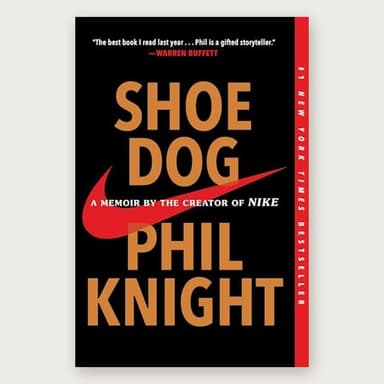
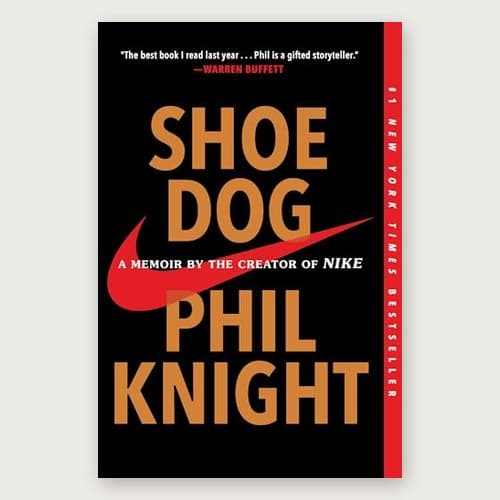
Shoe Dog is Phil Knight's memoir of the company that became Nike, told one year to a chapter from 1962 to 1980, with a closing chapter set in 2007. Part One runs from his first trip to Japan to the bank crisis of 1975, and Part Two from the death of Steve Prefontaine to the public offering of 1980.
PrologueDawn
On a foggy Oregon morning in 1962, Knight, 24, goes for a run. He has a degree from the University of Oregon, an MBA from Stanford and a year in the Army, and he still feels like the same shy, pale, rail-thin kid. He wants his life to be meaningful, creative and different, and he wants to win. His old track coach used to say that on the Oregon Trail the cowards never started and the weak died along the way. Knight has a crazy idea, and he decides that the world is made up of crazy ideas. Whatever comes, he tells himself, just don't stop.
Prologue · The trail at dawn
"So that morning in 1962, I told myself, let everyone else call your idea crazy."
19621962
At Stanford, Knight had written a seminar paper arguing that Japanese running shoes could do to the German-dominated market what Japanese cameras had done. His classmates were bored; the professor gave him an A. He asks his father for money for a trip around the world with a stop in Japan, knowing that 26 of 27 new companies failed and that 90% of Americans had never been on an airplane. His father, a believer in respectability, agrees. Knight and his friend Carter head first to Hawaii, where they sell encyclopedias door to door and surf. Knight is hopeless at encyclopedias, a rejection that reminds him of being cut from the baseball team as a boy, when his mother suggested track. He moves to selling Dreyfus Funds for Investors Overseas Services, Bernard Cornfeld's boiler room in a beachside tower, and finds he can close a few sales by knowing the numbers and speaking the truth.
1962 · The odds against the crazy idea
In Kobe, Knight goes first to the wrong building and arrives half an hour late at the Onitsuka factory, where executives led by Ken Miyazaki tell him they make 15,000 pairs of shoes a month and seat him at the head of the table. When they ask what company he represents, he thinks of the blue ribbons from track on his bedroom wall and invents one on the spot. He pitches the untapped American market, and Onitsuka agrees to send him samples. He continues around the world: Hong Kong, the Himalayas, the Ganges, Istanbul, Rome, where he has the Sistine Chapel to himself in a cold snap, Florence, Milan, where he reads da Vinci calling the human foot a masterpiece of engineering, and Turandot at La Scala, then Venice, Paris, the pyramids and the Temple of Nike.
"Gentlemen, I represent Blue Ribbon Sports of Portland, Oregon."
19631963
Back home, the samples have not arrived, and Onitsuka's letters promise them in a little more days. On the advice of Don Frisbee, CEO of Pacific Power and Light, Knight works toward his CPA, taking accounting classes at Portland State and working at the firm Lybrand, Ross Brothers and Montgomery, logging 12-hour days six days a week in busy season and earning $500 a month.
1963 · Shoes coming, any day
"Shoes coming, the letter said, in just a little more days."
19641964
Twelve pairs arrive, and Knight sends two to Bill Bowerman, his coach at Oregon, who was obsessed with shoes and liked to say that one ounce off a pair of shoes equals 55 pounds over a mile. Bowerman proposes a partnership, 51-49 in Knight's favor, and they each put in $500 toward a first order. Knight orders 300 pairs at $3.33 a pair, about $1,000 worth, after his father balks at funding more jackassing around with shoes. Bowerman's offer comes with total operating control for Knight. Knight sells the shoes from the trunk of his car at track meets. He had failed at selling encyclopedias, but he believed in running and in the shoes, and people wanted that belief. When a rival distributor Knight calls the Marlboro Man threatens his territory, his mother drives him to the airport and tells him to just be yourself. In a bowler hat and a new suit, with a book on doing business with the Japanese, he returns to Kobe. He reminds himself that the art of competing he learned in track was the art of forgetting: your limits, your doubts, your pain. Mr. Onitsuka gives him the western states for one year, and the Marlboro Man keeps track shoes on the East Coast. On the same trip Knight climbs Mount Fuji and meets Sarah, a romance that later ends in a letter of rejection.
1964 · The 51-49 handshake
"Belief is irresistible."
- You're Already an Impact Business22 to 30
- You're Closer Than You Think14 to 21
- You Have the Foundation7 to 13
- The Starting Line0 to 6
 Printable PDF
"Knight's own moral, on the last pages of Shoe Dog: don't take a job, seek a calling. If you're building yours, you want to know where it stands, right? Ten questions, a score on four parts of your business and the part to fix first. It's free with your email."
 Deven Davis, devendavis.com
- Ten questions about where your business is right now
- A score out of 30
- A four-part breakdown: Impact Clarity, Traction Proof, Model Strength, Founder Credibility
- The part to fix first
- Your tier's next steps
- A printable PDF
Free with your email. Your score and a printable PDF open right on the page.
19651965
Jeff Johnson, a runner Knight knew, starts selling Tigers on commission at $1.75 a pair and floods Knight with letters about sales, customers and ideas. After $8,000 in sales in the first year, Knight projects $16,000 in the second. His banker at First National, Wallace, tells him that his rate of growth is too fast for his equity, since he owes the bank $11,000 and keeps no cash. Knight hires Johnson as Blue Ribbon's first full-time employee at $400 a month and takes a job at Price Waterhouse, where he befriends Hayes, a heavy-drinking partner who later joins Blue Ribbon.
Chapter 5 · Growth outruns equity
"But the roadside was littered with cautious, conservative, prudent entrepreneurs."
19661966
Knight ignores most of Johnson's letters, following a lesson he took from reading about generals: tell people what to do, leave the how to them, and let them surprise you with their results. Johnson keeps index cards on every customer and redesigns soles for runners. He has customers in 37 states, well beyond Blue Ribbon's 13 western states. Knight promises him a store if he sells 3,250 pairs by the end of June 1966, and Johnson does it and opens the first store on Pico Boulevard in Santa Monica. When Onitsuka threatens to give the American market to the Marlboro Man, Knight flies to Japan and claims Blue Ribbon already has an East Coast office. He wins exclusive U.S. distribution rights on a three-year contract and orders 5,000 more shoes, costing $20,000 he does not have, for an office he does not have.
1966 · Tell them what, not how
19671967
Knight handles the news badly: Johnson learns he is being sent east when his replacement shows up at the store. Johnson goes, settling in Wellesley, outside Boston, and living in his office. He later sends demands for a raise and a share of profits, and in a meeting with Johnson's father, Owen, Knight offers a $50 raise and nothing more. Having nothing left to give, Knight writes, gave him leverage, and they seal the deal with a six-mile run. In Portland, Knight builds an office with a warped plywood wall and three thrift-store desks. Bowerman's former runners join the company. Jeff Hollister is hired after not flinching when Knight finds he has no money to pay for lunch. Bob Woodell, a standout on Bowerman's 1965 team who uses a wheelchair after an accident, opens a second store in Eugene for $400 a month. Bowerman designs a cushioned trainer that Onitsuka produces, and Knight names it the Cortez. He comes to see Adidas the way he once saw Jim Grelle, the faster Oregon runner whose back he stared at for years. Bowerman's little book Jogging sells a million copies. Blue Ribbon closes the year with revenue of $84,000.
1967 · A deal sealed on the road
19681968
1968 · Fifty dollars for a bicycle
Knight leaves Price Waterhouse to teach accounting at Portland State for $700 a month, giving him more time for the company, which is on track to double sales for a fifth straight year. In his class is Penny, whom he hires as a bookkeeper at $2 an hour and soon marries. On a trip to Japan he meets Fujimoto, an Onitsuka employee who loves America and has lost his home and bicycle to a typhoon, and Knight mails him $50 for a new bicycle. When Fujimoto's bosses will not let him keep it, he asks Knight to send it to his house, and he becomes Knight's source inside Onitsuka.
19691969
Sales were $150,000 in 1968 and head toward just under $300,000 in 1969. Knight quits Portland State and pays himself $18,000 a year. In a hallway on campus he hires a struggling art student, Carolyn Davidson, at $2 an hour to design ads. Penny, pregnant with their son Matthew, fills 1,500 mail orders, and they buy a 1,600-square-foot house for $34,000 by pledging it against his loans. Knight writes a memo describing Fujimoto as a spy inside Onitsuka's export department, a word he later regrets.
1969 · Sales double, and double again
19701970
Onitsuka renews Blue Ribbon for three more years, as Mr. Onitsuka says 70% of American runners own Tigers, and promotes Kitami, whose gaze unsettles Knight. Shipments still arrive late and wrong. With sales near $600,000, Knight asks Wallace for a loan of $1.2 million, and Wallace cuts him off and imposes sales quotas. An attempt to sell 30% of the company at $2 a share through a holding company called Sports-Tech, Inc. draws silence. Knight, up to 190 pounds, starts running six miles a night again and takes $36 off Grelle in a handicapped mile. In June 1970, Steve Prefontaine, a Bowerman runner, appears on the cover of Sports Illustrated. After reading in Fortune that Japanese trading companies are looser with credit, Knight asks a banker, who introduces him to Cam Murakami of Nissho Iwai, a hundred billion dollar company with a Portland office, willing to finance his imports. Then an East Coast distributor tells Knight that Onitsuka has approached him about becoming its new U.S. distributor.
1970 · Too fast for the bank
19711971
Kitami visits Portland in March 1971, berates the bank in a meeting meant to reassure it, and leaves behind a folder listing 18 American shoe distributors he plans to visit. In Japan, he tells Knight that Onitsuka will buy 51% of Blue Ribbon or set up other distributors. Knight stalls and, with Nissho's backing, arranges to make his own shoes. He pays Carolyn Davidson $35 for a logo he does not love, a mark later called the swoosh. The team argues over names like Falcon and Knight's choice, Dimension 6, until Johnson calls to say a name came to him in a dream: Nike. First National drops the account, Wallace casting the deciding vote, and the Bank of California takes Blue Ribbon in with a small line of credit. Blue Ribbon sells 200,000 shares of debentures at $1 each, and Knight's friend Cale buys $10,000 worth. The company finishes 1971 with sales of $1.3 million. Nissho introduces Knight to the world of shoe dogs, people devoted wholly to making, selling, buying or designing shoes; he notes that the average person takes 7,500 steps a day, 274 million over a long life.
1971 · A $35 logo
"I don't love it. Maybe it'll grow on me."
The Profit + Purpose Playbook
19721972
Nike debuts at the National Sporting Goods Association show in Chicago in bright orange boxes, and the first shoes from Nippon Rubber are flawed, with a crooked swoosh; the sales reps order anyway. Onitsuka announces it has acquired Blue Ribbon. Then, at a meeting in the office of Bowerman's lawyer, Jaqua, Kitami declares the contract null and void and bills $16,637.13, and Jaqua says they will sue. The manager Knight had hired for the Santa Monica store goes to work for Kitami. Knight gathers about 30 employees and tells them the company had posted 2 million in sales the year before that had nothing to do with Onitsuka. At the Olympic trials in Eugene, where half the crowd wears Legend T-shirts, Prefontaine runs in Adidas, and Nike-shod runners finish 4th, 5th, 6th and 7th in the marathon. Bowerman's waffle sole gets a patent application. At the Munich Olympics, gunmen kidnap 11 Israeli athletes, Bowerman calls those Games the low point of his life, and he retires from coaching. A boost comes when Ilie Nastase wins in Nike Match Points, and Knight signs him for $10,000.
1972 · Debut in Chicago
"Let's not look at this as a crisis. Let's look at this as our liberation, our Independence Day."
19731973
Prefontaine, haunted by finishing fourth in Munich, wins his fourth straight NCAA three-mile and sets an American record in the 5,000 in Nikes. Blue Ribbon hires him at $5,000 a year to keep him from injuring himself in illicit European races. Knight launches Futures, under which retailers commit to large, non-cancelable orders months out in exchange for a discount, which steadies supply and financing. He must tell his debenture holders that despite $3.2 million in sales, the company lost $57,000, its first loss. The lawsuit with Onitsuka moves toward trial, with his cousin Houser as the lawyer, and Rob Strasser, a big, fiery young attorney, arrives on the case.
1973 · The Futures loop
19741974
The trial opens in federal court in Portland on April 14, 1974, after Onitsuka rejects a settlement of $800,000. Knight is a poor witness, but the judge rules that Blue Ribbon keeps all rights to the names Boston and Cortez and that there are damages. A week later Onitsuka offers $400,000 to settle, which seems low to Knight, but everyone wants to be done. Knight hires Strasser. With the yen floating and Japan growing costly, Johnson opens a secret factory in Exeter, New Hampshire, for about $250,000, funded with money from Nissho meant for imports. Sales head for $8 million. Having signed Nastase for $10,000, Knight offers Jimmy Connors half that, but Connors leaves for Wimbledon before signing and wins it.
1974 · The names stay home
"One dollar, one million, that was tomorrow's problem."
19751975
Pay Nissho first becomes Knight's daily rule, because Nissho's million in credit, in second position, is what makes the bank's $1 million line safe. Knight refuses to order less inventory, believing in grow or die, and empties the accounts each month to pay Nissho. When the company owes Nissho its first million-dollar payment and is about $75,000 short, Knight and Hayes drain every other account, and the Bank of California calls them in, ends the relationship and notifies the FBI, saying it looks like fraud. A box supplier lends $5,000 in cash so the Exeter factory can make payroll. Nissho's Ito and Sumeragi review the books and find the secret factory. At a meeting with the bank, Ito asks the number and pays off Blue Ribbon's debt in full.
1975 · Pay Nissho first
Part TwoPart Two
Part Two follows Nike from its narrowest escape to its public offering, through a death that shakes the company, new factories in Asia, a government bill that threatens to end it, and the long argument over whether to go public.
"Knight's moral at the end of Shoe Dog is to seek a calling. You can start building yours on the side. The Part-Time Startup System replaces willpower with a system: six modules toward $1K of side income in 30 days, without quitting your job. That's about $33 a day. Seven bucks at the launch price. Start this week."
Deven Davis, devendavis.com- 6 modules: Operator Reset, Validation Gate, 90-Minute Block, Pre-Sale Protocol, Outcome-Anchored Offer, First 10
- The System Map, printable and digital: the six-sprint sequence on one page
- The Stranger Test Diagnostic: a one-page protocol to run on yourself every Sunday
- The Daily 60-Second Sermon: a daily inbox prompt for your first 30 days
- Bonuses: How To Tell Your Own Way (the Hero's Journey Workshop) and The Science of Becoming (Audio)
Seven dollars at the launch price. Finish the six modules with no first customer and you get a refund and keep the materials.
19751975
With a new bank found on the seventh call, First State Bank of Oregon, which offers $1 million in credit, Knight sleeps for the first time in weeks. At Prefontaine's meet in Eugene that Memorial Day weekend, before 7,000 fans, Pre wins the 5,000 meters. Early the next morning, Knight learns that Pre has died in a car accident after driving Frank Shorter home from a party, his MG crashing onto his chest. He was 24, holding every American distance record from 2,000 to 10,000 meters.
1975 · Every record from 2,000 to 10,000
"Pre was most famous for saying, somebody may beat me, but they're going to have to bleed to do it."
19761976
Knight and his inner circle ask what they are trying to build, and the answer is winning. They hold semiannual retreats called Buttface, a name Johnson coined, where no idea is too sacred to be mocked. They discuss going public and decide against it for fear of losing control. Bowerman, unwilling to personally guarantee a new loan, sells two-thirds of his stake to Knight, with payments spread over five years, and stays on the board. The Waffle Trainer at $24.95 becomes a cultural artifact, and Knight takes Jim Gorman to Taiwan, where a young shoe dog named Jerry Shea, working out of an office piled with shoe pieces, helps Nike find factories. At the 1976 Olympic trials in Eugene, Nike dominates, and Knight overhears that Nike is really kicking Adidas' ass. At the Montreal Olympics, though, Frank Shorter switches back to Tigers for the marathon, and Knight, watching in the dark, realizes that Nike is no longer just a shoe: Nikes were making him. Fiscal 1976 sales double to $14 million, yet the company is still cash poor.
1976 · The Waffle Trainer
"Whatever happened, I just didn't want to lose. Losing was death."
19771977
Frank Rudy, an aerospace engineer, pitches air soles, and after a six-mile run in them Knight hands the deal to Strasser, who has become Nike's best negotiator. A college team's vote for Nike goes from 6-6 to 12-0 in two years. Nike signs a young John McEnroe and shows up in television shows, including Farrah Fawcett's Charlie's Angels. Chuck Robinson looks at the books and calls the company 90% debt. Then comes a bill from U.S. Customs for $25 million, based on the American Selling Price, an archaic protectionist law that Nike's competitors had lobbied customs officials to enforce. Knight writes that if it was real, Nike was out of business.
1977 · Twelve to nothing
"Mr. Knight, we've come up with a way to inject air into a running shoe."
19781978
Strasser hires Richard Werschkul, an intense lawyer, and sends him to Washington to fight the customs case. Hayes buys an old factory in Saco, Maine, for $200,000 without asking first. Sales head toward $140 million for 1979, and the company moves into a 40,000-square-foot building in Beaverton. Knight, approaching burnout, orders a dress code and docks Strasser $75. The Tailwind, the first shoe with Rudy's air soles and 12 product innovations, launches and turns into a fiasco. Knight argues that to catch Adidas, Nike must also sell apparel.
1978 · Twelve innovations, one shoe
19791979
Knight meets the customs official demanding the $25 million, whom he privately names the Bureau Kraken, and gets nowhere. Werschkul gets him a meeting with Senator Mark Hatfield, chairman of the Senate Appropriations Committee. Nike opens a 3,500-square-foot store in downtown Portland and moves its 300 employees into a 46,000-square-foot building. With an intermediary, Chang, Nike begins pursuing China, with the pitch of one billion people and two billion feet.
1979 · Two billion feet
19801980
1980 · The bill shrinks
To end the customs fight, Knight proposes they American selling price themselves: Nike makes a cheap nylon shoe called One Line at Saco to set a new reference price, runs a television ad about a little Oregon company fighting the government, and on February 29, 1980, files a $25 million antitrust suit. Settlement offers fall from $20 million to $15 million and land at $9 million, and Knight writes a check he knows will not bounce. In July 1980, after Hayes nearly refuses to board the flight to Beijing, Knight and Strasser travel China for 12 days and sign deals with two factories, the first American shoemaker in 25 years allowed to do business there. Following Chuck Robinson's idea, Nike goes public with two classes of stock: 20 million Class A shares, which name three-quarters of the board, and 30 million Class B, with insiders owning 56% of the Class A. When Kuhn Loeb offers $21, then a little more, Knight holds at 22, and after a long silence the bankers agree. On December 2nd, 1980, the offering goes out. Knight owns about 46%, and the next morning he is worth 178 million dollars.
"And yet I was worth 178 million dollars."
The closeNight
At Christmastime 2007, Knight and Penny see The Bucket List and run into Bill Gates and Warren Buffett in the lobby. After 40 years he has stepped down as CEO. Nike's 2006 sales were $16 billion against Adidas at $10 billion, and its 5,000 employees in Beaverton work on a campus of 200 acres. He looks back on the people: Bowerman, who died on Christmas Eve 1999; Johnson and Woodell; Hayes and Strasser; the athletes, including LeBron James. He addresses the sweatshop controversy, admits he handled it with anger, and says the factories that make Nike products are now among the best in the world.
His son Matthew, after years of searching, had found purpose in a charity in El Salvador and died in a scuba diving accident, losing consciousness at 150 feet. Knight and Penny got the news at a showing of Shrek 2, and Tiger Woods was the first athlete to call. Knight describes a trip to Vietnam, where by 1997 Nike had four factories, to meet General Vo Nguyen Giap, and a debt to Nissho's former CEO, Masaru Hayami. He lists regrets: calling Magic Johnson a player without a position, three rounds of layoffs totaling 1,500 people, and above all not spending more time with his sons. Yet he wishes he could relive the whole thing. Knight closes with advice to people in their mid-twenties: seek a calling over a job, a profession or even a career, and know that sometimes giving up is wise, though giving up does not mean stopping.
"Seek a calling."