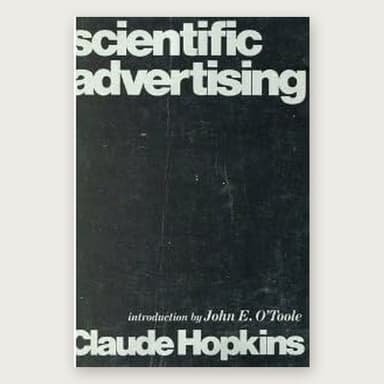
Scientific Advertising by Claude C. Hopkins: Summary and Notes
The full book, section by section.
Start hereThe short version
- 1Advertising is salesmanship, and its only purpose is to make sales. Chapters 1 and 2 argue that keyed ads and traced coupon returns have turned advertising from a gamble into a science, so every question should be answered by asking whether it would help a salesman sell.The claim
- 2The craft follows from that standard. Chapters 3 to 9 cover offering service, the lessons of mail order, headlines that pick out the right readers, psychology, specific claims over superlatives, telling the full story and pictures that earn their space.The craft
- 3Chapters 10 to 21 turn to the business side: costs too high to attempt, research, strategy, samples, distribution, test campaigns in a few towns, dealers, individuality, positive ads, letters and names, closing on the waste of advertising that is never measured.The business
The summaryIntroduction
Scientific Advertising was written by Claude Hopkins and copyrighted in 1923 by Lord & Thomas. The short introduction describes the author in the third person. Hopkins figures he has spent 70 years in advertising: about 35 years by the calendar, but measured by working hours and the work done, he has lived two years in one. He is described as a leading advertising authority who has probably written and planned more advertising than any other man, and as president of Lord & Thomas, an agency 50 years old and considered the largest in the world.
The book that follows has 21 short chapters and no parts. It moves from the claim that advertising has become a science, through the craft of headlines, specifics, pictures and samples, to the business questions of distribution, dealers and test campaigns, and closes with an argument against advertising that is never measured.
"Mr. Hopkins is a leading advertising authority."
Chapter 1How Advertising Laws Are Established
Hopkins opens with the book's claim: in some hands, advertising has reached the status of a science. It rests on fixed principles, its causes and effects have been analyzed, and the correct methods have been proved. Advertising, once a gamble, has under able direction become one of the safest business ventures. He promises a textbook of well-proved principles and facts, confined to established fundamentals, and says he will mark anything uncertain.
Chapter 1 · Thousands of tests, one science
The large advertising agencies made this possible. Over hundreds of campaigns they tested and compared thousands of plans and recorded the results, so they became storehouses of proved principles and a clearinghouse for nearly every selling question. The method is keyed advertising, traced returns, largely by use of coupons. One method is compared with many others, and when one invariably proves best, it becomes a fixed principle. Mail order advertising is traced to the fraction of a penny, and where a 1% reduction in cost means much, no guesswork is permitted. Where direct returns are impossible, one town is compared with another.
Coupon counts are only a first step. One ad may bring many worthless replies and another valuable ones, so final conclusions rest on cost per customer or cost per dollar of sale. Hopkins compares the old way of advertising to sailing without charts, lighthouses or buoys, where wrecks went unrecorded and ventures kept failing on the same rocks. Now the only uncertainties concern people and products. No one can say whether an article will be popular, but there are ways to find out very quickly.
"Advertising, once a gamble, has thus become, under able direction, one of the safest business ventures."
Chapter 2Just Salesmanship
The chapter Hopkins calls the most important in the book starts from one conception: advertising is salesmanship. Every advertising question should be answered by the salesman's standards. The only purpose of advertising is to make sales, so it should be treated as a salesman, forced to justify itself, compared with other salesmen and judged on cost and result.
Chapter 2 · Multiplied salesmanship
The difference is one of degree. Advertising is multiplied salesmanship, appealing to thousands while the salesman talks to one, and some people spend $10 per word on an average advertisement. A salesman's mistake may cost little, while an advertising mistake may cost a thousand times as much. Fine writing and a unique literary style are disadvantages because they take attention from the subject and reveal the hook. The best ad men he knows have been house-to-house canvassers who may know little of grammar but know which words convince.
His test for every question: would this help a salesman sell the goods? Slogans, clever conceits, big type and queer or unusual layouts all fail it. Asking ads to be very brief is like limiting a salesman to a certain number of words with a prospect in front of him. People read all they care to read in eight-point type, and anything larger is like loud conversation. He tells the writer to keep a typical buyer in mind, a single man or woman likely to want the product, and to do what a good salesman would do with a half-sold person. Some ad men sell house to house before writing, and it is customary to interview hundreds of possible customers. The most common cause of failure is trying to sell people what they do not want; next comes a lack of true salesmanship.
"Advertising is salesmanship. Its principles are the principles of salesmanship."
Chapter 3Offer Service
The people an ad addresses are selfish, as everyone is, and care nothing about the advertiser's profit. Ads that say, in effect, buy my brand make no popular appeal. Hopkins writes that the best ads ask no one to buy, often quote no price, and are based entirely on service: wanted information, advantages to users, a sample, or goods sent on approval so the customer can prove the claims without cost or risk.
Chapter 3 · The brush at the door
His examples are salesmen who never ask for the order. A brush maker with some 2,000 canvassers has them say at the door, "I was sent here to give you a brush," and the housewife, picking one, sees several she wants and is anxious to return the gift. A coffee concern selling by wagons in some 500 cities leaves half a pound of coffee and comes back offering a kitchen utensil, credited at five cents on each pound she buys. The maker of an electric sewing machine motor offered a week's free use with a man to show how it works, and about nine in ten trials led to sales. Cigar makers say smoke ten, then keep them or return them.
"People can be coaxed, but not driven."
Chapter 4Mail Order Advertising: What It Teaches
Selling by mail is the severest test of an advertising man, and Hopkins calls it a school he must graduate from. Cost and result show at once, false theories melt, and a man quickly learns how often his judgment errs. His example: a man selling a $5 article had replies costing $0.85. Another ad, thought better, brought replies at $14.20 each. A third brought replies for two years at an average of $0.41 each. On 250,000 replies a year, the gap is enormous, and advertisers who never key their returns end up paying from 2 to 35 times what sales need cost.
Chapter 4 · Cost per reply
Mail order ads that keep running are proved ads, so Hopkins tells readers to study them with respect. They are set in small type, which shows that larger type does not pay. They waste no space, carry no boasting or entertainment, and usually include a coupon, because a large percentage of readers who decide to act forget the decision in five minutes. Their pictures earn their space. One incubator seller added 50% to his space for a row of chickens in silhouette; his cost per reply rose by exactly that 50% and the ad brought not one added sale.
Mail order copy tells a complete story. The motto is that the more you tell, the more you sell, and Hopkins says it has never failed to prove out in any test he knows. A Mr. Mead of the Mead Cycle Company told him that not for $10,000 would he change a single word in his ads, which were the result of years of comparison. Every departure from proved mail order principles adds to selling cost, so the advertiser who departs from them should at least know the price of his pride.
"The motto there is, the more you tell, the more you sell."
Chapter 5Headlines
A salesman cannot be ignored, but he wastes time on prospects he can never interest. An ad can be ignored, but it is read only by interested people. The purpose of a headline, Hopkins says, is to pick out the people you can interest, the way you would call "Hi there, Bill Jones!" in a crowd. A blind or clever headline may attract many times as many readers who are impossible prospects, while the people you want never learn the ad is for them.
Chapter 5 · Hi there, Bill Jones
Headlines on ads work like headlines on news items: nobody reads the whole paper, and readers pick what to read by the headline. Hopkins writes that he spends far more on headlines than on the writing, often hours on one, discarding scores before choosing. Keyed returns show that a change of headline commonly multiplies returns from 5 to 10 times, and he has before him keyed returns on nearly 2,000 headlines for a single product. A soap headline like Keep Clean or No Animal Fat may attract few, It Floats may do better, and a beauty or complexion headline may attract many times as many. An automobile ad about a universal joint might fall flat while The Sportiest of Sport Bodies outpulls it 50 to 1. If 20 magazines are used, there may be 20 separate ads, because each approach attracts a different share of readers.
"Address the people you seek, and them only."
- You're Already an Impact Business22 to 30
- You're Closer Than You Think14 to 21
- You Have the Foundation7 to 13
- The Starting Line0 to 6
 Printable PDF
"Hopkins turned advertising from a gamble into a science by testing every claim. Fair enough. Run the same discipline on your business: ten questions, a score out of 30 and the part to fix first, instead of a guess. It's free with your email. Go find out."
 Deven Davis, devendavis.com
- Ten questions about where your business is right now
- A score out of 30
- A four-part breakdown: Impact Clarity, Traction Proof, Model Strength, Founder Credibility
- The part to fix first
- Your tier's next steps
- A printable PDF
Free with your email. Your score and a printable PDF open right on the page.
Chapter 6Psychology
Human nature, Hopkins argues, is the same as in the time of Caesar, so what the advertiser learns about psychology never needs to be unlearned. Curiosity is one of the strongest incentives: Puffed Wheat and Puffed Rice were failures until ads described grains puffed to eight times their normal size, food shot from guns, and 125 million steam explosions in every kernel. Cheapness is a weak appeal because Americans want bargains while feeling they can afford the best. People judge largely by price: a painting listed at $750,000 in the British National Gallery is passed by until visitors read its cost, and a department store's $1,000 Easter hat filled the floor.
Chapter 6 · Food shot from guns
Several findings concern offers. A dealer's signed warrant, a neighbor's promise to refund, outperformed a distant maker's guarantee. "Pay in a week if you like them" proved many times more impressive than a money-back trial, which one advertising man explained with two horse sellers who made equal claims; he bought from the one who said to try the horse for a week and pay then. A set of books for businessmen sold some hundreds of thousands once buyers' names were offered in gilt lettering on each book. A leather book with a man's name on it drew nearly every recipient to send for it and supply information. Offers limited to a class, such as veterans or executives, beat general offers.
An advertiser plagued by substitutes stopped warning buyers and invited them to try his rivals too, which ended the problem. Of two near-identical foods, the maker who gave his 15-cent package away failed and lost trade, while the one who paid retail price for a package at any store succeeded. Hopkins also tells of two installment clothing businesses side by side, one making a bare offer and one run in the name of a motherly woman who signed every ad and letter; the established rival soon had to quit.
"It is hard to pay for an article which has once been free."
Chapter 7Being Specific
Superlatives such as best in the world or lowest price in existence leave no impression and lead readers to discount every other statement. A specific claim, Hopkins argues, is either true or a lie, and since people do not expect advertisers to lie in the best mediums, definite statements are believed and actual figures are not discounted. Saying a tungsten lamp gives three and one third times the light of a carbon lamp shows that tests were made. Saying prices were reduced 25% gets the full value of the announcement.
Chapter 7 · Three and one third times the light
His examples are a run of specific claims that won. A mail order clothing seller whose rivals had copied lowest prices in America switched to "Our net profit is 3%," and business made a sensational increase the next year. An auto maker stated a 9% profit and showed $735 of hidden parts in a $1,500 car. A new shaving soap claimed it multiplies itself in lather 250 times, softens the beard in one minute, holds its fullness for 10 minutes and was chosen after testing 130 formulas. A razor maker advertised a 78-second shave. A brewer, while others cried pure beer, described a plate glass room, a white wood pulp filter, bottles washed four times, wells sunk 4,000 feet and 1,018 experiments, and made what Hopkins calls the greatest success ever made in beer advertising. Used the world over gave way to used by people in 52 nations.
"Platitudes and generalities roll off the human understanding like water from a duck."
Chapter 8Tell Your Full Story
Whatever claim gains attention, Hopkins says, the ad should tell a story reasonably complete. Advertisers who present one claim at a time or run serials that continue in another issue commit a folly, because readers rarely read successive ads on one line. Once a person's attention is won, every good argument should be brought to bear. The best advertisers find their appealing claims by testing headlines and then put all of them in every ad, even if the ads look monotonous to the people who read them all.
Chapter 8 · The whole story, every time
Ads should be written only for new customers. Present users have already decided and will not read the ads; he says you could advertise month after month that their product is poison and they would never know it. The reader is like a salesman's one chance in a busy man's office. On brevity, one sentence may tell the whole story for chewing gum, and other lines need columns. His example is a man choosing a car he could take pride in. The Rolls-Royce, Pierce Arrow and Locomobile ads were short and told him nothing; the Marmon told a complete story, so he bought a Marmon. He later learned facts about a car at nearly three times the price that would have sold him that car had he known them. Brief ads, Hopkins notes, are never keyed.
"Take the opinion of nobody, the verdict of nobody, who knows nothing about his returns."
Chapter 9Art in Advertising
From one third to one half of a campaign is often staked on pictures, counting the space they take, so pictures must sell. Hopkins says they should be used only when they make a better selling argument than the same space in type. Mail order advertisers use large, small or no pictures for reasons proved by results, and none of them uses expensive artwork. Pictures work for Arrow collars and most clothing by showing men others envy in surroundings others covet; for correspondence schools by showing men taking upward steps; and for beauty products by showing admired women, ideally with a fascinated man.
Chapter 9 · What pictures cost
Pictures should never be eccentric. People do not patronize a clown, and a striking picture takes attention from the headline. For Puffed Grains, pictures of the grains themselves beat any figure drawing. On disputed questions he reports both sides: some advertisers pay up to $2,000 per drawing, mail order advertisers use ordinary art; repeating a picture is probably an economy since the readers are always new; color generally does not pay better than black and white except on lines like oranges and desserts. He treats all of these as minor next to the basic principles that can cut results in two or multiply them.
"People do not patronize a clown."
Chapter 10Things Too Costly
Many things are possible in advertising and too costly to attempt, which is another reason every method should be weighed by cost and result. Changing people's habits is very expensive: selling shaving soap to Russian peasants would first require changing their beard-wearing habits. Hopkins writes that tests showed the cost of converting people to brushing their teeth could run $20 to $25 each, partly because much of the advertising reaches people already converted. One dentifrice maker who learned this never tries to educate and has done remarkably well; another spends heavily on converts and shares the new business with his rivals. Money spent to educate people to eat oatmeal produced results too small to discover.
Chapter 10 · The price of changing habits
One grower cannot increase consumption of oranges or raisins, but thousands of growers combined have done it. The shrewd course is to watch a popular trend develop and offer to satisfy the new desire, as was done with yeasts and antiseptics. A germicide that might sell to half the homes could cost $1.50 per customer and not repay that in 10 years, and mail order sales on single articles rarely cost less than $2.50 each. Prevention is an unpopular appeal: people will do much to cure trouble and little to prevent it. A toothpaste's beauty claim will likely outpull its decay claim, and a soap's complexion claim will reach nearly everyone while an eczema claim reaches one in a hundred.
"People will do much to cure trouble, but people in general will do little to prevent it."
The Founder Brain Kit
Chapter 11Information
An ad writer must gain full information on his subject, and Hopkins describes weeks of reading on a single problem. For a coffee without caffeine, one scientific article out of a thousand supplied the keynote: caffeine stimulation comes two hours after drinking, so removing it does not remove the kick, and caffeine is tasteless and odorless. For a toothpaste, an idea found in the middle of a volume of dry scientific matter helped make millions for the maker.
Chapter 11 · The keynote in the pile
Research takes many forms. Before advertising a food product, 130 men interviewed consumers for weeks. Letters went to 12,000 physicians on another line. A $25,000 a year man went from farm to farm before advertising acetylene gas outfits. Before advertising a shaving cream, 1,000 men were asked what they most desired. A canvass of homes for pork and beans showed only four percent of people used canned pork and beans and 96 percent baked their own, so the right appeal was to win people away from home baking. Rivals' literature is collected, chemists check doubtful claims, and a laboratory found one drink had 425 calories per pint, equal to six eggs. In scientific lines, a censor passes on every ad.
"Genius is the art of taking pains."
Chapter 12Strategy
Hopkins likens advertising to war minus the venom, or to chess. Strategy covers several questions. A name can be an advertisement in itself, as Shredded Wheat, Cream of Wheat and Puffed Rice are, while Toasted Corn Flakes left the demand open for others to share. Coined names like Kodak and Mazda are exclusive and the advertiser who gives them meaning never shares the advantage. On price, a high price limits the field, and the greatest profits come from great volume at small profit, as with Campbell Soup, Palmolive Soap and Ford cars. A price that appeals to 10% multiplies selling cost, though on items like a corn remedy, used in small amounts, a high margin is essential, and on some lines a higher price is itself an inducement.
Chapter 12 · The 10% price
Competition must be measured. Some fields are almost impregnable because the leader created the habit. To win a shaving soap user from a long-established favorite, the advertiser must learn what he would say to one man on a Pullman. There is nearly always something impressive the others have not told. Substitution must be headed off at the start: Vaseline nearly monopolized the demand it created, while Royal Baking Powder, Toasted Corn Flakes and Horlick's Malted Milk left the way open to perpetual substitution. Dealer attitudes and distribution complete the list.
"We cannot go after thousands of men until we learn how to win one."
Chapter 13Use of Samples
The product, plus the atmosphere placed around it, should be its own best salesman, so samples are of prime importance and usually the cheapest selling method. They let the ad use the word free, which often multiplies readers. They get action and capture the name of an interested prospect. They key the ads, so headlines and plans can be compared; Hopkins notes that some ads on the same product cost 10 times what others cost. If it costs 50 cents to bring someone to the point of asking for a sample, he says not to stop at 15 more cents to make that interest valuable.
Chapter 13 · The last 15 cents
Charging 10 cents for a sample may cost 40 cents to a dollar in lost replies and forfeits the word free. One issue of a paper in Greater New York brought 1,460,000 requests for a can of evaporated milk. Local delivery beats mail: inquiries by mail on one line averaged $0.70 each and $0.18 to $0.22 each when coupons were presented at a local store, and where women could write, telephone or call at a store, 70% of inquiries came by telephone. Full-size packages priced from 10 cents to 50 cents have long been offered free, and checking for repeaters cost more than the loss. Samples handed out promiscuously, like waifs on doorsteps, probably never pay. Give them only to people who have read the story and made some effort.
"Give samples to interested people only."
Chapter 14Getting Distribution
National advertising is unthinkable without distribution, and a venture cannot pay if 9 in 10 converts fail to find the goods. Hopkins lists many methods and focuses on articles of wide appeal and repeated sale. The usual start is local advertising, gaining distribution town by town before going national, sometimes naming stocked dealers in the ads; most dealers want to be named. Sample plans force distribution quickly, because dealers dislike sending customers to competitors even for a sample.
Chapter 14 · Converts who can't buy
The simplest method is a coupon good at any store for a full-size package. Proofs of the ad go to dealers in advance, each coupon representing a cash sale at full profit, and some makers have gained reasonable national distribution in one week this way. Palmolive Soap and Puffed Grains got their distribution so. Readers in outside towns who write in are referred to a local store. Sending every dealer free packages is expensive, and consignment is not widely favored. His advice: do not advertise without distribution, and do not gain it by slow, costly methods.
"Hopkins says advertising is salesmanship in print. That only works when you have something to sell, right? The Shortlist gives you 12 paths to your first thousand a month, each with startup costs and time to first dollar, plus 15 AI prompts to write your first offer. A thousand a month is $33 a day. Seven bucks. Pick a path this week."
Deven Davis, devendavis.com- 12 paths to your first $1K a month, each with startup costs, time to first dollar, difficulty and first steps
- The Skill Audit: what you already have that people will pay for
- 15 ready-to-use AI prompts by stage: Discovery, Launch, First Client, Scale
- The $1K Action Plan: your path, your first offer and a 48-hour deadline
Seven dollars, with the No-Brainer Guarantee: if it doesn't save you 10+ hours of research in the first week, full refund.
"But don't start advertising without distribution."
Chapter 15Test Campaigns
Almost any question, Hopkins writes, can be answered cheaply, quickly and finally by a test campaign, the court of last resort being the buyers. In the old days advertisers ventured on their own opinions and the many guessed wrong. Now a small venture establishes averages: when you learn what a thousand customers cost, you know almost exactly what a million will cost. A test in four or five towns may cost $3,000 to $5,000 and in time usually brings back its whole cost; sometimes the cost comes back before the bills are due. The largest advertiser in the world, he says, starts projects this way and now has 26 winners.
Chapter 15 · From a thousand to a million
Tests answer other questions too. A food advertiser certain his product would sell better in a new form tested it with a coupon in a few towns, and users almost unanimously disapproved; a later form won 91% of a few thousand women. Each test cost about $1,000. For one food advertiser, over 50 separate plans were tried in five years, and the best one reduced the cost of selling by 75%, four times more effective than the best before. Tests also let a new agent prove his skill in a few towns. Hopkins compares this to a chemist who makes hundreds of tests before stating which compound is best.
"We let the thousands decide what the millions will do."
Chapter 16Leaning on Dealers
Jobbers and dealers are busy, carry many lines, earn little on advertised brands and push their own brands if any. Extra discounts and loading offers, such as one case free in 10, rarely raise total sales; they swing trade from one store to another, and a free case means advertising must sell 10% more for the same return. Sales made by conviction bring permanent customers, while people who buy on casual recommendation do not stick. Window and store displays may give one dealer a lion's share without raising total sales, and tests comparing towns often show costly displays are worthless.
Chapter 16 · Deals swing trade, not totals
Hopkins calls this the old general publicity of 20 years before, casting bread upon the waters. The object of advertising is to buy new customers at a price that pays a profit. If customers cost $1 each, every wasted dollar costs a possible customer.
"Your object in all advertising is to buy new customers at a price which pays a profit."
Chapter 17Individuality
A person who wants to make an impression must stand out in a pleasing way, and so must a salesman in print. Hopkins describes giving each advertiser a becoming style in manner and tone suited to the people he addresses: rugged honesty in one line, the good fellow in another, the authority in a third. Signed ads give personal authority, and naming the man behind an improvement adds effect, since by making a man famous you make his product famous. Once an individuality has proved appealing, writers keep it, playing the part as an actor would. Changing it would force the best friends of the brand to get acquainted all over.
Chapter 17 · A part to keep playing
"By making a man famous, we make his product famous."
Chapter 18Negative Advertising
Attacking a rival is never good advertising, Hopkins says: the selfish purpose shows and it looks unfair. Show the bright side. Show the face as it will appear, pretty teeth, well-dressed people and successful men, the people others wish to be. Tell people what to do. Assume they will do what you ask: say send now for the sample, and avoid asking why they neglect the offer. In his experience, comparing a positive ad against a negative one, the positive ad outpulls the other four to one. Before and after ads, he writes, are follies of the past.
Chapter 18 · Four to one for the bright side
"Make your every ad breathe good cheer."
Chapter 19Letter Writing
Most circular letters go to the wastebasket. The ones a businessman acts on or files have a headline that offers something he wants. Hopkins describes a buyer who spends $50 million per year dropping a score of letters in the wastebasket in one minute, setting one aside and filing another under Varnish. One magazine that sends millions of letters tests first: before sending 5 million, it may try 25 letters on 1,000 prospects each and uses only the one that pays best.
Chapter 19 · The buyer's minute
A two-cent letter gets no more attention than a one-cent letter, and fine stationery no more than poor. Follow-up letters to inquirers should continue the argument that created the interest and push for immediate action, which is why so many selling letters set an expiry date. A mail order house enclosed a personal card with its catalog promising a gift with the first order, which gave its catalog preference over competitors. Another advertiser induced hundreds of thousands of women to buy six packages and send in the trademarks for a premium offer good for only one week.
"Strike while the iron is hot."
Chapter 20A Name That Helps
A name that tells a story justifies the space it occupies. Hopkins cites names that are almost complete ads, such as Cream of Wheat, Dutch Cleanser, Minute Tapioca and 3-in-1 Oil. Meaningless coined names like Kodak, Vaseline, Kotex and Postum can be protected and become very valuable if long advertising gives them meaning, but most never get there. Names built on ingredients anyone may use, like tar soap, invite substitution and keep the price in that class, and Toasted Corn Flakes and malted milk are his examples of unfortunate names where others shared a demand one advertiser created. On a patented product, the right to the name expires with the patent, as happened with Castoria, Aspirin and Shredded Wheat Biscuit. When a common name is unavoidable, a man's name is the best auxiliary because it shows someone is proud of his creation. Some names have lost their originators four-fifths of the trade they built.
Chapter 20 · A name that tells a story
"Names which tell stories have been worth millions of dollars."
Chapter 21Good Business
Hopkins closes with the stream by his boyhood home, which turned a wooden mill wheel and wasted all but a fraction of its power until someone put it through a turbine and dynamos, and with no more water it ran a large manufacturing plant. He sees wasted advertising power everywhere: men spending $5 to do what $1 might do, getting back 30% of their cost when they might get 150%. Those ads are always unkeyed.
Chapter 21 · The turbine on the stream
An advertiser spending as much as $700,000 per year told him he did not know whether his advertising was worth anything. Hopkins answered that it was utterly unprofitable and he could prove it the next week: end an ad with an offer to pay $5 to anyone who writes that he read it through, and the scarcity of replies will amaze you. Even a storekeeper with a $20 ad knows whether it pays, yet most national advertising is presumed to pay. An old advertising man told him only an hour earlier that the day for his type was done. Hopkins welcomes the change and predicts that advertisers will multiply once they see advertising can be safe and sure.
"The time is fast coming when men who spend money are going to know what they get."