Scaling Up by Verne Harnish: Summary and Notes
The full book, section by section.
Start hereThe short version
- 1Every growing company faces four decisions: people, strategy, execution and cash. Chapters 1 and 2 lay out the whole method and the three barriers to scaling, which are leadership, infrastructure and market dynamics.The claim
- 2People and strategy come first. Chapters 3 to 5 cover accountability charts, Topgrading and great managers. Chapters 6 to 8 cover the core values and purpose, the 7 Strata of Strategy and the One-Page Strategic Plan.People and strategy
- 3Execution and cash keep it running. Chapters 9 to 11 set one priority, gather data and install a daily, weekly, monthly, quarterly and annual meeting rhythm. Chapters 12 to 14 speed up the cash conversion cycle, fix the accounting and pull the seven levers of the Power of One.Execution and cash
The summaryThe Introduction: Tools for Scaling Up
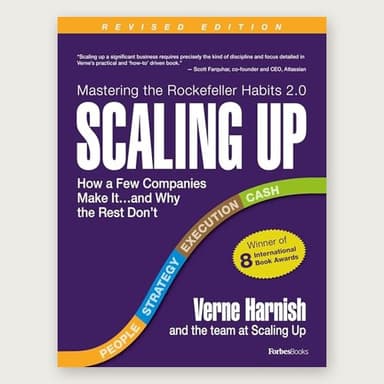
These notes follow the 2014 audiobook, Scaling Up: Mastering the Rockefeller Habits 2.0. The paperback and Kindle editions linked on this page are the later revised edition from Forbes Books, so some examples and figures in print may differ.
Harnish opens with Infusionsoft, an Arizona software firm that secured $54 million in growth capital from Goldman Sachs in 2013 after growing 53% the year before on a $50 million run rate. Its CEO, Clate Mask, told the authors that a copy of Mastering the Rockefeller Habits happened to be in the photo of the signing, and that its tools are discussed weekly by his leadership team. It has been 12 years since Mastering the Rockefeller Habits first came out, and this is its first major revision, drawn from over 30 years of helping more than 40,000 business leaders.
What is new: the book is organized around the four decisions a leader must make, people, strategy, execution and cash, and 75% of it is new material. The One-Page Strategic Plan has been updated and is backed by a deeper strategic thinking tool, the 7 Strata of Strategy. There are six new one-page tools, examples from more than 50 CEO interviews are placed throughout the chapters, and the authors explain why techniques like the daily huddle falter.
"If you want to teach people a new way of thinking, don't bother trying to teach them."
Chapter 1The Overview: People, Strategy, Execution, Cash
The overview is a 20-minute summary of the whole method. Most businesses follow a life cycle of start up, scale up, screw up or stall out. Of the ventures that survive, 96% remain mice, and only a few, the gazelles, scale beyond $10 million, $100 million or $1 billion in revenue. The key to climbing the growth curve is attracting and keeping the right people, creating a truly differentiated strategy, driving flawless execution and having plenty of cash to weather the storms.
Harnish cites a U.S. Small Business Administration study finding that high-impact firms are on average 25 years old and represent between 2 and 3% of all firms, yet account for almost all private sector employment and revenue growth. Apple had 9,600 employees when it released the iPod in 2001, its 25th anniversary, and all its phenomenal growth came after. Starbucks took its first 20 years to reach 100 locations and was at 1,000 stores by its 25th anniversary. Senior leaders know they have built something scalable when they are the dumbest people in the room.
The tools aim to reduce by 80% the time the top team spends managing operations, refocus the senior team on the market and align everyone else. Three barriers stand in the way: leadership, scalable infrastructure and market dynamics. To master the four decisions, lead people with a handful of core values repeated often; set a strategy that, following Gary Hamel, matters to enough customers and differentiates you; drive execution with a handful of priorities, daily and weekly data and a meeting rhythm; and on cash, do not run out of it. The overview then previews the tools, from the BHAG, a big, hairy, audacious goal for the next 10 to 25 years, to the Rockefeller Habits Checklist of 10 habits, installed one or two per quarter over roughly 24 to 36 months, and the Power of One's seven financial levers.
Chapter 1 · The four decisions
"The best leaders have the right questions, but turn to their employees, customers, advisors, and the crowd to mine the answers."
Chapter 2The Barriers: Leadership, Infrastructure, and Market Dynamics
In 1999, Alan Rudy, founder of ExpressMed, an Ohio mail-order medical supplies firm, was angry all the time and working 80-hour weeks. His CFO estimated a first-quarter profit of $300,000, then two days later reported a loss of $350,000. Within two years Rudy had reversed the trends with the tools in this book, scaled to a $65 million industry leader and sold for $40 million. At Perceptionist, a call center, a client said he would pay $25 to have his calendar booked; Rudy refocused the company on booked appointments for a few core industries and brought in revenue averaging $5 a minute, more than four times the industry average. At MemberHealth, where he helped install the daily huddle, revenue went from $7 million in 2003 to $1.2 billion by 2006, when it sold for $630 million.
Growth brings complexity. Expanding from 3 to 4 people grows the team only 33%, yet complexity may increase 400%. Harnish counts roughly 28 million firms in the U.S., of which only 4% reach $1 million in revenue and about 0.4% reach $10 million, and he describes the valleys of death, the points where a company is bigger but lacks the talent and systems for the next level. Scott Tannis of Western Financial Group, whose stock rose 1,038% over 15 years, describes them at 10 employees, 25 and 100.
The three barriers follow. Leaders must grow capable of delegation, prediction and repetition: to get to 10 employees, founders delegate what they are weak at, and to get to 50, they delegate what they are strong at. Infrastructure must handle the extra communication and decisions. And market dynamics, the competitive pressures that erode margins at scale, require leaders to stay close to customers, as Rudy did by spending three months on the road.
Chapter 2 · How few firms scale
"Great execution won't get you anywhere if your strategy is wrong."
Scaling UpPeople
The people section starts from two questions. Are you happy, meaning do you enjoy coming to work, or is a partner, executive, customer, supplier, investor or family member draining you? And would you enthusiastically rehire everyone, knowing what you know today? Relationship problems left unaddressed drain the emotional energy needed for strategy, execution and cash, which is why the four decisions start with people. The section covers three one-page tools: the One-Page Personal Plan, the Function Accountability Chart (FACe) and the Process Accountability Chart (PACe). The E in both stands for the energy and entrepreneurial spirit leaders need.
"It's a painful question that requires one to face the brutal facts and make changes."
Chapter 3The Leaders: The FACe and PACe of the Company
Peter Drucker said the bottleneck is always at the top of the bottle. Harnish starts with Shine Lawyers, a 600-person Australian firm with 30 locations, whose co-founders promoted new legal leaders and hired an executive team to prepare for an IPO. For organizational design he borrows from biology: a cell can only grow so large before it must divide, so teams should stay small and close to their customers, as in Amazon's two-pizza rule. He separates three terms. Accountability belongs to the one person who tracks progress and raises issues. Responsibility belongs to everyone who can respond. Authority belongs to whoever makes the final decision. At the Ritz-Carlton, any employee who receives a guest complaint owns it and can spend up to $2,000 to fix it, and managers up to $5,000, backed by 250 to 300 hours of first-year training.
The One-Page Personal Plan sets goals for relationships, achievements, rituals and wealth across faith, family, friends, fitness and finance. Harnish took a year to spend more time with his 6-year-old son, Quinn. The FACe lists the functions every company needs, names one person accountable for each, and adds 1 to 3 KPIs per function; he notes Michael Dell's CMO seat had been empty for two years even though the executive team had more than 20 members. The PACe lists the 4 to 9 processes that drive the business, each with one owner, and Harnish recommends lean methods to improve them: John Stapleton's call centers gained 28% in productivity within a week, and Ken Sim's Nurse Next Door handled a 100% increase in business in 2008 without adding headquarters staff.
Chapter 3 · One name per function
"The rule, if more than one person is accountable, then no one is accountable."
- You're Already an Impact Business22 to 30
- You're Closer Than You Think14 to 21
- You Have the Foundation7 to 13
- The Starting Line0 to 6
 Printable PDF
"Harnish answers every big growth decision with a simple one-page tool. Here's a quick one for where your business stands right now: ten questions, a score out of 30 and the part to fix first. It comes with a printable PDF, free with your email. Go find out."
 Deven Davis, devendavis.com
- Ten questions about where your business is right now
- A score out of 30
- A four-part breakdown: Impact Clarity, Traction Proof, Model Strength, Founder Credibility
- The part to fix first
- Your tier's next steps
- A printable PDF
Free with your email. Your score and a printable PDF open right on the page.
Chapter 4The Team: Attracting and Hiring
Hiring A players takes marketing to recruit and the Topgrading method to select, Harnish argues, because according to Topgrading a bad hire costs 15 times annual salary. Topgrading, created by Brad and Geoff Smart, helps leaders hire the right person more than 90% of the time, versus 25% to 60% for conventional methods. An A player is someone in the top 10% of the available talent pool who is willing to accept your offer. Start with a job scorecard in place of a job description: its purpose, measurable outcomes over one to three years and the cultural and technical competencies needed. He urges hiring specialists, chess pieces in Buckingham's image, and even people who are downright strange, if the strategy depends on being distinctive.
Marketing the job matters because you need a minimum of 20 applicants per position. Mom's Organic Market wrote an ad around its environmental purpose and received 40 resumes in a week; its CFO later helped the company grow to $130 million. Atlassian hired 15 developers after touring 15 European cities with a bus reading "Europe, we're coming to steal your geeks." Rackspace received 52,000 applicants for 569 openings in 2013. Gene Brown's City Bin Co. recruited a kickboxing champion to work its trucks. The process then narrows candidates with screening questions to the top three and a chronological in-depth interview of 3 to 4 hours for senior roles. Speedwire grew from 25 employees to 325 in one year using Topgrading. Zappos offers new hires $3,000 to quit after training, and Amazon offers $2,000 rising by $1,000 a year up to $5,000.
Chapter 4 · Hire with Topgrading
"Teams need to be well-rounded, but their individual members don't have to be."
Chapter 5The Managers (Coaches): Keeping and Growing (Educating) the Team
Harnish suggests replacing the word manager with coach. He cites Gallup that managers account for at least 70% of the variance in employee engagement, and Google's data showing periodic one-on-one coaching ranked as the number one key to successful leadership. Great managers focus on five activities, in reverse order of importance: hire fewer people and pay them more; give recognition and show appreciation; set clear expectations and a line of sight; dehassle; and help people play to their strengths.
On pay, The Container Store holds that one great person equals three good ones, hires only about 3% of applicants, pays salespeople 50% to 100% more than the retail average and gives 263 hours of first-year training against an industry average of 7. Costco pays roughly 70% more per hour than Sam's Club, needs almost 40% fewer employees per dollar of revenue and has 6% turnover after one year versus 21%. Mom's pays a minimum of $11 an hour when Maryland's was $7.25. On recognition, people need positive interactions with their manager at a ratio of at least 3 to 1. On growth, Harnish calls the best growth firms training companies and suggests 12 hours of training a year for the frontline, 25 for middle managers and 45 to 60 for senior leaders, budgeting 2% to 3% of payroll. Companies can cope with a charismatic leader who struggles with managing until about 50 employees, but not past 100.
Chapter 5 · Managers as coaches
"People join companies. They leave managers."
Scaling UpStrategy
The strategy section opens with Domino's Pizza and its promise of pizza delivered in 30 minutes or less, or it's free, which made Tom Monaghan a billionaire. The signs of a killer strategy are sustainable top-line growth and rising gross margin dollars; without one, the market commoditizes your products. Strategy work has to happen weekly, free from firefighting. Grandmaster chess players, Harnish notes, are no better at thinking ahead; they have ten times the next moves in their repertoire, so leaders should borrow moves from advisors who have seen hundreds of companies. Four tools are covered: the 7 Strata of Strategy, the Vision Summary, the SWT and the One-Page Strategic Plan.
Chapter 6The Core: Values, Purpose, and Competencies
A growing firm needs a strong core, like an athlete, made of values, purpose and competencies, and once it passes 50 to 70 employees and culture begins to drift, the core must be codified and reinforced. Hatim Tyabji grew VeriFone from $31 million to $600 million in 11 years with a nine-page blue book of values and, he says, spent the next 11 years repeating himself. Core values are discovered, Harnish argues, since a company's personality is set like a person's, and trying to change them sends the organization into endless therapy. J. Stuart Moore of Sapient called changing the company's values for an acquisition his biggest mistake. Purpose answers why the company exists, and Harnish cites research that people whose hearts are captured give 40% more discretionary effort. Core competencies, following Prahalad and Hamel, are the capabilities that let a company like BIC grow beyond cheap pens.
Appletree Answers shows the core at work. Its call center turnover was 110%, so founder John Ratliff launched Dream On, which granted employees' dreams, such as funding a family's car and a soldier's Christmas trip home. Turnover dropped to 20%, and the program paid a 20 times return in less than a year. Harnish outlines eight ways to use the core to drive a company's people systems, with Appletree as the case study.
Chapter 6 · A core that keeps people
"Core values are the rules and boundaries that define the company's culture and personality, and provide a final should or shouldn't test for all the behaviors and decisions by everyone in the firm."
Chapter 7The 7 Strata of Strategy: The Framework for Dominating Your Industry
BuildDirect.com, a Vancouver seller of building materials, has doubled sales each year since 2003 and has a 2014 run rate of $200 million. The 7 Strata framework, which Harnish calls the page behind the One-Page Strategic Plan, is worked on by a strategic thinking team of no more than 3 to 5 people meeting weekly, modeled on Jim Collins's council. The seven strata are: words you own in the minds of the market; the sandbox and brand promises, meaning who the core customer is, what you sell and the measurable promises behind it; the brand promise guarantee, a catalytic mechanism; a one-phrase strategy; 3 to 5 differentiating activities, per Michael Porter; the X-Factor, a 10x to 100x underlying advantage; and profit per X with the BHAG.
The Profit + Purpose Playbook
His examples fill each stratum. Darius Bikoff added vitamins to water and created a category Coke bought for $4.1 billion. A niche of no more than 10% of customers often holds most of the profit; dog owners who are fanatical about their pets are only 7% of owners and over 25% of dog food profits. BuildDirect's core customer is Debbie the Do-It-Yourselfer, and its best price means 40% to 50% less than elsewhere, with a 30-day money-back guarantee. Red Balloon refunds 100% of a voucher if the experience is cheaper elsewhere. Oracle once promised $1 million if its software did not run twice as fast. IKEA, with 6.8% global market share, focuses on the 7% of the market fanatical about it. Outback Steakhouse found its X-Factor by asking young managers to invest $25,000 in a restaurant, keeping them in the same location for 5 to 10 years.
Chapter 7 · The 7 Strata
"When you nail your strategy, top-line revenue growth and fat margins come almost effortlessly."
Chapter 8The One-Page Strategic Plan: The Tool for Strategic Planning
JSJ Corporation, a Michigan parent of six durable goods firms with 2,700 employees, adopted the OPSP in 2006; it helped CEO Nelson Jacobson decide to sell one company and invest in the rest, and he reports continuously improving profit and growth since. For firms of 50 employees or fewer, the Vision Summary is a simpler starting page: core values, purpose, brand promises, BHAG and the priorities for 3 to 5 years, the year and the quarter. To prepare the plan, the SWT augments a SWOT with trends.
The OPSP has seven columns. Column 1 holds core values. Column 2 holds purpose, profit per X and the BHAG, the measurable 10 to 25 year goal. Column 3, Where, sets 3 to 5 year targets, the sandbox, brand promises and key thrusts; a company growing 100% a year lives in dog years and should shorten every horizon. Column 4, What, sets the year's goals and critical number. Column 5, How, sets the quarter's priority and its rocks, a series of 3 to 5 simultaneous 13-week sprints. Column 6 sets the theme, scoreboard and celebration, and Column 7 names who is accountable for which KPIs and priorities. Harnish notes that more than 40,000 companies worldwide have used it.
Chapter 8 · The plan on one page
"It's a simple yet powerful tool that helps you edit down your vision to a single, action-oriented page."
Scaling UpExecution
Coastal.com, a Vancouver eyewear company, sold to Essilor in 2014 for 430 million Canadian dollars, and founder Roger Hardy credits disciplined execution of the Rockefeller Habits. Visiting German industrialists were blown away by its daily executive huddle. Its leaders called customers weekly, and one change from those calls lifted revenue 60% in one market; an internal shark tank of employee ideas added 15% to revenue in 2013. Hardy reviews the Rockefeller Habits Checklist every three months. The section is built around the 10 habits in three disciplines: priorities, data and meeting rhythm.
Chapter 9The Priority: Focus, Finish Lines, and Fun
The priority chapter argues for one main thing at every time scale. Gene Brown has never learned to drive a garbage truck, which he counts as a key to his success; the City Bin Co. reached $25 million in revenue and 120 employees in 2014 and is aiming for 1 million customers by 2020. Mark Zuckerberg made going mobile Facebook's single priority for 18 months, and mobile ads reached 50% of total revenue in the fourth quarter of 2013. At Ignite Social Media, Jim Tobin wrote two numbers on a whiteboard, 241 late tasks and 728 unassigned, and both reached zero by the end of the month. Ivy Lee told Charles Schwab to work his six tasks in order and was paid $25,000 for the lesson.
The critical number is the quarter's or year's key bottleneck, set with red, green and super green targets. ProService Hawaii set a target of 600 referrals in a year, three times more than it had ever achieved. A quarterly theme wraps the critical number in fun. The City Bin Co. ran Saving Mrs. Ryan to win 10,000 new customers, Life Begins at 40 to raise monthly earnings by 40,000 euros, 180 to 1 for job sharing among 60 employees, and Bin It, in which the team binned more than 150 activities. Each ends with a celebration, the finish line.
Chapter 9 · One priority, a finish line
"You'll be working on the most important ones, and the others can wait."
"Harnish answers every big growth decision with a simple one-page tool. Here's one for before you scale: purpose, opportunity, leverage, model. The same four questions Ivystone uses to evaluate deals, fill-in-the-blank, done in 47 minutes on average. A dollar. Go do it."
Deven Davis, devendavis.com- The P-O-L-M framework (Purpose, Opportunity, Leverage, Model) used by institutional investors to evaluate early-stage deals
- A fill-in-the-blank worksheet that produces a one-page business gameplan in one sitting
- Bonus: The 48-Hour Quick Start, the exact first 3 steps to take today
One dollar, backed by the Dollar-Back Promise, and done in 47 minutes on average.
Chapter 10The Data: Powering Prediction
Netflix's Reed Hastings fell from grace with the Qwikster spinoff, then recovered by using data to predict that House of Cards would succeed, tracking events such as about 4 million ratings and 3 million searches per day. Data has to be paired with human intelligence gathering. Walmart sent teams to stores Monday through Thursday, reviewed everything Friday morning and had corrections in place by Saturday noon; David Glass said competitors were 10 days behind. Senior leaders need to be in the market 80% of the week.
Habit 5 is gathering employee input. Big Ass Solutions grew from $34 million in 2009 to $115 million in 2013 with 93% retention against a U.S. average of 63%. Jimmy Calano's managers each submitted three ideas a month, and he rewarded the top 20 with a $20 bill. Habit 6 is customer input, using four questions asked in person. Fred Reichheld's research found companies growing 2.5 times faster than competitors spent roughly 20% of leadership meetings on customer feedback. Appletree's employees generated more than 8,800 ideas in 90 days. The Net Promoter Score measures how many customers actively recommend you. Habits 9 and 10 give everyone KPIs and a scoreboard tied to Column 7 of the OPSP.
Chapter 10 · Data on a weekly clock
"The fundamental job of a leader is prediction, according to the late business consultant W. Edwards Deming."
Chapter 11The Meeting Rhythm: The Heartbeat of the Organization
John D. Rockefeller lunched every day with his key people, Steve Jobs lunched almost daily with Jonathan Ive, and T. Boone Pickens credits daily breakfasts with turning $3.2 million into billions. Harnish compares a growth firm to a jazz band: talented players, shared rules, the same song in the OPSP and the same beat in the meeting rhythm. The rhythm should take no more than 10% of senior leaders' week, 5% to 7% for middle managers and 3% for frontline staff, and in the best-run companies the CEO's calendar is pre-programmed 200-plus days a year.
The rhythm runs on several beats. The daily huddle lasts 5 to 15 minutes, starts at an odd time and ends on time, covering what's up in the next 24 hours and where people are stuck; the Ritz-Carlton gathers about 80 people at headquarters for a 10-minute daily lineup. The weekly meeting runs 60 to 90 minutes on quarterly priorities and one or two main topics. The monthly management meeting is the key routine for developing middle managers. Quarterly and annual planning sessions reset the plan, and once a quarter leaders share it with all employees in a 45-minute meeting. Harnish names generalities as the main roadblock and asks for specifics in every update. If a company grows 20% to 100% a year, each quarter should be treated like a year.
Chapter 11 · The heartbeat
"To move faster, pulse faster."
Scaling UpCash
Growth sucks cash, so the aim is to generate enough cash internally to avoid banks and sharks. Costco's membership fees are 75% of its profit, $2.3 billion of $3 billion in pre-tax earnings in 2013. Harnish cites Jim Collins and Morten Hansen's finding that great companies keep 3 to 10 times more cash than competitors, and notes Bill Gates required Microsoft to keep a year's operating expenses in the bank. Gazelles itself ran out of cash after 9-11. The section's two tools are Cash Acceleration Strategies and the Power of One.
"You can get by with decent people, strategy, and execution, but not a day without cash."
Chapter 12The Cash: Accelerating Cash Flow
The Cash Conversion Cycle measures how long a dollar spent takes to come back as cash. When Michael Dell ran out of cash in the mid-90s, CFO Tom Meredith found a cycle of 63 days and, working on one improvement every 90 days, drove it to negative 21 days by the time he left a decade later. Catapult Systems switched from monthly billing to twice a month after more than 90% of clients agreed, and nearly doubled cash flow immediately.
The Cash Acceleration Strategies tool breaks the cycle into the sales cycle, the make or production cycle, the delivery cycle and the billing and payment cycle, and asks teams to brainstorm ways to shorten each, eliminate mistakes and improve the business model. PPR Talent Management freed up a million dollars every month by invoicing more accurately for a thousand clients, mostly hospitals. Benetton India ran an online bidding round that cut its shopping bag price from 52 cents to 34 cents and saved $1.2 million in one year. Harnish recommends a daily cash report from the CFO and one cash initiative every 90 days; improving the cycle by 30 days in a $30 million business frees $2.5 million.
Chapter 12 · The Cash Conversion Cycle
"Constantly improving the cash flow of the company and better understanding how cash moves through the business is a powerful driver for improving the firm as a whole."
Chapter 13The Accounting: Driving Profitability
Co-written with Greg Crabtree, this chapter calls accounting the second biggest weakness of growth firms after marketing. One service business took 14 years to reach $5 million, then grew to $25 million in five years at 10% profit once it measured gross margin, paid the owner a market wage and tracked labor efficiency. Waterfall graphs slice profit by customer, product or location and show where money is lost. Keeping two sets of books lets leaders decide on business terms, as Dell did by expensing technology within 12 months.
Crabtree's corrections: below $20 million in revenue, owner pay distorts profit, and one pair of owners boasting 25% profitability was at 3% once market wages were counted, then reached 20% the next year. Gross margin dollars are the true top line. When gross margin falls below 40%, relate profit to gross margin. At 5% pre-tax profit a business is on life support, at 10% it is doing well and at 15% it is in great shape. The labor efficiency ratio measures what each dollar of labor returns, split into direct, sales and management labor.
Chapter 13 · Read the thermometer
"Revenue is vanity, and the weakest number, when it comes to your P&L."
Chapter 14The Power of One: 7 Key Financial Levers
Gary's Furniture had grown profits for 10 years and reached $42 million in revenue, and Gary scored his business 10 out of 10, until his bank called him in to meet its special credit division, which the authors call the hospital division. His revenue had grown from $35 million to $42 million and profit from $1.7 million to $2.1 million, yet cash flow for 2013 was minus $3.3 million. The diagnosis: his gross margin was 31 cents per dollar of revenue while the business tied up 41 cents of working capital, so every dollar sold took him 10 cents backward. He was growing broke.
The Power of One shows the cash impact of a 1% or 1-day change in each of seven levers: price, volume, cost of goods sold, operating expenses, accounts receivable days, inventory days and accounts payable days. For Gary, a 1% change on every lever would add more than $1 million to cash flow. Cutting receivables by 5 days and inventory by 15 days alone would free more than $1.7 million and shrink the negative cash from $3.3 million to just under $1 million. The changes were then built into color-coded KPIs.
Chapter 14 · The power of one
"Nothing ages a company's leadership faster than being short of cash."
The closeNext Steps: 5 Things to Do Now
The book ends with five actions. Have the extended management team read the book, take the four decisions assessment and work on the weakest area one chapter a month. Form a weekly council to work through the 7 Strata. Launch a quarterly theme around a choke point, tracked on a whiteboard and closed with a celebration. Start the daily huddle with the executive team, kept to 15 minutes or less, and then cascade it. Plan the first quarterly or annual offsite and fill in the one-page tools, starting with the Vision Summary. Harnish advises adopting the habits one step at a time and giving one person, often the number two, accountability for implementation.
"It generally takes two to three years for all the tools, techniques, and habits to become part of the company's DNA, and another two to three years to truly master the use of them."