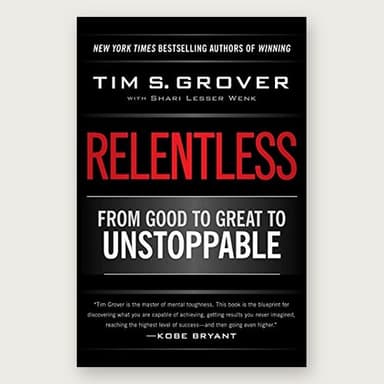
Relentless by Tim S. Grover: Summary and Notes
The full book, section by section.
Start hereThe short version
- 1Grover, trainer to Michael Jordan, Kobe Bryant and Dwyane Wade, sorts competitors into coolers, closers and cleaners: good, great and unstoppable. The opening note and the sections Don't Think and The Cleaner You Are, the Dirtier You Get set out the types and the mantra to stop thinking and trust instinct.The claim
- 2Traits 1 to 7 describe how cleaners work: they push harder when others quit, get into a quiet, unemotional Zone, know who they are, control their dark side, thrive on pressure, take over in emergencies and attack weaknesses.The mindset
- 3Traits 8 to 13 cover how they decide and lead: decisions over suggestions, addiction to results, being feared over liked, trusting very few people, refusing to recognize failure and never celebrating for long. Done. Next.The standard
The summaryA Note from Tim Grover
Grover opens with Kobe Bryant. In April 2013, four days before the book's first release, his longtime client tore his Achilles tendon. Bryant could have let his teammates carry him off the court. Instead he went to the free-throw line, made both shots and walked to the locker room. Grover calls that relentless: no time to think, plan or wait for instructions, only an instinctive drive to keep going.
He also points to Dwyane Wade's and LeBron James's championship runs, and to the response to the book's first edition: people wanted to talk about cleaners, his name for competitors who refuse to be satisfied with merely trying. He introduces the three types the book sorts people into: cooler, closer and cleaner, or good, great and unstoppable. Anyone can choose which one to be.
Grover says plainly that he will not give a 10-step process or a checklist. He offers insight into the mentality of people who trust their own instincts, and argues that no one needs Michael Jordan's skills to share his mindset. The note is signed September 2013.
"When it's time to act, you act, instinctively and without hesitation."
The methodDon't Think
At 10 p.m. a black SUV pulls up to Attack Athletics, Grover's training facility on the west side of Chicago, where Jordan, Bryant and Wade have kept lockers. In the middle of the playoffs, with less than 72 hours until his next game, a star who limped off the floor the night before has flown in secretly, 2,000 miles from his team, without telling his coach, the media or his family. The hard part, Grover writes, is never the injury. It is the noise in the player's head: everyone's opinions about whether he will be ready, until he no longer trusts himself.
Grover tells how he started. Starting out, he wrote letters to every Chicago Bulls player except Jordan, figuring Jordan would already have a trainer. No one was interested; basketball players were not yet into weight training. Then in 1989 he read that Jordan was tired of being outmuscled by the Detroit Pistons, and he talked his way into a meeting with the team doctor and head athletic trainer. Jordan gave him 30 days, and Grover stayed for 15 years. When Jordan finally retired, he joked that if he ever saw Grover in his neighborhood again, he would shoot him.
The chapter's message is the book's mantra: stop thinking, trust your instincts and make the end result all that matters. Grover warns that this is selfish and egocentric, and that the strategy is to make everyone else rise to your level. He describes how the visiting player's frustration showed in his eye-rolls and grimaces, how his teammates shut down when their leader did, and how the same thing happens in business when a boss snaps in meetings.
The method · 30 days, 15 years
"He gave me 30 days. I stayed for 15 years."
The taxonomyThe Cleaner You Are, the Dirtier You Get
Before the Miami Heat beat the Oklahoma City Thunder for the 2012 NBA championship, Grover wrote a note to Wade and put it in his pocket: in order to have what you really want, you must first be who you really are. Wade had called him after Game 2 of the finals to help him through the series on a damaged knee, although they had not worked together for two seasons. Grover argues a different player would have let LeBron carry the team and hoped for the best.
He then defines the three types. A cooler is good: he does what he is told, follows the plan and plays it safe. A closer is great: he can deliver under pressure when he is prepared and the spotlight is on, but he cares about what others think and loves the credit. A cleaner is unstoppable: he takes responsibility for everything, never counts on anyone else, cleans up the mess and moves on. Grover's cleaners include Navy SEALs, the custodian working alone at night, the parent working overtime and a bus driver who runs his route his way.
The comparisons fill the chapter. Coolers worry about the competition, closers study it, and cleaners make the competition study them. Coolers avoid the winning shot, closers take it if they have a good chance, and cleaners trust their gut and shoot. Closers feel successful when the job is done; cleaners never feel they have achieved success because there is always more to do. The rest of the book is organized around 13 traits that complete the sentence "When you're a cleaner . . ."
Chapter 2 · Cooler, closer, cleaner
"Coolers can have an amazing game. Closers can have an amazing season. Cleaners have amazing careers."
The traitsWhen You're a Cleaner . . .
Trait 1You keep pushing yourself harder when everyone else has had enough
Grover lives by the saying that those who talk don't know and those who know don't talk, which is why little has been revealed about how he trains his clients. He says no book can make anyone train like a pro; training like a pro means working at the highest intensity every moment and leaving no detail to chance.
His training is a dictatorship with three rules: show up, work hard and listen. He does the thinking and the homework so the athlete only has to do the work, and he insists that every day people do something they don't want to do. The challenge for him is taking someone already great, such as Jordan, Bryant, Wade, Hakeem Olajuwon, Charles Barkley or Scottie Pippen, and making him better. Jordan used to say he paid Grover so that he would not train anyone else.
Grover is blunt about weight. He writes that his team took 100 pounds off Eddie Curry so he could sign with the Miami Heat in 2012. A pitcher who needed to lose 40 pounds decided to do it on his own instead; Grover predicted he would be out of the game in eight months, and says he was wrong, because the pitcher was gone in four. His test of commitment is the first 48 hours: a new client who is sore and miserable after two days of work and still shows up on day three is ready.
Trait 1 · The 48-hour test
"Comfortable makes you good. We're going for unstoppable, and there's a price to pay for that."
Trait 2You get into the Zone, shut out everything else, and control the uncontrollable
A cooler gets everyone cranked up before a game, and a closer gets himself cranked up. A cleaner stays cool and calm and saves it all for game time. Grover describes the Zone as quiet, dark and alone, even in a screaming arena: no outside static, no emotion, only readiness and a quiet, icy anger under the skin.
He finds each athlete's triggers. With music, he avoids hype and looks for a song the player may not have heard in years that takes him back to a time when he felt right; when it works, he writes, the heart rate drops two or three beats a minute almost immediately, and the player smiles. Jordan stayed in the Zone from the moment he left for the arena until late at night, and changed into the public MJ in the trainer's room before facing reporters. When Gilbert Arenas lost the Zone, Grover watched him go from a killer on the court to someone who had forgotten how to step on an opponent's throat.
Emotions are the enemy of the Zone. Fear, jealousy and excitement pull focus toward something other than the job. The one exception is controlled anger, a slow-burning internal anger that is restrained and turned into energy and never becomes rage. Grover cites Jordan in Vancouver, shaking his head and then destroying the game without throwing a punch.
Trait 2 · Inside the Zone
"Controlled anger is a deadly weapon in the right hands."
The audiobook link goes to the 2020 Simon & Schuster Audio recording narrated by Pete Simonelli. These notes come from the 2013 Tantor Audio recording of the same book, narrated by Sean Pratt.
Trait 3You know exactly who you are
A cooler thinks about what he is supposed to think about, a closer thinks and analyzes before acting, and a cleaner simply knows. Grover's premise is that people are born bad and taught to be good, or born relentless and taught to relent. Babies follow their instincts and demand immediate results; then the world teaches them to doubt themselves.
Overthinking destroys natural ability. Grover describes coaches who watch so much film that they lose any feel for what is happening on the floor, and players who are perfect in practice but blow it when it counts. Before every Bulls game, Jordan would take the sheet of plays from the team meeting and go into another room, because he already knew what he needed.
- You're Already an Impact Business22 to 30
- You're Closer Than You Think14 to 21
- You Have the Foundation7 to 13
- The Starting Line0 to 6
 Printable PDF
"Grover says the cleaners, the unstoppable ones, are never satisfied. Their line is 'Done. Next.' Fair enough. So what's next in your business? Ten questions, a score on four parts of it and the part to fix first. It's free with your email. Go find out."
 Deven Davis, devendavis.com
- Ten questions about where your business is right now
- A score out of 30
- A four-part breakdown: Impact Clarity, Traction Proof, Model Strength, Founder Credibility
- The part to fix first
- Your tier's next steps
- A printable PDF
Free with your email. Your score and a printable PDF open right on the page.
Instinct comes from preparation: a player who has rehearsed a moment many times no longer has to think. Grover recalls being told his kinesiology degree would make him a gym teacher or a health club manager, and answering each time that he was going to train pro athletes. He tells readers to trust their gut and stop waiting for permission.
Trait 3 · He already knew
"Stop thinking. Stop waiting. You already know what to do."
Trait 4You have a dark side that refuses to be taught to be good
A cooler fights his dark side and loses, a closer acknowledges it but cannot control it, and a cleaner harnesses it into raw, controlled power. Grover uses Dr. Jekyll and Mr. Hyde, Superman and the Incredible Hulk to describe the alter ego that emerges when instinct is set free. He argues that the drive to show up every day and do what no one else will do comes from the dark side, and asks whether the instincts of a powerful businessman, crime boss and athlete really differ.
The rule is control. Grover asks whether people smoke or drink because they like it or because they need it, and says cleaners never perform under the influence of anything. He tells of a business owner who swore off affairs for a year to prove he controlled his dark side, though his marriage was already over. Tiger Woods is his case of a dark side exposed: a player who wore the mask so well that people were stunned by the revelation, and whose competitors stopped fearing him once his game fell apart.
Trait 4 · On a short leash
"Control your dark side. Don't let it control you."
Trait 5You're not intimidated by pressure, you thrive on it
A cooler is never in a situation where he has to be clutch, a closer is clutch under pressure, and a cleaner is always clutch. Grover rejects the clutch gene entirely. What exists, he says, is predatory instinct plus the readiness to know how and when to attack: preparation plus opportunity. Cleaners create pressure for themselves constantly instead of saving their best for big moments.
In a 2010 game, Orlando's Matt Barnes spent the night trying to antagonize Kobe, at one point faking the ball an inch from his nose; Kobe never flinched, and afterward asked reporters why he should. Grover insists everyone can handle pressure; most people choose not to because the comfort zone is easier, like staying in the shade. Pressure can burst pipes or make diamonds. He dismisses the idea that stress kills, calling stress what brings people to life, while separating productive pressure from the pointless stress people create by showing up unprepared or blowing off commitments.
Trait 5 · Pipes or diamonds
"There is no clutch gene."
Trait 6When everyone is hitting the 'In Case of Emergency' button, they're all looking for you
A cooler waits to be told the plan, a closer studies the plan, and a cleaner wants every possible option available at all times. Every October, Grover's phone fills with calls from players who partied all summer and agents and general managers who just realized their star did not do the work. By the time he gets the call, everyone else has tried and failed.
Grover traces his own ability to figure things out to his father, who dissected cadavers at a Chicago hospital and handed Grover a bone saw when he was six. His parents, from India, moved to London, where Grover was born; his mother came to Chicago alone for a year to work as a nurse. When the family arrived, his father stopped the cab miles short of their destination and they walked the rest of the way with their bags, because he did not have enough money for the fare.
Cleaners also own their mistakes. During the 2012 finals, Grover missed a detail that cost Wade a turnover, something almost nobody watching would have noticed, and he told Wade after the game that it was his fault. He argues that taking responsibility for everything you say and do builds the reputation that makes your opinions count.
Trait 6 · Break glass
"If you did it, own it. If you said it, stand by it."
Trait 7You don't compete with anyone, you find your opponent's weakness and you attack
For a cleaner there is no meaningless game. In the 2012 All-Star Game, Wade fouled Kobe, giving him a concussion and a broken nose; Kobe refused to go to the hospital until he could address Wade, then refused to miss a game. Grover writes that when two relentless people face each other, the rivalry can play out for years.
Cleaners set the standard and decide what everyone else will do. Jordan trusted Steve Kerr above Pippen, Horace Grant or Toni Kukoc to take the shot when he could not, and Kerr would not have had a second chance if he had failed the first time. Jordan told teammates at the start of each season that he would pass them the ball once, and if they did nothing with it, he would not pass it again. Grover notes that before Dennis Rodman came to the Bulls in 1995, the Spurs lost every time he decided to take a night off.
The Founder Brain Kit
Grover once told a star client that his disapproval was crushing teammates who needed to feel his support. By the next game, Grover reports, the player was meeting teammates at half court and showing that support. A leader works with people's strengths and does not put them where they will fail.
Trait 7 · One pass
"When a cleaner puts you in a position to execute, you'd better be prepared."
Trait 8You make decisions, not suggestions; you know the answer while everyone else is still asking questions
Grover names three things he will never praise: inner drive, passion and the question of whether the glass is half full or half empty. All three, he argues, mean thinking about something and doing nothing. Inner drive is thought without action; passion is a feeling until someone works at it and demands to be the best at it; and the glass is a concept invented by someone unable to decide.
Cleaners commit. He describes visiting an FBI training facility with Jordan, where an elite sharpshooter practiced alone, over and over, hitting a target 400 yards away and driving out to reset it himself. Grover contrasts people who dabble in many things and succeed at none with those who can say, "I do this." Asked what he does, Kobe says he gives out numbers, like 81 points. Grover tells players to become excellent at one thing so they are the first name called when it is needed.
Trait 8 · Add more or pour it out
"If you like what's there, add more. If you don't, pour it out and start over."
Trait 9You don't have to love the work, but you're addicted to the results
A cooler makes you wish you had paid him less, a closer decides how hard to work based on the money, and a cleaner just does the work. On draft night most players celebrate; Kobe went to the gym. Grover argues that making it to the top is different from making it at the top, and that for athletes who get rich quickly, signing day can be the beginning of the end. He tells of a player who moved teams against his advice for an extra $6 million and, by Grover's estimate, cost himself at least $20 million in a shortened career.
He rejects luck. People who say a successful rival got lucky are describing the price they were unwilling to pay. Work does not require talent, and anyone can show up, work hard and listen. He also tells clients to handle small issues first, in his phrase that you can't fight the elephants until you've wrestled the pigs.
Grover expects professionalism through pain: Jordan returned after his father's death and played at an even higher level, and Wade kept showing up through a divorce and custody battle. He has no patience for young players who drive $150,000 cars but won't spend money on summer training.
Trait 9 · The price of the easy money
"It doesn't take talent to work hard."
Trait 10You'd rather be feared than liked
A cooler keeps his opinions to himself, a closer says what he thinks behind your back, and a cleaner tells you to your face. Grover describes players freezing out a rival in an All-Star Game and warns that a true cleaner never forgets. When Tiger Woods dominated, every competitor's question was what Tiger did that day; when scandal and injury hit, his rivals stopped fearing him and their mental focus improved.
Respect, Grover argues, comes from mental edge as much as physical ability. He is under six feet and could not beat any of his athletes physically, so he makes sure to exceed them mentally, and he tells young trainers that being fit is not the same as knowing their craft. Jordan's quiet, unpredictable appearances earned him the nickname the Black Cat: there and gone before anyone knew what had happened.
When people call Grover names, he takes it as a sign they are intimidated and cannot compete any other way. Being liked leaves no impact; respect, trust and shared purpose do. The greatest compliment, he says, is being called difficult but the best at what you do, provided you really are the best.
Trait 10 · The mental edge
"Like is average."
Trait 11You trust very few people, and those you trust better never let you down
Coolers fear the truth, closers dig for it and get upset when it goes against them, and cleaners know when someone is lying and wait for the truth to come out. Grover has no tolerance for entourages and sends hangers-on away during workouts.
A cleaner tests people before trusting them, maybe for 15 minutes or 15 years, and never hands over responsibility casually. He chooses his people like tools, each for a specific job, and keeps a team intact once it works; constant turnover usually means the person at the center doesn't know what he needs. Grover warns athletes against hiring relatives or old friends for jobs they cannot handle.
"Grover says elite drive is self-owned, and it has almost nothing to do with talent or motivation. Look, owning it starts with how you see yourself. The Identity Shift is 30 days of work on that: a prompt, a reflection and an intention every day. Seven bucks, and the Quick Win Guide gets you a first result in under an hour. Do Day 1 today."
Deven Davis, devendavis.com- 30 days of guided identity reprogramming, rooted in Wattles' Impression of Increase principle
- Each day has a prompt, a reflection and an intention
- Bonus: The Quick Win Guide, your first identity shift result in under 1 hour
- Bonus: a 5-minute video from Deven on why identity precedes strategy
Seven dollars, with the No-Brainer Guarantee: if it doesn't change how you think about yourself and money within the first week, full refund.
Jordan and Phil Jackson, both cleaners, trusted each other: Jackson asked Jordan to run the triangle offense enough to look like it, and Jordan then did things his way. Grover says he and Jordan learned together, Jordan knowing basketball and Grover the human body, and that athletes now trust him because he gives a straight answer.
Trait 11 · The trusted few
"When a cooler speaks, you have doubts. When a closer speaks, you listen. But when a cleaner speaks, you believe."
Trait 12You don't recognize failure; you know there's more than one way to get what you want
After the Orlando Magic eliminated the Bulls from the 1995 playoffs, Grover sat with Jordan in the darkened United Center until 3 a.m. Jordan had come back from baseball only two months before, wearing number 45, and critics said he was done. Grover knew Jordan simply had not had time to get back to his level. Jordan told the Magic to enjoy the win because it would not happen again, switched back to number 23, and the next season led the Bulls to an NBA record 72 wins and the first of three more championships.
Grover dismisses the word try as an invitation to failure and asks people to do, and to do again in a different way if the first attempt fails. Cleaners do recognize when it is time to change direction.
He spent a summer with Robbie Hummel of Purdue, who had torn his ACL for the second time in eight months, the second time at his very first practice back. Hummel did the rehab until he passed Grover's test, a 48-inch jump down to the floor and back up, then returned to be named first team All-Big Ten and scored 26 points in his last NCAA tournament game. Tracy McGrady, facing an 18-month knee rehab, had to choose between a perfect knee at 40 or 50 and a faster, harder path; Grover says no one ever chooses the longer rehab.
Trait 12 · Failure? 72 wins
"A cleaner is done when he says he's done"
Trait 13You don't celebrate your achievements because you always want more
A cooler is first to the party and last to leave, a closer makes an appearance, and a cleaner wants to get back to work. Grover skips the parades. After a title, he and his client find each other for a minute: "You good? I'm good." Then: done, next. A cleaner who wins a series in six is disappointed it was not five; one who benches 195 wants 200.
When cleaners do celebrate, it is a brief private moment, because no one else can understand what it took, and the feeling fades as soon as it arrives. Never being satisfied means scrutinizing details others miss; Grover says he can tell whether a shot is going in from the release. He acknowledges burnout as a real risk and notes that athletes, unlike most people, cannot easily change careers or take a sabbatical, then ends where the book began, with the drive to keep going.
Trait 13 · Done. Next.
"You just have to be insatiable for the results."