Profit First by Mike Michalowicz: Summary and Notes
The full book, section by section.
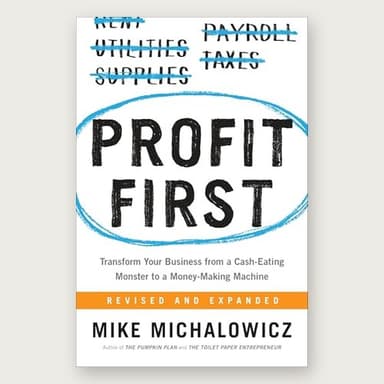
Start hereThe short version
- 1Most businesses treat profit as leftovers and stay trapped in a cycle of survival. Michalowicz flips the formula to sales minus profit equals expenses, using small plates, the primacy effect and Parkinson's Law. The Introduction and Chapters 1 and 2 make the case, starting from his own collapse.The claim
- 2The system runs on five foundational bank accounts plus two out of reach, an Instant Assessment against target percentages, and a twice-monthly 10/25 allocation rhythm with a quarterly profit distribution. Chapters 3 to 6 set it up and put it in motion.The system
- 3Chapters 7 to 9 apply it to debt, efficiency and advanced accounts. Chapter 10 brings it into personal finances, Chapter 11 names the eight mistakes that make it fall apart, and the Epilogue calls it the granny shot of accounting.The follow-through
The summaryIntroduction
Michalowicz opens with Debbie Horovich, owner of a social media agency, crying "I'm a fool!" after he ran the Instant Assessment on her business at a CreativeLive event watched by 8,000 online viewers. In a minute or two, the numbers showed her that years of hard work had produced almost nothing for her. He says conversations like this are common among entrepreneurs who are afraid to tell the truth about their financials, and that he was one of them: an award-winning young entrepreneur who covered payroll with loan after loan and whose business never once posted a profit. He would rather lose $10, he used to say, than pay the government $3.
He then shares a letter from Keith, who runs hot air balloon rides in Missouri, New Mexico and Arizona. Keith first thought Michalowicz had lost his mind, did nothing for the last few months of 2014, then reread the book and started. Keith reports that his year-to-date net profit was at one point up 1,721%, that he ended 2015 with net profit up 335.3%, and that he ran about a 22% net profit margin. Michalowicz says Profit First saved his own business and that every business he has started since has been profitable from the first day, including Profit First Professionals.
He front-loads the method because many readers quit early: open a profit account, move a small percentage of every deposit into it, and keep going. The rest of the book explains why it works and how to run it in full.
"Profit First saved my business and ensured that every new business I started would be profitable from day one."
Chapter 1Your Business Is an Out-of-Control Cash-Eating Monster
Roughly 50% of businesses fail within five years, and Michalowicz argues the survivors are often worse off, piling up debt while their owners live in constant stress. He compares entrepreneurs to Dr. Frankenstein: they bring a miracle to life from mismatched parts, then discover it has become a soul-sucking, cash-eating monster.
His own wake-up call began the day he received a check for $388,000 after building and selling his second company. He bought three cars that day, including the most expensive Land Rover on the lot, and told his wife Krista they had more money than God. He then wrote check after check to a dozen startups he had invested in as an angel. By February 14, 2008, he was down to his last $10,000. At the family's Valentine's Day dinner he admitted they were broke, and his nine-year-old daughter Adela left the table and returned with the piggy bank she had been given at birth. That same morning his accountant had called to say his 2007 tax return showed he owed $28,000, with $10,000 to his name and bills totaling three times that amount.
Michalowicz writes that he knew how to grow businesses but had never learned to keep, control or grow money. He describes the Survival Trap through his lawn guy Ernie, who keeps adding services, gutters, then roofing, then chimneys, because any sale feels like a good sale in a crisis. Reactive selling occasionally moves a business toward its vision by chance, which convinces owners they are on track while the monster keeps growing. Part of the problem is bank balance accounting: looking at one pool of money without first setting aside taxes, salary and profit.
The other part is the gap between accounting profit and cash. His accountant once congratulated him on a $15,000 profit, and Michalowicz asked where the cash was; there was none, because the profit had already been spent. He argues that profit must be baked into every transaction, every day, whether a business has $50,000 or $50 million in annual revenue.
Chapter 1 · The cash-eating monster
"Profit is not an event. Profit is a habit."
Chapter 2The Core Principles of Profit First
After that Valentine's Day, Michalowicz fell into depression and insomnia. Late one night, watching a fitness expert on PBS, he heard four principles for losing weight that he connected to money. Use small plates. Serve sequentially, starting with what matters most. Remove temptation. Enforce a rhythm of regular meals so hunger never leads to bingeing. He cites a 2012 report by Koert van Ittersum and Brian Wansink that average American plate size grew 23% between 1900 and 2012, from 9.6 inches to 11.8 inches; 50 extra calories a day can add 5 pounds a year.
Each principle rests on behavioral science. Parkinson's Law holds that demand expands to meet supply; Michalowicz compares a business to a tube of toothpaste that gets used carelessly when full and stretched creatively when nearly empty. If he gave his business a smaller plate, he reasoned, it would spend differently. The same logic already works in 401(k) plans, which Richard Thaler and Cass Sunstein describe in Nudge: once deductions start, people rarely stop, and their lifestyle adjusts to the remaining pay. The primacy effect means people place extra weight on whatever comes first, which is why profit goes first in the formula.
The traditional formula, sales minus expenses equals profit, leaves profit as the leftovers. Michalowicz flips it. Money lands in an income account, which acts as a serving tray, and is then split by percentage into four other accounts: profit, owner's compensation, taxes and operating expenses. Together these are the five foundational accounts. He describes the system as pay yourself first meets small plates meets the envelope system, built to work with natural human tendencies.
The chapter's action steps are deliberately small: trust the process, which he says roughly 30,000 companies were using at the time, open one new profit account, and transfer 1% of current money into it without touching it.
Chapter 2 · Sales minus profit equals expenses
"Sales minus profit equals expenses."
Chapter 3Setting Up Profit First for Your Business
When Michalowicz was a teenager, his mother divided each paycheck at the kitchen table into envelopes labeled food, mortgage, community, fun money, vacation and emergencies. Half went to the mortgage, 15% to vacation, 5% to fun money and 10% each to food, community and the emergency envelope. Her hours varied, yet she always had enough for food because she never borrowed from one envelope to fill another.
Profit First applies the envelopes to a business. At the primary bank, set up the five foundational accounts: income, profit, owner's comp, tax and operating expenses, with the existing main account renamed OPEX since the bills are already paid from it. All deposits go to the income account; Michalowicz estimates updating payment details takes about half an hour, maybe an hour.
Then open two "no temptation" accounts at a second bank, one for profit and one for taxes, to keep that money out of sight. When something isn't readily available, people rarely go to extraordinary lengths to consume it. Profit belongs to the owner, and tax money belongs to the government, so borrowing from either is a soft term for stealing. He tells of a reader named Peter who asked a bank manager for the most inconvenient account options available, and he notes that banks exist to serve their customers: when one bank refused to accommodate his late hours in 2005, he moved everything to Commerce Bank, which stayed open nights and weekends, and never went back.
Chapter 3 · The envelope system
"Because when something isn't available to consume, you don't consume it."
Chapter 4Assessing the Health of Your Business
Business coach Lisa Robin Young, one of his volunteer editors, implemented Profit First before the book was published and was furious within minutes of completing the Instant Assessment, because it showed how much she had been overspending on infrastructure. Michalowicz writes that many readers react the same way, and that facing the truth is the first step.
The assessment is a simple table. Start with top-line revenue for the last 12 months. Subtract materials and subcontractors, but only if they make up 25% or more of revenue; for most service businesses this cell is zero. The result is real revenue, the money the business actually has to work with. Then fill in what was actually paid to profit, owner's compensation, taxes and operating expenses, and compare each with the Target Allocation Percentages, or TAPs, for the company's real revenue range. Michalowicz says he derived the TAPs from studying fiscally elite, very healthy companies. The difference between actual and target shows the fix.
- You're Already an Impact Business22 to 30
- You're Closer Than You Think14 to 21
- You Have the Foundation7 to 13
- The Starting Line0 to 6
 Printable PDF
"Michalowicz flips the formula: Sales minus Profit equals Expenses. Fair enough. Before you flip anything, you want to know where your business stands today, right? Ten questions, a score out of 30 and your tier's next steps. It's free with your email. Go find out."
 Deven Davis, devendavis.com
- Ten questions about where your business is right now
- A score out of 30
- A four-part breakdown: Impact Clarity, Traction Proof, Model Strength, Founder Credibility
- The part to fix first
- Your tier's next steps
- A printable PDF
Free with your email. Your score and a printable PDF open right on the page.
He stresses that the assessment is only a ballpark tool. His worked example is a law firm with just $5,000 in profit for the year, which makes it essentially a break-even business. The assessment shows it should be filling the profit account with an additional $118,000, that the two owners' combined salary of $190,000 is too high by $67,000, and that operating expenses are too high by more than $140,000. Anyone who feels overwhelmed by their numbers is told they are normal; at minimum, they should set up a profit account at a separate bank and move 1% of every deposit into it.
Chapter 4 · The Instant Assessment
"This is not accounting, and you don't need to reconcile to the penny."
The audiobook link goes to the 2023 Penguin Audio recording, also read by the author. These notes come from an earlier recording of the same revised edition.
Chapter 5Allocation Percentages
A speaker at a boot camp heard that a good back-of-the-room pitch sells to 80% of an audience. She started at 25%, climbed to 50%, then 60%, then consistently 75%, and finally asked the instructor how to reach 80%. He had said 18%. Michalowicz uses the story to argue that targets shape results.
Target Allocation Percentages are where the business is heading; Current Allocation Percentages, or CAPs, are where it is today. Most businesses start with a profit CAP of 0%. The method moves the CAPs slowly toward the TAPs, from 0% to 1%, then 3% the next quarter, then 5%, because the business has to live on what is left and needs enough to keep going. Profit also builds a cash reserve: by his rule of thumb, a 5% profit allocation equals three weeks of operating cash, 12% about two months and 24% five months.
Owner's compensation is pay for the work owners do in the business, set by what they do 80% of the time and what they would pay someone else to do it. Michalowicz notes that only around 2% of a typical owner's time goes to true CEO work. Below $250,000 in annual revenue, the owner is likely the only employee. He recommends setting the owner's comp percentage at one and a quarter times the salaries needed. In his example, four equity owners each drawing $50,000 in a business with $1 million in revenue need an owner's comp TAP of at least 25%.
The tax account covers the business's taxes and the owners' personal income taxes on what the business pays them, so the company effectively pays all taxes. He writes that many entrepreneurs have an average income tax rate of 35% or so, though it varies widely, and he insists readers work out the tax TAP with an accountant. The chapter also includes his dinner with Michael Gerber, author of The E-Myth Revisited, where Michalowicz argued that moving from working in the business to working on it works like a throttle that opens gradually.
Chapter 5 · From CAPs to TAPs
"No matter what the number is, if you work toward it and believe it's a possibility, you will not only achieve it, you will blow past the reasonable numbers others have set."
Chapter 6Putting Profit First into Motion
Jorge Morales and Jose Payne, who started Specialized ECU Repair in 2007, were the first owners to implement Profit First, from two paragraphs in an earlier book. They paid for a trip to Michalowicz's meetup in New Jersey, spouses included, out of their profit account. Michalowicz contrasts them with owners who believe profit and free time are naive dreams.
Before starting, he says, talk to an accountant or bookkeeper, and if they dismiss the system, ask how many of their clients are consistently profitable; find one trained in Profit First if needed. Then set day zero: work out the historical percentages, which for most businesses means 0% profit and all owner draws counted as owner's comp. Take the money in the old primary account, subtract checks and payments that have not cleared, move the remainder to income and do the first allocation. In his example, $2,000 is split at CAPs of 1% profit, 5% owner's comp, 1% tax and 93% OPEX: $20, $100, $20 and $1,860.
From then on the business runs on the 10/25 rhythm. Twice a month, on the 10th and the 25th, allocate all new deposits and pay bills from OPEX. Michalowicz found that this rhythm made him less reactive and showed him patterns, such as 80% of his bills falling at the start of the month. At the start of each quarter, take 50% of the profit account as a distribution to the owners and leave the other 50% as a reserve. Profit is a reward for owning the business, separate from pay for working in it. Each quarter, move the CAPs toward the TAPs, conservatively by about three percentage points in total, and never take a step back.
Chapter 6 · The 10/25 rhythm
"Profit is a reward for owning the business."
The Profit + Purpose Playbook
Chapter 7Destroy Your Debt
Michalowicz's friend Pete called to cancel dinner in New York because his bank had called his line of credit and he was broke. Pete's plan was the financial version of a crash diet, which Michalowicz argues produces the same rebound. Even in deep debt, he says, keep taking profit first, because the habit is what fixes the business permanently, and a growing profit reserve eventually lets a business act as its own bank.
He recommends training the mind to enjoy saving: celebrate every choice to save, whether $10 or $10,000. To avoid treating the best recent month as normal, plan with a 12-month rolling average.
The core tool is the Debt Freeze. Print the last 12 months of the income statement, payables, card and loan statements and payments, then mark every expense P if it directly generates profit, R if it is necessary but could be replaced with something cheaper, or U if it is unnecessary. Circle recurring expenses. Cut the U items, renegotiate the R items, and target operating expenses about 10% below the OPEX TAP. If layoffs are needed, do them once and support the people let go, then reassure the team that everyone remaining is staying. Michalowicz warns never to ask staff to take a pay cut: when he did, nearly half his remaining employees started looking for other jobs. Stop automatic withdrawals except for P expenses and get new card numbers so every payment becomes deliberate.
To pay off the debt, take 95% to 99% of each profit distribution for debt and keep the rest as a small reward, and use Dave Ramsey's debt snowball from The Total Money Makeover: pay the smallest debt first to build emotional momentum. Michalowicz redefines success as the most profit from the fewest employees and the least expensive office space.
Chapter 7 · The Debt Freeze
"Well-dressed poverty is still poverty."
Chapter 8Find Money Within Your Business
At a dinner with Vistage board members, a consultant Michalowicz calls Mr. Wrong argued that profit can only come from the bottom line. Another executive, Mr. Innovator, blurted out "split the truck," and explained how he had grown a $50 million company with his own version of Profit First. His company delivered oil to bulk buyers such as Jiffy Lube by tanker and to retailers such as Walmart by shelf truck, so nearly everything was duplicated. Challenged to cut costs by at least one-third while serving the same customers, he divided a box truck in half, one side tank and one side shelves, and cut expenses nearly in half.
Michalowicz argues that more sales without efficiency make a business less profitable, so efficiency comes first; he clarifies that he means putting efficiency ahead of sales while sales continue. He challenges owners to ask how to get two times the results with half the effort. UPS drivers save 5 to 10 seconds at each stop by keeping their keys on a pinky finger, and UPS saved millions by washing trucks every other day. Wesley Rocha of LinkU Systems, who had not taken a raise in 10 years, chipped away at expenses after reading the book.
The other lever is clients. Fire bad clients who drain margins, a point from Michalowicz's book The Pumpkin Plan, and clone the best ones, since similar clients make a business efficient, enjoyable and easier to market. The Pareto Overlap applies the 80/20 rule twice: 20% of clients yield 80% of revenue, and 80% of profit comes from 20% of products or services, so the overlap shows which clients and offerings to keep and grow.
Chapter 8 · Split the truck
"Your company has more money than you realize. You just don't know where to find it."
"Michalowicz takes profit off the top of every deposit and lets the business run on the rest. That works best when you know what the business is for. The One-Page Gameplan puts purpose, opportunity, leverage and model on one page, the same four Ivystone uses to evaluate deals. A dollar, and 47 minutes on average. Go do it."
Deven Davis, devendavis.com- The P-O-L-M framework (Purpose, Opportunity, Leverage, Model) used by institutional investors to evaluate early-stage deals
- A fill-in-the-blank worksheet that produces a one-page business gameplan in one sitting
- Bonus: The 48-Hour Quick Start, the exact first 3 steps to take today
One dollar, backed by the Dollar-Back Promise, and done in 47 minutes on average.
Chapter 9Profit First Advanced Techniques
At ProfitCon, the profitability conference Michalowicz started in 2015, an attendee said the five foundational accounts did not fit his business. A team member answered with what became a rule: when in doubt, add an account. Advanced accounts include a vault for long-term reserves, a drip account for seasonal businesses, an equipment account, a pass-through or reimbursement account for money that only passes through the business, a materials account, a subcontractor or commissions account and an employee payroll account.
He shows how he lists each account with its dollar amount or percentage at each 10th and 25th allocation, with the target in parentheses, so he can run an instant assessment at any time. Owners should write a one-page document describing each account and the allocation process so a bookkeeper can follow it.
He tells readers to stop focusing on the monthly nut and instead work backward from the income they require. On hiring, he gives rules of thumb from real revenue per employee and cites Greg Crabtree, author of Simple Numbers, Straight Talk, Big Profits: real revenue should be two and a half times total labor cost in businesses with expensive labor such as tech, and four times in cheap-labor businesses. A manufacturer with $6 million in real revenue and cheap labor would cap labor at $1.5 million.
Chapter 9 · When in doubt, add an account
"This process is a system, so it needs to be documented."
Chapter 10The Profit First Life
Jorge Morales told Michalowicz that his mother, a pharmaceutical executive, once said that people who make enough money don't have to budget. Michalowicz initially rejected the idea, then understood it: Profit First imposes restrictions on the business so that when reward time comes, the owner can enjoy the distribution without guilt.
The same system applies to personal finances, starting with an income account for deposits and adding accounts for big life events such as houses, cars, weddings and college. People carrying debt should cut up their credit cards, except for one card sealed in an envelope marked emergency only and given to a trusted friend. He explains why people cling to things they cannot afford through loss aversion and the endowment effect, and suggests letting them go. For personal debt, he describes a Death to Debt party: when the quarterly profit distribution arrives, put on loud music and use 99% of it to pay down the smallest debt immediately.
He asks readers to lock in their lifestyle for five years so that rising income builds cash, and describes the Wedge, attributed to Brian Tracy: each time income rises, save half the increase. The chapter ends with Adela, now in college, who barely remembers offering her piggy bank. Michalowicz writes that recent profit distributions had already paid for her college, and asks readers to set up personal accounts, decide what they should truly live on and talk numbers with their families.
Chapter 10 · The Wedge
"When you make enough money, you don't have to budget."
Chapter 11How to Keep It from Falling Apart
The system is simple; the hard part is the discipline to run it. Michalowicz lists eight mistakes. The first and biggest is going it alone, which is why he recommends an accountability buddy or group. The second is too much, too soon: owners who start at 20% or 30% profit, pull the money back out and turn the account into a shell game. He allows one mulligan, provided the percentages are reset to something realistic. The third is growing first and taking profit later.
The fourth is cutting the wrong costs, the ones that support profit, such as employees who stay for the long haul. The fifth is plowing back profit and reinvesting, which he calls fancy terms for taking money out of the allocation accounts; his alternative is to invest thought. The sixth is raiding the tax account because the accountant's quarterly estimates look lower than the reserve. In his example, a business reserving $8,000 a quarter against $5,000 estimates is tempted to withdraw the $3,000 difference. He argues that rising taxes are a sign of a healthier business. The seventh is adding complexity, and the eighth is skipping the bank accounts and letting a bookkeeper track allocations on paper.
He closes by describing Profit First Professionals, the bookkeepers, accountants and coaches he trained to help owners run the system, comparing them to a trainer waiting at the gym.
Chapter 11 · Eight ways it falls apart
"The worst enemy of Profit First is you."
EpilogueEpilogue
Rick Barry, a 12-time NBA All-Star, made 89.3% of his free throws by shooting underhand, granny style. Michalowicz notes that the NBA average is 75%, and that Shaquille O'Neal and Wilt Chamberlain each shot below 53% and missed more than 5,000 free throws in their careers. The underhand shot has fewer moving parts and more backspin, so it is more consistent, yet almost no player uses it because it looks silly.
Michalowicz calls Profit First the granny shot of accounting: simple, unglamorous and effective. He argues that an owner does not need a windfall or a giant client to realize the vision behind the business, only the habit of taking profit first.
"Financial freedom really is just a few small plates away."