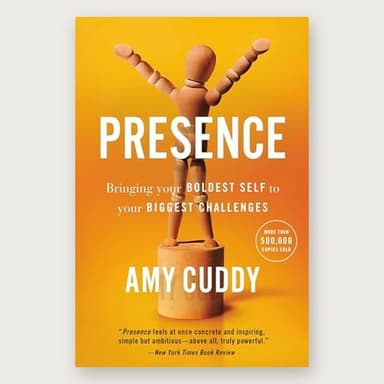
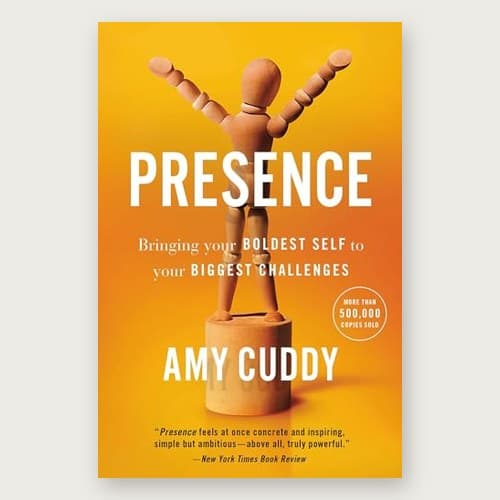
Presence by Amy Cuddy: Summary and Notes
The full book, section by section.
Start hereThe short version
- 1Presence is a momentary state of being attuned to and able to express your true thoughts, feelings, values and potential, and it shows up as synchrony between words, face, voice and posture. Chapter 1 defines it, and Chapters 2 to 4 cover owning your story, listening, and the imposter fears that block it.The claim
- 2Personal power, control over your own states and resources, makes presence possible, and powerlessness shrinks thinking and the body alike. Chapters 5 and 6 set out the research on power and on the body language of pride and shame.The mechanism
- 3Cuddy argues the body can lead the mind: Chapters 7 and 8 report facial feedback, breathing and her power posing studies, whose hormone findings later failed to replicate. Chapters 9 to 11 give the practice: pose big in private beforehand, stay open but subtle during, use small self-nudges, and fake it till you become it.The practice
The summaryIntroduction
Cuddy opens in a Boston bookstore cafe, where a server named Fatane thanks her for a TED Talk. Fatane had stood in a bathroom like Wonder Woman before taking the MCAT, and she was now applying to medical school. Cuddy writes that this kind of meeting happens far more often than she expected: strangers of every age and background tell her how they coped with a moment of pressure, then thank her for a small part in it. For most authors the book comes first and the responses follow. For her it ran the other way, and the stories people sent shaped what she wrote.
She then tells her own story. At 19, asleep in the back of a car crossing Wyoming in the middle of the night, she was thrown from the vehicle when it rolled. She suffered a traumatic brain injury, a diffuse axonal injury, and learned that her IQ had dropped 30 points, two standard deviations. She had to drop out of college, and because the injury was invisible, people told her how lucky she was. For years she tried to pass as her former self and felt like an imposter in her own body. She relearned how to learn, studied circles around others and finished college four years after her classmates, having found a subject she loved, psychology.
The emails she later received came from shelters, call centers, firefighters, Alzheimer's families, a World War II veteran, opera singers, children afraid of math and people closing the biggest deals of their lives. Cuddy presents the book as the research behind those moments, built on the idea that people can find a way out of powerlessness right when the pressure peaks.
"All have felt powerless in the face of great pressure and anxiety, and all discovered a remarkably simple way to liberate themselves from that feeling of powerlessness, at least for that moment."
Chapter 1What Is Presence?
Cuddy describes her worst moment as a fifth-year doctoral student in 2004, at a small conference where students pitch their research to senior faculty in about 90 seconds. Caught in an elevator with a senior scholar, she froze and delivered what she remembers as the worst elevator pitch imaginable. She ties the feeling to Denis Diderot, who in 1773 described thinking of the perfect retort only at the bottom of the stairs, the origin of the phrase l'esprit d'escalier, or staircase wit. The regret after an interaction where a person failed to show who they are is the opposite of presence.
A visiting student at Harvard, Lakshmi Balachandra, analyzed videos of 185 venture capital presentations. The pitches that won funding were marked less by credentials or content than by confidence, comfort, passion and enthusiasm. Cuddy argues these qualities signal how much people believe in their own ideas, and that self-assured enthusiasm predicts drive, persistence, creativity and the ability to spot good opportunities in entrepreneurs, as well as hiring outcomes in job interviews.
From conversations with successful venture capitalists, she distills four observations. Investors watch for signs that founders do not fully buy what they are selling. They are put off by people trying too hard to make a good impression instead of showing how much they care about the idea. They distrust pitches that are too high-energy and aggressive, and they do not expect founders to have every answer. And they do not mind a little nervousness, because nervousness shows the idea matters. Cuddy notes that introverts, as Susan Cain argues, often bring exactly this kind of focused passion, and that scripted impression management tends to come across as fake because it eats the bandwidth needed to respond to the real moment.
She defines presence as the state of being attuned to and able to comfortably express our true thoughts, feelings, values and potential. It is a momentary state, available in the challenges people actually face, rather than the permanent, transcendent awareness of spiritual traditions. Presence shows up as synchrony: when people are authentic, their facial expressions, posture, movement, voice and words line up. In a survey of 2,520 adults in 63 countries, 70% said liars avoid eye contact, yet Cuddy reports there is no single cue that betrays a liar. Deception, and inauthenticity in general, shows up as asynchrony between channels, which observers sense even when they cannot name it.
Chapter 1 · Presence as synchrony
"If they don't buy what they're selling, I don't buy what they're selling."
Chapter 2Believing and Owning Your Story
Cuddy asks what the authentic self is. Drawing on more than 100 years of psychology, she gives three answers: the self is multifaceted, it is expressed through thoughts, feelings, values and behaviors, and it is dynamic and flexible, responsive to the situation without being a chameleon. Presence means bringing the best of those selves to the moment, which first requires knowing what that best self is.
Organizational scholar Laura Morgan Roberts helps people build a portrait of who they are at their best by listing enablers and blockers. Cuddy reprints her questions: what three words best describe you, what is unique about you that leads to your happiest times and best performances, when did you last act in a way that felt natural and right, and what are your signature strengths.
The chapter's main tool is self-affirmation. In studies by Creswell and Sherman, participants faced the Trier Social Stress Test, a speech to stern judges followed by counting backward from 2,083 in steps of 13 while being told to go faster. Those who had first written about a core personal value showed no increase in cortisol, while the comparison group showed the usual spike. The team later replicated the effect with real midterm exams. Cuddy adds research on life narratives: people who told their stories in terms of agency, communion or redemption had better mental health trajectories than those who told stories of contamination, where good beginnings turn bad.
Chapter 2 · Affirm a value first
Finding the authentic best self is only half the work; it also has to be expressed. Employees whose onboarding asked them to bring their best selves to the job performed better and stayed longer than those in other groups. Cuddy closes with a four-hour conversation with Julianne Moore, whose director on What Maisie Knew said she enters without fear, performs without anxiety and leaves without regret. Before auditioning for Todd Haynes's Safe, Moore decided she would play the character as she heard it, and if Haynes heard something different, she was not right for the part. Moore also advises preparing answers to the questions people dread so they can focus on what is actually happening in the room.
"Preparation is obviously important, but at some point, you must stop preparing content and start preparing mindset."
Chapter 3Stop Preaching, Start Listening: How Presence Begets Presence
In the spring of 1992, more than 300 clergy crowded into a small Boston church after a surge of gang violence: 73 young people murdered in one year, a 230% increase from three years earlier. A week before, during a funeral in that same church, 14 gang members had stormed in and stabbed a young man. Reverend Jeffrey Brown, a young Baptist minister with no experience of gangs, watched the clergy talk and schedule more meetings. After praying at a vigil for a murdered teenager named Jesse and feeling strangers shake his hand, he began walking the streets at night with other ministers.
- You're Already an Impact Business22 to 30
- You're Closer Than You Think14 to 21
- You Have the Foundation7 to 13
- The Starting Line0 to 6
 Printable PDF
"Cuddy says presence means trusting and expressing your real feelings, values and abilities in the moment. Trust comes easier when you know the facts, right? Ten questions, a score on four parts of your business and the part to fix first. It's free with your email. Go find out."
 Deven Davis, devendavis.com
- Ten questions about where your business is right now
- A score out of 30
- A four-part breakdown: Impact Clarity, Traction Proof, Model Strength, Founder Credibility
- The part to fix first
- Your tier's next steps
- A printable PDF
Free with your email. Your score and a printable PDF open right on the page.
The young people on the street were wary of another hustle. Before any dialogue, they tested whether the ministers could be trusted, then whether they were strong enough to handle what was out there. Cuddy uses this order to introduce the research on warmth and competence. Most people say they would rather be seen as competent, yet observers judge warmth, or trustworthiness, first, and competence only matters once trust is established. She has watched MBA interns lose job offers by trying to prove competence over a 10-week summer while ignoring the relationships around them.
Chapter 3 · Trust before strength
Negotiator William (Bill) Ury tells of a 2003 meeting with Hugo Chavez arranged by Jimmy Carter. Ury decided to offer no advice unless asked and simply listen, and the meeting became the opening he had hoped for. Brown found the same thing on the streets: his perceptions had been shaped by the 11 o'clock news, and listening turned young people from a problem to be solved into partners. Cuddy lists what listening produces: trust, useful information, a view of others as individuals and allies, and solutions people will adopt because they helped build them.
The ministers' approach grew into the Boston Ten-Point Coalition. Cuddy reports that youth murders in Boston dropped from a peak of 72 in 1990 to an all-time low of 15 in 1999. She ends with the night a young peacemaker named James was shot. Brown, unable to find words in a crowded emergency room, led James's angry friends outside to pray and then told them to hug somebody.
"The paradox of listening is that by relinquishing power, the temporary power of speaking, asserting, knowing, we become more powerful."
Chapter 4I Don't Deserve to Be Here
As a clinical psychology doctoral student in the late 1960s, Pauline Clance was sure everyone else was smarter and that she would be found out. She had grown up in Appalachia and attended a school with only 11 grades. Later, as a therapist, she saw the same fear in high-achieving students. With Suzanne Imes she published the first academic paper on the imposter phenomenon in 1978, based on 178 high-achieving women who persisted in believing they were not bright and had fooled anyone who thought otherwise.
Later research showed the phenomenon is far from limited to women. Cuddy writes that in a 1985 survey by Clance and Gail Matthews of 41 clinical clients, around 70% had experienced imposterism, and that at least two-thirds of Harvard Business School students experience it although more than 60% of them are men. A university administrator named David described feeling like a 50 while the world told him he was a 90; every award only widened the gap. Novelist Neil Gaiman, winner of both the Newbery and Carnegie Medals for The Graveyard Book, told Cuddy he long had a fantasy of a man with a clipboard knocking on his door to say he had been found out.
Chapter 4 · The imposter's gap
Cuddy argues that achievement does not cure imposter fears and can make them worse, since each success brings a new proving ground and higher expectations. A physicist named Elena, a Latina from the South Bronx, earned her PhD after a professor told her she did not belong, yet still felt like a fraud teaching an honors class. Cuddy describes her own years at Princeton, including a 20-minute first-year talk she nearly quit school to avoid. She kept accepting every talk she could, until a student at Harvard who had barely spoken all semester came to her office and said, through tears, that she was not supposed to be here, the same words that had run through Cuddy's own head.
The imposter phenomenon makes people self-focused, which blocks presence. Gaiman's turning point came after finishing American Gods, when his friend Gene Wolfe told him a writer never learns how to write a novel, only the novel he is on. Cuddy concludes that most people will never fully shed the fear but can work through it one challenge at a time.
"You never figure out how to write a novel. You just learn how to write the novel that you're on."
Chapter 5How Powerlessness Shackles the Self (and How Power Sets It Free)
Cassidy, a former national and collegiate track and field champion for 15 years, wrote that after retiring she lost her identity, felt defeated in new careers and sat hunched at her desk, avoiding every risk. Cuddy hears versions of this story daily: a change brings a felt loss of power, then insecurity, anxiety and physical signs of powerlessness.
She separates two kinds of power. Social power is power over others, control of their resources and behavior. Personal power is power to: control over one's own states and behaviors, access to one's own resources. A senior executive who wrote to her had social power without personal power, and it was not enviable. Joe Magee, a New York University professor and expert on power, describes personal power as the confidence to act on one's own beliefs and values with a sense that those actions will be effective, meaning a person leaves each interaction having accurately represented who they are.
Powerlessness damages thinking. Anxiety arises when a demanding moment feels like a threat and the resources to meet it feel out of reach, and it impairs executive functions such as reasoning, flexibility, attention control and working memory. It also feeds self-focus: Cuddy cites a review of more than 200 studies linking self-focus with anxiety and depression. A major league player described staring at his batting average on the jumbotron; Cuddy's point is that people think about us far less than we imagine.
Feeling powerful, by contrast, shows up across studies. In an experiment led by Dana Carney, people assigned high-power roles kept their hands in ice water nearly 45 seconds longer than low-power participants. Primed to feel powerful, 69% of subjects turned off or redirected an annoying fan, against 42% of those primed to feel powerless, and powerful subjects were four times as likely to choose to go first in a debate. Cuddy describes the hormone profile of power, higher testosterone and lower cortisol, and a 2012 study with Jennifer Lerner, Gary Sherman and other Harvard researchers in which real leaders showed lower cortisol and anxiety than non-leaders. She argues this profile goes with responsible power, and that personal power makes people less threatened, more open and more able to be present.
Chapter 5 · Power moves you to act
"The reality is that people just aren't thinking about you as much as you think they are, even when you actually are the center of attention."
The Founder Brain Kit
Chapter 6Slouching, Steepling, and the Language of the Body
The chapter opens with the haka the All Blacks perform before rugby matches, a ritual Cuddy describes as the fiercest display of power in New Zealand sport. She then turns to the animal kingdom. Primatologist Frans de Waal sometimes mutes political debates to watch the bodies. Dominant chimpanzees puff their chests and walk upright, gorillas beat their chests, peacocks spread their tails and king cobras rear up. Powerful animals expand; powerless ones make themselves small.
Humans do the same. Jessica Tracy's research found that athletes who win make the same pride display, arms raised in a V, chest out, chin up, across cultures, and that even congenitally blind athletes who had never seen it did the same thing when they won. Losers slump. Observers read pride displays as status and competence. Cuddy describes how people cover their faces when their team makes a mistake, a contractive gesture others read as powerless and distressed.
Chapter 6 · Expand or contract
Cuddy reports that men generally show more expansive, dominant nonverbal behavior and women more contractive behavior. In a study using photos of a wooden artist's mannequin in high-power and low-power poses, children were asked which doll was the boy and which the girl across 16 pairs; Cuddy reports that 73% of 4-year-olds and 85% of 6-year-olds showed a male power bias, and that 44% of the 6-year-olds saw every powerful doll as male. In eye-tracking studies, viewers averted their gaze from people displaying dominant postures, much as primates do.
Overt dominance often backfires in real interactions, and Cuddy argues that the most effective body language combines strength with warmth. She returns to the haka and the players' own words: they describe it as a way to connect with the man beside them and draw strength from their heritage. That raises the question the rest of the book pursues, whether body language also speaks to the self.
"When we are feeling powerless in virtually every way that we can, we make ourselves smaller."
Chapter 7Surfing, Smiling, and Singing Ourselves to Happiness
Journalist Eve Fairbanks wrote that learning to surf taught her how to live on dry land. As a beginner she fixated on skill and fell constantly; what she needed was to decide to stand up and stay upright. Cuddy uses the story to introduce the body-mind connection, which she argues people overlook because they assume the mind always leads.
William James proposed that emotions follow bodily responses. In 1974, James Laird tested facial feedback by disguising his study as research on facial muscles: subjects whose faces were arranged into frowns felt angrier, and those arranged into smiles felt happier. A later review co-written by Laird concluded that across hundreds of experiments, inducing an expression produces the matching feeling, and preventing an expression reduces it. She describes how the same logic has been applied to depression with Botox, which blocks frowning; a 2009 study compared the depression scores of women who had Botox forehead injections with those who had other cosmetic treatments.
The body below the neck also feeds back into the mind. Cuddy quotes Colum McCann's 2013 novel Transatlantic on Frederick Douglass trying a new walk that was conducive to the idea of himself. She discusses research on yoga for post-traumatic stress, including Emma Seppala's breathing-based program for veterans, which reduced startle responses and anxiety, and Bessel van der Kolk's work. Van der Kolk notes that some 80% of the fibers of the vagus nerve run from the body to the brain, which is why breathing, chanting and movement can train the arousal system. Cuddy guides a short exercise: inhale for two seconds and draw the exhale out for around five, which activates the calming parasympathetic system.
Chapter 7 · The body talks to the brain
"Feelings are the consequences of emotional behavior and bodily response."
Chapter 8The Body Shapes the Mind (So Starfish Up!)
Cuddy remembers trying to coax pill bugs to uncurl in her palm as a child in a tiny town in eastern Washington. Years later, teaching at Harvard Business School, she noticed that the students who participated least sat hunched and small. At a meeting with a former FBI interrogator, she asked whether anyone had tested if adopting dominant body language could make a person feel more powerful. He told her she was going to do it.
With Dana Carney and Andy Yap she ran the first power posing studies, trimming the poses to two held for a total of two minutes. Cuddy reports that high-power posers showed a 19% increase in testosterone and a 25% decrease in cortisol, while low-power posers showed a 10% decrease in testosterone and a 17% increase in cortisol. On a gamble, 86% of high-power posers took the risk, against 60% of low-power posers. In a follow-up mock job interview for a dream job, she writes that subjects who prepared with high-power poses performed significantly better and were more likely to be hired.
She surveys further studies she presents as support. Li Huang found that posture affected unconscious feelings of power more than an assigned role did. In a walking study by Michalak and colleagues, a happy, upright gait made it easier for people to recall positive words; Pablo Briñol found upright sitters believed their positive self-descriptions more. Expansive poses raised pain thresholds. In a study with Maarten Bos, Cuddy compared people working on devices from an iPod Touch to an iMac and concluded that the smaller the device, the more people contract their bodies to use it, and the more powerless they feel. In an imagination study of around 200 online subjects, 70% of those who imagined high-power poses described feeling comfortably confident, and 72% of those imagining low-power poses described feeling socially threatened. In a virtual reality study, people given superhero flight were more likely to help pick up spilled pens.
"Cuddy says presence is trainable through mindset, including self-affirmation, and it isn't reserved for extroverts. Self-affirmation takes reps. The Identity Shift is 30 days of them: a prompt, a reflection and an intention every day, built on Wattles. Seven bucks, and the first shift shows up in Week 1. Start today."
Deven Davis, devendavis.com- 30 days of guided identity reprogramming, rooted in Wattles' Impression of Increase principle
- Each day has a prompt, a reflection and an intention
- Bonus: The Quick Win Guide, your first identity shift result in under 1 hour
- Bonus: a 5-minute video from Deven on why identity precedes strategy
Seven dollars, with the No-Brainer Guarantee: if it doesn't change how you think about yourself and money within the first week, full refund.
A note on the evidence. The notes file this summary is built from flags that the hormone findings above have not held up: a preregistered replication by Ranehill and colleagues in 2015 failed to reproduce them, and in 2016 Dana Carney, the original study's first author, publicly said she does not believe power pose effects are real. The book was published before that disavowal and was never revised. The chapter is reported here as Cuddy's account of her own research, which remains disputed.
Chapter 8 · A disputed finding
"The way you carry yourself is a source of personal power, the kind of power that is the key to presence."
Chapter 9How to Pose for Presence
The shortest chapter is the practical protocol. Cuddy lists the moments people have used it for: job interviews, negotiations, auditions, athletic events, difficult conversations, speaking a foreign language, asking for help and giving or receiving critical feedback. She asks readers to notice which situations and people make them shrink, so they know when to prepare.
Prepare with big poses. Before a challenge, take up as much space as possible in private: first thing in the morning, at home or in the office, in an elevator, a bathroom stall or a stairwell. Stand or walk in waiting rooms instead of hunching over a phone. When posing physically is impossible, imagine the pose. If sitting is the only option, wrap the arms around the back of the chair to open the chest, and arrive early to get comfortable in the room.
Present with good posture. Cuddy writes that high-power poses in the middle of an actual interaction are likely to backfire by violating norms and making others shrink. During the event she recommends subtler moves: sit or stand up straight, shoulders back, breathe slowly, keep the chin level and the feet grounded, move with purpose without pacing, use props such as a table edge or a glass of water, use open gestures with palms up, and avoid "penguin arms." She adds the idea of taking up temporal space: pause, slow down and let the voice settle.
Mind your posture throughout the day. Set hourly phone reminders, put sticky notes on doors, ask friends to point out slouching, place the mouse far enough away to force expansion, hang pictures high, stretch before and after sleep, use a headset on calls, take walking meetings and wear layers instead of swaddling up against office cold.
Chapter 9 · Before, during, all day
"Don't just take up physical space, take up temporal space."
Chapter 10Self-Nudging: How Tiny Tweaks Lead to Big Changes
Cuddy used to respond to every rejected paper by revising it instantly from a place of anxiety, until her friend Holly reminded her that nothing had to be done that day, and she came to see slowing down as a power move. She quotes Anne Lamott calling perfectionism the voice of the oppressor.
The chapter applies nudge research to the self. Older energy campaigns asked households for big changes, such as spending $1,000 on new appliances, and few complied. Starting in 2006, Opower instead showed people how their usage compared with their neighbors', using smiley faces. Cuddy reports energy reductions of between 1.5% and 3.5% in 75% of households contacted. Nudges are small, low-cost changes to the environment in which people decide; self-nudging makes a person both the architect and the building. In one study she describes, adolescents taught that personality can change showed no rise in signs of depression, while a control group showed around a 39% increase.
Chapter 10 · Self-nudging
Big goals such as New Year's resolutions fail because they are too ambitious, too distant and focused on outcomes; Carol Dweck's work shows that attention to process keeps people going. Small nudges reinforce themselves: behavior shapes attitudes, and each act of courage makes the next easier. Her colleague Alison Wood Brooks found that people who said "I am excited" before singing, speaking or doing math outperformed those who tried to calm down, because excitement primes an opportunity mindset. Posture, she argues, is the ultimate tiny tweak.
"Slowing down is just another kind of expansion."
Chapter 11Fake It Till You Become It
The final chapter is built from the thousands of stories readers and viewers sent Cuddy. She says the part of her TED Talk with the biggest impact was her confession that she spent much of her life believing she did not deserve to be where she was, because it made people feel less alone. The stories are offered as examples of people faking it until they became it.
A student named Renee began raising her hand in class and speaking at conferences. A father named Noah taught his daughters, ages 8 and 10, to power pose; his daughter Sophie, petrified of a 30-minute Friday class presentation, posed in the 10 minutes beforehand and gave a talk she called awesome. Kenyon College swimming coach Jess Book had his team stand in the X-pose before meets, and swimmer Sarah Lloyd wrote that the team connected in a way it had not the season before. A high school volleyball team that lost its first regional playoff game came onto the court in a power pose and won the next three games.
Annika, terrified of meeting an ex-boyfriend she had not seen in a year and a half, straightened up and led the conversation for the first time. A clinical psychologist in South Africa reports that patients cannot hold a negative belief while standing in a power position, and a disability instructor in Australia says the poses helped most of his clients gain the confidence to find full-time work. A horse trainer named Kathy used expansive postures with her horse Vafi, dismissed as a family horse, and entered him in the most advanced class, against the number one ranked horse and rider team in the world.
The book ends with Kristen, who moved to South America after a divorce and lived in an open-air house she called the treehouse. After practicing power poses, she stood up to the boss who had been mistreating her and found that he seemed smaller than he had been in her mind. She later met Cuddy in person to tell her the story. Cuddy writes that she had hoped people would use the research exactly that way: to find personal power when they have very little social power and to change the course of their lives.
Chapter 11 · Fake it till you become it
"But the absolute truth is that I didn't change anyone's lives. They changed their own lives."