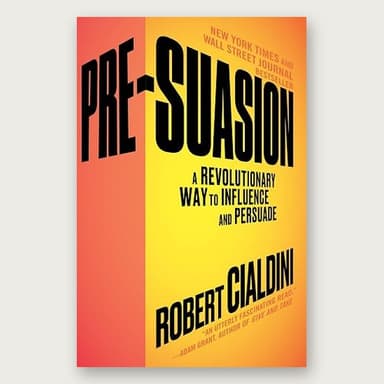
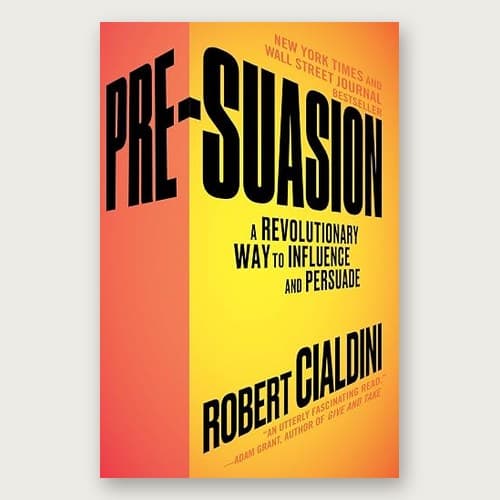
Pre-Suasion by Robert Cialdini: Summary and Notes
The full book, section by section.
Start hereThe short version
- 1What a communicator presents first changes how the audience experiences what comes next. Part 1, Chapters 1 to 6, shows how channeled attention makes an idea seem important and causal, and which stimuli command attention: the sexual, the threatening, the different, the self-relevant, the unfinished and the mysterious.Attention
- 2Part 2, Chapters 7 to 9, explains the mechanism: what people attend to triggers associations, through words, metaphors, images and places, and those associations steer what they do next. If-when-then plans let people pre-suade themselves.Association
- 3Part 3, Chapters 10 to 14, applies it to the six principles of influence, adds a seventh, unity, built by being together and acting together, makes the economic case for ethical use, and shows how to make change last.Best practices
The summaryAuthor's Note
Cialdini begins with the rise in status of behavioral science. When his earlier book, Influence, first appeared in 1984, it had little impact; behavioral science has since become popular and respected, helped by the rise of behavioral economics. He notes, with some humor, the condescension academics feel toward a popularizer. This book, he says, asks a different question from Influence: what savvy communicators do before delivering a message, in the last instant before it is sent, to get it accepted.
"It identifies what savvy communicators do before delivering a message to get it accepted."
Part 1Pre-Suasion: The Frontloading of Attention
Part One argues that what a communicator puts first changes how the audience experiences what comes next, chiefly by directing attention.
Chapter 1Pre-Suasion: An Introduction
Cialdini studied top performers in many professions during a period of nearly three years, working his way into training programs to learn what the best did differently. One consultant he met had trouble with clients who balked at his price. He solved it by accident: after his standard presentation and just before stating his $75,000 fee, he joked that he would not be able to charge a million dollars for this. The client looked up from the proposal and said he could agree to that, and the meeting ended with a signed contract and no further mention of price. In another study, shoppers were more likely to buy a French wine when French music was playing.
Jim, the top salesperson at a company selling expensive home fire alarm systems, had a habit Cialdini noticed during in-home visits. Once a couple had started a short knowledge test about fire safety, he would slap his forehead, say he had forgotten important information in his car, and ask whether he could let himself out and back into their home, which often meant being given a door key. People let only someone they trust come and go from their home, so Jim was associated with trust before he made his pitch. Cialdini concludes that the best performers spend more time arranging what happens before the request than on the request itself, and he outlines the book: privileged moments, attention, association, the six principles of influence plus a new seventh, ethics, and aftereffects.
Chapter 1 · The million-dollar opener
"The best persuaders become the best through pre-suasion, the process of arranging for recipients to be receptive to a message before they encounter it."
Chapter 2Privileged Moments
Cialdini confesses that he once read palms and was very accurate. When he said a man was flexible, the man agreed; when he said the man was stubborn, the man agreed with that too. The trick was in the question. Asking a person whether he has a trait sends him looking for evidence that he does, and he usually finds it. People asked if they were unhappy with something were 375% more likely to say they were unhappy than people asked if they were happy.
The communication scientists Bolkan and Andersen showed how to use this. When they approached people asking for help with a survey, only 29% agreed. When they first asked, do you consider yourself a helpful person, nearly everyone said yes, and then 77.3% volunteered. In a companion study, only 33% gave their contact information to try a new product, but among people first asked if they considered themselves adventurous, 97%, 70 out of 72, said yes, and 75.6% went on to provide it, even an email address in an age of warnings about spam and identity theft.
Cialdini calls the window that opens after such a question a privileged moment, a period when a person is especially receptive to a matching request. Attention is selective: focusing on one thing means turning away from others.
Chapter 2 · The privileged moment
"Not hocus, not pocus, but focus."
Chapter 3The Importance of Attention . . . Is Importance
When attention is drawn to something, people judge it more important. The psychologist Daniel Kahneman summarized what he called the focusing illusion in the title of a short essay: nothing in life is as important as you think it is while you are thinking about it. Media coverage works this way. After a pipe bomb exploded in Dusseldorf in the summer of 2000, the share of Germans rating right-wing extremism as the country's most important issue spiked from near zero to 35 percent, then sank back as the coverage disappeared.
Naomi Mandel and Eric Johnson showed the same effect online in an article published in 2002. Visitors to a furniture site whose landing page had fluffy clouds on its background wallpaper rated comfort as more important and preferred a comfortable sofa; visitors who saw pennies rated price as more important and preferred an inexpensive one. Most denied that the wallpaper had affected them. A survey can lift ratings of a strong brand, such as Canon cameras, simply by asking people to consider its qualities without asking about rivals. Cialdini adds that this works only when the idea has merit.
He also describes the US military's choice to embed reporters with combat units. One study found embedded reporters included human interest elements in over a third of their stories, against 1% for unembedded reporters, and their focus on soldiers set the media agenda for the conflict.
Chapter 3 · The focusing illusion
"Nothing in life is as important as you think it is while you are thinking about it."
Chapter 4What's Focal Is Causal
When people see themselves giving special attention to something, they also tend to see it as a cause. In one experiment, a man asked to cut into a line and offered a payment; half of everyone offered $1 let him in, even though few took the money. Almost no one took the money; Cialdini reads the result as a response to the need the offer made salient, since the more someone needs our help, the more obligated we feel to provide it. The psychologist Shelley Taylor had observers watch conversations from different angles; whoever's face was more visible was judged to have been more influential in the discussion.
The effect can be absurd. After the Tylenol poisonings in the Chicago area in the autumn of 1982, warnings publicized lot numbers 2880 and 1910. Residents of lottery states began playing those two numbers at unprecedented rates, and Rhode Island, New Hampshire and Pennsylvania halted wagers on them. The effect can also be tragic. In 1973, 18-year-old Peter Reilly came home to find his mother dying and, after hours of interrogation, confessed to her murder. He no longer believed his confession the next morning. Twenty years later he sat on a panel about wrongful confessions beside the playwright Arthur Miller, one of his key supporters. Cialdini connects Taylor's camera-angle findings to the videotaped interrogations used to help decide guilt, and reports that the focal-is-causal pattern appeared whether the watchers were ordinary citizens, law enforcement personnel or criminal court judges.
Chapter 4 · What's focal is causal
"Whomever's face was more visible was judged to be more causal."
Chapter 5Commanders of Attention 1: The Attractors
Some stimuli pull attention automatically. Cialdini names three. The sexual commandeers attention, though it sells only products bought for sexual purposes, such as cosmetics, perfume and form-fitting clothing. The threatening works too; after September 11, 2001, many thousands of Americans drove instead of flying, and about 1,600 more lost their lives in auto accidents as a result. Fear appeals work best when they include clear steps people can take to reduce the threat, otherwise people deny it, like the smoker whose grandfather lived to 80.
- You're Already an Impact Business22 to 30
- You're Closer Than You Think14 to 21
- You Have the Foundation7 to 13
- The Starting Line0 to 6
 Printable PDF
"Cialdini says the best persuaders win in the moment before the message. Here's your moment before: know where your business stands before you ask anybody for anything. Ten questions, a score on four parts of it and the part to fix first. It's free with your email. Go find out."
 Deven Davis, devendavis.com
- Ten questions about where your business is right now
- A score out of 30
- A four-part breakdown: Impact Clarity, Traction Proof, Model Strength, Founder Credibility
- The part to fix first
- Your tier's next steps
- A printable PDF
Free with your email. Your score and a printable PDF open right on the page.
The audience's state matters. In one study, ads that stressed popularity worked better on people watching a scary film, and ads that stressed distinctiveness worked better on people in a romantic mood. Cialdini suggests advertisers choose placements accordingly, for example running Ford F-150 ads that trumpet popularity during crime dramas and scary movies. The different is the third attractor. Change grabs attention, which is why Pavlov's dogs failed to salivate when a visitor entered the lab, and why the frequent cuts in modern TV ads pull eyes but scatter the message. In a study of sofas, a comfortable model called the Dream lost to the durable Titan when the two were compared alone, then won 77% of choices once three more models with durable cushions were added, which made the Dream stand out.
Chapter 5 · The attractors
"There's no secret that prominent sexual stimuli can commandeer human attention from other, sometimes all other matters."
Chapter 6Commanders of Attention 2: The Magnetizers
Some information also holds attention once it has it. The self-relevant is first: people attend to information about themselves, so health messages work better when they replace people and they with you. Self-focus also explains the next-in-line effect: people barely process what is said just before or just after their own turn to speak, so a plan aimed at the most influential person in a meeting should not be delivered from the seat beside him.
The unfinished is second. In a beer garden in mid-1920s Germany, Kurt Lewin and his student Bluma Zeigarnik noticed that a waiter remembered every order of a large table perfectly while serving it. Once he had finished serving, they covered their plates and asked him to recall the orders, and he could not come close. Over 600 studies since have confirmed that people remember and are drawn to unfinished tasks. A colleague taught Cialdini a writing strategy based on it: never finish a writing session at the end of a paragraph or even a thought, so the unfinished work pulls you back.
The mysterious is third. Cialdini found students paid more attention when he opened a class with a mystery, and he applies the idea to a lesson on tobacco. After the 1964 Surgeon General's report, the tobacco industry supported a law banning its ads from the airwaves, absent in the United States since 1971, while the broadcast industry sued to overturn it. They shifted marketing to print ads, sponsorships and movie placements, one company paying for placements in 22 films in a four-year period. The mystery's solution: under the Fairness Doctrine, every tobacco ad on the air had to be matched by equal time for a counter-ad, and during the three years that they ran, those anti-tobacco spots slashed tobacco consumption in the United States by nearly 10%. Taking tobacco ads off the air took the counter-ads with them. Cialdini's lesson is that counter-arguments are often more powerful than arguments.
Chapter 6 · The pull of the unfinished
"Whereas descriptions require notice and questions require answers, mysteries require explanations."
Part 2Processes: The Role of Association
Part Two explains why channeled attention changes behavior: what people attend to triggers associations, and those associations steer what they do next.
Chapter 7The Primacy of Associations: I Link, Therefore I Think
Every idea sits in a network of linked ideas, and Cialdini argues the main function of language is to influence by sending listeners to sectors of reality preloaded with favorable associations. SSM Health, a not-for-profit hospital system, asked him to speak at its leadership conference. Its chairperson, Steve Barney, told him not to use bullet points or to tell them how to attack their problems, because the organization had removed violent language from its vocabulary. Cialdini cites a study where people who unscrambled 30 sets of words with hostile content later delivered more painful shocks to a fellow subject.
Metaphor works the same way. Readers told that crime was a wild beast rampaging through a city favored catching and caging criminals; readers told it was a virus favored fixing the conditions behind it. The size of the difference due to the change of a single word, 22%, was more than double the effect of the reader's gender, 9%, or political party, 8%. Cialdini covers the warmth of the word together, the pull of images of achievement on a team's performance, and fluency: companies with easier-to-pronounce names, in one analysis of 89 companies that began trading on the New York Stock Exchange between 1990 and 2004, outperformed those with difficult names.
Chapter 7 · One word, one metaphor
"In the family of ideas, there are no orphans."
Chapter 8Persuasive Geographies: All the Right Places, All the Right Traces
Physical and psychological environments carry cues. Cialdini found he wrote better for general readers once he worked in a place that reminded him of them, and he describes a consulting team that downloads photos of the employees a program is meant for and puts them on the wall before working sessions. He describes how focusing on a symptom produces it, as in the disorder that afflicts 70% to 80% of medical students, who become convinced they have whatever disease they are studying.
The Founder Brain Kit
The same mechanism can improve wellbeing. Laura Carstensen's research shows that older people, sensing the time left in their lives, choose to focus on the positive. Sonja Lyubomirsky, who came to the United States as a child in a family of Russian immigrants, describes practices for making yourself happier, much as you can make yourself lose weight. Cialdini tells of a student who scored in the top 1% on all three sections of the graduate record exam by reviewing only material he had mastered before the test, and of Asian American women who scored better in math when asked first to record their ethnicity and worse when asked to record their gender.
Chapter 8 · Persuasive geography
"Who we are is where we are."
Chapter 9The Mechanics of Pre-Suasion: Causes, Constraints, and Correctives
The basic idea of pre-suasion, Cialdini writes, is that guiding preliminary attention strategically moves recipients toward agreement with a message they have not yet seen. Concepts brought to mind gain a standing in consciousness that colors perception and motivation. The effect is strongest when the primed concept is closely linked to the later action. In his research team's littering studies, a focus on the social norm against littering reduced it most when the reminder was closely related to that norm.
People can pre-suade themselves with if-when-then plans, which link a cue to an action. When epilepsy sufferers formed a plan such as, when it is 8 in the morning and I finish brushing my teeth, then I will take my prescribed pill dose, adherence rose from 55% to 79%. Merely stating an intention works far less well. Cialdini also notes the limits: careful thought can correct a pre-suasive nudge, but people rarely have the time, energy or motivation to think carefully. In one study, the majority, 67%, favored a camera with fewer but more significant advantages only when observers had unlimited time to weigh the features.
Chapter 9 · If-when-then
"The cavalry of deep analysis will rarely arrive to reverse the outcome because it will rarely be summoned."
Part 3Best Practices: The Optimization of Pre-Suasion
Part Three applies the ideas to the principles of influence, adds a seventh principle, and addresses ethics and lasting change.
Chapter 10Six Main Roads to Change: Broad Boulevards as Smart Shortcuts
Cialdini reviews the six principles from Influence as shortcuts people use to decide. Reciprocity: Dutch residents asked to take part in a long survey agreed far more often when payment was sent before they decided, and when hotel guests were asked to reuse towels, a donation the hotel had already made was 47 percent more effective than one promised afterward. Visitors to a store who received a keychain spent 12 percent more, and those given a cup of yogurt spent 24 percent more. Liking: people favor those who are similar to them and who compliment them; hair salon stylists who told customers any hairstyle would look good on them saw their tips rise by 37%.
Social proof: in his team's energy study, a message saying most fellow community residents try to conserve energy at home generated 3.5 times as much energy savings as any of the other messages. Authority: a credible authority has expertise and trustworthiness, and admitting a weakness first builds trust. Scarcity: he describes a woman 25th in an overnight line who traded her $2,800 Louis Vuitton shoulder bag for the spot of the woman 23rd in line. Consistency: people want to act in line with what they have said and done. For each principle he describes what to establish before the request.
Chapter 10 · Six roads to change
"A credible authority possesses the combination of two highly persuasive qualities, expertise and trustworthiness."
Chapter 11Unity 1: Being Together
Cialdini names a seventh principle of influence, unity: shared identity, the sense of we. It goes beyond similarity, and it comes from two sources, being together and acting together. The first source is kinship. People treat those they see as family as extensions of themselves, and reminders of the family-like nature of national ties made some Spaniards more willing to fight and die for Spain. Warren Buffett, who with Charlie Munger has led Berkshire Hathaway since taking over in 1965, wrote his 50th anniversary letter to shareholders in a family frame, offering advice he would give to his own family. No commentator remarked on the frame.
"Cialdini says whatever sits in the spotlight at the moment of decision gets treated as more important. Your deck decides what's in that spotlight. The Pitch Kit gives you 5 Sequoia-style templates for an investor, a partner or a big client, in Canva and Google Slides. Seven bucks. Have a first draft in 60 minutes."
Deven Davis, devendavis.com- 5 Sequoia-style deck templates in Canva and Google Slides
- Covers the essential pitch deck, the one-pager and early-stage variations
- Bonus: The Deck Doctor, Deven's 5-minute video on the 3 slides people skip to first
- Bonus: The Quick Win Guide, to have your first draft in 60 minutes
Seven dollars, with the No-Brainer Guarantee: if the templates don't save you at least 10 hours of work, full refund.
The second source is place. Chiune Sugihara, Japan's consul general in Lithuania, helped thousands of European Jews flee, and Cialdini suggests that exposure to diverse individuals in his home gave him an expanded sense of family. After the 1941 attack on Pearl Harbor, the Jewish refugees in Japan sent two rabbis to a tribunal of the Japanese high command. Asked why the Japanese should not side with their Nazi allies, Rabbi Shimon Kalish answered with a statement Cialdini calls the most persuasive he has encountered in over thirty years of study. The officers granted the community their protection.
Chapter 11 · Unity: being together
"we are Asian, like you."
Chapter 12Unity 2: Acting Together
Acting in synchrony creates unity. People who tapped in time with a partner later felt more alike and helped more; music, collective dance and marching have bound groups since prehistoric times. When four-year-olds walked and sang together in time with music, they were later over three times more likely to help their partner. Cialdini notes how song works on romance, and cites the 36 questions, a procedure of escalating personal self-disclosure that produced feelings of emotional closeness in 45 minutes between strangers in a laboratory.
Co-creation unifies too. The conservationist Aldo Leopold, who believed in leaving nature in its natural state, found himself cutting down a red birch so one of his white pines could get more light, and wondered why; Cialdini suspects co-creation with nature had bound him to the pine. He also describes a study he helped conduct on how managers' personal involvement in creating a work product affects how they rate it. Asking customers for advice draws them into partnership with a company; asking for their opinions or expectations does not. After working together, even three-year-olds share equally most of the time.
Chapter 12 · Unity: acting together
"Romance isn't at issue the vast majority of the time when we speak or think or write, but it is when we sing."
Chapter 13Ethical Use: A Pre-Pre-Suasive Consideration
Before deciding what to present first, a communicator must decide whether to use such tactics at all. Cialdini argues for ethics on economic grounds. Survey data show 80% of Americans say a company's ethics affect their purchases, and after Volkswagen's diesel emissions trickery became known in 2015, its sales dropped to one-sixteenth of the industry average. He describes what he calls the triple tumor structure of organizational dishonesty: harmful costs that grow inside an organization that approves or encourages dishonesty and slip undiagnosed under the radar of most business systems.
Occupational stress in the United States, he reports, leads annually to about 120,000 deaths and $200 billion in extra health care costs. In his team's study, business students on some teams learned their team had gotten only 67% of the answers correct and that their leader intended to report 80%. For an average mid-size firm of 1,000 employees, losing just 10% of workers who average $40,000 in salary and benefits would cost $4 million every year in turnover. And participants who, given the chance, opted to remain in a dishonest environment cheated 77% more than the average of everyone else.
Chapter 13 · The cost of dishonesty
"Those who cheat for you will cheat against you."
Chapter 14Post-Suasion: Aftereffects
The last chapter asks how to make pre-suasive change last. One way is to make the cue a lasting part of the environment, and the other is to secure commitments that affect a person's identity. In 2008, before the election between Barack Obama and John McCain, people who saw a small American flag on an online survey became more favorable to McCain's Republican Party, voted for him at a significantly greater rate, and still held more conservative views eight months later.
Commitments last longest when they are active, public, effortful and freely chosen. Cialdini describes a wealth seminar he attended with about 50 others, who met at a Phoenix restaurant and were bused two hours to Tucson. On the bus came wealth slogans, a waved $11,000 commission check and testimonials. Halfway there he saw a matching bus carrying people from Tucson to Phoenix and realized the long ride was itself the pitch for what he had suspected was a pyramid scheme. He closes with doctors and hand hygiene: a sign reminding doctors to protect themselves had no effect, but a sign reminding them to protect their patients increased soap and gel use by 45%, because it matched the reason most doctors entered medicine.
Chapter 14 · A commitment that fits identity
"The most effective commitments reach into the future by incorporating behaviors that affect one's personal identity."