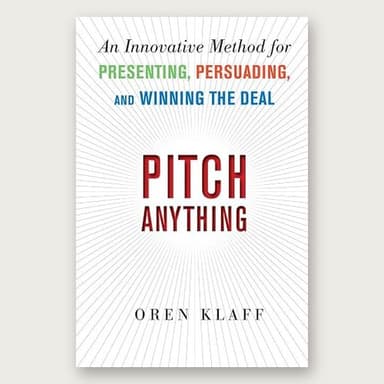
Pitch Anything by Oren Klaff: Summary and Notes
The full book, section by section.
Start hereThe short version
- 1Klaff argues that 9 out of 10 times our most important messages fail because the crocodile brain filters them out. Chapter 1 explains the three-part brain and the STRONG method: set the frame, tell the story, reveal the intrigue, offer the prize, nail the hook point, get the deal.The problem
- 2Chapters 2 and 3 cover frame control and status: how to beat power, time and analyst frames with power-busting, time-constraining, intrigue and prize frames, and how to avoid beta traps and seize local star power.Frames and status
- 3Chapters 4 to 6 give the 20-minute pitch in four phases, the four stacked frames that create a hot cognition, and how to eradicate neediness. Chapter 7 walks through a $1 billion airport pitch, and Chapter 8 lays out steps to practice the method.The pitch
The summaryPitch Anything
Chapter 1The Method
Klaff opens with the big idea in 76 words: there is a fundamental disconnect between the way we pitch anything and the way it is received, so at the moment it matters most, 9 out of 10 times we are not convincing. He says he is not a natural. He raises capital for a living, has raised money for deals involving Marriott, Hershey's and Citigroup, and does so at a rate of about $2 million per week. His claim is simple: better method, more money.
He illustrates with a pitch to Jonathan, an investment banker who hears between 600 and 800 pitches a year and has seen more than 10,000 deals. Jonathan cut him off, changed the frame and tried to take control. When Klaff mentioned revenue, Jonathan said he did not care about made-up revenue projections and wanted expenses; when Klaff described his secret sauce, Jonathan said it was just ketchup. After just 12 minutes, the pitch showed all the signs of being one of his worst, with nine minutes left. Klaff held his frame, and at the end of 21 minutes his pitch was complete and Jonathan changed his mind about the deal. Asked how long he had practiced, Klaff answered over 10,000 hours.
The reason pitching is so hard, Klaff argues, is a flaw in the brain. The brain evolved in three parts: the old crocodile brain, which handles survival; the midbrain, which handles social meaning; and the neocortex, which handles reasoning and took some 5 million years to evolve. Pitches are built in the neocortex and received by the crocodile brain, which is not nearly as smart. Its job is to ignore anything that is not dangerous or new, and when it cannot ignore something it summarizes it radically and passes on a fraction. Klaff says up to 90% of a message is discarded before it reaches the neocortex, and that most new messages get coded as boring or threatening and dropped.
To get through, a pitch must make the crocodile brain feel safe and must register as positive, unexpected and out of the ordinary. Klaff realized that his good pitches followed five rules of engagement: they were simple, clear, visual, novel and did not make the brain work hard. From that he built his method, which he remembers by the acronym STRONG: set the frame, tell the story, reveal the intrigue, offer the prize, nail the hook point, and get the deal. He says he has used it with executives from Goldman Sachs, Boeing, Disney, Honda, LinkedIn, Texas Instruments and Yamaha.
Chapter 1 · Three parts of the brain
"As a result, at the crucial moment when it's most important to be convincing, 9 out of 10 times we are not."
Chapter 2Frame Control
The chapter opens with Tom, a charismatic 31-year-old CEO whose company needed money to grow. Tom rehearsed what he called a bulletproof pitch for Bill Bellsberg, a 69-year-old investor. After more than 30 minutes of waiting in the conference room, Bellsberg strode in, stayed standing and cut Tom off almost immediately: he only wanted to know the monthly expenses and how much Tom was paying himself. Tom dropped his papers, stuttered and was lost. Bellsberg had said only 20 words, and Klaff says a 20-word disruption can control the fate of any deal.
Klaff describes a frame as a point of view, an energy field that surrounds each person and silently transmits power, authority, strength and information. When two people meet, their frames collide, and the stronger frame absorbs the weaker one. Frame collisions are primal, run by the crocodile brain, and rational appeals do not win them. Sales techniques, he argues, were created for people who have already lost the frame collision and are trying to do business from a low-status position; there are more than 35,000 such books on Amazon. A frame-based approach needs little technique, and the less you say, the more effective you are.
His example is a traffic stop on California Highway 101 north of Santa Cruz at 80 miles an hour. The police officer's frame is nearly invincible, because it rests on authority and consequences, and no argument from the driver will win. Klaff says the same dynamics run every business meeting.
He names three opposing frames people meet in business. The power frame comes from a person with a massive ego and status. The time frame comes from someone who says he has only a few minutes. The analyst frame comes from someone who wants details, numbers and technical facts. Against them Klaff uses three response frames: the power-busting frame, the time-constraining frame and the intrigue frame. A fourth, the prize frame, works against all three.
To bust a power frame, use small acts of denial and defiance with a little humor. Klaff tells of meeting Steve, a big trader at a firm where he and his investors had pulled together about $60 million, who arrived several minutes late and talked about himself for 15 minutes. Klaff used a small act of defiance, delivered with humor, to make Steve's power trivial and get the focus back on the real subject, the $60 million he was there to spend. He also tells of Dennis, an avocado farmer ready to retire, whose $640,000 sat in an escrow account controlled by a man named Donald McGann. Klaff went in person, ended up facing McGann's son Jim, and used what he calls the moral authority frame, plowing forward without letting up. McGann's status dropped, and they walked out with all $640,000 secured by wire transfer.
To answer a time frame, take control of time: if the customer says he has 10 minutes, acknowledge it and start wrapping up when time is short. To break an analyst frame, tell a short, provocative personal story and hold back the ending. Klaff describes a Legacy 600 jet that skids to a stop at the far edge of a runway and then, on takeoff, goes into a nosedive. He goes straight back into his pitch without explaining it, which shocks the room out of its analyst mode, and he finishes the story after the pitch. He points to Jaws, the 1975 Steven Spielberg film, which hides the shark as long as possible.
The prize frame reverses the usual roles. Instead of chasing the buyer, you make yourself the prize the buyer must qualify for, the way BMW makes buyers of a special edition M3 sign a contract promising to take care of the special paint. Prizing does not mean giving up the pursuit of buyers. It means giving up always be closing, the phrase popularized by sales gurus of the 80s.
Chapter 2 · Frames collide
"Rational appeals to higher order logical thinking never win frame collisions or gain frame control."
Chapter 3Status
Klaff opens on Benoit, a waiter at a famous Paris restaurant who can show diners the table where Hemingway wrote in the 1920s. Klaff arrived with guests and Benoit made them wait another 15 minutes, corrected the wine, overruled the orders and finally presented a dessert of his own choosing. By the end of the meal the table was his. Benoit had borrowed local star power, and when a high-status person makes a statement, it is treated as true and goes unchallenged.
For more than 40 years, Klaff says, sales trainers have taught techniques for situationally disadvantaged salespeople, and those techniques worked in the 70s and 80s. They no longer do. The obstacle now is the beta trap, a social ritual that puts the visitor in the low-status position and keeps him there. The reception desk, the lobby, the conference room and any public meeting space are beta traps. So is the trade show booth, an 8 by 10 foot cube where the seller waits like a pet shop puppy.
Status, Klaff argues, is situational. A cardiac surgeon outranks his golf pro everywhere except on the golf course, where the roles reverse during the lesson. That means status can be seized in the moment. He tells of a meeting where he was seated in a secretary's chair, surrounded and stamped beta for a 15-minute meeting. He broke the frame with one simple move, took control and spent the next 20 minutes answering questions on his terms, then pulled away, checking his watch as if late for the next meeting.
The first thing to do on meeting a target, he says, is to establish local star power. On your own turf, like the golf pro or the French waiter, use your domain expertise and location knowledge to take the high-status position. In the target's domain, step around the beta traps, use small denials and defiance, and move the discussion to a level where you cannot be challenged, using the core values of hard work, domain expertise and moral authority. When the pitch is done, start pulling away. Status built in a meeting is fragile; leave and come back later and you have to start over, even if that's only five minutes later.
Chapter 3 · Status is situational
"If you do not have high status, you can create it temporarily."
Chapter 4Pitching Your Big Idea
Klaff argues that a pitch should last about 20 minutes, the limit of human attention, and that he opens with a time constraint: he has only about 20 minutes, which will leave time to talk before he has to leave. The pitch runs in four phases. Introduce yourself and the big idea in about five minutes. Explain the budget and the secret sauce in about 10 minutes. Offer the deal in two minutes. Stack frames for a hot cognition in about three minutes.
- You're Already an Impact Business22 to 30
- You're Closer Than You Think14 to 21
- You Have the Foundation7 to 13
- The Starting Line0 to 6
 Printable PDF
"Klaff says the croc brain filters almost everything as boring, dangerous or too complicated. Investors and partners will run your business through that same filter, right? Know where it stands first. Ten questions, a score out of 30 and the part to fix first. It's free with your email. Go find out."
 Deven Davis, devendavis.com
- Ten questions about where your business is right now
- A score out of 30
- A four-part breakdown: Impact Clarity, Traction Proof, Model Strength, Founder Credibility
- The part to fix first
- Your tier's next steps
- A printable PDF
Free with your email. Your score and a printable PDF open right on the page.
Phase one. Give your background, and spend less than two minutes on it. Then explain why now, by showing how the market has moved toward the idea. Klaff's colleague Joe pitched an airport deal by naming three forces changing the market: banks had started lending to aviation projects, the FAA was issuing building permits again, and the main competitor was excluded from bidding. Klaff says framing the idea as a change in the market prevents change blindness, the brain's tendency to miss slow change. Then introduce the idea with the pattern the venture capitalist Jeff Moore developed in 1999: for target customers dissatisfied with the current offerings, my product is a new kind of category that solves these problems, and unlike competing products it has these important features.
Attention. Klaff says attention is the balance of two neurotransmitters. Dopamine is the neurotransmitter of desire, triggered by novelty and reward. Norepinephrine is the neurotransmitter of tension, triggered by the possibility of loss. Together they add up to attention, and they stay in balance for about 20 minutes. Novelty means giving the target something new; tension means showing that there is something to win or lose. A pitch narrative is a series of tension loops: push, then pull, create tension, then resolve it. Without tension there are no stakes and the target has no emotional involvement. His low-key push-pull pattern goes like this. Push: there's a real possibility that we might not be right for each other. Pause, and let it sink in. Pull: then again, if this did work out, our forces could combine to become something great. It has to be authentic.
He tells of a pitch in Denver to 25 people, many more than he expected, who had each been given a book about a financial technique called bifurcation. When he finished, there was silence, like looking out at 25 concrete garden gnomes. He said that since they had no questions, he would take the books back, and walked around the horseshoe taking them out of their hands, pulling harder in some cases. Now they had something to lose, the questions started flowing, and over the next two years he closed $5 million with those targets.
Phase two. Explain the budget and the secret sauce. Show you can execute the plan on the budget, and focus on the competitive advantage. Klaff says buyers care more about whether you can control expenses than about projections; Jonathan had told him, who cares about your made-up revenue projections, tell me what your expenses are going to be. Do not spend more than 10 minutes on the fundamentals. Phase three offers the deal: what the target gets, when and how, and his part in it. He notes that Jerry Seinfeld needs months to build 20 minutes of material, which is why an hour-long pitch is up to three times the basic limit of human attention.
Chapter 4 · Twenty minutes in four phases
"No company in America should let its executives pitch for an hour."
Chapter 5Frame Stacking and Hot Cognitions
Phase four is frame stacking. Klaff distinguishes cold cognitions, such as problem solving, calculations and statistics, from hot cognitions, the fast, emotional judgments that decide whether people want something before they know why. He argues that very few decisions are anything but hot, and that the goal is to make the target want the deal, because learning to like something is slow and intellectual. He stacks four frames in quick succession to create a hot cognition: the intrigue frame, the prize frame, the time frame and the moral authority frame.
The intrigue frame is a short narrative with the person at the center, a dramatic arc and an unresolved ending. What matters is who it happened to and how the characters react. Klaff's pattern has three steps: put a man in the jungle, have beasts attack him, and open the question of whether he will get to safety. Hold the man just short of safety for as long as you want the intrigue to last. Klaff's own example is an $18 million deal that nearly collapsed less than 72 hours before closing, when an investor, Jeff Jacobs, could not be reached and Klaff tracked down his wife, only to learn she had been separated from him for 11 years and would not sign anything to help him. Klaff stops there, with the man at the edge of the jungle, and moves to the next frame. In another example, he tells a story about his eccentric partner Joshua and holds back the ending so the audience leans in. The prize frame positions the pitcher as the one being chosen; he compares it to a rescue shelter that made him prove he deserved the dog. The time frame puts a deadline on the decision; in one example the deadline is July 18th, and then he says they really need to decide by the 15th. The moral authority frame rests on admiration. Klaff tells of Mother Teresa in December 1991, treated for a bacterial infection and heart problems at Scripps Clinic in La Jolla, California, asking the doctors what they were doing to give back and whether they had seen the medical facilities 25 miles away in Tijuana.
Selling, he says, tempts people to do three things he dislikes the most: to supplicate, to make rational appeals to the neocortex, and to ask invasive questions. Hot cognitions are primal; in a rush of excitement the crocodile brain takes over and no analysis gets done. The acid test of a pitch, he says, is whether the target wants to buy your stuff and be part of your team.
Chapter 5 · Stacking frames
"No pitch or message is going to get to the logic center of the other person's brain without passing through the survival filters of the crocodile brain system first."
The Founder Brain Kit
Chapter 6Eradicating Neediness
Klaff calls neediness the worst thing a pitcher can show. It erodes status, freezes hot cognitions and topples frame stacks, and investment bankers name validation-seeking behavior, which is neediness, as the number one deal killer. Early in his career he made up to 50 calls a day to venture capital firms and kept failing, until a mentor told him to get some game.
He describes a meeting in 1999, in an anonymous office overlooking a freeway, where 30 minutes went well and then a few needy remarks at the end ruined it. He lists the signs that a target is losing interest, from closing a folder to allowing interruptions. Neediness comes from a natural fear response when the target withdraws. The cure comes from Taoism by way of the film The Tao of Steve, whose lead character, Dex, models his cool on three Steves: Steve McQueen, Steve Austin and Steve McGarrett. It has three rules. One, eliminate your desires; it is not necessary to want things. Two, be excellent in the presence of others by showing one thing you are very good at. Three, withdraw at the crucial moment when people expect you to come after them. People want what they can't have, so when you finish your pitch, deny your audience and start pulling away.
His proof is a pitch to Enterprise Partners, the largest venture capital firm south of Silicon Valley. He had $468, enough for half of a payment on his Porsche, and ran a constant loop in his head to stay calm. At nearly 4 p.m., he gave exactly 20 minutes of hardcore finance in a sexy internet wrapper, said the deal would be fully subscribed in the next 14 days, and sat with no trace of neediness waiting for them to react. They came up with a $14 million valuation, $6 million more than he expected. He got a balance slip from an ATM to see the $2.1 million printed on it, and 30 days later the company completed the financing with an additional $4 million.
Chapter 6 · No neediness, more money
"Once under control, you'll impress others and make them actually come after you."
Chapter 7Case Study: The Airport Deal
After 10 years of nonstop deal-making, Klaff had sworn off deals and was resting near the Salton Sea when Greenberg, head of Greenberg Capital, pulled him back in to win a contract to raise $1 billion for a new private airport. The decision belonged to Simon Jeffries, who would build it on a thousand acres of Southern California land at Davis Field, a site with history going back to the 1920s. Their rival was the larger firm Goldhammer, which would bring 12 to 15 people against Greenberg's six and whose top pitch man, Timothy Chance, was Klaff's old rival. If they won, Greenberg Capital would earn more than $25 million in fees over five years, and Klaff would take 30%.
Klaff walks through the pitch as an application of the whole method. He broke Greenberg's power frame early with an expert frame. In front of Jeffries, he set a serious but lively tone, used the field's history, including B-17 bombers that served in the Pacific campaigns, and explained why now: while everyone had told Jeffries the market was flat, the window for raising $1 billion was open. He reframed Goldhammer as big, bloated and overstaffed, presented his own plan as bold, and pointed out that 115,000 people now live around the field. The Goldhammer pitch, by contrast, talked about data and left out why now, how and the critical path.
"Klaff says win the frame first, then give the croc brain content it can take in fast. A clean deck handles the second part. The Pitch Kit gives you 5 Sequoia-style templates for an investor, a partner or a big client, in Canva and Google Slides. Seven bucks. Your first draft is 60 minutes away."
Deven Davis, devendavis.com- 5 Sequoia-style deck templates in Canva and Google Slides
- Covers the essential pitch deck, the one-pager and early-stage variations
- Bonus: The Deck Doctor, Deven's 5-minute video on the 3 slides people skip to first
- Bonus: The Quick Win Guide, to have your first draft in 60 minutes
Seven dollars, with the No-Brainer Guarantee: if the templates don't save you at least 10 hours of work, full refund.
Klaff boiled two months of work into a pitch lasting 20 minutes and 52 seconds. Jeffries called with the decision, let the moment linger and said one word: congratulations.
Chapter 7 · The airport deal
"This would work because the mind is not a camera."
Chapter 8Get in the Game
Klaff says he learned the method alone through more than 10,000 hours of trial and error. Frames shape the meaning of every social interaction, and he gives Ronald Reagan in the 1984 debate with Walter Mondale as an example: asked about his age, Reagan said he would not exploit his opponent's youth and inexperience, and changed the frame. The core problem remains the neocortex trying to persuade a crocodile brain that is afraid of almost everything.
He lays out progressive steps for learning the method. Step one: learn to recognize beta traps, a low-risk way to start thinking in frames. Step two: start stepping around them gradually, ideally practicing with a partner. Step three: identify and label the social frames around you; power frames, time frames and analyst frames crash into you every day. Step four: begin to initiate frame collisions with safe targets, using small denials and defiance. If the method is not working, choose a different social environment. Step six: frame control cannot be forced, because forcing it takes the fun out of it. Step seven: work with other frame masters who are better than you. He warns that forcing the method backfires, that the secret is creating tension in a fun way that invites people into the frame, and that apprenticeship leads to mastery faster than going it alone. He says he has prospered for over 10 years using only four basic frames and the ability to avoid beta traps.
Chapter 8 · Seven steps into the game
"Weak frames and non-essential details bounce off of strong frames."