Out of Your Mind by Alan Watts: Summary and Notes
The full book, section by section.
Start hereThe short version
- 1Westerners live inside two unexamined myths of the universe: the ceramic model, a world made by a potter-king God, and the fully automatic model, a world of blind mechanism. Both leave people feeling like strangers in their own skin. Sessions 1 and 2 propose a third, the world as a drama or game, and show how symbols come to feel more real than experience.The claim
- 2Nothing exists on its own. Sessions 3 and 4 present existence as relationship, a web seen as selectivity, mutuality, trap and play, and Sessions 5 and 6 show the ego as a hang-up, a useless muscular bracing, which loosens in the face of death.The web
- 3Three traditions point at the same thing from different sides. Zen points directly, through koans and the masters of Sessions 7 and 8. Vedanta says that art thou, the Self at play in Maya and Lila, in Sessions 9 and 10. Buddhism, in Sessions 11 and 12, breathes out instead of clinging and ends in Nagarjuna's emptiness.The traditions
The summaryAbout This Edition
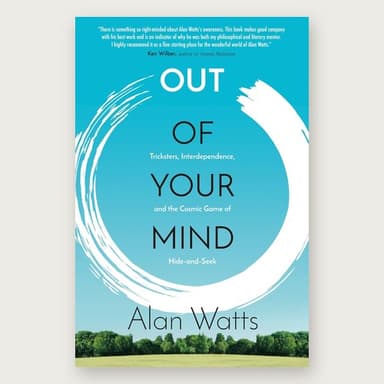
These notes follow the audio edition, Out of Your Mind: Essential Listening from the Alan Watts Audio Archives, twelve recorded lecture sessions running about 14 hours. The opening narration says many of the lectures were recorded during the late 1960s in Watts's home, an old ferry boat in Sausalito, California, and introduces him as an author, philosopher and self-proclaimed spiritual entertainer. The print book sold under the same name carries a different subtitle, Tricksters, Interdependence, and the Cosmic Game of Hide-and-Seek. It is drawn from the same lecture series, but its content is not identical to the recordings summarized here.
The sessions come in six pairs, each pair a seminar on one theme: the nature of consciousness, the web of life, the inevitable ecstasy, Zen, Hindu philosophy and Buddhism. Across all of them Watts makes one argument. The separate ego that feels locked inside a body, looking out at a hostile world, is a social convention mistaken for a fact, and the reality behind it is the universe playing a game of hide-and-seek with itself.
"I'm going to talk about what there is."
Sessions 1 and 2The Nature of Consciousness
The first seminar examines the images Westerners use, mostly without noticing, to make sense of the world, and the kind of consciousness that confuses its symbols with reality.
Session 1The Nature of Consciousness
Watts begins with background: the basic ideas that shape common sense in the United States are built into language and logic, and he calls them myths, using the word in a powerful sense rather than to mean something untrue. Two images dominate. The ceramic model comes from the book of Genesis, from which Judaism, Islam and Christianity derive their picture of the world. God is a technician, potter, carpenter or architect with a plan, shaping stuff from the outside, as the Lord God makes Adam from the dust of the earth. Watts notes that the image arose in monarchies, so the maker of the universe was also its king. Things that grow, he points out, work in the opposite direction, from the inside out.
Over time the ceramic image ran into trouble and became the fully automatic model: Western science's laws of nature, operating with no maker at all, a world of blind mechanism in which life is an accident. Both models leave a person feeling like a stranger in the world, either an artifact under a ruler or a fluke in a machine. Watts proposes a third, the dramatic image: consider the world as a drama, a game the universe plays. He adds that any satisfactory theory of the universe has to be one worth betting on, since there is no point in going on with the game otherwise. He plays with Camus's claim that the only serious philosophical question is whether to commit suicide. Watts counts four or five serious questions: who started it, are we going to make it, where are we going to put it, who's going to clean up, and is it serious. The real question behind them is why go on, and the answer is that you go on only if the game is worth the candle.
Chapter 1 · Hide and seek
"A myth is an image, in terms of which we try to make sense of the world."
Session 2The Nature of Consciousness, Part 2
Watts describes the game our culture plays: the only thing you really know is what you can put into words. If he loves a woman and cannot write poetry about it, nobody would say he does not love her, yet the culture acts as if nothing really happens unless it is in the newspaper. At a great party someone says it is too bad there was no tape recorder, and children come to feel they do not exist authentically unless their names are in the papers.
Reflexive consciousness, being aware of being aware and representing life through words, numbers and accounts, let humans plan and discipline their lives with foresight. The cost is that the symbolic version starts to seem more real than direct experience, as if we were living two lives at once, one representing the other. Watts compares it to money: the money represents the wealth, and a person who forgets that the symbol is secondary starts to value the representation over the thing.
The session then reaches the image the whole series turns on. What there is, Watts says, is the Self of all beings everywhere, and it is playing the game of hide-and-seek with itself. It gets lost and involved in the farthest-out adventures, but in the end it always wakes up and comes back to itself. In Hindu terms the Self, the Atman, is you, and since hide-and-seek is the game of games, the basis of all games, you are deliberately forgetting who you really are, though you cannot or will not admit it. When you are ready to wake up, you will; until then you keep pretending to be just a little, poor little me.
Session 2 · Nothing happens unless it is in the newspaper
"So the whole game that our culture is playing is that nothing really happens unless it's in the newspaper."
Sessions 3 and 4The Web of Life
The second seminar argues that things and people only seem separate because ordinary attention ignores the connections between them.
Session 3The Web of Life
Human consciousness, Watts says, is at the same time a form of awareness and a form of ignorance: it leaves out more than it takes in, including the things that would quiet our anxieties if we knew them. Society's rules forbid knowing the lowdown on life, which means both the real dirt and what is profound. He uses the rug in front of his audience. On the front, a black thread ends in one place and appears again in another; on the back, it runs underneath and joins up. Sound and silence, life and death, work like warp and woof, holding together by going over and under. The point the session builds to is that things do not exist apart from their relations. In his words, existence is relationship. If his finger is alone, with no wind and nothing touching it, it stops knowing it is there; the moment something touches it, it knows. It takes two.
Session 3 · The back of the rug
"In other words, if my finger up here is all alone and the wind doesn't move and nothing touches it, it stops knowing that it's there."
- You're Already an Impact Business22 to 30
- You're Closer Than You Think14 to 21
- You Have the Foundation7 to 13
- The Starting Line0 to 6
 Printable PDF
"Watts keeps coming back to one warning: don't mistake the symbol for the thing it points at. Fair enough. So let's look at the business itself instead of your hunch about it. Ten questions, a score on four parts of it and the part to fix first. It's free with your email."
 Deven Davis, devendavis.com
- Ten questions about where your business is right now
- A score out of 30
- A four-part breakdown: Impact Clarity, Traction Proof, Model Strength, Founder Credibility
- The part to fix first
- Your tier's next steps
- A printable PDF
Free with your email. Your score and a printable PDF open right on the page.
Session 4The Web of Life, Part 2
Watts recaps two readings of the web. As selectivity, the way we pay attention creates isolates, separate things, events and persons that seem alone because we ignore the threads joining them on the back of the embroidery, the unconscious side of life. As mutuality, cloth exists only through the mutual support of its threads. He then adds two more. The web is a trap, like a spider's web for flies, and some people see existence that way and get stuck there, finding it simply hateful. He also calls life a drama, and a drama a deception, a big act, and notes that people with nothing to do, as far as he can make out, get together and sing and dance or watch somebody else do it, while ours has become a non-participative culture that watches other people do it on television. He wants to consider the web as something playful, and he ends on the onion: look deeper and deeper into yourself and you find a rhythm doing a rhythm, and whoever is doing it vanishes every time you try to see him. That situation, Watts says, is what's called life.
Session 4 · The web is a trap
"The web is a trap, like the spider's web is a trap for flies."
Sessions 5 and 6The Inevitable Ecstasy
The third seminar takes up the problem the Buddha addressed, suffering, by way of attachment, the ego and death.
Session 5The Inevitable Ecstasy
Before discussing suffering, Watts says, we need to understand a state of mind that is extremely simple and very hard to talk about, like the state of a baby who has no names for anything yet. Growing up means learning to tell things apart, and above all to tell ourselves apart from everything else. That is fine, he says, as long as we keep the foundation, the way mountains are differentiated but all rest on the earth.
Attachment, the Sanskrit klesha, is exactly what modern slang calls a hang-up: a stickiness, a state of wobbly hesitation. Watts compares the ego to a passenger on a jet that runs too long down the runway, pulling on his seat belt to get the plane off the ground, a muscular effort that does nothing. He describes meeting Karlfried von Dürkheim in Zurich in 1958, a former German diplomat who had studied Zen in Japan and who found that some of his patients had had a sudden awakening when they heard a bomb whistling straight at them and accepted that they were finished. In so many cases, Watts says, the bomb was a dud and they lived to tell of it. Others had the same experience in a concentration camp.
Session 5 · Pulling on the seat belt
"You are an aperture through which the universe looks at itself."
Session 6The Inevitable Ecstasy, Part 2
Watts recaps the comparison between the open, unselective consciousness of a baby and the highly selective consciousness of an adult, which insists that the positive must win over the negative. The baby also does not distinguish voluntary action from involuntary happening, which adults treat as a defect. Watts argues instead that the child's vision returns only when one realizes that the "I" cannot do anything about it at all, and cannot even do nothing about it. Christian and Islamic mystics say the same thing more clumsily when they call the mystical experience a gift of God. Trying or not trying, Watts says, both aggravate the sensation of the separate ego, which is why the effort to get rid of the ego only strengthens it. The knowledge of death helps, because it tells the ego it cannot hang on. What remains is a situation in which there is nothing to do except watch what happens, and what is happening is watching itself.
Session 6 · Open and selective attention
"At least in the moment of death, you'll see that it was all a fake."
Sessions 7 and 8The World as Just So
The fourth seminar is on Zen, which Watts calls a domain of experience that cannot be talked about, so that any lecture on it is something of a hoax.
Session 7The World as Just So
Every poet feels something essential was left out at the end of the work, Watts says, and Zen has always described itself as a finger pointing at the moon. It concerns the "that" of the Sanskrit saying tat tvam asi, that art thou: the absolute reality of Hindu philosophy, which you are in a disguise so good you have forgotten it. Zen is summed up in four statements, starting with a direct transmission outside the scriptures and apart from tradition, and continuing with no dependence on words, direct pointing to the mind and seeing into one's nature.
The Right to Be Rich
Watts tells how Bodhidharma, said to have brought Zen to China a little before 500 A.D., was interviewed by Emperor Wu of Liang, a great patron of Buddhism who listed the monasteries he had built and asked what merit he had earned. Bodhidharma said no merit whatever, which set the emperor back, since popular Buddhism held that good religious works earn merit. Bodhidharma always insisted he had nothing to teach. Watts places Zen's origins around the year 414, when the Hindu scholar Kumarajiva and his assistants were translating the Buddhist sutras into Chinese and one of his students taught that all beings have the capacity to become Buddha. The real founder of Chinese Zen, in Watts's account, is the Sixth Patriarch, Huineng, who died in 715 AD and whose discourses are collected in the Platform Sutra, which Watts says any student of Zen should read. In another story, a master asked his monks to say something about a water pitcher without calling it a pitcher, and the monastery cook came forward, kicked the pitcher over and walked away. He got the job.
Session 7 · A finger pointing at the moon
"A lecture on Zen is always something in the nature of a hoax."
Session 8The World as Just So, Part 2
A Zen teacher's function is to put students in situations where they would normally get stuck: nonsensical questions, absurd remarks and impossible demands, such as hearing the sound of one hand, stopping a ship on the water without moving, or taking Mount Fuji out of a pillbox. These koans unhinge the language game and the social games we play. Watts tells of a dinner party where a Zen master suspected a geisha of Zen training and handed her a red-hot piece of charcoal with the iron chopsticks from the brazier. She whirled her long sleeves around her hands, took it to the kitchen, changed her burnt kimono, returned and later offered him a coal of her own. He produced a cigarette and said, thank you, that's just what I needed.
He then traces a split in the 17th century between two great masters, Hakuin and Bankei. Since Hakuin's time, koans have been given fixed answers, and students must hit on the prescribed one. Bankei, abbot of Myoshinji, stopped the monks from using the stick on those who dozed in meditation, because even a sleeping man is still a Buddha. Watts adds that Myoshinji, the biggest temple in Kyoto, was built to house 600 monks and now has only 80.
Session 8 · Koans
"What is the sound of one hand? Who were you before your father and mother conceived you?"
Sessions 9 and 10The World as Self
The fifth seminar turns to Hindu philosophy, whose foundation in the Upanishads is the Self.
Session 9The World as Self
The basis of all Indian philosophy, Watts says, is the Self, Atman, in the vastest and most inclusive sense: yourself, and also existence as such, the totality of all being. It cannot be talked about logically, though poets can talk about anything, and the Upanishads are largely poetry. Everything is indescribable in the end, and Watts quotes Korzybski calling the physical world the unspeakable world. When people asked the modern Hindu saint Sri Ramana Maharshi who they had been in their last incarnation, he turned the question back on the questioner. His answer was always: who is asking the question?
The world is called Maya, usually translated as illusion; the distinctions between things are imaginary, though what an imagination. Maya is linked with Lila, which means play, and the spell of the world is a kind of fascination. Watts explains the Hindu cycles of time: the Kalpa is 4,320,000 years, the span during which a world is manifested before it is withdrawn again. He contrasts this sense of play with the stern faces of soldiers on parade, who look serious because seriousness implies that something might go absolutely wrong. He takes the reversal of the word immaterial seriously: what lies behind Maya doesn't matter, and the real Self doesn't matter either, which is another way of saying it does not exist for any purpose and does not need to.
Session 9 · Lila, the play of the kalpas
"And it is, therefore, Maya is linked with the word Lila. And that means play."
"Watts says you are much more than a separate ego locked inside a body. Seeing that changes how you think about yourself, and that kind of change takes daily reps. The Identity Shift is 30 days of a prompt, a reflection and an intention, built on Wattles. Seven bucks, and the first shift shows up in Week 1. Start tonight."
Deven Davis, devendavis.com- 30 days of guided identity reprogramming, rooted in Wattles' Impression of Increase principle
- Each day has a prompt, a reflection and an intention
- Bonus: The Quick Win Guide, your first identity shift result in under 1 hour
- Bonus: a 5-minute video from Deven on why identity precedes strategy
Seven dollars, with the No-Brainer Guarantee: if it doesn't change how you think about yourself and money within the first week, full refund.
Session 10The World as Self, Part 2
Watts recaps tat tvam asi: being is something we proceed out of, the way leaves come from a tree, and we do not come into the world from somewhere else. He then discusses the human world as the Self. He contrasts the shaman, who is initiated by going off alone into forests and mountains, with the priest of the agrarian community, who receives power from a community of priests or a guru, from tradition. Hindu society has four castes based on four divisions of labor, starting with the priests, the brahmana, and the warriors and rulers, the kshatriya, and in a community without general education you are born into one.
A life passes through stages, beginning with brahmacharya, studentship or apprenticeship, followed by grihasta, the householder, who has duties that include artha and kama, the cultivation of sensual and aesthetic beauty from which the Kama Sutra takes its name. Later stages turn away from social roles toward liberation. Once the householder has taught his oldest son to run the household, he or she may enter the stage of the vanaprastha, going out to the forest, and one of the first practices there is silence, called mauna. Watts stresses that this outgoing stage is a higher state than that of the hunting-society person: it is no simple return to where one came from. Watts presents the whole arrangement as a social enactment of the same pattern of losing and finding the Self.
Session 10 · Leaves from the tree
"You come out of this world just in the same way as the leaves come from the tree."
Sessions 11 and 12The World as Emptiness
The final seminar is on Buddhism, which Watts describes as Hinduism stripped for export.
Session 11The World as Emptiness
Hinduism is a whole culture, a legal system, a social system and a system of etiquette that includes housing, food and art, because ancient peoples did not make religion a department of life. A culture that inseparable from its religion is hard to export, so the question became what its essentials were. Buddhism was the answer. The Buddha summed up his teaching in the Four Noble Truths, beginning with the truth about dukkha, suffering, which comes with anitya, impermanence, and anatman, the absence of a separate self. The third truth is nirvana. The word is usually said to mean blow out, but Watts believes it means breathe out, because in Indian thought breath, prana, is the life principle, and if you try to hold on to life, you lose it. The fourth truth is the Eightfold Path. Marga, the Sanskrit word for path, is the most complicated of the four. Watts tells of the great Buddhist scholar Dr. Suzuki, lecturing at the University of Hawaii, who named the first step of the noble eightfold path, right view, and then admitted he had forgotten the second.
Session 11 · Hinduism stripped for export
"I believe that it means breathe out rather than blow out."
Session 12The World as Emptiness, Part 2
Buddhism emphasizes change first to unsettle people who think they can achieve permanence by hanging on to life, and Watts tells a joke about a Scottish preacher thundering at his congregation about vanity. He argues that the knowledge of death can help the ego disappear before death catches up with it, and he imagines a better way of dying, with a party, morphine so nothing hurts, and no more bills to pay. He suggests that someone might start what nowadays would be called an institution for creative dying, with one department offering a champagne cocktail party to die with and another offering glorious religious rituals and priests. He tells of a kamikaze pilot whose plane went wrong and landed in the water instead of hitting an American aircraft carrier. The pilot said afterward that he had felt an extraordinary exaltation at the thought that in a moment he would cease to exist.
The session closes on Nagarjuna, who lived about 200 AD and whom Watts calls one of the most astonishing minds the human race has produced. His school, Madhyamika, the doctrine of the middle way, is also called the doctrine of emptiness, from the word sunya. Nagarjuna showed that every concept of reality, including the concept of the void, is an attempt to catch water in a sieve, and he extended the Buddha's own dialectic into a method of teaching that flourished at the University of Nalanda, which Watts says was destroyed when the Muslims invaded India. In the dialectic debates of that tradition, whoever won had the others as disciples, and Watts tells of the layman Vimalakirti, a wealthy merchant who out-argued the Buddha's other disciples, even Manjusri.
Session 12 · Water in a sieve
"Nagarjuna is saying that always your concepts will prove to be attempts to catch water in a sieve, or wrap it up in a parcel."