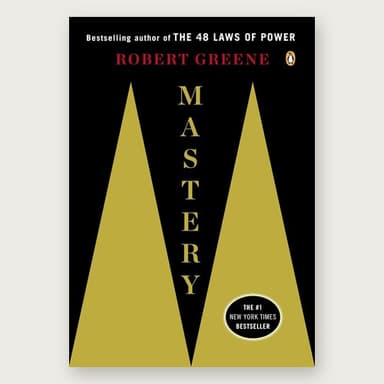
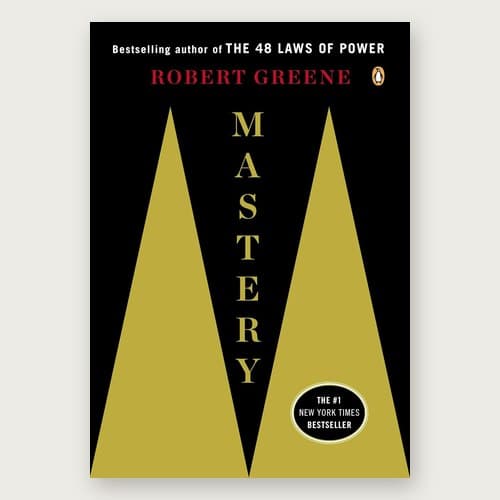
Mastery by Robert Greene: Summary and Notes
The full book, section by section.
Start hereThe short version
- 1Mastery has three phases: the apprenticeship, the creative-active phase and mastery itself. Greene argues that our hunter-gatherer brains, built for deep focus and reading other people, make it available to anyone willing to do the work, and that natural talent explains far less than people think.The claim
- 2The path starts inward with a life's task, the calling that was clear in childhood (Part I), then submits to an ideal apprenticeship of observation, practice and experimentation (Part II), absorbs a mentor's power (Part III) and learns to see people as they are (Part IV).The path
- 3With skills internalized, the mind grows bold and creative (Part V), and after many years masters fuse intuition with reason (Part VI). Each part runs on lives such as Darwin, Faraday, Franklin, Mozart, Coltrane and Proust, and closes with a reversal that tests the rule.The payoff
The summaryIntroduction
Robert Greene's introduction makes three moves: it names the power the book is about, explains where it comes from in human evolution, and argues that it is available to anyone who follows the right process. Every part after it follows the same pattern: a long opening story about a master, a Keys to Mastery section that draws out the principle, a set of strategies illustrated with more lives, and a short Reversal that tests the principle against its exceptions.
IntroductionThe Ultimate Power
Greene opens with Goethe: we are born with the capability to shape our fortune, and the skill must be learned and cultivated. He describes a form of power and intelligence that schools do not teach but that most people glimpse under pressure, facing a deadline or a crisis or after long work on a project, when the mind feels unusually focused and events seem to bend toward us. Masters such as Leonardo da Vinci, Napoleon Bonaparte, Charles Darwin, Thomas Edison and Martha Graham live in that state for long stretches.
The root of this power is a process, and Greene lays out its three phases. In the apprenticeship, we stand outside our field, learning its basic elements and rules with only a partial picture. In the creative-active phase, practice and immersion let us see inside the machinery and play creatively with its elements. In mastery, knowledge, experience and focus run so deep that we see the whole picture with complete clarity. The great danger along the way is giving in to boredom, impatience, fear and confusion and stopping the learning. People have always hunted for shortcuts, as the alchemists searched for the philosopher's stone, and Greene argues that the hunger for a magical shortcut is exactly what keeps most people from the real thing.
Chapter 1 · Three distinct phases
"In the process leading to this ultimate form of power, we can identify three distinct phases or levels."
IntroductionThe Evolution of Mastery
Our earliest ancestors on the grasslands of East Africa some six million years ago stood less than five feet tall, had no claws, fangs or poison, and were easy prey. Greene argues that two adaptations turned that weakness into dominance. The first was sustained, deep focus: the ability to watch the environment patiently, read its signs and learn the habits of predators and prey. The second was social. In the 1990s, he writes, a group of Italian neuroscientists studying monkeys found motor neurons that fire both when the animal performs an action and when it watches another do it. These mirror neurons let our ancestors read each other's desires from subtle signs and helped make toolmaking possible.
For three million years humans lived as hunter-gatherers, and Greene quotes Richard Leakey that we still carry their brains. Mastery, on this reading, is the natural use of the brain we were given: patient observation, deep immersion and reading other people. Modern distraction and the wish for quick results work against that design, but the brain remains plastic and can still be trained.
Introduction · Watching the grasslands
"The great salvation for all of us is that we have inherited an instrument that is remarkably plastic."
IntroductionKeys to Mastery
If everyone is born with an essentially similar brain, why do so few excel? The usual answer is natural talent. Greene rejects it. Thousands upon thousands of children show exceptional skill early and amount to little, while people less brilliant in youth often attain much more. What separates masters is a deep desire for their subject, an intense connection to their field, and the patience and persistence to keep learning through the long, unglamorous years. He names the people whose lives carry the book, among them Leonardo da Vinci, Albert Einstein, Henry Ford, Marcel Proust, Martha Graham, Buckminster Fuller, John Coltrane and Glenn Gould, alongside nine contemporary masters he interviewed. He closes the introduction by asking readers to treat the book as a guide to recover the power we already possess.
"But thousands upon thousands of children display exceptional skill and talent in some field, yet relatively few of them ever amount to anything."
Part IDiscover Your Calling: The Life's Task
Part I argues that everyone possesses an inner force that points toward a life's task, clear in childhood and drowned out later by parents, peers and daily anxiety. The first move toward mastery is inward.
Part IThe Hidden Force
The opening story is Leonardo da Vinci. Barred from the professions as the illegitimate son of a notary, he grew up drawing the plants and animals around Vinci and trusted the voice that drew him toward them. Greene follows him through Florence and Milan, where he was asked to design an equestrian statue in memory of Francesco Sforza. Leonardo worked on the design for months and displayed a clay replica the size of a large building in the city's largest square, and word spread through Italy. The bronze was never cast. Greene reads the episode as typical of Leonardo, for whom the process of learning mattered more than any single finished product.
"The first move toward mastery is always inward learning who you really are and reconnecting with that innate force."
Part IKeys to Mastery
Many masters describe a guiding force: Napoleon's star, Socrates's demon, which Goethe also called his own. Greene treats it as a real expression of each person's uniqueness. Finding your life's task takes three steps. First, reconnect with your inclinations, the subjects that sparked a deep, primal curiosity in childhood. Second, see your career as a vocation, a calling, which the word itself means. Third, expect the path to wind, with twists and turns, more journey than straight line. Greene quotes Pindar, become who you are by learning who you are.
Part I · Finding your life's task
"The word vocation comes from the Latin meaning to call or to be called."
Part IStrategies for Finding Your Life's Task
Greene gives five strategies, each built on a life. Return to your origins, the primal inclination strategy: when Albert Einstein was five, his father gave him a compass, and the invisible force that moved its needle fascinated him for life. Occupy the perfect niche, the Darwinian strategy: V.S. Ramachandran, a lonely boy in Madras who loved science and collected seashells on the beach, built a career in an unclaimed corner of neuroscience, and Yoky Matsuoka later found a niche of her own. Avoid the false path, the rebellion strategy: Mozart began piano at four under his father and later broke with him to follow his own music. Let go of the past, the adaptation strategy: Freddie Roach, groomed from birth to be a boxing champion, adapted when his fighting career ended and became a trainer. Find your way back, the life-or-death strategy: Buckminster Fuller, born with extreme nearsightedness, lost his way in conventional work and nearly ended his life before recommitting to his own path.
Part I · Return to your origins
Part IReversal
Some people discover limitations before they discover any calling. Temple Grandin was diagnosed with autism in 1950, at three, and doctors expected her to be institutionalized for life. A speech therapist slowly taught her language. She built from her narrow strengths, visual thinking and an affinity with animals, and they led her to a career in animal science. Greene's lesson is that a person who cannot see a grand calling can still start from what they are good at and let the path open from there.
Part IISubmit to Reality: The Ideal Apprenticeship
After formal education comes a second, practical education. Greene calls it the most critical phase of life and says we re-enter it every time we change careers or learn new skills.
Part IIThe First Transformation
Charles Darwin grew up under a successful, demanding father who once told him he cared for nothing but shooting, dogs and rat catching and would be a disgrace to the family. Darwin seized the chance to sail as a naturalist on the Beagle and wrote to its captain, Robert Fitzroy, that his second life would then begin. Away from home and under a volatile captain, he submitted to the voyage completely, observing, collecting and recording. Greene presents the voyage as the model apprenticeship: years of patient work that transformed an aimless young man into the thinker who would develop the theory of evolution.
"Every time you change careers or acquire new skills, you re-enter this phase of life."
- You're Already an Impact Business22 to 30
- You're Closer Than You Think14 to 21
- You Have the Foundation7 to 13
- The Starting Line0 to 6
 Printable PDF
"Greene says mastery is learnable, and it starts with a long, disciplined apprenticeship. Every apprentice needs to know where they actually stand, right? Ten questions, a score out of 30 and your tier's next steps, so you know what to work on. It's free with your email. Go find out."
 Deven Davis, devendavis.com
- Ten questions about where your business is right now
- A score out of 30
- A four-part breakdown: Impact Clarity, Traction Proof, Model Strength, Founder Credibility
- The part to fix first
- Your tier's next steps
- A printable PDF
Free with your email. Your score and a printable PDF open right on the page.
Part IIKeys to Mastery
The goal of an apprenticeship is the transformation of the mind and character, with money and status secondary. It has three overlapping steps. Deep observation, the passive mode: watch the rules and power dynamics of the environment before trying to impress anyone. Skills acquisition, the practice mode: build tacit knowledge through repetition, starting with one skill. Greene notes that medieval apprentices working directly on materials accumulated more than 10,000 hours, and that researchers repeatedly arrive at 10,000 hours as the practice needed for expertise. Experimentation, the active mode: take on more responsibility, test your work in front of others and expose it to criticism.
Part II · The ideal apprenticeship
"There are no shortcuts or ways to bypass the apprenticeship phase."
Part IIStrategies for Completing the Ideal Apprenticeship
Greene gives eight strategies. Value learning over money: in 1718 Josiah Franklin brought his 12-year-old son Benjamin into the family candle business, but Benjamin chose a printing apprenticeship for what it would teach him. Keep expanding your horizons: Zora Neale Hurston, who grew up in the all-black town of Eatonville, Florida, kept pushing past every limit placed on her. Revert to a feeling of inferiority: Daniel Everett approached each new language as a beginner. Trust the process: Cesar Rodriguez, the son of an Army officer, chose the Citadel and stuck with pilot training. Move toward resistance and pain: Bill Bradley, tall but slow and gawky, practiced the parts of basketball he was worst at. Apprentice yourself in failure: Henry Ford fell in love with the gas engine at 23 and learned from failed ventures. Combine the how and the what: Santiago Calatrava, who loved drawing, studied how things are built as well as how they look. Advance through trial and error: Paul Graham, fascinated by computers as a boy near Pittsburgh, learned by building and failing quickly.
Part IIReversal
People point to Mozart and Einstein as geniuses who skipped the apprenticeship. Greene answers that Mozart did not write an original and substantial piece until well after ten years of composing, and that Einstein began his serious thought experiments at 16 and produced his first revolutionary theory ten years later. He cites a study of some 70 great classical composers in which all but three needed at least 10 years to produce their first great work, and the exceptions needed nine.
Part II · No shortcuts
Part IIIAbsorb the Master's Power: The Mentor Dynamic
Life is short and time for learning is limited, so Greene urges finding the right mentor, absorbing what they know and then moving on without remaining in their shadow.
Part IIIThe Alchemy of Knowledge
Michael Faraday grew up in poverty in London and in 1805 began a seven-year apprenticeship as a bookbinder, reading the scientific books he bound. With no teachers and no structure, he seemed to have no route into science until a customer invited him to lectures by the renowned chemist Humphry Davy at the Royal Institution. Faraday's careful notes earned him a post as Davy's assistant. He absorbed Davy's methods, including on a long tour of Europe and in experiments on the composition of diamonds, and eventually made a discovery of his own. When Davy spread rumors that he had plagiarized it and tried to block his election to the Royal Society, the relationship ended, and Faraday went on to outshine his one-time mentor.
"The mentor-protege relationship is the most efficient and productive form of learning."
The Founder Brain Kit
Part IIIKeys to Mastery
Greene compares the mentor to the alchemists' Philosopher's Stone, the substance said to turn base metals into gold. A good mentor tells you where to focus, provides real-time feedback that practice alone cannot and passes along a way of thinking. It is always possible to practice alone, he writes, but you will not receive enough focused feedback. You should seek mentors who fit your life's task, accept their criticism and avoid mentors whose ideas you simply copy.
Part III · The Philosopher's Stone
"The mentor is like the Philosopher's Stone."
Part IIIStrategies for Deepening the Mentor Relationship
Four strategies. Choose the mentor according to your needs and inclinations: in 1888 the 20-year-old Frank Lloyd Wright left a prestigious Chicago firm to work for Louis Sullivan, whose ideas fit his own vision. Gaze deep into the mentor's mirror: the Zen student Hakuin, bored by priests who covered dead words with clever quotes, went looking for a demanding teacher and found Shoju. Transfigure their ideas: in 1943 the pianist Alberto Guerrero took on an 11-year-old named Glenn Gould, who absorbed Guerrero's approach and then made it his own. Create a back-and-forth dynamic: Freddie Roach learned from the legendary trainer Eddie Futch and later built a two-way relationship with his own fighters, among them Manny Pacquiao, a 122-pound featherweight from the Philippines.
Part IIIReversal
Thomas Edison is Greene's example of someone who reached mastery with no mentor. His family was poor, and by 12 he was earning money selling newspapers on trains in Michigan. He taught himself from books and experiments and made each source a kind of mentor. Greene does not recommend the path. Going without a mentor wastes time, he says, and when there is no choice you must make a virtue of necessity, as Edison did.
Part IVSee People As They Are: Social Intelligence
The greatest obstacle to mastery, Greene argues, is often the emotional drain of other people's resistance and manipulation. The fix is to see people realistically.
Part IVThinking Inside
In 1718 Benjamin Franklin went to work in his brother James's printing shop. When James rejected his writing as too immature for publication, Franklin found ways around his brother's stubbornness rather than arguing with him. Later, working for the printer Samuel Keimer in Philadelphia, he studied Keimer's moods and motives so closely that dealing with him became, in Greene's phrase, all maneuvers on a chessboard. Greene calls this thinking inside: entering another person's perspective to understand what drives them.
Part IV · Thinking inside
"Social intelligence is the ability to see people in the most realistic light possible."
Part IVKeys to Mastery
Most people see others through the naive perspective, projecting their own emotional needs onto people, idealizing or demonizing them and then being blindsided. Social intelligence means discarding that view without overcorrecting into cynicism. Greene divides it into specific knowledge, reading particular individuals, and general knowledge, which he calls the seven deadly realities: envy, conformism, rigidity, self-obsessiveness, laziness, flightiness and passive aggression. Everyone carries them in mild doses, and in any group someone will carry one strongly enough to cause harm, so it pays to recognize them early.
Part IV · The seven deadly realities
Part IVStrategies for Acquiring Social Intelligence
Four strategies. Speak through your work: in 1846 Ignaz Semmelweis, a 28-year-old Hungarian doctor in Vienna, concluded that physicians' hands, infected in the autopsy room, carried childbed fever to their patients, a revolutionary concept at the time; Greene uses his struggle to win colleagues over as the cautionary case. Craft the appropriate persona: the artist Teresita Fernández, a watchful child in Miami, learned to shape how she was seen. See yourself as others see you: Temple Grandin, aware that the social world was her weakness, studied how her behavior struck others. Suffer fools gladly: in 1775 the 26-year-old Goethe went to the court of Weimar at the invitation of its 18-year-old duke, Karl August, and learned to tolerate the courtiers around him.
Part IVReversal
Paul Graham discovered during his PhD in computer science at Harvard that he had a profound distaste for politicking, and a later job at a software company convinced him that in groups politics and ego often trump sound decisions. His answer was to avoid political environments altogether: doing startups and, later, building Y Combinator around a structure that limits office politics. Greene allows the approach but notes it still demands an understanding of people.
Part VAwaken the Dimensional Mind: The Creative-Active
As skills accumulate, the mind wants to become active. Greene argues that what blocks creativity is attitude more than talent, and that we must grow bolder just when insecurity tempts us to play safe.
Part VThe Second Transformation
Mozart, a child prodigy paraded around Europe by his father, spent years writing music to please others before breaking free in Vienna and writing in his own voice. Greene tells how, the night before the Prague premiere of Don Giovanni, Mozart went drinking and had not written the overture; he hurried home and wrote it in a matter of hours while his wife kept him awake by singing to him. The speed came from years of absorbed knowledge, and Greene presents the opera as the product of a second transformation, from apprentice to creative master.
"Greene says Mozart, Einstein and Darwin each put in about a decade of disciplined apprenticeship before their first original work. The reps come first, right? The Identity Shift is 30 days of reps on how you see yourself: a prompt, a reflection and an intention every day. Seven bucks, and the first shift shows up in Week 1. Start today."
Deven Davis, devendavis.com- 30 days of guided identity reprogramming, rooted in Wattles' Impression of Increase principle
- Each day has a prompt, a reflection and an intention
- Bonus: The Quick Win Guide, your first identity shift result in under 1 hour
- Bonus: a 5-minute video from Deven on why identity precedes strategy
Seven dollars, with the No-Brainer Guarantee: if it doesn't change how you think about yourself and money within the first week, full refund.
Part VKeys to Mastery
The creative-active phase has three steps. The creative task: choose a project tied to your deepest interests. Creative strategies: loosen the mind by cultivating negative capability, Keats's capacity for doubt and uncertainty; allowing for serendipity; alternating the mind through the current, as Darwin did between observations and speculation; altering your perspective; and reverting to primal forms of intelligence such as visual thinking. The creative breakthrough: expect a pattern of tension and impasse followed by insight. Greene then lists six emotional pitfalls: complacency, conservatism, dependency, impatience, grandiosity and inflexibility. He calls impatience perhaps the single greatest of them.
Part V · The creative breakthrough
"Think of the mind as a muscle that naturally tightens up over time unless it is consciously worked upon."
Part VStrategies for the Creative-Active Phase
Greene gives nine strategies. The authentic voice: John Coltrane mastered the forms of jazz before finding his own sound, and after years of struggle released A Love Supreme, recorded in one day. The fact of great yield: V.S. Ramachandran built discoveries on strange anomalies such as phantom limbs. Mechanical intelligence: Wilbur and Orville Wright, bicycle mechanics fascinated by the workings of every device, beat better-funded rivals to flight. Natural powers: Santiago Calatrava drew on organic forms in his architecture. The open field: Martha Graham, inspired by her father's work reading patients' bodies, created a new language of dance. The high end: Yoky Matsuoka aimed at the most ambitious problems in robotics. The evolutionary hijack: in the summer of 1995 Paul Graham heard Netscape promoting online commerce and built an online store builder. Dimensional thinking: after a French soldier found the Rosetta Stone during Napoleon's campaign in Egypt, Jean-Francois Champollion, from a poor family near Grenoble who had befriended a monk who still spoke the old language, decoded it by seeing the language in all its dimensions. Alchemical creativity and the unconscious: Teresita Fernández works by combining opposites, as the alchemists believed nature does.
"Sometimes greater danger comes from success and praise than from criticism."
Part VReversal
Greene debunks the myth that drugs or madness produce creative breakthroughs. Coltrane did his worst work while addicted to heroin and kicked the habit in 1957. August Strindberg seemed histrionic in public, but his letters and journals show a disciplined private life, and the madness in his plays was consciously crafted. Real creative work requires discipline and self-control.
"Coltrane himself admitted that he did his worst work during the few years he was addicted to heroin."
Part VIFuse the Intuitive with the Rational: Mastery
Through years of immersion, Greene writes, masters internalize their field so completely that they gain an intuitive feel for it, and fusing that intuition with rational analysis is the highest form of intelligence.
Part VIThe Third Transformation
Marcel Proust was born small and frail and hovered near death for two weeks. A sickly, sensitive child, he spent years in society, dabbling and failing to find a subject for a novel. Then he realized that his own life and his own failed attempts were the subject. He withdrew and wrote In Search of Lost Time, drawing on decades of observation. Greene notes that in French the word for lost, perdu, also means wasted, and reads the novel as proof that no time spent learning is wasted.
"All of us have access to a higher form of intelligence, one that can allow us to see more of the world, to anticipate trends, to respond with speed and accuracy to any circumstance."
Part VIKeys to Mastery
Greene describes the intuitive power of masters, the chess player who sees the whole board or the doctor who senses a diagnosis. Since the brain is literally altered after approximately 10,000 hours of practice, he writes, these powers come from a further transformation after some 20,000 hours and beyond. Masters tolerate chaos, keep their negative capability and train themselves to entertain several possibilities at once. He argues that society has developed a prejudice against conscious effort and treats mastery as innate, and he wants that reversed.
Part VI · Twenty thousand hours
"It is time to reverse this prejudice against conscious effort and to see the powers we gain through practice and discipline as eminently inspiring and even miraculous."
Part VIStrategies for Attaining Mastery
Seven strategies. Connect to your environment, primal powers: the navigators of Oceania, an area that is 99.8% water, crossed open ocean by reading waves, stars and birds. Play to your strengths, supreme focus: Einstein, slow to talk as a child, built on his visual way of thinking. Transform yourself through practice, the fingertip feel: Cesar Rodriguez, not naturally gifted at flying jets after graduating from the Citadel in 1981, practiced until his reactions were instinctive. Internalize the details, the life force: Leonardo studied anatomy and nature in obsessive detail. Widen your vision, the global perspective: Freddie Roach moved from a boxer's feel to seeing whole strategies; he has been named Boxing Trainer of the Year five times since 2003. Submit to the other, the inside-out perspective: Daniel Everett arrived in a remote Amazonian village in December 1977 and spent much of the next 20 years living with its people. Synthesize all forms of knowledge, the universal man or woman: Goethe, who grew up in an unhappy home in Frankfurt, combined literature, science and statecraft.
Part VI · Reading the ocean
"Know your strengths and move with them."
Part VIReversal
The reversal of mastery is to deny that it exists or matters. Greene says this leads to enslavement by the false self, the accumulation of voices from parents, friends and society plus the ego's self-protection, which says mastery is for geniuses or is ugly and immoral. The true self, by contrast, speaks quietly, through inclinations and a sense of rightness, and following it leads back to the process the book describes.
Part VI · The false self and the true self
"Your true self does not speak in words or banal phrases."
AppendixContemporary Master Biographies
The book ends with short biographies of the nine living masters Greene interviewed. Santiago Calatrava, born in 1951 in Valencia, Spain, earned an architecture degree and then a PhD in civil engineering in Zurich, and designs bridges, train stations and museums inspired by organic shapes. Freddie Roach has worked with 28 world champion boxers, including Manny Pacquiao, Mike Tyson and Oscar De La Hoya. Cesar Rodriguez Jr. was born in 1959 in El Paso, Texas, and graduated from the Citadel before his Air Force career. The others are V.S. Ramachandran, Daniel Everett, Teresita Fernández, Paul Graham, Yoky Matsuoka and Temple Grandin, each of whose paths runs through the book.
"Inspired by organic shapes in nature, Calatrava has sought to infuse these public projects with a mythic yet futuristic quality, featuring parts of buildings that move and change shape."