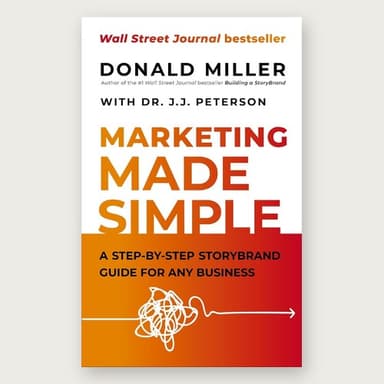
Marketing Made Simple by Donald Miller and Dr. J.J. Peterson: Summary and Notes
The full book, section by section.
Start hereThe short version
- 1Every customer relationship passes through three stages: curiosity, enlightenment and commitment. Part I, Chapters 1 to 3, explains why asking for the sale too early fails and why marketing, the words that state an offer, matters more than branding for most companies.The claim
- 2The funnel has five pieces: a one-liner built from problem, solution and result, a nine-section wireframed website that passes the Grunt Test, a lead-generating PDF, a nurture email campaign and a six-email sales campaign. Part II builds them in Chapters 4 to 9.The funnel
- 3J.J. Peterson's dissertation found the framework works only to the degree it is executed. Chapter 10 turns the funnel into six scheduled meetings, from the goal meeting to a printed table read and a results review, and the bonus interview adds email volumes and ad spend advice.The execution
The summaryAuthor's Note and Introduction
Donald Miller reads the audiobook himself and opens with a short note. The book is written in his voice, with his co-writer, Dr. J.J. Peterson, credited on a cover for the first time, and a rough draft compiled by Allie Fallon of Find Your Voice from hundreds of hours of the two of them teaching companies to build sales funnels. Readers can download a free paper wireframe and the book's examples at marketingmadesimplebook.com, and Miller says filling in that wireframe is how nearly every company StoryBrand has helped got started.
The introduction states the premise plainly. Whatever you sell, if you use words to sell it, a sales funnel will work, and the funnel is the foundation of a digital marketing plan that advertising then supports. A sales funnel is a way to capture and convert leads. Miller says StoryBrand has helped over 10,000 small, medium and large companies create sales funnels, and that he and Peterson have trained hundreds of StoryBrand certified marketing guides.
The book's empirical anchor is Peterson's doctoral dissertation on the StoryBrand messaging framework. Miller reports that Peterson defended the idea that the framework works for any business, large or small, B2B or B2C, and found that success hinges on one crucial imperative: execution. Clarifying a message is the start. Building and running the funnel is what grows the company, and that is what this book teaches.
"Marketing should be easy, and it should work."
Part IThe Three Stages of Relationship
Part I sets up why a funnel has the shape it does. It covers the plan Miller wishes he had followed, the psychology of how any relationship moves from first contact to commitment, and an overview of the checklist the rest of the book builds out piece by piece.
Chapter 1The One Marketing Plan You Will Never Regret
Twenty years earlier, Miller had just written his first bestselling book. His first book had sold so few copies that, as he puts it, only his mother bought them. He notes that more than 99% of book writers fail to sell enough copies to make a living, and he assumed success would keep coming on its own: more bestsellers, crowds at every speech, perhaps movies. None of it followed. By his own calculation he wasted about 10 years by resting on that success instead of building a platform.
Then he lost everything. He had put all his money into an investment, and on a bright and cool September morning he got a call saying it had failed and his life savings was gone. Miller says that not having a marketing plan cost him millions of dollars, serious international influence and the chance to accomplish some of his dreams. This book is the letter he would write to himself 20 years back.
The plan he should have followed has five parts. Create a brand script to clarify the message. Distill it into a one-liner. Wireframe a landing page that elaborates on that message clearly. Create a lead-generating PDF to capture email addresses. Then send an automated email campaign that builds trust and asks for the sale. Miller presents these as the steps that keep momentum going after any early success.
Chapter 1 · The plan he should have followed
"Not having a marketing plan cost me millions of dollars, serious international influence, and the chance to accomplish at least some of my dreams."
Chapter 2The Actual Stages of a Relationship
Asking for a sale is a relational proposition, Miller argues, and relationships have rules. Most businesses ask for the sale the way a shy young boy asks a girl to the movies in the school hallway, with a firm handshake and an invitation to come along with his mom. Relationships are built slowly, and every one, including the relationships people have with brands, passes through three stages: curiosity, enlightenment and commitment.
Curiosity is a snap judgment that comes down to one question: can this person, product or service help me survive? Miller describes human beings as collectors of physical, emotional and social resources, like the squirrels in his backyard gathering nuts. A person with no curiosity filter would stand in the kitchen all day wondering how the toaster works. Customers scan the 3,000 pieces of marketing collateral they encounter each day and ignore anything that does not connect to their survival, so the header of a website, an email subject line, the title of a lead generator and an elevator pitch all need to state succinctly one way you help people survive. Customers are curious about how you can solve their problem, and much less about you.
Enlightenment answers the next question, which is how. Miller's example is his own purchase. He and his wife, Betsy, often host listening parties in Nashville for artists working on albums, and after the fifth or sixth one he decided the tiny Bluetooth speaker in their kitchen was no longer good enough. A search led him to Oswald's Mill Audio, whose turntable weighed 80 pounds and whose speakers looked like steel bullhorns from an old football stadium. The company's videos explained the physics of sound waves and how their system worked, and that explanation moved him from curious to enlightened.
Commitment comes last because it requires a calculated risk, and risk works against the survival mechanism. Miller met Betsy at a bed and breakfast where she worked, and his only goal that first morning was to avoid spilling coffee on his shirt. He did not ask her out, for the same reason many businesses do not ask customers to commit: fear of rejection and of seeming pushy. He says the hesitation nearly cost him the relationship. When the time is right, a brand has to make its intentions known.
Chapter 2 · Three stages of a relationship
"Your customers are not curious about you. They are curious about how you can solve their problem."
Chapter 3An Introduction to the Marketing Made Simple Checklist
Many companies confuse branding with marketing, and Miller says the confusion is costing them millions. Branding affects how a customer feels and concerns itself with fonts, colors and design. Marketing puts the right words together to pique interest and close the deal. He compares a business absorbed in branding to an NFL coach who spends 90% of his time on the logo, the jerseys and game day trinkets while the team never drills the fundamentals.
Coca-Cola can afford to do more branding than marketing because it has extreme brand familiarity: it was invented in the 19th century, marketed brilliantly in the early 20th, and hundreds of millions of dollars have been spent telling the world what it is. Most companies have nothing close to that. Miller imagines an automotive product that lets you change your oil once a year and says a billboard for it would need to say exactly that, to drivers passing at 80 miles per hour. He estimates, anecdotally, that more than 50% of advertising fails this test. GEICO's line is the model: in only 15 minutes, GEICO can help you save up to 15% on car insurance.
The Marketing Made Simple checklist is the collection of best practices StoryBrand has learned from helping more than 10,000 businesses. Its five tools map onto the three stages: a one-liner and website to create curiosity, a lead generator and nurture emails to enlighten, and a sales email campaign to ask for commitment. Miller also says StoryBrand hired an independent research company to survey thousands of its customers about who sees greater success from clarifying their message.
Chapter 3 · Five tools for three stages
"Branding affects how a customer feels about your brand, while marketing communicates a specific offer."
Part IICreate Your Marketing Made Simple Sales Funnel
Part II walks through the five tools in order: a one-liner, a website or landing page, a lead-generating PDF, an email nurture campaign and an email sales campaign. Miller argues that marketing has some art in it but is mostly a science anyone can learn, and he deputizes the reader as a part-time marketer, whatever their job title.
Chapter 4Create Your One-Liner
Miller opens with a joke about his failed childhood magic, including a sister's goldfish that started flopping again during its backyard funeral, and then says he started believing in magic again when he discovered the one-liner. Words make worlds, and a one-liner is a concise statement that clearly explains what you offer. It is the most powerful tool for making customers curious, the sentence that makes people lean in at a cocktail party.
The idea comes from Hollywood. A screenwriter writes a logline, one sentence that makes investors take a risk on the story and later makes audiences pick the film. A confusing logline costs producers millions at the box office. A business one-liner has three parts.
- You're Already an Impact Business22 to 30
- You're Closer Than You Think14 to 21
- You Have the Foundation7 to 13
- The Starting Line0 to 6
 Printable PDF
"Miller and Peterson say a clear message grows a business only once you build the five-piece funnel and run it. So where does your business need the work first? Ten questions, a score on four parts of it and the part to fix first. It's free with your email. Go find out."
 Deven Davis, devendavis.com
- Ten questions about where your business is right now
- A score out of 30
- A four-part breakdown: Impact Clarity, Traction Proof, Model Strength, Founder Credibility
- The part to fix first
- Your tier's next steps
- A printable PDF
Free with your email. Your score and a printable PDF open right on the page.
The problem comes first, because stating it opens a story loop and raises the perceived value of the solution. Miller's example is a Nashville bike store: with 110 people moving to Nashville every day, people are wasting more and more time sitting in traffic. The solution closes the loop and should invite no new questions. A vitamin company that says its patented formula was created by 10 of the world's most recognized nutritionists has said nothing about the customer's problem; a formula that gives balanced energy from morning until night has. A lawnmower that works like a Roomba beats one guided by 10 different satellites. The result describes how the customer's life will look once the problem is solved, sharpened by asking what that results in until the answer is something the customer feels.
The finished one-liner belongs everywhere: on business cards, the website, email signatures and in what every employee says when someone asks what the company does.
Chapter 4 · The one-liner
"Clarity sells, while cute and clever confuse."
Chapter 5A Wireframed Website That Works
A great website can be worth hundreds of thousands or even millions of dollars, Miller says, yet most companies pay a designer who cares more about colors and images than about the words, and words are what sell. At the StoryBrand workshop he puts client websites on a big screen at the end of the second day and has reviewed thousands. The common mistakes: too much insider language, too many words in the header, passive calls to action that are not repeated down the page, images unrelated to the product, and cute or clever language.
A website must pass the Grunt Test. A stranger should be able to say within seconds what you offer, how it will make their life better and what they need to do to buy it. Miller cites Chow Liu and colleagues at Microsoft Research, who found that the first 10 seconds on a page are the most critical for a visitor's decision to stay or leave. The wireframe has nine sections.
1. The header carries a headline that passes the Grunt Test, an image of a happy customer or the product, and a direct call to action, placed at the top right of the page and repeated in the center. Miller says getting the header right means you are 50% done. 2. The stakes show what the customer will lose by not acting. A story without stakes is no story, and an outside consultant once caught StoryBrand's own site lacking any. A little goes a long way here, since negative stakes can be overdone. 3. The value proposition lists benefits to raise perceived value. For an HVAC maintenance package that costs $200 a year, adding that it will never break down raises perceived value to $300, never having to schedule maintenance raises it to $350, and clean air all year takes it to something like $500.
4. The guide positions the business as the helper through empathy and authority, using testimonials, logos and statistics. 5. The plan gives three or four simple steps so buying feels easy. 6. The explanatory paragraph is where longer copy goes for readers who want detail, and it also helps search ranking. 7. The video repeats the pitch, and Miller notes one study showing 33% of viewers click away within the first 30 seconds of a web video, so it has to grab attention fast. 8. Price choices show packages, ideally three. 9. The junk drawer is the footer, where everything else lives: links, staff, careers and contact details.
Chapter 5 · The nine sections of a website
"If you get the header of your website right, you are 50% done with your website."
Chapter 6Lead Generator
Once someone is curious, a lead generator gives them a reason to trade their email address, which Miller compares to handing over a $10 or $20 bill. It works like asking for a phone number after an interesting first meeting: let me send you that information. A good lead-generating PDF takes about 20 minutes to read, a real commitment from a busy customer.
The chapter gives a checklist for what a lead generator should do. Position yourself as the guide, with empathy and authority. Stake claim to your territory and differentiate from the crowd. Qualify the audience, so a firm targeting first-time investors might offer Five Mistakes People Make With Their First Investment while a more advanced audience gets something else. Create trust by solving a problem, since customers who see you solve one problem will trust you with more. Generate reciprocity by giving real value. Give it an interesting title, because nobody wants a white paper or a case study but people will download the five mistakes most people make when training a puppy.
The Founder Brain Kit
Miller adds a list of formats, from checklists and interviews with experts to webinars, samples and live events, and examples such as 10 Terrific Ways to Start a Speech for a speaking coach. He says StoryBrand built its entire early business on one PDF, Five Things Your Website Should Include, and that about 60% of the lead generators his team has created found an audience while 40% were duds.
Chapter 6 · The lead generator trade
"Free value leads to trust."
Chapter 7The Power of Email
A customer who gives an email address is a hot lead, and failing to follow up is like getting someone's phone number and never calling. Miller recommends two kinds of campaigns: a nurture campaign that keeps in touch and earns trust over time, and a sales campaign that closes the sale. People worry that they email too often, but they are writing to people who asked to hear from them, and Miller says that his free business tip every weekday at businessmadesimple.com has brought in tens of thousands of subscribers and very few unsubscribes.
For people who do not know where to start, he offers writing tips: read the subject lines in your own inbox and notice which ones you open and why, use short words, use short sentences and use short paragraphs. Long sentences require the reader to burn mental calories, and an email that unfolds like a book gets closed.
Chapter 7 · Short words, short sentences
"By trying to sound smart and interesting, we often sound dumb and dull."
Chapter 8Nurture Email Campaigns
Nurture emails, sometimes called drip campaigns, keep a relationship warm until the customer is ready. Most customers have to hear about a product five or six times before buying, because they trust the familiar. Miller counts the touchpoints: a friend mentions you, then another friend, then the website, the PDF, several emails, a conversation at work and another email. A business can send nurture emails once a week for seven years before a purchase and still be building the relationship, and even emails that get deleted unread keep the name in front of the customer.
"Miller and Peterson hand you the funnel. Here's the one page that sits underneath it: purpose, opportunity, leverage, model. The same four questions Ivystone uses to evaluate deals, fill-in-the-blank, done in 47 minutes on average. A dollar. Go do it."
Deven Davis, devendavis.com- The P-O-L-M framework (Purpose, Opportunity, Leverage, Model) used by institutional investors to evaluate early-stage deals
- A fill-in-the-blank worksheet that produces a one-page business gameplan in one sitting
- Bonus: The 48-Hour Quick Start, the exact first 3 steps to take today
One dollar, backed by the Dollar-Back Promise, and done in 47 minutes on average.
StoryBrand sends a nurture email every Monday morning previewing its podcast, which gives it a reason to write to the whole list each week with expert content and an ad for its products at the bottom. The other dependable format is the weekly tip. Miller's example starts with a clear title, 10 tips for losing 15 pounds, then empathizes with how hard the last pounds are, gives the tips and closes with a call to action for the product. The aim of every nurture email is the same: offer real value that relates to the problem your products solve.
Chapter 8 · Touch points before a purchase
"Stay connected until they want to make a purchase."
Chapter 9Sales Email Campaigns
Where the nurture campaign builds trust, the sales campaign closes the deal by giving the customer something to accept or reject. Business relationships are transactional, Miller argues, and if you fear asking for money, you do not believe in your product. If it truly solves people's problems, selling it is the right thing to do. Passive-aggressive selling, mentioning products without ever asking for the order, reads to customers as weak, the way it did when he dated and kept dropping hints instead of asking a girl out.
He lays out six emails that have worked, he says, for thousands of clients. Email one delivers the asset the customer signed up for and explains how to use it. Email two names the problem and the solution, empathizing with the customer's pain. Email three is a customer testimonial, short and full of sound bites. Email four overcomes a common objection that stops people from buying. Email five is a paradigm shift, language that says, in Miller's words, "you used to think this, but now you should think this way." Email six is the sales email, and it does only one thing: ask for the sale.
Chapter 9 · The six-email sales sequence
"Give the customer something to accept or reject."
Chapter 10How to Execute the Marketing Made Simple Sales Funnel
Hope means nothing without execution. Miller's friend Doug told his wife he intended to help more around the house, and she explained that intentions do not cook the rice. Peterson's dissertation, Miller reminds the reader, showed the framework helps a business grow only to the degree it is actually executed. So the chapter turns the funnel into a series of six scheduled meetings with web designers, copywriters, approving managers and support staff, each with objectives and accountability.
Meeting one, the goal meeting, decides exactly what will be sold and sets goals by establishing three specific numbers, starting with the actual goal. Meeting two creates the BrandScript and then the one-liner, which is a truncated version of it. Meeting three wireframes the website, using a sample agenda from the companion PDF. Meeting four assigns the lead generator and email sequences, mostly to copywriters, with designers and whoever runs the email platform kept in the loop. Meeting five brings the campaign together in printed form for a table read, like the cast of a film reading the script before shooting. At StoryBrand's last table read, Miller says, the team realized it had hardly mentioned customers' problems at all. Meeting six analyzes results and decides what to tweak.
Chapter 10 · Six meetings to build the funnel
"Stop talking and do the work."
ConclusionImagine a Year From Now
The conclusion is a single page. Miller asks the reader to imagine having built one or two sales funnels a year from now and to picture the revenue and what that revenue allows. Other parts of marketing exist, he says, but these are the basics, and if the plan is followed it will produce results.
"This really is Marketing Made Simple, and it will work for you."
Audiobook bonusBonus Interview with the Authors
The audiobook ends with Miller and Peterson in conversation. Peterson says he assembled the sales funnel portion and Miller refined it, though they built the system together over the past few years with others on staff and taught it to thousands. Their aim was an assembly line any business leader can follow, in place of 50 pieces to plug and tweak, and Peterson will be teaching it in a course at a major university.
In the Q&A they put numbers on the advice. A sales campaign runs from eight to about 15 emails, with two or three on the last day, and a nurture campaign runs weekly for about 8 to 12 weeks, ideally longer. Miller says StoryBrand's unsubscribe rate is less than 1% as long as the emails keep delivering value. On paid advertising, he recommends starting with five hundred dollars or a hundred dollars and tweaking ads at low risk before scaling slowly, and he says StoryBrand built a $4 million business without Facebook ads or billboards. An About Us page should say that you care about the pain the customer experiences and have created a product to solve it. They also take the common question of whether the funnel works differently for B2B and B2C businesses.
"Let's just make it an assembly line that any business leader can actually follow."