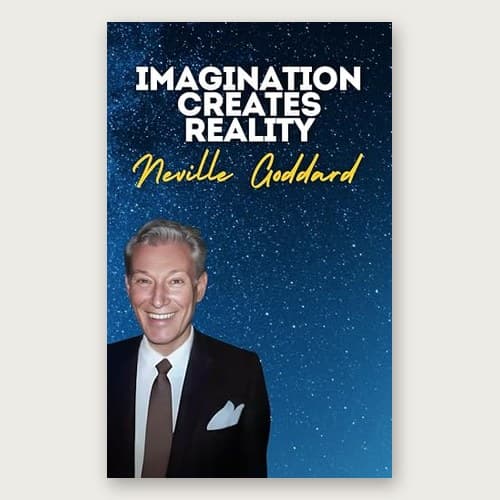
Imagination Creates Reality by Neville Goddard: Summary and Notes
The full book, section by section.

Start hereThe short version
- 1Imagination is the creative power of God within you, and consciousness is the only cause of what appears in your world. Chapters 1 to 3 give the method and the law: relax, enter the end result with all five senses, release it, and remember that only thought joined with feeling creates.The claim
- 2Every I am statement is a creative declaration, so the word if goes and inner talk has to match the wish. Chapters 4 to 10 cover I am, choice, desire, observing your thoughts, disregarding appearances, inner conversations and nightly revision of the day.The practice
- 3Every state already exists, life is a play authored by the dreamer, and its purpose is to wake up knowing you are God. Chapters 11 to 13 widen the frame, and Chapter 14 closes on case histories of people who used the method.The frame
The summaryThe Lectures
Imagination Creates Reality gathers Neville Goddard's teaching into 14 short chapters. The first six lay out the doctrine: imagination is the creative power of God within each person, creation is finished, and consciousness is the one cause of everything a person meets. The middle chapters turn the doctrine into daily practice, from watching inner talk to revising the day's events before sleep. The last three widen the frame to the whole of life as a dream authored by God, then close on case histories of people who used the method. Several chapters are told in the first person by a student who attended Neville's lectures, so the voice shifts between the teaching itself and stories about the teacher.
Chapter 1Imagination Creates Reality
The book opens on its central claim: a person's own imagination is the creative power of God within them, and it is their savior in the same way water saves the thirsty and employment saves someone who needs a job. Nothing is impossible to it. Goddard's first example is a person confined to a wheelchair who imagines running on the beach until the scene takes on the tones of reality.
The method is laid out step by step. Relax in a chair or on a bed and close the eyes. Decide what you wish to experience, then bring to mind the end result. For a promotion, the end result might be friends congratulating you, a larger office or a raise in pay. Take one of those events and actually hear the congratulations and feel the friend's hand in yours. The imaginal act is instantaneous, but in a three-dimensional world events appear in a time sequence, so it may take a short interval to show up outside. Open your eyes, go about your normal affairs, and keep your inner conversations in line with what you imagined.
Goddard insists the scene be entered, more than watched. Picturing a new car in the mind's eye falls short; you sit behind the wheel, smell the newness of the interior and feel the happiness of the finished dream. He calls the act a fact in the fourth dimension of space that will appear in this world as surely as a planted seed grows, and warns against uprooting the seed by worrying about how it will happen. If other people are needed, imagination draws them into the drama. The only responsibility is to stay faithful to the imaginal act, repeating it each night before sleep until it feels natural, with all five senses in play: the smooth wood and keys of a new piano, the fragrance and velvety petals of a dozen roses. Beyond that, the reader does nothing to obtain the desire; any needed action comes in a normal, natural way, and when the desire comes to mind during the day, the reader gives thanks that it is already done.
Chapter 1 · Imagination creates reality
"You must make then now and make there here."
Chapter 2One Cause
Goddard reads "nothing is impossible" two ways: anything can be achieved, and nothing cannot exist, since something cannot come from nothing. According to the Bible, creation is finished and God called it good. He asks what God could have used to create, and answers that God made everything out of the only substance available, himself. God is the creator and the creation, and the one substance behind everything is energy, which is God, or the word.
If creation is good, why do wars, crime and starvation exist? He answers with mathematics. Adding five and six can produce the wrong answer of twelve, and removing twelve from the numbers to prevent the error would also make it impossible to add six and six correctly. Mathematics survives because people learn the principle, and creation works the same way. God gave everyone free will to choose the states they occupy, does not predetermine fate and does not punish. A man who subtracts wrongly in his check register is hurt by his error, never by the law of mathematics.
From this he draws the chapter's flat claim that thought, belief and imagination created each person's world, and there is no other cause. Blaming others, fate or chance misses that the world reflects what a person believes about themselves and others. He applies the claim to illness: if viruses or germs truly caused disease, everyone who came in contact with one would be affected. Prayer, read this way, means believing you have already received. Most people petition God to change something and, when nothing changes, decide God withheld it or they were undeserving. Goddard says prayers are always answered because a person always receives what they believe, and faith is the substance of things hoped for, the evidence of things unseen. Because creation is finished, what you want already exists and is activated by the belief that you already have it.
Chapter 2 · One cause
"Consciousness is the only reality."
Chapter 3How the Law Works
The law of identical harvest, cause and effect, is impersonal. Every possible state already exists, and fusing with a state by imagining with feeling what you would experience in it projects that state on your screen of space. The law always reproduces outside the exact duplicate of a belief you consent to as true, so changing your world means changing your beliefs. What appears now, however fixed it looks, is a reflection of earlier activity in consciousness, and a change in consciousness shows up in the future just as past beliefs show up in the present.
Not every thought is creative. Only thoughts believed to be true, or joined with feeling, create circumstances, which makes emotions such as anger, fear, love and joy creative. Goddard tells the reader to guard which emotions enter the mind the way they would screen a stranger at the door of their home. Fear of loss brings loss, whatever outward precautions are taken. Love and joy create happy events, feeling abundant brings riches, and a suspicious person who feels others take advantage of him draws exactly that. Like attracts like: as within, so without.
Chapter 3 · How the law works
"Fear of loss brings loss into your world."
Chapter 4Conscious Use of the Law
This chapter is spoken in the first person, and the speaker says 66 books have been written about who I am. In Exodus, Moses asks who he should say sent him, and the voice answers that I am has sent him, a name forever. The commandment against taking the Lord's name in vain is read as a statement about that name: every time a person says "I am" and follows it with something, they are using God's creative name, and nothing said after it is in vain. People say I am hundreds of times a day without knowing it.
A person can lie and not believe the words, the chapter says, but cannot believe something about I am without creating it. Saying "I don't feel well" and believing it perpetuates illness, so the statement changes to "I feel wonderful," said with belief and never like a parrot. The second word to watch is "if." "I feel wonderful" followed by a plan to see a doctor on Tuesday if the pain continues lets doubt in to steal the seed. If puts everything in the past or future tense, while I am is present, and getting well is a different thing from being well. The reader is told to monitor every I am statement, see the pattern it has made in their life, and make each one conform to what they want.
Chapter 4 · The power of I am
"We are creating morning, noon, and night by our I am statements."
Chapter 5Choice, Free Will
Because creation is finished, free will comes down to choosing which state to occupy, and the only free will a person can exercise is the choice of what to focus attention on. Once a thought is accepted and charged with feeling, the creative power within externalizes it, and assumptions, conscious or unconscious, direct all action toward their fulfillment. Goddard calls it a delusion that anything other than assuming the feeling of the wish fulfilled can aid its realization.
- You're Already an Impact Business22 to 30
- You're Closer Than You Think14 to 21
- You Have the Foundation7 to 13
- The Starting Line0 to 6
 Printable PDF
"Neville says assume the feeling of the wish already fulfilled, with all five senses, as if it's happening now. Here's one practical step to go with it: know where you're starting. Ten questions, a score on four parts of your business and the part to fix first. It's free with your email."
 Deven Davis, devendavis.com
- Ten questions about where your business is right now
- A score out of 30
- A four-part breakdown: Impact Clarity, Traction Proof, Model Strength, Founder Credibility
- The part to fix first
- Your tier's next steps
- A printable PDF
Free with your email. Your score and a printable PDF open right on the page.
People live in a sea of ideas from the radio, the television news and gossip. Any of it that calls forth an emotion plants a seed. Thoughts do not recede into the past; they advance into the future to meet the person who planted them. He suggests waking each morning and imagining the end of the day with everything accomplished, and spending a few moments imagining the outcome wanted for any situation of concern later that day.
Chapter 5 · Choice, free will
"Choice is what you will focus your attention upon, is the only free will that you can exercise."
Chapter 6Desire
Desire is a gift of God, and accepting it only requires giving thanks for the unseen reality before it appears. Through desire God beckons people to higher levels of consciousness, and the urge to do, be and have more is the urge for expansion. Goddard takes on the hard case of a desire to kill or injure someone and argues that no one actually desires to harm another. The person wants to be free of that seeming other and, with limited understanding, believes destroying the other is the only way. The desire for freedom already contains the power and means of its fulfillment, and lack of faith is what distorts it. The reader is told to be grateful for their desires, which already exist, and to accept them as they would a gift from a loved one, without doubting how they will come.
Chapter 6 · Desire
"Desire is a gift of God."
Chapter 7Be Observant
The narrator, describing themselves as impatient and eager to get home after work, noticed that every stop at the market met a delay at the checkout: price checks, people writing checks who could not find their identification. Watching their own thoughts, they found they were saying in line, "I always have to wait." They changed the statement to "no matter when I stop at the market, I never have to wait," and report that the new statement worked as well as the old negative one had. The chapter's advice is to observe your thoughts without discouragement when inner talk does not match the wish, because you have to see what you are doing with your creative power before you can change it. The potter's house image closes it: if the vessel is spoiled, rework it into one that pleases you.
Chapter 7 · Be observant
"You alone can change it."
Chapter 8Appearances
What confronts a person now is the result of past thoughts, beliefs, feelings and imaginal activity, and those appearances last as long as attention keeps them alive. The reader is told to disregard the evidence of the senses about any unwanted condition and feel instead that the wanted one is already attained.
The narrator tells of being in their early twenties, in a situation they badly wanted out of. After a lecture they explained it to Neville, who smiled and said, "Don't accept it." Thinking he had misunderstood, they explained that they had chosen the situation themselves, and he smiled and said it again. They left frustrated, kept reading the two Neville books they owned, and gradually understood that circumstances need not be accepted as final. Two weeks after starting their imaginal acts an event took place that led, five months later, to a brand new home, and the situation itself improved in the meantime.
The chapter points to how people already use the principle in reverse, thinking a looked-forward-to event is too good to be true until something spoils it. Habit keeps thoughts in old negative ruts, and no one else can change them. Persistence in assuming you are the person you wish to be, whatever the present circumstances, is named as the only condition imposed.
Chapter 8 · Appearances
"Appearances confirm our former habitual patterns of thought."
The Right to Be Rich
Chapter 9Inner Conversations
Everyone speaks inwardly every waking moment, and those conversations must match the wish fulfilled. Someone who imagines being congratulated on a wonderful new job undercuts it by thinking that the boss never promotes anyone, or that any job, never mind a better one, would be hard to find. Someone who imagines a new car in the garage should hold the inner conversations of an owner: telling friends about the fuel mileage, hearing them say how much they enjoy riding in it. Goddard says inner conversations are as creative as deliberate imagining and, when they run the opposite way, can negate it. When they contradict the wish, revise them.
Chapter 9 · Inner conversations
"Our inner conversations are just as creative as our deliberate imagining of the wish fulfilled."
Chapter 10Revision
The present world reflects the sum of what a person believes about themselves and others, and what they imagine today goes forward to meet them. Revision is the tool for changing the effects of earlier thoughts. If someone interviews for a job they truly wanted and later hears another candidate was hired, they can revise the news into the words they wished to hear. Reacting with depression would bring the same rejection again, since reactions of either kind are creative.
The practice is to review each day and revise every negative reaction so it is remembered as what you wished had happened. Because what is felt with emotion is the real fact and the outer world is a delayed reflection, Goddard says revising a conversation, an unhappy experience or a quality in yourself literally changes the past, and the revised scene goes forth to change future events. Dwelling on old hurts keeps a vicious circle going; revision breaks it.
Chapter 10 · Revision
"Revision is truly the key, which can be used to unlock the doors that have kept you trapped in a particular state."
Chapter 11States of Consciousness
All states exist as a fixed part of creation, and a person can enter one consciously or fall into one inadvertently. A state is total, so whoever occupies it behaves as it dictates. In the state of poverty a person is always short of funds, and even a large gift of money soon disappears if they stay in that state. The reverse holds for a state of wealth. Most people credit a change of fortune to a change in circumstances, but Goddard says no change of circumstance lasts unless the state itself has changed, and moving into another state in imagination changes the outer world automatically.
"Neville says assume the feeling of the wish already fulfilled, as if it's happening now. Look, that takes reps. The Identity Shift gives you 30 days of them, built on Wattles' Impression of Increase: a prompt, a reflection and an intention each day. Seven bucks, and the Quick Win Guide gets you a first result in under an hour. Start tonight."
Deven Davis, devendavis.com- 30 days of guided identity reprogramming, rooted in Wattles' Impression of Increase principle
- Each day has a prompt, a reflection and an intention
- Bonus: The Quick Win Guide, your first identity shift result in under 1 hour
- Bonus: a 5-minute video from Deven on why identity precedes strategy
Seven dollars, with the No-Brainer Guarantee: if it doesn't change how you think about yourself and money within the first week, full refund.
He reads the Bible as a catalog of states personified by name: Moses, Noah, Job, Peter, Andrew and Jesus. The journey begins with Adam, who fell asleep and dreamed the dream of life, and ends in the state of Jesus Christ, where a person knows themselves to be God the Father, with a son symbolized as David who personifies all of humanity.
Chapter 11 · States of consciousness
"All states exist and are a fixed part of creation."
Chapter 12The Play
The chapter starts from Shakespeare's line that all the world's a stage. Waking life is as much a dream as the dreams of sleep, only with continuity. God is the dreamer and plays every part, so everyone who appears in a person's world is God playing that part for the author. Each person writes their own script, and a dissatisfied author rewrites it rather than demanding that the actors change. Someone who irritates you has no choice but to play the part your script calls for, and nothing done on the outside will change them. Revision is the editing tool: change a line of dialogue, replace a character, write happy endings to the subplots. The character who disturbed you today will not do so tomorrow if you write the dialogue you wish to hear.
Chapter 12 · The play
"All changes must take place in the mind of the author."
Chapter 13Your Real Purpose
God became man so completely that he forgot he was God, reaching the limit of contraction and opacity in order to animate his creation. He then passes through good and evil and even death, confident that man will wake from the dream of life and know again that he is God. Imagination is God in action; I am is Christ in you, the power and wisdom of God. God speaks through desire, and in using imagination to fulfill desires a person is experiencing God at work. Man's purpose, the chapter says, is to experience scripture, every state personified in the Bible, until he reaches the state called Jesus Christ. Along the way he may pursue possessions, power or fame, but eventually the hunger to know God comes, followed by the experiences that bring back the memory that he is God the Father.
Chapter 13 · Your real purpose
"Your own wonderful human imagination is God in action."
Chapter 14Case Histories
The book ends on case histories, each person identified by initials. Mrs. A.B. had taught the principle to her three children, ages twelve, ten and six, though her husband stayed skeptical. On a Sunday drive the family found a tract of new homes they loved, but they had little equity in their current house and an agent's commission would eat it. She placed a small newspaper ad to sell the house themselves. A few nights later she took the children to the tract, found a model unlocked, and walked through it in the dark while each child chose a bedroom; she told them to sleep in the new house in their imagination that night. That same week a man answered the ad, came back with his wife, and agreed to her asking price. He turned out to be a real estate agent who handled the escrow through his company. The sale produced the exact down payment, and they moved in a month later.
Mrs. C.D., recently divorced and receiving no child support, had been left an old, unreliable car that died in a flooded intersection one rainy Friday. The next Monday a co-worker insisted she drive her new Pontiac Tempest back from lunch, and Mrs. C.D. felt the thrill of owning it. All week she imagined driving a new car of her own. The following Friday her ex-husband, now selling cars, called to offer a new car with no money down that he would pay for in lieu of child support. The model eligible for the deal was a Pontiac Tempest.
Mrs. E.F. wanted to live by the ocean and lease her home for a year first. A friend agreed to imagine visiting her at the beach, and they did so for one week. While Mrs. E.F. was on a scheduled vacation in Hawaii, a friend in San Diego called about a perfect year-round rental, and she took it on the friend's word. Back home, her daughter found someone who wanted to lease her house. A nurse, she found a new hospital job, later bought a house near the ocean, and has spent 17 years at the beach. The narrator draws the lesson: after imagining the wish fulfilled, do nothing.
E.P., an outrigger canoe paddler, was on a team that placed seventh in the 50-mile race from Molokai to Honolulu, where Hawaiian teams were considered unbeatable. He spent the next year imagining his team had won while forming a new team and building his own canoe. The following year his team finished first, ahead of the Hawaiians, and he holds a paddle engraved World Champion. He went on to coach and to make paddles used by top teams.
Mrs. J.K., divorced and living with her children in her twin sister's crowded home, wanted to marry and have her own house. She, her twin and a friend imagined a ring on her finger for several weeks, but whenever she imagined her own home it came out exactly like her sister's. Helping a friend wallpaper a kitchen in the same tract, she met a neighbor and married him five months later. Only four homes in the tract of 1,200 had the same floor plan as her sister's, and her husband owned one of them. The last story is about Mrs. L.M., a doubter who imagined receiving a handkerchief to test the idea, got one in the mail with a thank-you note, and was so frightened that she called it black magic and wanted to hear no more. The narrator closes by saying they could relate hundreds of such incidents.
Chapter 14 · Case histories
"It is only necessary to go to the end, to live in the end."