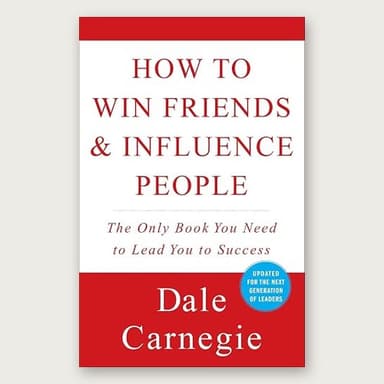
How to Win Friends & Influence People by Dale Carnegie: Summary and Notes
The full book, section by section.
Start hereThe short version
- 1Dealing with people is a skill that can be learned, and it starts with three moves: don't criticize, condemn or complain; give honest, sincere appreciation; and arouse in the other person an eager want. That is Part One, three chapters that the rest of the book builds on.The claim
- 2People like those who are genuinely interested in them. Part Two gives six ways: become interested in others, smile, remember names, listen, talk in terms of the other person's interests, and make the other person feel important, sincerely.Being liked
- 3You win people to your way of thinking by avoiding arguments, respecting their opinions and letting the idea become theirs, the twelve principles of Part Three. Part Four adds nine ways to lead and correct people without giving offense or arousing resentment.Persuading and leading
The summaryHow This Book Was Written and Why
Carnegie had run courses for business and professional people in New York since 1912, first in public speaking, until he saw that his students needed training in getting along with people even more, and that he did too. He writes that research under the Carnegie Foundation for the Advancement of Teaching, later confirmed at the Carnegie Institute of Technology, found that even in engineering about 15% of financial success came from technical knowledge and about 85% from skill in human engineering. A survey of adults in Meriden, Connecticut, which cost $25,000 and asked 156 questions, found that people's second interest after health was how to understand and get along with people, yet no practical textbook existed.
So he wrote one. He and a researcher read everything they could find, including over 100 biographies of Theodore Roosevelt alone, and he interviewed people from Marconi and Edison to Franklin D. Roosevelt and Clark Gable. The material became a talk, then a lecture of an hour and 30 minutes that students tested in their own lives and reported back on, a laboratory of human relationships. The rules grew from a postcard to a leaflet to booklets, and after 15 years became this book. His example: an employer with 314 employees who had only ever criticized them turned 314 enemies into 314 friends. He closes with Herbert Spencer's line that the great aim of education is action.
"And this is an action book."
Part OneFundamental Techniques in Handling People
Part One sets out three principles that the rest of the book builds on: don't criticize, condemn or complain; give honest, sincere appreciation; and arouse in the other person an eager want.
Chapter 1"If You Want to Gather Honey, Don't Kick Over the Beehive"
On May 7, 1931, 150 police officers besieged Two-Gun Crowley, a killer who had shot a policeman asking for his license. Bleeding, Crowley wrote that under his coat was a weary heart, but a kind one. Al Capone called himself a misunderstood public benefactor, and the warden of Sing Sing told Carnegie that few of his prisoners regarded themselves as bad men. Carnegie concludes that 99 times out of 100, people excuse themselves for anything, however wrong. He cites B.F. Skinner's finding that animals rewarded for good behavior learn faster than animals punished for bad behavior, and later studies showing the same for humans.
Theodore Roosevelt's attacks on Taft split the Republican Party, which carried only two states in the following election, and still left Taft saying he could not see how he could have done differently. Lincoln learned the lesson after his ridicule of James Shields nearly ended in a duel with broadswords; when General Meade let Lee escape after Gettysburg, Lincoln wrote a scathing letter and never sent it. Carnegie adds Bob Hoover, the test pilot who, after a mechanic fueled his plane with the wrong fuel, asked the same mechanic to service his F-51 the next day, and the essay "Father Forgets" by W. Livingston Larned, about a father ashamed of a day of scolding his small son.
Chapter 1 · Don't kick over the beehive
"Criticism is futile because it puts a person on the defensive and usually makes him strive to justify himself."
Chapter 2The Big Secret of Dealing with People
There is only one way to get anybody to do anything: make the other person want to do it. Freud named the desire to be great, John Dewey the desire to be important, and William James the craving to be appreciated. Carnegie's father's blue ribbons at county fairs, Lincoln studying law books from a barrel, Rockefeller funding a hospital in Peking and Dillinger announcing himself as public enemy number one all came from the same hunger; what differs is how people satisfy it. He goes as far as a psychiatrist's view that some people find in insanity the feeling of importance they could not find in reality.
Charles Schwab, paid a million dollars a year, said his greatest asset was his ability to arouse enthusiasm, and that the way to develop the best in a person is by appreciation and encouragement. Rockefeller congratulated a partner who lost a million dollars for saving 60% of the investment. A husband asked to list six things his wife could improve sent her six red roses instead. Carnegie separates appreciation from flattery: one is sincere, the other insincere; one comes from the heart out, the other from the teeth out. He asks readers to stop thinking about themselves, which people do about 95% of the time, and look for the other person's good points.
Chapter 2 · Appreciation, not flattery
"Flattery is counterfeit, and like counterfeit money, it will eventually get you into trouble if you pass it to someone else."
Chapter 3"He Who Can Do This Has the Whole World with Him. He Who Cannot Walks a Lonely Way"
Carnegie likes strawberries and cream, but he baits his hook with worms because that is what fish want. Emerson and his son pushed and pulled a calf toward the barn without success; the housemaid let the calf suck her finger and led it in. Harry A. Overstreet's advice gives the chapter its title: first arouse in the other person an eager want. Andrew Carnegie won a $100 bet by writing his neglectful nephews a chatty letter mentioning a $5 bill he never enclosed; replies came by return mail.
Facing a rent increase of almost three times on a hotel ballroom, Carnegie listed the advantages and disadvantages to the manager without mentioning his own wishes, and the increase dropped to 50%. He quotes Henry Ford: the secret of success lies in seeing things from the other person's angle as well as your own. He shreds a self-centered advertising agency letter, rewrites a freight terminal's letter around the customer's interests, and tells of Barbara Anderson, whose letter to 12 banks about how she could help them drew interviews from eleven. A child who refused to eat changed his mind when told he could one day beat the neighborhood bully; another stopped wetting the bed once he had pajamas like his father and a bed he chose himself. Carnegie adds that this is never manipulation for one side's gain; both parties should benefit.
Chapter 3 · Arouse an eager want
"So the only way on earth to influence other people is to talk about what they want and show them how to get it."
Part TwoSix Ways to Make People Like You
Part Two gives six principles for being liked: become genuinely interested in other people, smile, remember names, listen, talk in terms of the other person's interests, and make the other person feel important, sincerely.
Chapter 1Do This and You'll Be Welcome Anywhere
The greatest winner of friends, Carnegie says, is the dog, who makes a living giving nothing but love; his own dog, Tippy, was killed by lightning when Carnegie was a boy. A New York Telephone Company study found the word "I" used 3,900 times in 500 conversations. Alfred Adler wrote that the individual not interested in other people has the greatest difficulties in life. The magician Howard Thurston, seen by more than 60 million people, told himself before every show that he loved his audience.
Theodore Roosevelt phoned his valet's wife to tell her a bobwhite was outside her window and greeted White House kitchen staff by name. A Johnson & Johnson salesman kept an account because he always said hello to the soda clerk. Carnegie kept a birthday book and sent letters that were often the only ones remembered. A banker got a reluctant executive to share everything he knew by bringing stamps for his 12-year-old son, and a fuel salesman who asked a chain store executive for help with a debate was given an hour and 47 minutes and, eventually, an order. He closes with Martin Ginsberg, alone in a hospital ward at ten on Thanksgiving, and the student nurse who stayed with him until almost 11 p.m.
Chapter 4 · Become genuinely interested
"You can make more friends in two months by becoming interested in other people than you can in two years by trying to get other people interested in you."
Chapter 2A Simple Way to Make a Good First Impression
A wealthy woman covered in sables and pearls made a poor impression because her face radiated sourness. Schwab said his smile had been worth a million dollars. A smile says I like you, I'm glad to see you; a baby's smile once turned a tense veterinary waiting room into a friendly one. Carnegie asked thousands of business people to smile at someone every hour for a week. William B. Steinhardt, married over 18 years and a self-described grouch, began smiling at his wife, the doorman and people on the stock exchange floor, and reported more happiness at home in two months than in the previous year, and more dollars every day.
If you don't feel like smiling, force yourself; William James held that by regulating action we can indirectly regulate feeling. Happiness depends on what you think about your circumstances. A Chinese proverb says a man without a smiling face must not open a shop.
Chapter 5 · Smile
"Actions speak louder than words, and a smile says, I like you, you make me happy, I'm glad to see you."
Chapter 3If You Don't Do This, You Are Headed for Trouble
Jim Farley left school to work in a brickyard after his father was killed by a horse, never went to high school, and became chairman of the Democratic National Committee and postmaster general. Carnegie credited him with calling 10,000 people by their first names; Farley corrected him to 50,000. He collected names and family facts and wrote thousands of personal letters signed Jim. As a boy Andrew Carnegie got friends to feed his rabbits by naming the rabbits after them, and later named a steel mill after the Pennsylvania Railroad's president and offered George Pullman the name Pullman Palace Car Company. Franklin D. Roosevelt remembered and thanked a shy mechanic he had met once. Napoleon III asked for spellings, repeated names and wrote them down before tearing up the paper.
Chapter 6 · Remember names
"Remember that a person's name is to that person the sweetest and most important sound in any language."
- You're Already an Impact Business22 to 30
- You're Closer Than You Think14 to 21
- You Have the Foundation7 to 13
- The Starting Line0 to 6
 Printable PDF
"Carnegie's whole method comes down to one move: find what the other person already wants and show them the path to it. Fair enough. Your customers want something too, right? Ten questions, a score out of 30 and the part of your business to fix first. It's free with your email. Go find out."
 Deven Davis, devendavis.com
- Ten questions about where your business is right now
- A score out of 30
- A four-part breakdown: Impact Clarity, Traction Proof, Model Strength, Founder Credibility
- The part to fix first
- Your tier's next steps
- A printable PDF
Free with your email. Your score and a printable PDF open right on the page.
Chapter 4An Easy Way to Become a Good Conversationalist
At a dinner party Carnegie listened to a botanist for hours and said almost nothing, and the botanist called him a most interesting conversationalist. Harvard's Charles W. Eliot held that exclusive attention to the speaker is the most flattering thing there is. A store nearly lost a long-time customer whose damaged coat a clerk refused to discuss; the manager listened and kept her. A New York Telephone Company troubleshooter listened to a furious customer for nearly three hours across four visits until he paid his bills and withdrew his complaints. Edward Bok, a poor immigrant boy, wrote to famous people asking about their lives and was invited to dinner by General Grant. Lincoln once called an old friend to Washington, talked for hours and sent him home without asking his opinion.
Chapter 7 · Be a good listener
"To be interesting, be interested."
Chapter 5How to Interest People
Theodore Roosevelt read up the night before on whatever his next visitor cared about. William Lyon Phelps remembered a lawyer who talked boats with him for an evening only because the boy loved boats. A Boy Scout leader asked to see a corporate president's framed million-dollar check before mentioning his request and came away with a trip for five boys, himself and a $1,000 letter of credit. A baker who had called on a hotel manager every week for four years got the order after talking about the manager's passion, the Hotel Greeters of America.
Chapter 8 · Talk about their interests
"Talk in terms of the other person's interests."
Chapter 6How to Make People Like You Instantly
Carnegie told a bored postal clerk he wished he had his head of hair, and when asked what he wanted out of it, said he wanted the feeling of doing something for someone who could do nothing in return. The one law of human conduct is to make the other person feel important, the golden rule that Carnegie traces through Zoroaster, Confucius, Lao Tse, Buddha, Hinduism and Jesus. Hall Caine, a blacksmith's son with eight years of schooling, wrote a lecture praising Rossetti and became his secretary and a famous novelist. A widow gave a visitor who admired her house her late husband's Packard. James Adamson, warned to take no more than five minutes of George Eastman's time, admired his office, stayed for hours and won the $90,000 seating order and a lifelong friendship.
Chapter 9 · Make them feel important
"Always make the other person feel important."
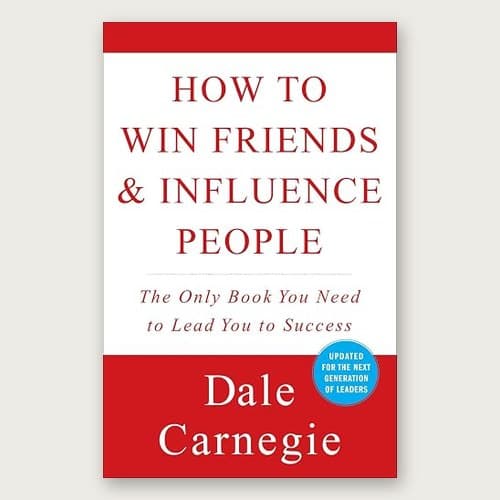
A note on editions: the print and audiobook links sell the classic text these notes follow. The Kindle link goes to the later edition Updated for the Next Generation of Leaders, a different text.
Part ThreeHow to Win People to Your Way of Thinking
Part Three is the persuasion core: twelve principles for changing minds without argument, from avoiding arguments altogether to throwing down a challenge.
Chapter 1You Can't Win an Argument
At a banquet for Sir Ross Smith, Carnegie corrected a guest who attributed a line to the Bible; his friend Frank Gammond, a Shakespeare scholar, kicked him under the table and sided with the guest, then explained on the way home that the line was from Hamlet but that proving a man wrong at a festive occasion would only make him dislike you. Nine times out of ten, an argument leaves each side more convinced. Patrick J. O'Hare won arguments and lost sales until he learned to agree that a rival truck was good. An income tax consultant stopped arguing over $9,000 with an inspector, praised his experience, and had the return accepted. Carnegie lists steps from Bits and Pieces for keeping a disagreement from becoming an argument: welcome it, distrust your first reaction, control your temper, listen first, look for agreement, be honest, promise to think it over and thank your opponent.
Chapter 10 · You can't win an argument
"You can't win an argument. You can't because if you lose it, you lose it. And if you win it, you lose it."
Chapter 2A Sure Way of Making Enemies, and How to Avoid It
Theodore Roosevelt said he would be satisfied to be right 75% of the time; if you could be sure of being right even 55% of the time, Carnegie writes, you could make a million dollars a day on Wall Street. Telling people they are wrong strikes at their intelligence and pride. Phrases such as "I may be wrong. I frequently am. Let's examine the facts" disarm. A young attorney who bluntly corrected a Supreme Court justice lost the room. Benjamin Franklin, rebuked as a youth by a Quaker friend, banned words like "certainly" and "undoubtedly" from his speech in favor of "I conceive" and "it so appears to me at present," and credited the habit for his influence. A lumber salesman let an inexperienced inspector discover for himself that the white pine was within grade and was paid in full.
Chapter 11 · Never say "You're wrong"
"Show respect for the other person's opinions."
Chapter 3If You're Wrong, Admit It
Caught a second time with his dog off leash in Forest Park, Carnegie confessed before the mounted policeman could speak, and the officer ended up urging leniency. A commercial artist condemned his own small error so thoroughly that a critical art director defended him, took him to lunch and gave him another commission. Robert E. Lee, after Pickett's Charge, rode out alone to meet his beaten troops and took the whole blame. In Hong Kong, a father who had been estranged from his son for years set aside tradition, admitted he had wronged him and met his grandchildren.
Chapter 12 · If you're wrong, admit it
"I, and I alone, have lost this battle."
Chapter 4A Drop of Honey
In 1915 John D. Rockefeller, Jr., the most despised man in Colorado during a bloody coal strike, spent weeks visiting miners' homes and then addressed their representatives as friends; the strikers went back to work. When 2,500 employees struck at the White Motor Company, its president praised them in the newspapers and bought baseball bats for the pickets, who in turn cleaned the factory grounds. A tenant praised his building and was offered a rent reduction. An engineer talked first about his developer's vacation and got his $2,000 of water damage paid. Carnegie retells Aesop's fable of the sun and the wind.
Chapter 13 · A drop of honey
"It is an old and true maxim that a drop of honey catches more flies than a gallon of gall."
Chapter 5The Secret of Socrates
Begin with what you agree on and get the other person saying yes, because, as Overstreet explains, a no sets the whole body against acceptance and pride demands consistency. A bank teller won over a customer who refused to fill in a form by asking whether he would want his money passed to his next of kin. Joseph Allison of Westinghouse, after 13 years of calls on one account, answered a complaint that his motors ran too hot with a chain of yes questions about standards and room temperature, ending with whether the engineer would scald his hand at 147 degrees, and lined up about $35,000 of business. Socrates built his whole method on such questions.
Chapter 14 · The secret of Socrates
"Get the other person saying yes, yes at the outset."
The Founder Brain Kit
Chapter 6The Safety Valve in Handling Complaints
Most people trying to persuade talk too much. A textile salesman who lost his voice before a pitch let the automaker's president argue his case for him and won a contract worth $1,600,000. A mother who finally asked her rebellious daughter why, and listened, got her daughter back. A job applicant who researched a founder's early struggles let him talk about them and was hired. La Rochefoucauld's advice closes the chapter: to make friends, let your friends excel you.
Chapter 15 · Let the other person talk
"Let the other person do a great deal of the talking."
Chapter 7How to Get Cooperation
People trust ideas they discover themselves. An auto sales manager asked his team what they expected of him, then what he could expect of them, and got a moral bargain. Eugene Wesson failed 150 times to sell sketches to a stylist until he brought unfinished ones and asked how to complete them. An X-ray manufacturer asked a hospital's department head for advice on its new machines, and he sold himself. Colonel House planted ideas so that Woodrow Wilson would later present them as his own, and let him take the credit. Lao Tse observed that rivers and seas reign over mountain streams because they keep below them.
Chapter 16 · Let the idea be theirs
"Let the other person feel that the idea is his or hers."
Chapter 8A Formula That Will Work Wonders for You
Other people may be wrong, but they don't think so; find the reason they act as they do. A husband who mocked his wife's lawn work joined her pulling weeds and complimented her instead. Carnegie stopped threatening boys who built fires in the park and began asking whether they were having a good time, explaining the danger and asking them to rake the leaves away. A woman behind on her car payment apologized for being a troublesome customer and was given until the end of the month. Dean Donham of Harvard said he would rather walk the sidewalk for two hours than enter an interview without knowing what the other person was likely to answer.
Chapter 17 · See it their way
"Try honestly to see things from the other person's point of view."
Chapter 9What Everybody Wants
Carnegie offers a magic phrase: I don't blame you one iota for feeling as you do; if I were you, I would undoubtedly feel just as you do. Three-fourths of the people you meet, he says, are hungering for sympathy. After he mistakenly placed Louisa May Alcott's home in New Hampshire on the radio, he phoned the woman who had sent him the angriest letter, apologized, and ended with her apologizing to him. President Taft answered an ambitious mother's furious letters with sympathy. A piano teacher praised a student's beautiful long nails before suggesting she trim them, and she did. The impresario Sol Hurok handled Chaliapin's pre-performance panics with sympathy, sympathy and more sympathy.
Chapter 18 · Sympathy
"Three-fourths of the people you will ever meet are hungering and thirsting for sympathy."
Chapter 10An Appeal That Everybody Likes
J. Pierpont Morgan observed that a person usually has two reasons for doing something, one that sounds good and a real one. A landlord told a tenant threatening to break his lease that he had sized him up as a man of his word, and the tenant stayed. Lord Northcliffe asked a paper to stop using a photo because his mother didn't like it, and Rockefeller asked photographers to spare his children because it was not good for youngsters to get too much publicity. A credit man asked six customers disputing bills to adjust them as fair-minded people; five gave the company the best of it, and all six bought new cars within two years.
Chapter 19 · Appeal to nobler motives
"Appeal to the nobler motives."
Chapter 11The Movies Do It. TV Does It. Why Don't You Do It?
Merely stating a truth isn't enough; it has to be made vivid. The Philadelphia Evening Bulletin answered a rumor that it carried too little news by printing one day's reading matter as a 307-page book. A cash register salesman threw a handful of pennies on a grocer's floor. An employee who could not get time with her boss sent him a form letter to fill in with a time and got an hour. James B. Boynton, after losing an argument about his research methods, dumped 32 jars of competing cold cream on a client's desk, each tagged with its findings, and talked for an hour.
Chapter 20 · Dramatize your ideas
"Merely stating a truth isn't enough."
"Carnegie says show people the path to what they already want, through you. A good deck does exactly that. The Pitch Kit gives you 5 Sequoia-style templates for an investor, a partner or a big client, in Canva and Google Slides. Seven bucks, and a first draft in 60 minutes, about one lunch hour. Go build it."
Deven Davis, devendavis.com- 5 Sequoia-style deck templates in Canva and Google Slides
- Covers the essential pitch deck, the one-pager and early-stage variations
- Bonus: The Deck Doctor, Deven's 5-minute video on the 3 slides people skip to first
- Bonus: The Quick Win Guide, to have your first draft in 60 minutes
Seven dollars, with the No-Brainer Guarantee: if the templates don't save you at least 10 hours of work, full refund.
Chapter 12When Nothing Else Works, Try This
Charles Schwab asked a day shift how many heats they had made, chalked a big 6 on the mill floor and left. The night shift rubbed it out and wrote 7; the day shift answered with 10, and the lagging mill soon led the plant. Theodore Roosevelt stayed in the race for governor when challenged as the hero of San Juan Hill, and Lewis Lawes took the job of warden at Sing Sing after Al Smith said it would take a big person. Carnegie cites Frederick Herzberg, who studied the work attitudes of thousands of people and found the work itself was the greatest motivator.
Chapter 21 · Throw down a challenge
"The way to get things done, says Schwab, is to stimulate competition."
Part FourBe a Leader
Part Four carries the subtitle How to Change People Without Giving Offense or Arousing Resentment. Its nine principles cover correcting and motivating people while keeping their goodwill.
Chapter 1If You Must Find Fault, This Is the Way to Begin
Calvin Coolidge complimented a secretary's dress before asking her to be more careful with punctuation. McKinley praised a supporter's unsuitable campaign speech before asking him to write another along different lines. Lincoln's 1863 letter to General Hooker, which sold for $12,000 at auction in 1926, praised Hooker's bravery and confidence before naming his grave faults. A contractor's envoy praised a bronze subcontractor's name and factory and left with a promise of on-time delivery without asking for it. Carnegie compares beginning with praise to a barber's lather or a dentist's Novocaine.
Chapter 22 · Begin with praise
"Begin with praise and honest appreciation."
Chapter 2How to Criticize, and Not Be Hated for It
Schwab found men smoking under a No Smoking sign, handed each a cigar and asked them to smoke outside. John Wanamaker quietly served a neglected customer himself. Carnegie recommends changing one word: praise followed by "but" makes the praise sound like a setup, while praise followed by "and" keeps it whole. A homeowner thanked builders for a tidy yard after cleaning it herself, and they kept it tidy. Lyman Abbott's wife said his dull sermon would make an excellent magazine article, and he preached without notes.
Chapter 23 · Call attention indirectly
"Call attention to people's mistakes indirectly."
Chapter 3Talk About Your Own Mistakes First
About to criticize his 19-year-old niece and secretary, Josephine, Carnegie remembered his own mistakes at 19 and began instead by admitting them. An engineer showed his secretary the little book of words he himself misspelled. Prince von Bülow, after telling Kaiser Wilhelm II that no one could believe he had advised such blunders, recovered by praising the Kaiser's superior knowledge and humbling himself. A father who described his own addiction to cigarettes kept his son from smoking and quit himself.
Chapter 24 · Your own mistakes first
"It isn't nearly so difficult to listen to a recital of your faults if the person criticizing begins by humbly admitting that he, too, is far from impeccable."
Chapter 4No One Likes to Take Orders
A man who shared an office with Owen D. Young for three years never heard him give a direct order; he gave suggestions such as "you might consider this." An instructor who screamed at a student to move his car turned the whole class against him. A plant manager facing an impossible deadline asked his employees questions, and they found ways to take the order and deliver it on time.
Chapter 25 · Ask questions, not orders
"Ask questions instead of giving direct orders."
Chapter 5Let the Other Person Save Face
General Electric moved Charles Steinmetz out of a department he ran poorly by giving him a new title, consulting engineer, for work he already did. An accountant began letting seasonal staff go with specific praise for their work, and they came back gladly. A vice president who berated a supervisor in a meeting lost a good worker to a competitor, while a boss who backed a young marketer in front of her colleagues after her test failed won lasting loyalty. Antoine de Saint-Exupéry wrote that diminishing a man in his own eyes is a crime.
Chapter 26 · Let them save face
"Let the other person save face."
Chapter 6How to Spur People On to Success
Animal trainer Pete Barlow praised and fed his dogs at the slightest improvement; Carnegie asks why we don't use meat instead of a whip with people. Caruso's mother praised the voice a teacher had dismissed, Dickens was transformed by one editor's acceptance, and H.G. Wells was rescued from drudgery by his old schoolmaster's encouragement. Skinner showed that minimizing criticism and emphasizing praise reinforces good behavior. Carnegie stresses that praise works best when it is specific, and repeats that he means a new way of life, never a bag of tricks.
Chapter 27 · Praise every improvement
"Abilities wither under criticism. They blossom under encouragement."
Chapter 7Give a Dog a Good Name
If you want to improve a person in some respect, act as though the trait were already one of their outstanding characteristics. Shakespeare advised, "Assume a virtue if you have it not." A service manager reminded a slipping mechanic of his fine record. Georgette Leblanc told Marie the dishwasher that she did not know the treasures within her, and two months later Marie announced her marriage. A dentist thanked his cleaner for her fine work and mentioned the cup holders, which gleamed the next day. A teacher greeted the school's worst troublemaker, Tommy T, as a natural leader, and he lived up to it.
Chapter 28 · Give a dog a good name
"Give the other person a fine reputation to live up to."
Chapter 8Make the Fault Seem Easy to Correct
A dance teacher who said a man's fundamentals were sound kept him learning after another had told him to start over. Lowell Thomas got Carnegie to play bridge by telling him it was only memory and judgment. Ely Culbertson made bridge his profession because his wife convinced him he had a flair for it. Clarence M. Jones helped his son David, labeled brain injured and placed in classes for slow learners, master arithmetic with nightly flashcards, celebrating as his time fell from 52 minutes toward the 8-minute goal. David went on to win prizes in science fairs and make the honor roll through high school.
Chapter 29 · Make the fault easy to correct
"Make the thing seem easy to do."
Chapter 9Making People Glad to Do What You Want
When Wilson chose Colonel House over William Jennings Bryan as peace emissary, House told Bryan he was too important to go without attracting attention, and Bryan was satisfied. Wilson made William Gibbs McAdoo feel he was doing the president a favor by joining the cabinet, yet snubbed Republican leaders over the League of Nations, with consequences Carnegie calls history-altering. A store manager made a careless employee supervisor of price tags, and Napoleon, criticized for handing out 15,000 Legion of Honor crosses, replied that men are ruled by toys. Carnegie gives six guidelines: be sincere, know exactly what you want, be empathetic, consider the benefits to the other person, match them to that person's wants, and frame the request so the person sees the benefit. He allows that the approach will not always work, but even a 10% improvement makes you 10% more effective as a leader.
Chapter 30 · Make them glad to do it
"Make the other person happy about doing the thing you suggest."