How to Talk to Anyone by Leil Lowndes: Summary and Notes
The full book, section by section.
Start hereThe short version
- 1Successful people win by their more skillful way of dealing with others. Dale Carnegie said what to do, and Lowndes breaks the how into 92 named tricks, framed by the difference between walking into a room saying here I am and saying there you are.The claim
- 2The first impression comes before a word is spoken. Part One, tricks 1 to 9, covers the smile, eye contact, posture and body language, and Parts Two and Three, tricks 10 to 37, cover small talk and talking like a VIP.First moves
- 3The rest builds rapport and keeps it. Parts Four to Six, tricks 38 to 59, cover sounding like an insider, creating similarity and praising well; Parts Seven and Eight, tricks 60 to 77, cover the phone and working a party; Part Nine, tricks 78 to 92, gives the unspoken rules behind favors, safe havens and the great scorecard in the sky.The system
How to Talk to Anyone on four pages
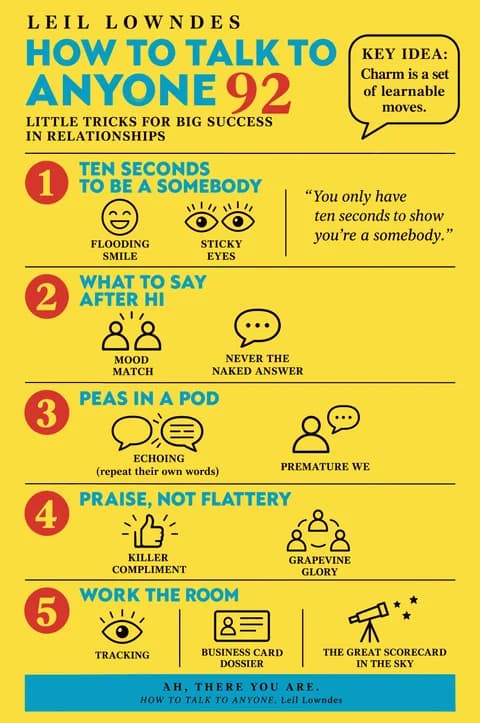
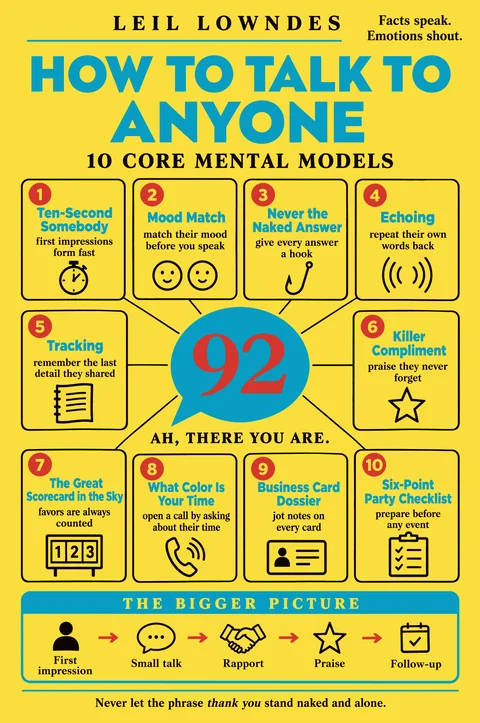
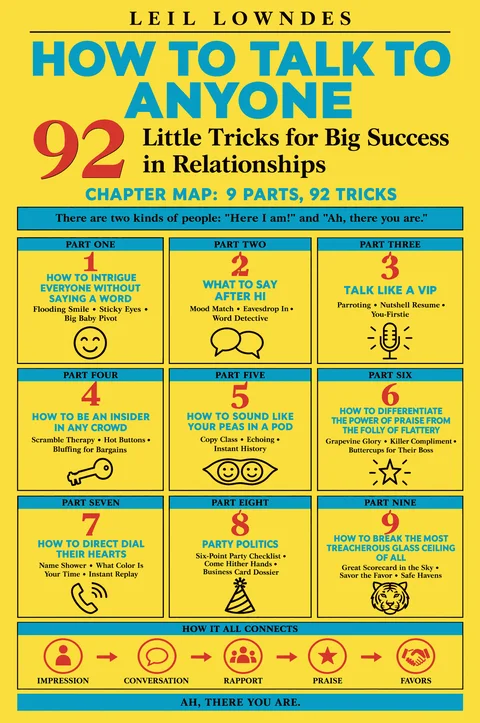
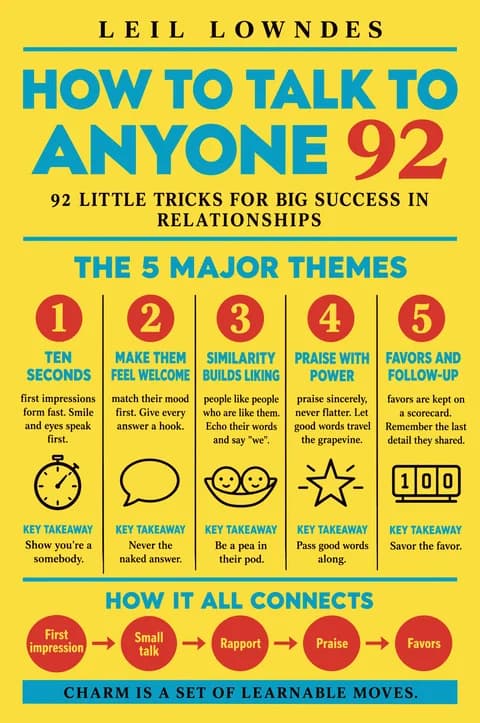
Four printable posters in the cover's colors: big ideas, mental models, a chapter map, and major themes.
Free. You'll also get each new summary by email.
The summaryIntroduction
Lowndes opens with the line that frames the book: there are two kinds of people, those who walk into a room and say here I am, and those who walk in and say there you are. She asks why some people seem to have the best jobs, spouses, friends and bank accounts when many of them are no smarter, better educated or better looking. Her answer is their more skillful way of dealing with other people. Nobody gets to the top alone, and the people who complain about cliques or glass ceilings, she argues, often never realize they lost the deal or the friendship through their own communication fumbles.
Introduction · Two kinds of people
A drama teacher once told her that the face can make 7,000 different expressions and that the way you move is your autobiography in motion. She cites a University of Pennsylvania communications authority's estimate that as many as 10,000 units of information flow per second between two people. Most of what she read confirmed Dale Carnegie's 1936 advice to smile, show interest in other people and make them feel good about themselves. She gives two reasons a new book is needed: Carnegie said what to do without saying how, and the world has changed since 1936, with cynical business people now reading more subtleties into a smile or a compliment. So she studied top salespeople, speakers, clergy, performers and athletes, broke their moves into small techniques, and gave each one a name that comes to mind in the middle of a conversation. The result is 92 little tricks in nine parts.
"There are two kinds of people in this life. Those who walk into a room and say, well, here I am. And those who walk in and say, ah, there you are."
Part OneHow to Intrigue Everyone Without Saying a Word
Part 1 covers the first ten seconds, before anyone speaks. Lowndes's friend Robert Grossman, a caricature artist, told her he captures a personality simply by looking at the subject, because almost every facet of it shows in appearance, posture and movement. She writes that the way you look and the way you move is more than 80 percent of someone's first impression. Grossman's formula for drawing somebody who is a somebody became her checklist: great posture, a heads-up look, a confident smile and a direct gaze. The next nine techniques, she says, make you stand out in any crowd, even one that is not yours.
Part 1 · The ten-second somebody
"You only have ten seconds to show you're a somebody."
Trick 1How to Make Your Smile Magically Different
Her college friend Missy, taking over the family box company, won three new clients in one dinner. Missy's father had shown her a study finding that women in business who were slower to smile were seen as more credible. Lowndes spent several months watching smiles and found that the people seen as having the most integrity were slightly slower to smile. The Flooding Smile: look at the other person's face for a second, pause, then let a big, warm smile flood over your face and into your eyes, so the delay makes it feel genuine and meant only for them.
Trick 1 · The flooding smile
Trick 2How to Strike Everyone as Intelligent and Insightful by Using Your Eyes
Lowndes reports a Boston study in which people tricked into intense eye contact, by counting their partner's blinks, left the two-minute chat with more respect and fondness for each other, and a Yale study in which men felt hostile or threatened when another man stared too long. A hearing-impaired seminar participant who watched her lips the whole talk inspired her even though she was only lip reading. Sticky Eyes: keep your eyes on your conversation partner even after they finish speaking, and break away slowly, like stretching warm taffy. Men should use a little less of it with other men on personal matters. Her friend Sammy, a salesman, said it changed how people treated him.
Trick 3How to Use Your Eyes to Make Someone Fall in Love with You
Epoxy Eyes takes three people. Keep watching your target, the listener, even while someone else is talking, or in a gentler version let your glance bounce to the target each time the speaker finishes a point. It signals intense interest and confidence and is used by interviewers, attorneys and police investigators. She says intense eye contact releases a substance associated with romantic excitement, so it works on someone who finds you attractive and is obnoxious to someone who does not. Never use it on strangers in public.
Trick 4How to Look Like a Big Winner Wherever You Go
Winners hold their heads high and their shoulders back. Remembering the great Wallendas from the circus, Lowndes offers a visualization for posture: before walking through any door, picture a circus acrobat's leather bit hanging from the frame, bite it, and let it lift you into perfect alignment. She counted 60 doorways in one day, so the image becomes a habit. That is Hang by Your Teeth.
Trick 5How to Win Their Heart by Responding to Their "Inner Infant"
Everyone silently asks a new acquaintance how they are doing so far, and jury consultants read the answer in posture and hands. Her friend Carla gave half smiles to interested men at a party, then gave the hostess's five-year-old son a huge smile, a full turn of her body and a touch on the arm. When Lowndes asked her to treat the next man the same way, Carla left the party on his arm. The Big-Baby Pivot: give everyone you meet the warm smile, total body turn and undivided attention you would give a baby.
Trick 6How to Make Someone Feel like an Old Friend at Once
Quoting Zig Ziglar that people don't care how much you know until they know how much you care, Lowndes notes that our bodies respond perfectly only around people we already love. Hello, Old Friend: when meeting someone, imagine they are a dear old friend you lost touch with and have just found again. You say only a polite hello, but your whole body warms up. She reports an Adelphi University study in which volunteers told to act as if they liked unsuspecting subjects ended up genuinely liking them, and the subjects returned the feeling.
Trick 7How to Come Across as 100 Percent Credible to Everyone
Her friend Helen, a headhunter, caught a job applicant lying by watching her shift, cross her legs, touch her mouth and rub her arm only when asked why she left her last job. Lowndes notes that innocent people fidget too, from nerves or a hot room, and listeners read it as lying; pundits blame Nixon's mopping and fidgeting for the 1960 debate. Limit the Fidget: when the conversation counts, don't scratch, squirm or wiggle, and keep your hands away from your face.
Trick 8How to Read People Like You Have ESP
Clever Hans, a Berlin horse in the early 1900s, seemed to do arithmetic and answer questions by tapping his hoof. A second commission found he simply watched the audience relax when he reached the right number. Hans's Horse Sense: while you talk, keep watching how your listeners react, from nods and open palms to looking away or feet pointed at the door, and adjust as you go. People will say you never miss a trick.
Trick 9How to Make Sure You Don't Miss a Single Beat
Athletes visualize their events before performing. Her friend Richard, bedridden after a car crash three weeks before the New York Marathon, ran the full 26 miles, 385 yards in his imagination each day and finished the race without injury. Watch the Scene Before You Make the Scene: before a party or meeting, relax and rehearse yourself using the first eight techniques, so they happen automatically when you arrive.
Part TwoHow to Know What to Say After You Say "Hi"
Part 2 tackles small talk, which Lowndes says brighter people tend to hate most, and which she compares to stage fright that troubles even great performers. She describes her own childhood shyness and her first prom invitation, which went by mistake to a boy named Donnie, who put her at ease with small talk and became her first boyfriend. Small talk, she says, is the first crucial step toward being a dynamic conversationalist.
Part 2 · Make a mood match
"When it comes to small talk, think music, not words."
Trick 10How to Start Great Small Talk
At a Mensa convention, when Lowndes remarked that a slow elevator seemed flaky, every passenger pounced with a technical explanation, and their energy jarred her tired mood. A maître d' who answered her excited party plans without a smile lost the booking. Small talk, she writes, is about music and putting people at ease. Make a Mood Match: before you speak, read your listener's mood and voice and match it, if only for a sentence or two.
Trick 11How to Sound like You've Got a Super Personality (No Matter What You're Saying!)
A party guest held a crowd spellbound saying banal things with great passion. In 1943, linguist and later senator S.I. Hayakawa, stared at suspiciously in a Wisconsin train station, made unoriginal remarks about the late train and a couple's child, and within ten minutes they invited him to dinner. Prosaic with Passion: almost any opening line works if it puts people at ease and is said with passion, except anything complaining, rude or unpleasant, since your first words are the stranger's whole sample of you.
Trick 12How to Make People Want to Start a Conversation with You
Wear or carry something unusual, a pin, a tie, an unusual purse, that gives people an excuse to ask what it is. Lowndes wears her grandmother's lorgnette, and her friend Alexander carries Greek worry beads. Look for other people's conversation pieces too, like a golf club lapel pin on someone you want to meet.
- You're Already an Impact Business22 to 30
- You're Closer Than You Think14 to 21
- You Have the Foundation7 to 13
- The Starting Line0 to 6
 Printable PDF
"Lowndes gives every people skill a name so you can use it on the spot. Here's the same idea for your business: ten questions, a score on four parts of it and the part to fix first. It's free with your email. Go find out."
 Deven Davis, devendavis.com
- Ten questions about where your business is right now
- A score out of 30
- A four-part breakdown: Impact Clarity, Traction Proof, Model Strength, Founder Credibility
- The part to fix first
- Your tier's next steps
- A printable PDF
Free with your email. Your score and a printable PDF open right on the page.
Trick 13How to Meet the People You Want to Meet
Politicians ask the party giver who an interesting guest is and request an introduction, or at least pump the host for a fact, such as that the man loves to ski, to use as an icebreaker.
Trick 14How to Break into a Tight Crowd
Stand near the group you want to join, listen for a topic, and step in with a line like excuse me, I couldn't help overhearing, followed by something relevant, such as asking for advice on a destination they mentioned.
Trick 15How to Make "Where Are You From?" Sound Exciting
Lowndes froze when an association head told her she was from Columbus, Ohio. Never the Naked City: never answer where you are from with just a place name. Learn engaging facts about your hometown from the chamber of commerce or historical society and tailor the bait to the listener, as she shows with facts about Columbus for a business person, a history buff or someone with a German or Italian surname.
Trick 16How to Come Out a Winner Every Time They Ask, "And What Do You Do?"
A bare job title leaves the asker with nothing to say, as when a dinner partner announced he was a nuclear scientist and the table fell silent. Flesh out your job with a small story the listener can relate to, adjusted to who is asking, as an employment lawyer might describe one case to a young mother and another to a business owner.
Trick 17How to Introduce People Like the Host(ess) with the Most(est)
When introducing people, add a detail to each name, such as that John has a wonderful boat or that Susan edits a magazine, or a hobby or talent, as when a hostess introduced Gilbert by saying his gift is sculpting. The detail gives the two people something to talk about.
Trick 18How to Resuscitate a Dying Conversation
A cantankerous nursing home resident answered small talk about rain with the remark that it was good for the plants. When the young aide followed Lowndes's advice and asked whether she liked plants, the woman talked endlessly about her garden and her late husband, a gardener. Be a Word Detective: listen for any unusual reference or digression, because it is a clue to what the person wants to talk about, and pick up on it.
Trick 19How to Enthrall 'Em with Your Choice of Topic: Them!
Her friend Diane's favorite person at a party was a man named Dan who lives in Paris, produces sound and light shows around the world, and hang glides, yet she learned none of it because he kept asking about her. Sales trainer Brian Tracy teaches the same idea. The Swiveling Spotlight: picture a spotlight between you, and keep it shining on the other person.
Trick 19 · The Swiveling Spotlight
Trick 20How to Never Need to Wonder, "What Do I Say Next?"
When your mind goes blank, repeat the last two or three words the other person said in a sympathetic, questioning tone. Half asleep in her friend Phil's car, Lowndes kept parroting his phrases about the theater and he talked happily about Sweeney Todd for the whole 45-minute drive. A car salesman parroted a customer's doubts until the man admitted he wanted something sportier and bought a Lamborghini.
Trick 21How to Get 'Em Happily Chatting (So You Can Slip Away If You Want To!)
As a cruise director, Lowndes could not get the ship's Italian officers to mingle until a midnight rescue at sea. She then asked the doctor, the captain and another officer to tell the story to group after group, and they loved retelling it. Encore: in a group, ask someone to tell a story they told you earlier, one in which they come out the winner. Then you are free to slip away.
Trick 22How to Come Across as a Positive Person
Confessing a foible can endear a person of high stature, but when you first meet someone it makes them wonder what else you are hiding. Keep the skeletons in the closet until later in the relationship.
Trick 23How to Always Have Something Interesting to Say
Listen to a newscast or scan the paper before you go to a gathering. Lowndes tells of Sydney Biddle Barrows, who required her employees to keep up with the daily news after learning that 60% of their working hour was spent chatting, and says her business increased significantly.
Part ThreeHow to Talk Like a VIP
Like tigers in a clearing, people size each other up on first meeting, and humans judge communication skills. Lowndes repeats the claim that 85% of one's success in life is due to communication skills and cites a U.S. Census Bureau survey showing employers choose candidates with good communication skills over education and experience. One cliché or insensitive remark, she warns, can get you demoted in someone's eyes. The techniques in this part separate the big cats from the little ones.
Part 3 · One cliché down
"Mouthing a common cliché around uncommonly successful people brands you as uncommonly common."
Trick 24How to Find Out What They Do (Without Even Asking!)
Big cats never ask what you do. The question can embarrass people out of work, people in unloved jobs and mothers who chose to stay home, and leaving it out shows you value the person beyond their job. Ask instead, how do you spend most of your time?
Trick 25How to Know What to Say When They Ask, "What Do You Do?"
Her friend Roberto tailored truthful resumes to two companies and got them bidding for him. Lowndes says to prepare a dozen versions of your answer and lead with a benefit, the way Brian Tracy opens cold calls by offering a method that can increase sales 20 to 30 percent over the next 12 months, and the way her hairdresser Gloria described a different specialty to each person she met. Say I help people moving into our area find the right home, instead of a bare job title.
Trick 26How to Sound Even Smarter Than You Are
The difference between a respected vocabulary and a mundane one is only about 50 words. Look up the tired words you use every day in a thesaurus, try the alternatives aloud, and adopt the ones that fit; a man who tells his date she looks ravishing gets a different reaction than one who says you look great every time. Substitute a word a day for two months.
Trick 27How to Not Sound Anxious (Let Them Discover Your Similarity)
A man listened to Lowndes rave about skiing and only at the end mentioned he kept an apartment in Aspen, which made it unforgettable. When someone mentions an interest you share, let them enjoy talking about it, then casually reveal the connection, though not so late that it seems tricky.
Trick 28How to Be a "You-Firstie" to Gain Their Respect and Affection
The brain translates everything into how it affects me, so start sentences with you. Ask boss, can you do without me Friday, and tell a guest you will love this restaurant. Asking passersby could you tell me where the Golden Gate Bridge is got her better directions than other phrasings. She reports therapists' finding that institution inmates say I and me 12 times more often than people outside.
Trick 28 · Be a you-firstie
Trick 29How to Make Them Feel You "Don't Smile at Just Anybody"
A cruise passenger with a dazzling smile lost his appeal when he flashed the identical smile at everyone in the receiving line. Practice a range of smiles in the mirror and give each person a distinct one, with your biggest flooding smile for the most important. Lowndes reports a University of Missouri bar study in which men approached a woman 60% of the time when she smiled and 20% when she did not.
Trick 30How to Avoid Sounding like a Jerk
Successful people silently moan at phrases like tired as a dog or cute as a button, because a cliché signals an impoverished imagination. Avoid them.
Trick 31How to Use Motivational Speakers' Techniques to Enhance Your Conversation
Professional speakers use their hands, voices and silence, and they collect phrases. Broadcaster Barry Farber invents vivid similes, and speakers memorize escape lines for awkward moments. Lowndes cites catchy phrases that stuck, from political slogans to Mark Victor Hansen's retitling of his book as Chicken Soup for the Soul. Gather quotations and similes from books, make your humor relevant, and fit it to the situation, as she learned when love poems that charmed passengers bound for England bombed on a Caribbean cruise.
Trick 32How to Banter like the Big Shots Do (Big Winners Tell It like It Is)
Big cats skip euphemisms and say rich, toilet paper and the correct anatomical words, without resorting to vulgarity.
Trick 33How to Avoid the World's Worst Conversational Habit
At an ad agency president's dinner, a young guest teased the slightly tipsy host and hurt her date's standing. Never make a joke at anyone else's expense.
Trick 34How to Give Them the Bad News (and Have Them Like You All the More)
A grinning neighbor predicting rain on her picnic and a cheerful clerk announcing her bus had left made her furious. Deliver any news with the emotion the receiver will feel, not your own.
Trick 35How to Respond When You Don't Want to Answer (and Wish They'd Shut the Heck Up)
After her divorce, her client Barbara answered a persistent dinner companion three times with the same words in the same tone: we've separated, but the company is unaffected. Repeat your original response exactly until the questioner stops.
Trick 36How to Talk to a Celebrity
Leave celebrities alone at dinner. If you must approach, wait until someone is leaving, then tell them how much pleasure their work has given you, without judging the work. Mention recent work, include their companion in the conversation, and never ask a celebrity guest to perform.
Trick 37How to Make Them Want to Thank You
Always say thank you for something: for coming, for waiting, for being such a good customer. Lowndes thanks airline pilots for getting her there, and they respond warmly.
Part FourHow to Be an Insider in Any Crowd
At a party full of accountants, architects or publishers, outsiders stand silent with a pasty smile. As a teenager, Lowndes was tongue-tied around boys who talked about cars until her mother gave her a book on car models. Carnegie's advice to show sincere interest only goes so far, she says; people open up when you have enough knowledge of their field to ask the right questions.
Part 4 · A sampling
"A sampling gives you 80% of the conversational value."
The Founder Brain Kit
Trick 38How to Be a Modern-Day Renaissance Man or Woman
Her friends Rita, a bowler, and Walter, a whitewater rafter, had nothing to say to each other. One out of every four weekends, do something totally outside your pattern. Lowndes took a resort scuba dive in Bermuda and learned the insider questions divers ask each other, like whether they prefer wrecks or reefs.
Trick 38 · The Renaissance weekend
Trick 39How to Sound like You Know All About Their Job or Hobby
Every field has insider opening questions; writers ask each other fiction or nonfiction, and dentists ask general practice or specialty. Ask a friend in the field for a few, along with the dumb outsider questions to avoid. An artist friend might tell you to ask what medium an artist works in and whether there is a place you might see their work.
Trick 40How to Bare Their Hot Button (Elementary Doc-Talk)
Her friend John told his wife to ask doctors their specialty, their hospital affiliation and how the medical environment was affecting them, and she was the hit of the party. Find out each industry's burning issues and its insider greetings, such as break a leg for actors and see you at the big one, which won Lowndes smiles from firefighters.
Trick 41How to Secretly Learn About Their Lives
Read newspaper sections you normally skip, then trade journals and special-interest magazines. Insider words win people over: crew members work on a ship, and passengers who say boat reveal themselves as landlubbers; thanks to a gardening magazine, Lowndes talked flowers with a prospective client and steered the walk toward consulting work.
Trick 42How to Talk When You're in Other Countries
Her friend Geraldine flew 6,737 miles to Japan in jeans, pocketed her hosts' business cards, wrote on her own, opened their gift and hugged them, and was never invited back. Before going abroad, study the local customs and taboos, from business card etiquette to gestures that mean something offensive.
Trick 43How to Talk Them into Getting the "Insider's Price" (on Practically Anything You Buy)
Vendors give insiders better prices because they need less hand-holding. Her painter Iggy taught her what to say to a painter about prep and cutting in. Before a big purchase, visit several vendors to learn the lingo, such as the jeweler's terms for parts of a stone, then buy where you want to buy.
Part FiveHow to Sound Like You're Peas in a Pod
Birds of a feather flock together, and Lowndes says people are most receptive to those they believe share their values. She cites a study in which pairs told they were similar liked each other much more than pairs told they were dissimilar, though neither statement was true. She offers six techniques for creating a sense of similarity.
Part 5 · Peas in a pod
"Hearing their words come out of your mouth creates subliminal rapport."
Trick 44How to Make Them Feel You're of the Same "Class"
People of different backgrounds move differently, and people are comfortable with those who move as they do. Her friend Jeannie picked out the richest man in a Las Vegas casino, a fellow in torn jeans, because he moved like old money. Watch how your conversation partner moves and imitate the style, and match your manner to your product as well.
Trick 45How to Make Them Feel That You're Like "Family"
Every family, region and profession has its own words. Echoing means using the other person's exact words: toddler if a mother says toddler, profession for a lawyer and job for a construction worker, chalet when the owner says chalet. Her friend Phil lost an invitation by calling a woman's chalet a cabin. An office furniture seller uses agency, publishing house, firm or station depending on the client.
Trick 46How to Really Make It Clear to Them
After a meeting where men peppered her with football analogies, Lowndes recommends drawing analogies from the listener's world: sowing seeds for a gardener, a concept taking off for a pilot.
Trick 47How to Make Them Feel You Empathize (Without Just Saying "Yep, Uh Huh, Yeah")
When her friend Phil murmured uh-huh to her announcement that she would get tattooed all over, she knew he was not listening. Replace the grunts with complete, supportive sentences, such as I see what you mean.
Trick 48How to Make Them Think You See/Hear/Feel It Just the Way They Do
Her tap-dancing roommate Brenda experienced the world through her ears. Since it is hard to identify a person's dominant sense, match the sense they are using at the moment: I see what you mean for visual language, I hear you for auditory, I understand how you feel for kinesthetic.
Trick 49How to Make 'Em Think We (Instead of You vs. Me)
Conversation progresses through four levels: clichés, facts, feelings and personal questions, and finally we statements. Skip ahead by asking a new acquaintance's feelings and using we, as in they really laid out a nice spread for us.
Trick 50How to Create a Friendly "Private Joke" with Them
A company's team-building exercise ended with the CEO's broken toe and became a private joke. Lowndes and her friend Daryl, who grew up on a duck farm, still greet each other by quacking. Find a special moment from a first meeting and turn it into a shared refrain.
Part SixHow to Differentiate the Power of Praise from the Folly of Flattery
Compliments are the most widely used way of getting what you want, but in today's world unskilled or self-serving praise can ruin trust. Lowndes cites sociologists' findings that a compliment from a new person carries more weight, that praise is more credible to an unattractive person or one whose face you have never seen, and that a self-effacing preface helps only when the speaker is higher in status. She offers nine ways to praise.
Part 6 · Grapevine praise
"A compliment one hears is never as exciting as the one he overhears."
Trick 51How to Compliment Someone (Without Sounding Like You're Brownnosing)
Thomas Fuller wrote in 1732 that he is my friend that speaks well of me behind my back. Tell someone close to the person how much you admire them, and the praise will reach them, Lowndes wagers, within 24 hours, free of any suspicion of brownnosing.
Trick 52How to Be a "Carrier Pigeon" of Good Feelings
Recalling Cher Ami, the pigeon credited with saving 200 lives in World War I, Lowndes says to pass along the nice things you hear people say about each other, and to send people clippings about their interests. Everyone loves the bearer of good news.
Trick 53How to Make 'Em Feel Your Admiration "Just Slipped Out"
An old friend greeted her with you've obviously been well, which made her evening; a maintenance man who asked if she was a model, when she was young, ruined her week. Imply something positive about the person, carefully.
Trick 54How to Win Their Hearts by Being an "Undercover Complimenter"
A dinner companion who said she was too young to remember the July 1969 moon landing delighted her. Slip praise into the parenthetical part of a sentence, such as telling a colleague that because they are so knowledgeable in contract law they would have read between the lines.
Trick 55How to Make 'Em Never Forget You with a "Killer Compliment"
Her roommate Christine decided to date a man who praised her teeth. A killer compliment names a specific, personal quality. Three rules: deliver it in private, make it credible, and give each person no more than one per half year. Use it at the end of a conversation with a new acquaintance, looking them in the eye and saying their name.
Trick 56How to Make 'Em Smile with "Itty-Bitty Boosters"
Drop short kudos into daily conversation: nice job, well done, not too shabby. She retells a Reader's Digest story of a girl who sobbed at bedtime asking whether she had been a good girl that day, because her mother noticed only her misbehavior.
Trick 57How to Praise with Perfect Timing
After her first speech, her roommate commented on the dessert before saying the talk went well, and the moment passed. Praise people the instant they finish a feat. Lowndes says this is one moment when even a compassionate lie is condoned, if the performance bombed.
Trick 58How to Make 'Em Want to Compliment You
Americans receive compliments badly, and deflecting one insults the giver's judgment; a man told a woman she had beautiful eyes and she replied, boy, are you blind. The French say, how kind of you. Let compliments and concerned questions boomerang back with appreciation, as in I'm so happy you told me.
Trick 59How to Make a Loved One Feel You Are THE Partner for Life
In a quiet moment, mention reading about what people want carved on their tombstones, share your own, and ask what the other person would want. Remember the answer, say nothing for at least three weeks, then tell them you love or appreciate them for exactly that quality.
Part SevenHow to Direct Dial Their Hearts
For years Lowndes thought her travel agent, Rainey, was snippy on the phone. When she met her in person during a family emergency, she found a warm, smiling woman whose body language never traveled through the wires. Hundreds of people judge you by your voice alone, she writes, and she offers ten techniques for the phone.
Part 7 · Only the voice travels
"Your caller's name recreates the eye contact, the caress you might give in person."
"Lowndes gets you through the room. The Pitch Kit gets you through the meeting after it: 5 Sequoia-style deck templates for an investor, a partner or a big client, in Canva and Google Slides. Seven bucks, and a first draft in 60 minutes."
Deven Davis, devendavis.com- 5 Sequoia-style deck templates in Canva and Google Slides
- Covers the essential pitch deck, the one-pager and early-stage variations
- Bonus: The Deck Doctor, Deven's 5-minute video on the 3 slides people skip to first
- Bonus: The Quick Win Guide, to have your first draft in 60 minutes
Seven dollars, with the No-Brainer Guarantee: if the templates don't save you at least 10 hours of work, full refund.
Trick 60How to Sound More Exciting on the Phone
Her friend Tina's show flopped on Broadway because the actors did not enlarge their small-theater performances. Lowndes reports studies showing people lose 30% of the energy in their voices on the phone. Translate your nods and smiles into words like I see, that's great and tell me more, then punch up the whole act 30%.
Trick 60 · Talking gestures
Trick 61How to Sound Close (Even if You're Hundreds of Miles Away)
Use the caller's name far more often than you would in person. It sounds manipulative face to face, but on the phone it pulls the listener back to attention.
Trick 62How to Make 'Em Happy They Called You
Answer warmly and professionally, then let a big smile into your voice once you hear who is calling or why. Her friend Steve's staff greet every caller this way. Trying it, Lowndes put off her dentist's reminder, soothed a customer with a broken tape and got a late fee waived.
Trick 63How to Sneak Past the Gatekeeper
If you screen calls, have staff say I'll put you right through, may I tell her who's calling, so callers never feel screened when the boss turns out to be unavailable.
Trick 64How to Get What You Want on the Phone from Big Shots
A fundraiser who never greeted the wife of a hotel chain owner on the phone risked the donation, because she was the real brains behind the business. Always greet whoever answers, and befriend the secretary of anyone you call often.
Trick 65How to Get What You Want, by Timing!
Always open a call by asking whether it is a good time. Her friend Barry, a broadcaster, asks people what color their time is: red for rushed, yellow for busy but go ahead if it's quick, green for free to talk. Salespeople should pitch only on green.
Trick 66How to Impress Everyone with Your Outgoing Voicemail Message
Keep your outgoing message short, friendly and professional, with no music, jokes, inspirational speeches or boasts, and change it every day. Lowndes cites studies showing callers think people with updated messages are brighter and more efficient.
Trick 67How to Get Them to Call You Back
Treat a voicemail as an audition. Make it confident, clear and credible, and include a cliffhanger like I have some big news about that project. If voicemail catches you unprepared, hang up before the beep, craft the message, and call back.
Trick 68How to Make the Gatekeeper Think You're Buddy-Buddy with the VIP
Inspired by walking confidently past coffee shop cashiers to their restrooms, Lowndes suggests asking is she in? in place of the boss's name, which signals you and the boss are old buddies.
Trick 69How to Make Them Say You Have Super Sensitivity
When you hear another phone, a dog or a baby in the background, stop and ask whether the person needs to attend to it. Translate times into their time zone and learn other countries' holidays.
Trick 70How to "Listen Between the Lines" on the Phone
Her friend Laura lost a supermarket owner's interest by making him repeat his address while she hunted for a pen. Lowndes recommends recording important business calls, legally and ethically and with consent where the law requires it, then listening again for details and for hesitation, as when a client's hesitant yes about copying handouts really meant no.
Part EightHow to Work a Party Like a Politician Works a Room
Politicians approach a party with a six-point party checklist: who will be there and whom they must meet, when to arrive and leave, what to bring (business cards, social cards, a pad and pen), why the party is really being given beneath its ostensible reason, where the collective mind of the guests will be, and how they will follow up afterward.
Part 8 · Work the room
"Come to munch or come to mingle, but do not expect to do both."
Trick 71How to Avoid the Most Common Party Blooper
People hesitate to approach someone who is eating, and food or a drink in hand acts as a wall. Eat before you go.
Trick 72How to Make an Unforgettable Entrance
Stars pause in the doorway before making an entrance. Stop in the doorway, survey the room, the lighting and the faces, and choose your first moves.
Trick 73How to Meet the People YOU Want to Meet
In her seminars, participants look into each other's eyes and choose four people to talk to, and everyone finds someone. Her dear friend Chip, whom she might never have noticed at a party, became her best friend for twelve years. Choose the people you want to meet and approach them yourself. A participant named Todd found the opening line: I'm Todd, I wanted to talk to you.
Trick 74How to Subliminally Lure People to You at a Gathering
Stand with an open body, arms uncrossed, and show your palms and wrists, never your knuckles. Position yourself near a doorway, where everyone passes.
Trick 74 · The open body
Trick 75How to Make 'Em Feel Like a Movie Star
Everyone feels like the star of their own movie. Remember the details people share and refer to them next time, such as asking about a trip or a child's baseball team. Lowndes asked a former editor about the kitten she had mentioned years earlier, and a week later the editor offered her a big story.
Trick 76How to Amaze Them with What You Remember About Them
A man at a political fundraiser wrote Sancerre on the back of her business card after she mentioned her favorite wine, then months later sent a postcard announcing his run for state senator and asking whether she had had any good Sancerre lately. Note a personal detail on each card and use it in your next contact.
Trick 77How to Make the Sale with Your Eyeballs
Her friend Jimmy, a lighting equipment salesman, watches his customers' bodies more than his own pitch. He finds the decision maker by saying something slightly confusing and seeing where heads turn, hands prospects with crossed arms something to hold, and closes when heads start nodding. Read body language and adjust your pitch and pace.
Part NineHow to Break the Most Treacherous Glass Ceiling of All
Children can be cruel about physical differences, and adults, Lowndes writes, can be brutal about social disabilities they rarely recognize in themselves. Many bright people hit a glass ceiling built of unspoken rules. If a technique in this part seems obvious, she says, you already follow it; if it surprises you, pay special attention.
Part 9 · The unspoken rules
"Tarnish always wears off on the tarnisher."
Trick 78How to Win Their Affection by Overlooking Their Bloopers
When a waiter dropped a tray and an executive spilled her coffee at a business lunch, none of the four executives at the table reacted. Ignore other people's spills, sneezes and slips.
Trick 79How to Win Their Heart When Their Tongue Is Faltering
When an interruption cuts off someone's story, wait until things settle, then ask them to get back to their story, ideally repeating where they left off.
Trick 80How to Let 'Em Know "What's in It" for Them
Everyone listens to station WIIFM, what's in it for me. Sam, the head of a marketing association, invited Lowndes to a consulting lunch and surprised her with a table of speakers he hoped would present for free, and lost her goodwill. A friend, Stefan, pressed her for band contacts without saying he was the one responsible for hiring a band. State what's in it for you and for the other person, even if it is nothing.
Trick 81How to Make Them Want to Do Favors for You
A real estate executive agreed to help her brother-in-law's young cousin, who called her within minutes and dropped in her estimation. Give people at least twenty-four hours to enjoy granting a favor before you take them up on it.
Trick 82How to Ask for Favors (and Get Them!)
A talent agency friend who gave Lowndes celebrity contacts reminded her she owed a favor, then asked two days later for a place to stay in New York. When someone owes you, wait a suitable time before asking.
Trick 83How to Know What Not to Say at Parties
At an agency Christmas party, a tipsy mailroom worker told the president the party's cost could fund child care, which management was already planning. Parties are the first of three safe havens where no one should confront anyone.
Trick 84How to Know What Not to Say at Dinner
At a business meal, big players keep to pleasant topics, watching each other's skills, and raise business only over coffee. Disagreements go to the conference table. The same rule applies to couples.
Trick 85How to Know What Not to Say in a Chance Meeting
A salesman who meets a prospect in the supermarket line should say only hello. The one who pitches never gets his call returned.
Trick 86How to Prepare Them to Listen to You
In the emergency room, with a cracked skull, Lowndes had to give her insurance numbers before anyone asked what happened. A nurse friend gets better information by asking what happened first. Let people have their entire say before you pour in your own ideas.
Trick 87How to Turn Their Anger Around (in Three Sentences or Less)
Helen Gurley Brown's editing note, more emo, means give more emotion. When her friend Phil's new trousers split on a date, an L.L. Bean agent calmed Lowndes by echoing how mortified Phil must have felt and how she herself must have felt after recommending the product. Empathize with the emotions while you hear the facts.
Trick 88How to Make 'Em Like You (Even When You've Messed Up)
L.L. Bean sent replacement trousers with a handwritten apology and a gift certificate. When Lowndes broke a client's vase, she sent a far finer one with roses. Whenever you make a mistake, make sure the other person comes out ahead.
Trick 89How to Trap a Rat with Class
Lady Stephanie retrieved a Fabergé egg from a guest's mink coat pocket by suggesting the guest wanted to see it in the sunlight, and never invited her back. Unless it is your job, let wrongdoers escape with their dignity, then drop them from your life. For friends' small foibles, take the blame yourself.
Trick 90How to Get Whatever You Want from Service Personnel
After she offered to write a commendation to a store manager's boss, her copying job was done two days early. A travel agent friend keeps a standard letter praising employees to their supervisors. Ask for the supervisor's name only as part of a compliment, then write the letter.
Trick 91How to Be a Leader in a Crowd, Not a Follower
McCarthy-era agents watched who clapped first at rallies as a sign of leadership. Speakers notice who applauds first. Be the first to applaud or agree with a speaker you support.
Trick 91 · The first clapper
Trick 92How to Make All the Right Moves
Every pair of people has a scorecard overhead, and the person with the lower score defers. Laura asked the supermarket owner who had offered to try her drink whether FedEx had refrigerated trucks. A man named Charles stood Lowndes up for a pesto dinner and then asked to reschedule at her house. Lowndes closes by tracking down people from the book: those who ignored the unspoken rules had stalled, while Barry, Joe, Jimmy, Steve, Tim and Gloria had prospered. A cross-country skier who stepped out of the track for her, saying good morning, embodied the there-you-are attitude. Repeating an action makes a habit, habits create character, and character is destiny.
How to Talk to Anyone on four pages
Four printable posters in the cover's colors: big ideas, mental models, a chapter map, and major themes.
Free. You'll also get each new summary by email.