Hooked by Nir Eyal: Summary and Notes
The full book, section by section.
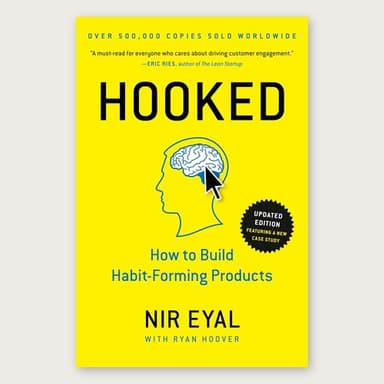
Start hereThe short version
- 1Products that attach to a user's internal triggers bring people back with no outside prompting, and the first-to-mind solution wins. The Introduction makes that case, and Chapter 1 defines the habit zone, where a behavior has enough frequency and perceived utility to become a default.The claim
- 2The Hooked Model has four phases: a trigger, the simplest action done in anticipation of a reward, a variable reward from the tribe, the hunt or the self, and an investment that stores value and loads the next trigger. Chapters 2 to 5 take one phase each.The model
- 3Chapter 6 asks whether a maker should hook users at all and sorts makers into Facilitator, Peddler, Entertainer and Dealer with the Manipulation Matrix. Chapter 7 walks the Bible App and Fitbod through the model, and Chapter 8 gives habit testing and where to look for new opportunities.The use
Hooked on four pages
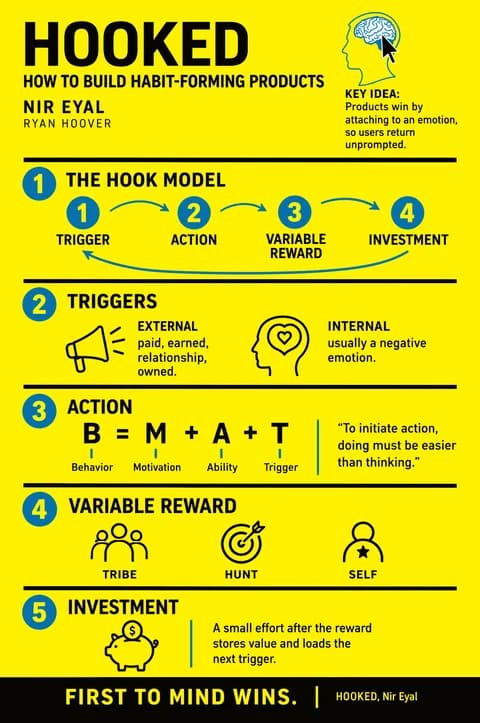
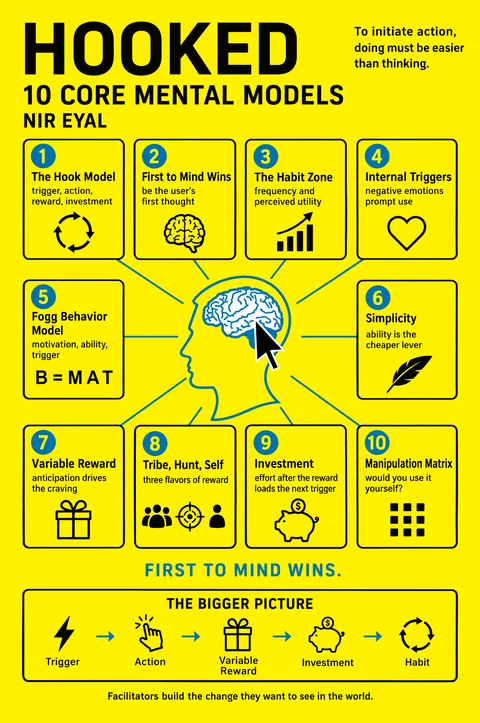
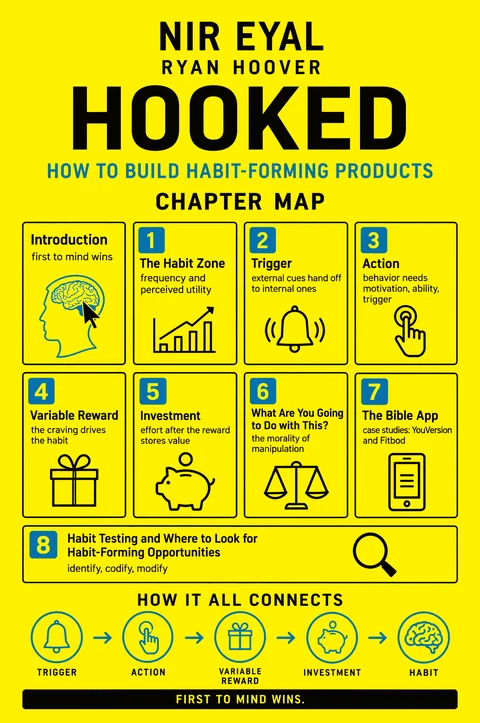
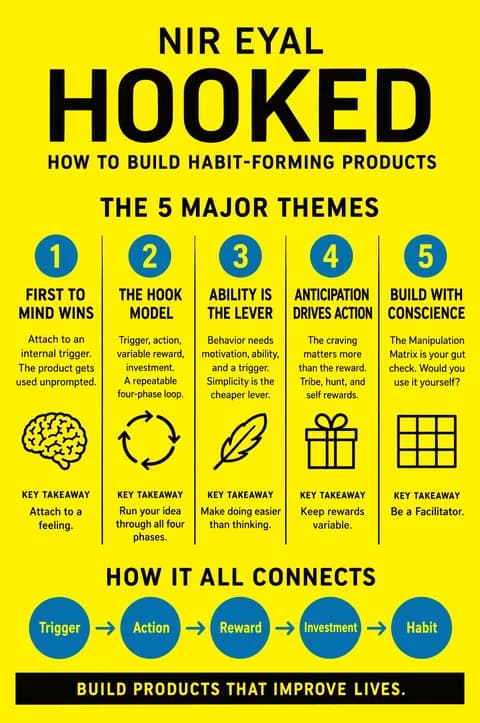
Four printable posters in the cover's colors: big ideas, mental models, a chapter map, and major themes.
Free. You'll also get each new summary by email.
The summaryIntroduction
Eyal opens the second edition with readers who used the book to build products that changed habits for the better: Kahoot, a Norwegian classroom startup that filed for an initial public offering; Fitbod, a gym app making millions for its developers; and PAGA, which helps millions of previously unbanked Africans form habits of saving and managing money. The tech giants already know these techniques, he writes. He wrote the book for everyone else.
Introduction · The Hook Model
The introduction starts with numbers Eyal reports: 79% of smartphone owners check their device within 15 minutes of waking, one-third of Americans say they would rather give up sex than lose their cell phones, and a 2011 university study suggested people check their phones 34 times a day, while industry insiders put it closer to 150 daily sessions. Cognitive psychologists define habits as automatic behaviors triggered by situational cues. Eyal argues that a company's economic value increasingly depends on the strength of the habits it creates, because a product attached to a user's internal triggers brings people back with no external prompting. Bored, a user opens Twitter; lonely, she scrolls Facebook; curious, he queries Google. In his phrase, the first-to-mind solution wins.
He explains how he got here. In 2008 he was part of a team of Stanford MBAs building a platform for advertising inside online social games, and he set out to learn how products change behavior and what the moral implications are. Finding no how-to manual, he documented hundreds of companies, drew on consumer psychology, human-computer interaction and behavioral economics, consulted from 2011, and in 2012 designed and taught a class at the Stanford Graduate School of Business with Baba Shiv. The result is the Hooked Model, a four-phase process: trigger, action, variable reward and investment. He walks through it with Barbara, who sees a family member's photo in her Facebook feed (the trigger), clicks through to Pinterest (the action), finds an endless mix of relevant and irrelevant images and spends 45 minutes scrolling (the variable reward), and starts pinning and following (the investment), which primes her for the next loop. Barbara and her brother Johnny, he then admits, are named after characters in Night of the Living Dead.
Eyal frames habit-forming technology as a new superpower that can be used well or badly. He quotes Paul Graham's prediction that the world will get more addictive in the next 40 years than it did in the last 40, and cites the idea of choice architecture, used to nudge people toward choices they would judge better for themselves. The book, he says, is for innovators who want to help people do the things they already want to do.
"If it can't be used for evil, it's not a superpower."
Chapter 1The Habit Zone
Eyal runs about three mornings a week. After moving a run to the evening for an overseas call, he greeted a neighbor with good morning, corrected himself, then did it again to another runner, and back home he found himself shaving before he realized it, about 10 hours off schedule. Habits, behaviors done with little or no conscious thought, guide nearly half of our daily actions by some estimates. The brain stores them in the basal ganglia so it can stop deliberating and focus elsewhere, the way a nail biter's habit takes over once the cue of stress drives the behavior.
He separates businesses that need habitual users from those that do not: a life insurance company relies on salespeople and referrals, and once a policy is bought the customer has nothing more to do. For businesses that depend on ongoing, unprompted engagement, habits pay off in four ways. They raise customer lifetime value, which is why credit card companies spend heavily to acquire customers. They provide pricing flexibility; Eyal cites Warren Buffett's line that you can judge a business by the agony it goes through in raising prices, and notes that Candy Crush Saga, downloaded by more than 500 million people as of December 2013, nets its maker nearly $1 million per day through its freemium model. They supercharge growth: venture capitalist David Skok calculates that after 20 days a viral cycle time of two days yields 20,470 users, while a cycle time of one day yields over 20 million. And they sharpen the competitive edge. Harvard Business School professor John Gourville argues that a new product has to be nine times better to displace an incumbent, which is why the QWERTY keyboard of the 1870s survived August Dvorak's better layout patented in 1932.
Changing habits is hard. Behaviors are last in, first out, so the newest habits are the first to go; Eyal reports that two-thirds of alcoholics who complete rehabilitation return to drinking within a year and that nearly everyone who loses weight on a diet regains it within two years. A University College London flossing study found the more frequently a new behavior occurred, the stronger the habit became. Google Search shows the payoff of frequency: its results are nearly identical to Bing's, yet the familiar interface keeps users loyal. Amazon shows the other route, high perceived utility, by running ads for competing products on its own pages to become the default place to find what you want, a tactic Eyal says a 2003 study supports and that helped Progressive grow from $3.4 billion to over $15 billion in annual insurance sales.
Plotting frequency against perceived utility defines the habit zone; a behavior with enough of both becomes a default. A 2010 study found some habits form in weeks and others take more than five months. Eyal's answer to the investor's question of whether a product is a vitamin or a painkiller is that habit-forming products are both: they start as nice-to-have vitamins and, once the habit forms, relieve an itch like painkillers. He separates habits from addictions, which are self-destructive by definition, and closes with exercises asking what habit your business model requires and what behavior you want to make into a habit.
Chapter 1 · The habit zone
"A habit is when not doing an action causes a bit of discomfort."
Chapter 2Trigger
Yin, a Stanford student in her mid-twenties, posts dozens of Instagram photos a day. Eyal notes that Facebook bought Instagram for $1 billion in 2012, when it had 150 million users, and that by 2018 it had over 1 billion monthly active users and was reported to be worth over $100 billion. Habits, he writes, are built upon the way pearls form around a grain of grit, and the grit is a trigger, the actuator of behavior.
External triggers carry information about what to do next, explicitly, like a Coca-Cola vending machine or a big login button in an email, or implicitly, like a link or an app icon. They come in four types. Paid triggers such as advertising work for acquisition but are too costly for re-engagement. Earned triggers, like press mentions and app store features, are free but short-lived. Relationship triggers, from invitations to word of mouth, can drive viral growth, as PayPal's did, though designers who trick users into inviting friends with dark patterns lose their goodwill. Owned triggers, such as an app icon or an opted-in newsletter, occupy real estate in the user's environment and prompt repeat engagement until a habit forms.
Internal triggers arrive in the mind as thoughts, emotions or routines. Negative emotions are the most powerful: boredom, loneliness, frustration, confusion and indecisiveness prompt an almost instant action to quell the discomfort. Eyal cites a Missouri University of Science and Technology study in which 216 undergraduates had their internet use tracked in 2011, and those showing depressive symptoms used email, video, games and chat more. The designer's job is to know the user's internal trigger, the pain in emotional terms, and declared preferences rarely reveal it. Eyal recommends Jack Dorsey's user narratives and the five whys technique from the Toyota production system. Asking why a busy manager named Julie would use email leads, by the fifth why, to her fear of being out of the loop. Instagram's internal trigger is the fear that a special moment will be lost; over time it adds boredom and the fear of missing out.
Chapter 2 · External to internal
"New habits are sparked by external triggers, but associations with internal triggers are what keeps users hooked."
- You're Already an Impact Business22 to 30
- You're Closer Than You Think14 to 21
- You Have the Foundation7 to 13
- The Starting Line0 to 6
 Printable PDF
"Eyal builds habits one loop at a time. Before you build a hook into anything, you want to know what's working in the business underneath it, right? Ten questions, a score out of 30, the part to fix first. It's free with your email."
 Deven Davis, devendavis.com
- Ten questions about where your business is right now
- A score out of 30
- A four-part breakdown: Impact Clarity, Traction Proof, Model Strength, Founder Credibility
- The part to fix first
- Your tier's next steps
- A printable PDF
Free with your email. Your score and a printable PDF open right on the page.
Chapter 3Action
A trigger is useless if the user does not act. Eyal adopts the model of Dr. B.J. Fogg of Stanford's Persuasive Technology Lab, B = MAT: a behavior occurs when motivation, ability and a trigger are present at the same time in sufficient degrees. An unanswered phone call illustrates it; the phone was buried in a bag (ability), the caller was a telemarketer (motivation), or the ringer was off (trigger). Fogg's three core motivators are seeking pleasure and avoiding pain, seeking hope and avoiding fear, and seeking social acceptance and avoiding rejection, levers advertisers pull in everything from Obama's 2008 hope poster to a motorcycle helmet ad built on fear.
Chapter 3 · B = MAT
Ability is about removing steps. Eyal traces the web from dial-up connections to always-on access, and content creation from setting up your own domain to Blogger, to Twitter, which reached 500 million registered users by 2012 and, as of late 2013, 340 million tweets a day, to Pinterest, Instagram and Snapchat. Fogg's six elements of simplicity are time, money, physical effort, brain cycles, social deviance and non-routine, and Eyal says designers should find the user's scarcest resource in the moment. Examples include Facebook login, Twitter's tweet button (built after the company noticed 25% of tweets contained a link), Google's clean search page, the iPhone camera launchable from the lock screen, and Pinterest's infinite scroll. When choosing between motivation and ability, he says to start with ability, because increasing motivation is expensive and slow. Twitter's homepage went from a cluttered 2009 version to one with two calls to action, sign in or sign up, by 2012.
Heuristics also shape action. In the 1975 scarcity study, identical cookies were valued more in a jar of two than a jar of 10, and less when a jar went from 2 to 10. The framing effect left violinist Joshua Bell largely ignored in a Washington, D.C. subway station, and a 2007 study found people enjoyed wine more, with their brains agreeing, as the stated price rose from $5 to $90, though it was the same wine. Anchoring almost had Eyal buy three Jockey undershirts on sale for $29.50 when five Fruit of the Loom shirts cost $34. In the endowed progress experiment, a 10-square car wash card with two free punches produced an 82% higher completion rate than a blank card with eight squares, a principle LinkedIn uses in its profile strength meter.
"To initiate action, doing must be easier than thinking."
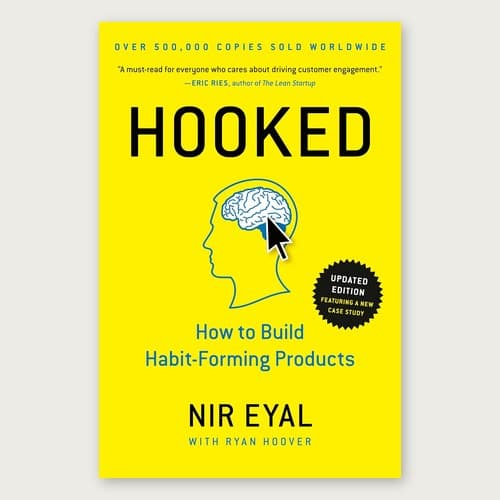
These notes follow the updated second edition audiobook read by Nir Eyal (copyright 2019). The hardcover linked above is the original Portfolio edition, which predates the Fitbod case study in Chapter 7.
Chapter 4Variable Reward
In the 1940s, James Olds and Peter Milner found that lab mice would forgo food and water to keep stimulating an area of the brain called the nucleus accumbens. Later research by Stanford's Brian Knutson showed the nucleus accumbens activates while people anticipate a reward, ahead of the payout, so what drives us is the need to relieve the craving. A baby meeting a dog for the first time laughs at the uncertainty, and years later the predictable dog bores the child. In the 1950s B.F. Skinner found pigeons pressed a lever far more often when food came after a random number of presses. Variability, Eyal writes, spikes dopamine and drives the search for rewards, and he proposes three types.
Rewards of the tribe are social: feeling accepted, attractive, important and included. Albert Bandura's social learning theory explains their pull. Facebook's likes and comments, Stack Overflow's 5,000 daily answers written for upvotes and badges, and League of Legends' honor points, introduced after its 2009 launch to counter trolls, all run on them. Rewards of the hunt are the search for resources and information. Harvard's Daniel Lieberman argues early humans hunted by persistence long before spears and arrows, which date back only 500,000 years against more than 2 million years of eating meat; a San hunter runs a 500-pound kudu to exhaustion over eight hours. Eyal reports that gamblers put $1 billion a day into American slot machines, and Twitter's and Pinterest's feeds, Pinterest with over 250 million monthly users, keep people scrolling for the next find. Rewards of the self are mastery, competence and completion, from leveling up in World of Warcraft to reaching inbox zero with Gmail's Priority Inbox to Codecademy's instant feedback.
Chapter 4 · Three variable rewards
Variable rewards are no free pass. Mahalo, launched in May 2007, paid users for answers and peaked at 14.1 million monthly visitors before fading, while Quora, launched in 2010, paid nothing and thrived on social rewards. Rewards have to fit why the product is used. Autonomy matters too: when Quora opted users into its Views feature in August 2012, exposing their browsing, a user revolt forced it to make the feature opt-in. In a French study, adding the phrase "but you are free to accept or refuse" doubled what strangers gave toward bus fare, and a meta-analysis of 42 studies involving over 22,000 participants found it doubled compliance. Eyal quit MyFitnessPal when calorie tracking felt like something he had to do, and found Fitocracy's community of fellow exercisers easy to keep using.
The Founder Brain Kit
He warns against finite variability. Breaking Bad drew 5.9 million viewers to its final season premiere in 2013, yet a known plot holds less interest the second time. Zynga's FarmVille hit 83.8 million monthly active users in 2009 and generated more than $36 million in 2010; Zynga was valued at over $10 billion in March 2012, and by November its stock was down over 80% because its follow-up games were retreads. Infinite variability comes from other people and from content creation, which is why World of Warcraft still had more than 10 million active users eight years after release. Products with inherent variability, like Google and Uber, should give users a sense of agency, the way Uber's map shows the car approaching. Email, he notes, offers all three reward types at once.
"Variable rewards are not magic fairy dust that a product designer can sprinkle onto a product to make it instantly more attractive."
Chapter 5Investment
The flossing study found the second most important factor in forming a habit is a change in attitude toward the behavior, a move up the perceived utility axis. Investment drives that change through three tendencies. We irrationally value our own effort: in a 2011 study by Dan Ariely, Michael Norton and Daniel Mochon, students valued origami they folded themselves five times higher than other students did, which Ariely calls the IKEA effect. We seek consistency with past behavior: only 17% of residents agreed to a large Drive Carefully sign on their lawns, while 76% agreed when they had put a small three-inch sign in their window two weeks earlier. And we avoid cognitive dissonance, the fox deciding the unreachable grapes are sour, the way people learn to like beer and spicy food. Together these produce rationalization, which game designer Jesse Schell used to explain why players paid real money in Zynga's text-based Mafia Wars.
Chapter 5 · Consistency
Unlike the action phase, investment is about anticipation of rewards in the future, and it deliberately adds friction. Its timing matters: it comes after the variable reward, when users are primed to reciprocate. Stanford researchers found people did almost twice as much work for a computer that had helped them as for one that had not. Investment stores value in five forms. Content, like the songs Spotify uses to build Discover Weekly or the timeline of a Facebook life. Data, like a LinkedIn profile or a Mint budget; former LinkedIn product manager Josh Elman told Eyal that users who entered a little information were much more likely to return. Followers, which is why App.net failed to replace Twitter, a service a Bloomberg commentator said on the morning of its November 7, 2013 IPO could be built in a day. Reputation, on eBay, Upwork, Yelp and Airbnb. And skill, like the hours spent learning Adobe Photoshop. He advises staging investments in small chunks of work that grow over successive cycles.
Investment also loads the next trigger. Eyal cites a study finding 26% of mobile apps were downloaded and used only once. Any.do has new users connect their calendar so it can prompt them after meetings. Tinder generated 3.5 million matches from 350 million swipes a day in mid-2013, each match notifying both people. Snapchat, with 5 million daily active users sending over 200 million photos and videos a day as of June 2013, builds a prompt to reply into every message. Each pin, repin, like or comment on Pinterest gives the company permission to notify the user when someone else adds to the thread, completing the full Hook.
"The more users invest time and effort into a product or service, the more they value it."
Chapter 6What Are You Going to Do with This?
Eyal restates the model as five questions: what users really want and what pain the product relieves, what brings them to the service, what is the simplest action they take in anticipation of a reward, whether the reward leaves them wanting more, and what bit of work they invest that loads the next trigger and stores value. Then he turns to the morality of manipulation. Manipulation, he says, is an experience crafted to change behavior. Weight Watchers fits that definition and few question it, while game designer Ian Bogost calls habit-forming technology the cigarette of this century. Paul Graham writes that society has not had time to develop antibodies to addictive new things.
His decision tool is the Manipulation Matrix, built on two questions a maker asks before building: would I use the product myself, and will it help users materially improve their lives? A Facilitator answers yes to both. Jake Harriman, a former Marine who founded Nuru International after seven and a half years of active duty, learned what kept Kenyan farmers from yield-boosting techniques only by living among them. Eyal notes that even for the most habit-forming technologies, such as slot machines, industry estimates put pathological users at just 1%, and says companies have a moral obligation to identify and help the users who form unhealthy attachments. A Peddler believes the product improves lives but would not use it, and usually fails for lack of empathy with users. An Entertainer uses the product but cannot claim it improves lives, and runs a hits-driven business that has to keep releasing new work. A Dealer does neither, and Eyal compares this quadrant to casinos and drug dealers; Bogost shut down his satirical game Cow Clicker after some players became obsessed with it.
Chapter 6 · The Manipulation Matrix
"Let's admit it. We're all in the persuasion business."
Chapter 7Case Studies
Eyal urges readers to build for meaning and offers two facilitator products. The first is the Bible App from YouVersion. CEO Bobby Gruenewald told him a user walking into a strip club received a notification from the app at that moment. In July 2013 the app passed 100 million devices, with a new install every 1.3 seconds and, on average, 66,000 people opening it every second. A search for Bible in the App Store returned 5,185 results, yet it led the list with over 641,000 reviews. Investor Jules Maltz told Eyal a company that size could be worth $200 million and up, assuming it can monetize through advertising.
"Eyal starts with the user's itch. If you haven't picked the business you'll build the hook for, the Shortlist gives you 12 paths to your first thousand a month, plus 15 AI prompts to find your niche and write your first offer. A thousand a month is $33 a day. Seven bucks."
Deven Davis, devendavis.com- 12 paths to your first $1K a month, each with startup costs, time to first dollar, difficulty and first steps
- The Skill Audit: what you already have that people will pay for
- 15 ready-to-use AI prompts by stage: Discovery, Launch, First Client, Scale
- The $1K Action Plan: your path, your first offer and a 48-hour deadline
Seven dollars, with the No-Brainer Guarantee: if it doesn't save you 10+ hours of research in the first week, full refund.
The app moved from a desktop site to mobile, where it was always at hand, and 18% of readers reported using it in the bathroom. Its more than 400 reading plans chunk scripture into daily portions. Triggers run through everything: a Christmas greeting the team feared would annoy users was instead shared widely, and daily notifications, red badges and emails bring readers back. Gruenewald's data showed that placing the more interesting sections first increased completion, and an audio option made the action easier. Variable rewards come from the verse of the day, which one woman stayed up past midnight to see, and a checkmarked calendar uses the endowed progress effect. Every highlight, comment, bookmark and share is an investment, and 200,000 pieces of content are shared from the app every 24 hours.
The second case is Fitbod. Eyal, an obese child who never won a wrestling match, struggled with exercise until the app kept him in the gym for over two years. He reports that Americans spend $19 billion a year on gym memberships and that about 44% of people who join quit within six months. Founder Alan Chen read Hooked in 2015 and identified the internal trigger as the uncertainty of not knowing what to do in the gym; designer Jesse Venticinque joined him. One tap generates the next workout with exercises, weights, repetitions and rest times. The variable rewards are the surprise of the chosen exercises and the chance to beat a personal best, and every logged exercise is an investment that tailors future workouts. Over 3 million people have downloaded the app, and the founders say it is used on average nine times per month per user.
Chapter 7 · The Fitbod case
"If you only build for fame or fortune, you will likely find neither."
Chapter 8Habit Testing and Where to Look for Habit-Forming Opportunities
Eyal's process for testing an existing product, inspired by the lean startup's build-measure-learn loop, is habit testing in three steps. Identify: define how often a devoted user should use the product, realistically (multiple times a day for a messaging app, once or twice a week for a movie site), and find who meets that bar, using cohort analysis. Codify: if at least 5% of users are habitual, his rule of thumb, study the steps they took to find the habit path; early Twitter discovered that new users who followed 30 people hit a tipping point. Modify: change the product to nudge new users down the same path, as Twitter did by having new users follow others immediately.
Chapter 8 · Habit testing
For new opportunities he says to look first in the mirror, citing Paul Graham's advice to ask what problem you wish someone else would solve for you. Joel Gascoigne built Buffer, founded in 2010 and used by over 1.1 million people, because he wanted to tweet five times a day without picking exact times. Look also for nascent behaviors that critics dismiss as toys: George Eastman's $1 Brownie camera, the telephone, the airplane a future Allied commander called of no military value in 1911, the data processing a Prentice Hall editor called a fad in 1957, and the internet Clifford Stoll mocked in Newsweek in 1995. Facebook began with Harvard students, opened to the world in September 2006, and now has over 2 billion users. Look for enabling technologies, following investor Mike Maples Jr.'s 2012 description of tech waves moving from infrastructure to platforms to applications. And look for interface changes, from graphical interfaces to Google's simple search page to Instagram's filters for phone cameras, which make behaviors suddenly easier. The book closes with exercises to run habit testing and to observe your own triggers for a week.
"Building a habit-forming product is an iterative process and requires user behavior analysis and continuous experimentation."
Hooked on four pages
Four printable posters in the cover's colors: big ideas, mental models, a chapter map, and major themes.
Free. You'll also get each new summary by email.