Feeling Is the Secret by Neville Goddard: Summary and Notes
The full book, section by section.
Start hereThe short version
- 1Consciousness is the one and only reality and the cause of the visible world. Chapter 1, Law and Its Operation, splits it into the conscious, which impresses ideas, and the subconscious, which accepts whatever is felt as true and gives it form.The law
- 2Feeling is the only medium of impression, and of two feelings the dominant one is expressed, so a wish has to be felt as a present fact. Chapter 1 sets the rule with its example: I am healthy is a stronger feeling than I will be healthy.The rule
- 3Sleep and prayer are the two gateways into the subconscious. Chapter 2 gives the nightly practice of falling asleep in the feeling of the wish fulfilled, Chapter 3 the daytime reverie, and Chapter 4 closes on faith as feeling.The method
Feeling Is the Secret on four pages
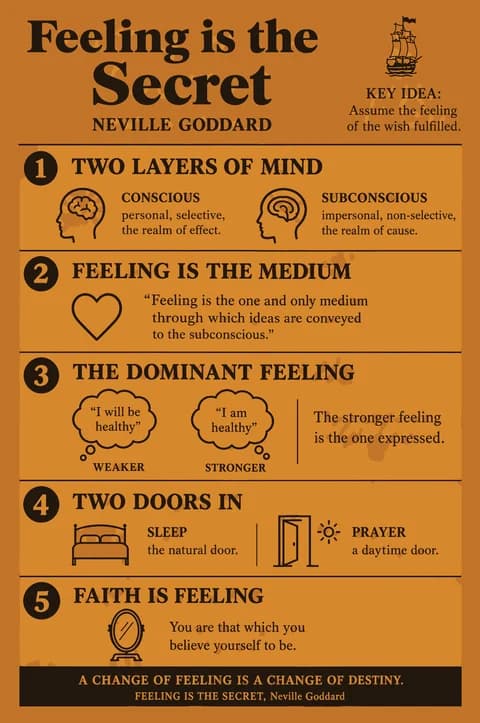
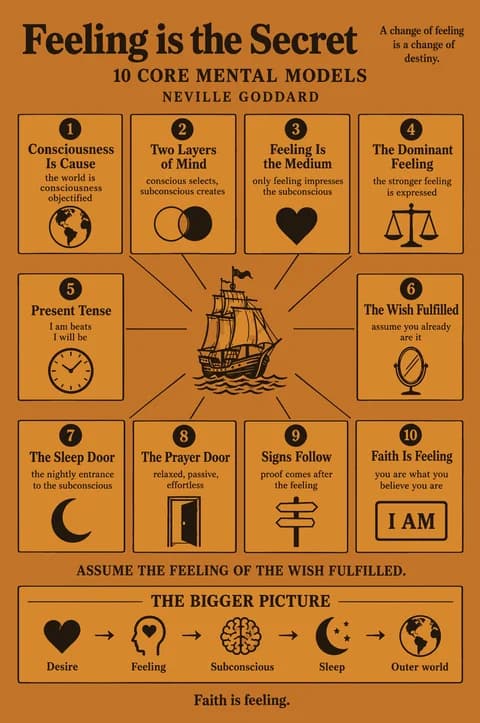
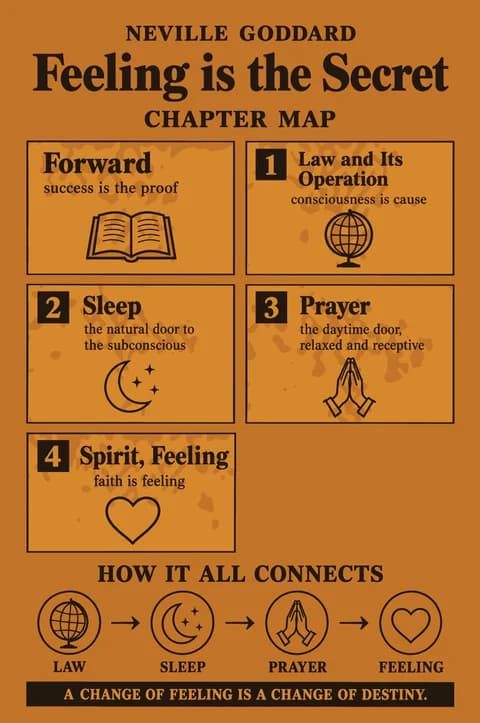
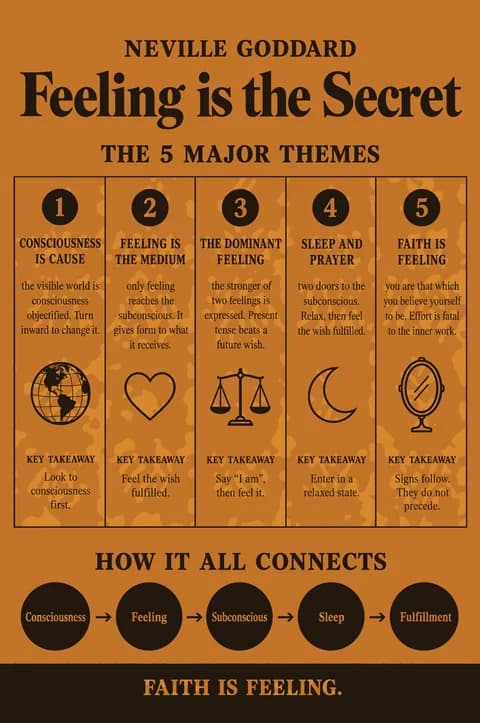
Four printable posters in the cover's colors: big ideas, mental models, a chapter map, and major themes.
Free. You'll also get each new summary by email.
The summaryForeword
The book opens with two epigraphs: a line from Ecclesiastes on the endless making of books, and an old saying that whoever would perfect himself in any art should read one sure and certain work on it many times over, since reading many books on an art produces confusion. Goddard then states what the book is for. It is concerned with the art of realizing your desire and gives an account of the mechanism that produces the visible world. He calls it "a small book, but not slight" and says it holds a clearly defined road to the realization of your dreams.
He explains why it is so short. Were it possible to convince another person with reasoned arguments and detailed instances, the book would be many times its size. A reader with suspended judgment can always decide the author was dishonest or deluded, so Goddard says he purposely omitted all arguments and testimonials. He challenges the open-minded reader to practice the law of consciousness the book reveals and to let the results do the convincing.
"Personal success will prove far more convincing than all the books that could be written on the subject."
Chapter 1Law and Its Operation
Goddard begins with his premise: the world, and everything in it, is man's conditioned consciousness objectified. Consciousness is both the cause and the substance of the world, so the secret of creation has to be sought there. He insists consciousness is the one and only reality, actually and literally, and that a working knowledge of its law lets a person build and maintain an ideal world.
For clarity he compares consciousness to a stream divided in two parts, the conscious and the subconscious. The conscious is personal and selective, the realm of effect. The subconscious is impersonal and non-selective, the realm of cause. He calls them the male and female divisions of consciousness: the conscious generates ideas and impresses them on the subconscious, and the subconscious receives those ideas and gives them form and expression. The subconscious originates nothing. It accepts as true whatever the conscious mind feels to be true and objectifies it in a way known only to itself. Through the power to imagine and feel, and the freedom to choose which idea to entertain, Goddard concludes, man has control over creation.
The medium is feeling. No idea can be impressed on the subconscious until it is felt, and once it is felt, whether good, bad or indifferent, it must be expressed. Goddard draws the practical rule from this: the person who does not control his feeling can easily impress the subconscious with undesirable states. Control here means disciplining yourself to imagine and entertain only the feelings that contribute to your happiness. He warns against dwelling on the imperfections of yourself or others and against thinking sympathetically about wrong in any form, and he sums up the whole law of a full and happy life in one instruction: what you do not want done unto you, do not feel that it is done unto you or another.
Every feeling makes a subconscious impression, and unless a more powerful feeling of the opposite kind counteracts it, it must be expressed. This gives Goddard his dominant feeling rule: of two feelings, the dominant one is expressed. He illustrates it with health. "I am healthy" is a stronger feeling than "I will be healthy," because to feel I will be is to confess I am not. What you feel you are always outweighs what you feel you would like to be, so a wish has to be felt as a present state to be realized. Sensation precedes manifestation. He adds that the body is an emotional filter that bears the marks of its prevalent emotions, that suppressed emotions are the causes of disease, and that one should never entertain feelings of regret or failure.
Chapter 1 · The dominant feeling
Goddard rules out chance, accident and fate as the authors of a person's fortune. Subconscious impressions determine the conditions of your world, and the subconscious is no respecter of persons: it never asks whether a feeling is true or false, beneficial or harmful, and it outpictures accepted beliefs to the last detail. To impress it with a desirable state, you must assume the feeling that would be yours had you already realized your wish, and concern yourself only with the objective itself. Dwelling on difficulties, barriers or delay, he warns, impresses those very things, and the non-selective subconscious produces them.
The Right to Be Rich
He returns to the male and female image to describe the relationship. The ancient prophets called the subconscious the slave and servant of man, and Paul wrote of the woman being subject to the man (Ephesians 5). Goddard says the subconscious has a distinct distaste for compulsion and responds to persuasion, so it resembles a beloved wife more than a servant, and the leadership of the conscious over it is that of a lover. By assuming the feeling of already possessing your objective, you move the subconscious to build the exact likeness of that assumption. The outside mirrors the inside. Your world, in every detail, is your consciousness objectified, and you express and have only what you are conscious of being or possessing. Until perfect self-control is reached, so that you can feel what you want to feel in spite of appearances, he recommends sleep and prayer, which he calls the two gateways into the subconscious.
"A change of feeling is a change of destiny."
The audiobook link goes to the recording read by Mark Manning and Tim Grimes, the closest match on Amazon. These notes were made from a separate recording of the same text that amazon.com does not carry.
Chapter 2Sleep
Sleep, which occupies one-third of our stay on earth, is the natural door into the subconscious. Goddard says the conscious two-thirds of life is measured by the attention we give to sleep, and he quotes the Book of Job on God opening the ears of men and sealing their instruction in slumber. In sleep, and in prayer, a state akin to it, the conscious and subconscious are creatively joined. He describes the subconscious as a lover with no desire to change the waking self, one who loves it as it is and faithfully reproduces its likeness, so the conditions and events of your life are your children, formed from the molds of your impressions in sleep.
Whatever you hold in consciousness as you fall asleep is the measure of your expression in the waking hours. Once asleep, a person has no freedom of choice, because the whole slumber is dominated by the last waking concept of self. So Goddard gives his protocol. Ask how you would feel were your wish realized, and let that feeling monopolize and immobilize your attention as you relax into sleep. Lie flat on your back with your head level with your body, feel as you would in possession of your wish, and quietly relax into unconsciousness. Never go to sleep feeling discouraged or dissatisfied, and never sleep in the consciousness of failure.
He reads the Song of Solomon as a description of the same romance: by night on my bed I sought him whom my soul loveth. Your realized wish is the one you seek, and you carry the feeling of it into the chamber of her that conceived you, which is sleep. Disregard appearances and feel that things are as you wish them to be. Proof that you are will follow the consciousness that you are, never the reverse. He tells the reader not to be limited by the past, to imagine states beyond past experience, and to remember that you have no one to change but yourself. You convince yourself that another person already is what you desire him to be, and results follow.
Goddard closes the chapter on free will. The actions and events of the day are effects. Free will is only the freedom to choose the mood you assume, and the expression of that mood is the secret of the subconscious. A person who falls asleep without consciously defining his attitude takes the composite of the day's reactions into sleep and is instructed in how they will be expressed tomorrow, then rises believing he is a free agent. His image is the gardener: awake, you select seed, and your conception of yourself as you fall asleep is the seed you drop into the ground of the subconscious. Sleep, he concludes, is the door into heaven.
Chapter 2 · Falling asleep in the wish fulfilled
"Signs follow. They do not precede."
Chapter 3Prayer
Prayer is the second entrance to the subconscious. Goddard calls it an illusion of sleep that diminishes the impression of the outer world and makes the mind more receptive to suggestion from within. It depends less on what you ask for than on how you prepare to receive it. The only condition, he says, is to believe that your prayer is already realized; the moment you accept the wish as an accomplished fact, the subconscious finds the means for its realization.
He contrasts the disciplined man, who knows ideas and feelings are facts of consciousness as real as objects in space and never entertains a feeling that does not contribute to his happiness, with the undisciplined man, who accepts or rejects things on the evidence of the senses. Because the senses deny the wish, they have to be shut down before praying. Effort works against the person who prays: when the senses confirm the absence of your wish, conscious effort to counteract them only intensifies the suggestion. "You never attract that which you want, but always attract that which you are conscious of being." Whenever feeling conflicts with wish, feeling wins, and in trying to fix an attitude the senses deny, Goddard writes, effort is fatal.
His method is to create a passive state, a reverie similar to the feeling that precedes sleep, in which you could move or open your eyes but have no desire to. Relax in a comfortable chair or lie flat on a bed with your head level with your body, close your eyes and imagine that you are sleepy, so very sleepy. A faraway feeling and a loss of all desire to move follow. In that state, imagine the wish already fulfilled, picture what you want to achieve, and feel yourself as having achieved it, without concern for how it came about. Acceptance of the end wills the means. Coming out of prayer, he says, is like having been shown the happy end of a play without being shown how it was reached, and you remain calm in the knowledge that the end has been perfectly defined.
Chapter 3 · Yielding, not forcing
"Prayer is the art of yielding to the wish and not the forcing of the wish."
Chapter 4Spirit, Feeling
The last chapter opens with the scriptural line "Not by might, nor by power, but by my spirit" and turns it into an instruction: get into the spirit of the state desired by assuming the feeling that would be yours were you already the one you want to be. Once you capture that feeling you are relieved of all effort to make it so, because it already is so. There is a definite feeling associated with every idea, and capturing the one associated with the realized wish lets the wish objectify itself.
"Neville says live in the feeling of the wish fulfilled until it's the only thing you know. That's a daily practice. The Identity Shift gives you 30 days of it, built on Wattles: a prompt, a reflection and an intention every day. Seven bucks. Start tonight."
 Deven Davis, devendavis.com
- 30 days of guided identity reprogramming, rooted in Wattles' Impression of Increase principle
- Each day has a prompt, a reflection and an intention
- Bonus: The Quick Win Guide, your first identity shift result in under 1 hour
- Bonus: a 5-minute video from Deven on why identity precedes strategy
Seven dollars, with the No-Brainer Guarantee: if it doesn't change how you think about yourself and money within the first week, full refund.
Goddard equates faith with feeling and reads the scriptural "according to your faith" as according to your feeling. That which you feel yourself to be, you are, and you are given that which you are. He ends on identity, reading the creation of man in God's image and the line "I and my father are one" as a statement about belief: Jesus found it natural to do the works of God because he believed himself to be God, and it is natural to do the works of the one you believe yourself to be. So live in the feeling of being the one you want to be, he concludes, and that you shall be.
Chapter 4 · Faith is feeling
"Faith is feeling."
Feeling Is the Secret on four pages
Four printable posters in the cover's colors: big ideas, mental models, a chapter map, and major themes.
Free. You'll also get each new summary by email.