Essentialism by Greg McKeown: Summary and Notes
The full book, section by section.
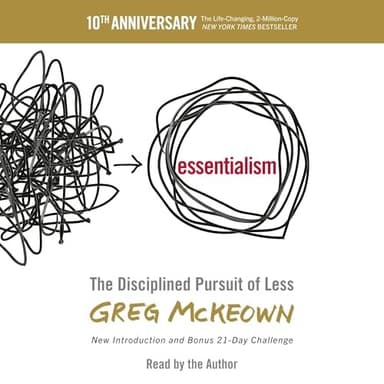
Start hereThe short version
- 1Essentialism is the disciplined pursuit of less but better, a phrase McKeown takes from the designer Dieter Rams. Chapter 1 defines it and lays out the paradox of success: clarity brings success, success brings more options, and more options erode the clarity that started it.The claim
- 2Three false beliefs keep people on the non-essentialist path: I have to, it's all important, and I can do both. Part I, Essence, replaces them in Chapters 2 to 4 with three truths: I choose to, only a few things really matter, and I can do anything but not everything.The mindset
- 3The method runs in three steps. Part II, Explore, separates the vital few from the trivial many in Chapters 5 to 9. Part III, Eliminate, cuts the rest in Chapters 10 to 14. Part IV, Execute, makes what remains almost effortless in Chapters 15 to 20, and an appendix applies it to leading teams.The method
Essentialism on four pages
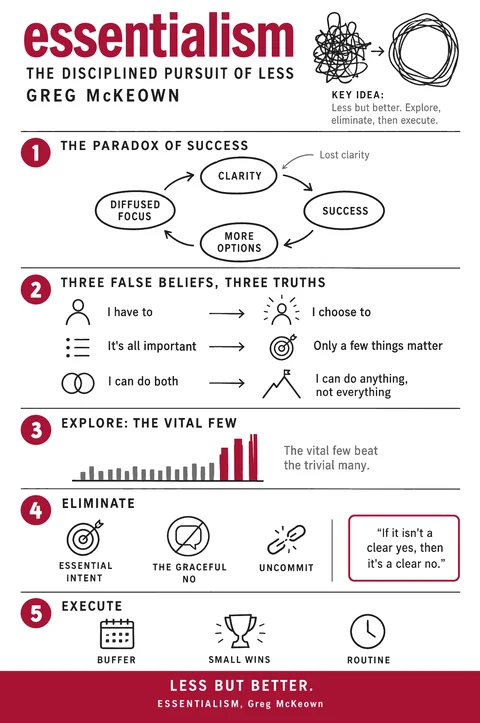
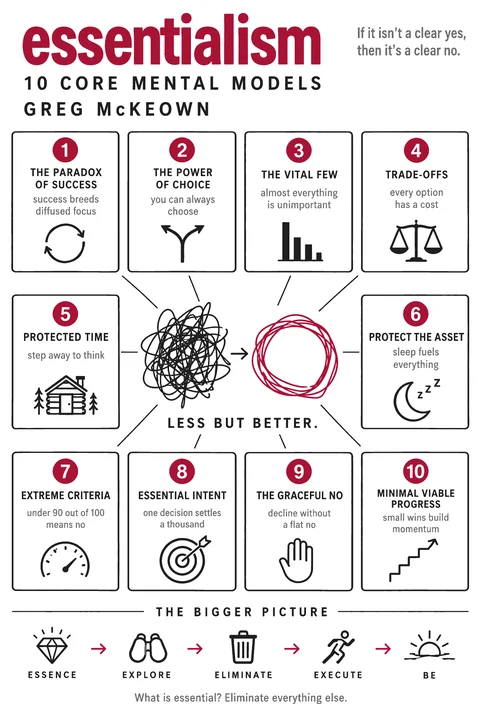
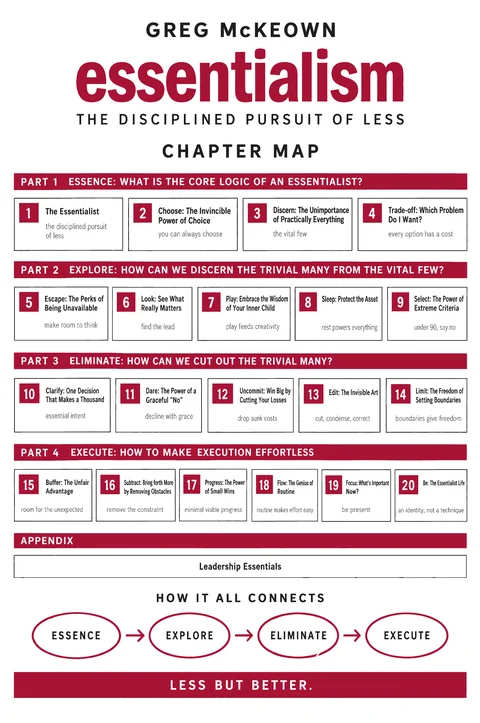
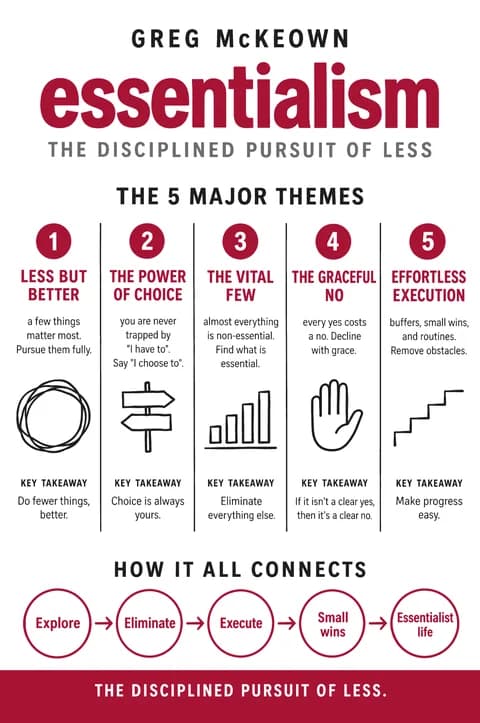
Four printable posters in the cover's colors: big ideas, mental models, a chapter map, and major themes.
Free. You'll also get each new summary by email.
The summaryIntroduction to the 10th Anniversary: A Decade of Essentialism
McKeown opens the anniversary edition with three readers who rebuilt their work around the book. Banks Benitez, then CEO of Uncharted, a Denver social impact firm, started asking of every task, meeting and email whether it was absolutely essential, then moved the whole company to a four-day workweek. McKeown reports that productivity rose, employee satisfaction hit an all-time high and the company's performance strengthened. Kyle Westaway founded a law firm for early-stage startups with essentialism as its operating manual and replaced billing by the hour with a fixed-rate model.
The third is Jerry Swale, an eye surgeon who said yes to every patient, every favor for the other doctors and every church and community request. At 56 he had health problems that threatened his surgical career and kept putting off a doctor's visit. On a long road trip with his wife, Beth, he decided the time would never appear on its own. He cut back his office hours, stepped down from his church's elder board, started riding a bike, slept eight hours a night and saw a dermatologist. When his business partner retired with a month's notice, he had room to take on the partner's patients. Beth called the change life-changing, maybe even life-saving.
McKeown notes that the book arrived in April 2014, that one Hollywood agent told him he had read or listened to it 17 times, and that he has since given keynotes to 500 organizations across 44 countries, which he says is less than 10% of the requests he received. He argues that a world more cluttered and distracting than it was ten years ago makes the principles more crucial than ever.
Chapter 1The Essentialist
Sam Elliott, a Silicon Valley executive, found himself stretched thin after his company was acquired by a larger, bureaucratic business. He said yes to nearly every request, his stress rose and the quality of his work fell. Offered early retirement in his early 50s, he went to a mentor, who told him to stay and do only what he would do as a consultant, and to tell no one. Elliott began refusing requests he could not fulfill, then raised the bar to whether each one was the most important use of his time right now. He stopped joining calls and meetings where he had nothing to contribute. He got his evenings back, his performance ratings went up and he received one of the largest bonuses of his career.
McKeown takes the book's principle from Dieter Rams, the Braun designer who at 24 helped design a record player with only a clear plastic cover on top. Rams summed up his approach in three German words, "Weniger aber besser," which translate as less but better. McKeown defines essentialism as a disciplined, systematic approach for determining where our highest point of contribution lies and then making execution of those things almost effortless.
Chapter 1 · Less but better
He tells his own failure next. The day after his daughter was born, he left his wife, Anna, in the hospital to attend a client meeting because a colleague had asked him to. Nothing came of the meeting. From that he draws the chapter's lesson, then describes the paradox of success in four phases: clarity of purpose leads to success; success makes you the go-to person and brings more options; more options diffuse your effort; diffused effort undermines the clarity that produced the success. He cites Jim Collins's How the Mighty Fall, where the undisciplined pursuit of more was a key reason for collapse.
Chapter 1 · The paradox of success
Three trends feed non-essentialism: too many choices, which produce decision fatigue; too much social pressure, which technology turns into opinion overload; and the idea that you can have it all. The word priority entered English in the 1400s as a singular word and stayed singular for 500 years until people began speaking of priorities in the 1900s. He cites Bronnie Ware, a nurse who cared for people in their last 12 weeks, whose patients' most common regret was not having lived a life true to themselves. The chapter closes on a closet metaphor that previews the method: explore and evaluate what to keep, eliminate the rest, and build a routine that keeps execution easy.
"If you don't prioritize your life, someone else will."
Part IEssence: What Is the Core Logic of an Essentialist?
Part I names three assumptions that pull people toward non-essentialism, "I have to," "it's all important," and "I can do both," and replaces each with a truth: "I choose to," "only a few things really matter," and "I can do anything but not everything." Each of the next three chapters takes one of these on.
Part I · Three false beliefs
Chapter 2Choose: The Invincible Power of Choice
Halfway through his first year of law school in England, McKeown sat in an office lobby in the United States and wrote down what he would do if he could do only one thing with his life. Law school was absent from the page. He had enrolled on the advice to keep his options open and had been straddling law, management reading and writing at once. A nonprofit executive's passing remark, "if you decide to stay," made him see that he had a choice. By refusing to choose to leave law school, he had chosen it by default. A few weeks later he quit.
His argument is that options are things and can be taken away, while a choice is an action, and the ability to choose can only be forgotten. He explains how it gets forgotten with Martin Seligman and Steve Maier's learned helplessness experiments. Dogs that had been able to stop a shock, or had never been shocked, quickly stepped over a divider to escape a shock. Dogs that had been powerless did nothing. McKeown sees the same pattern in organizations, where people who believe their effort does not matter either check out or turn hyperactive and accept every assignment because they believe they have to do it all.
Chapter 2 · Learned helplessness
"When we forget our ability to choose, we learn to be helpless."
Chapter 3Discern: The Unimportance of Practically Everything
The chapter opens on Boxer the horse in Animal Farm, whose answer to every problem is to work harder until he is worn out. At 12, McKeown delivered newspapers for about a pound a day for an hour of work, then realized he could wash neighbors' cars on Saturdays for two pounds a car, three cars an hour. Later, in a $9 an hour customer service job, he focused on the most valuable result available, winning back customers who wanted to cancel, and reached a zero rate of cancellation.
He builds the case that effort and results are not proportional. Ferran Adrià's El Bulli received about 2 million reservation requests a year and served 50 people a night. Vilfredo Pareto's idea, which McKeown dates to the 1790s, holds that 20% of efforts produce 80% of results, and in 1951 Joseph Moses Juran called it the law of the vital few and used it to help transform Japanese manufacturing. Warren Buffett, McKeown writes, owes 90% of his wealth to just 10 investments. Nathan Myhrvold told him the best software developers are 10,000 times more productive than average ones, which McKeown allows may be an exaggeration. The conclusion: an essentialist discerns more so he can do less.
Chapter 3 · The law of the vital few
"A non-essentialist thinks almost everything is essential. An essentialist thinks almost everything is non-essential."
Chapter 4Trade-off: Which Problem Do I Want?
McKeown writes that, of the companies in the S&P 500, the best return on a dollar invested from 1972 to 2002 came from Southwest Airlines, according to Money Magazine's analysis. Herb Kelleher chose point-to-point flights only, no meals, no assigned seats and coach only, each trade-off made to keep costs down. Continental Airlines tried to copy the model with Continental Light while keeping its existing strategy, which Michael Porter calls straddling. It lost hundreds of millions of dollars to delayed planes, generated a thousand complaints a day, and the CEO was fired.
Chapter 4 · Straddling or trade-offs
McKeown applies the lesson to people. Erin Callan, the former CFO of Lehman Brothers, described how work crept into her Sundays a half hour at a time until nothing else was left. A CEO of a $40 billion company proposed values that told employees nothing about what mattered most. In contrast, Johnson & Johnson's 1943 credo ranks its constituents with customers first and shareholders last, which let the company recall all Tylenol in 1982 after seven people died from tampered bottles, at a reported cost of $100 million. One manager asked to pick five priority projects came back with 17. Jim Collins, told by Peter Drucker he could build a great company or great ideas but not both, chose ideas and still has three full-time employees. The chapter's question replaces "how can I do both" with "which problem do I want."
"We can try to avoid the reality of trade-offs, but we can't escape them."
- You're Already an Impact Business22 to 30
- You're Closer Than You Think14 to 21
- You Have the Foundation7 to 13
- The Starting Line0 to 6
 Printable PDF
"Look, McKeown's whole book comes down to one question: what are the vital few? Most founders guess at that for their own business. Ten questions, and you get a score on four parts of your business and the first thing to fix. That's your vital few on one page. It's free with your email. Go find out."
 Deven Davis, devendavis.com
- Ten questions about where your business is right now
- A score out of 30
- A four-part breakdown: Impact Clarity, Traction Proof, Model Strength, Founder Credibility
- The part to fix first
- Your tier's next steps
- A printable PDF
Free with your email. Your score and a printable PDF open right on the page.
Part IIExplore: How Can We Discern the Trivial Many from the Vital Few?
Part II opens with a paradox: essentialists explore more options than non-essentialists, because they intend to commit to only a few. McKeown lists five practices for that exploration, space to think, time to look and listen, permission to play, wisdom to sleep, and highly selective criteria, and notes that a busy culture treats each of them as a luxury.
Chapter 5Escape: The Perks of Being Unavailable
Frank O'Brien, founder of the marketing firm Conversations, gathers his 50-person company for a full day once a month, on the first Monday, with no phones, no email and no agenda. If someone is too busy to attend, he treats it as a sign the company is doing something inefficiently or needs to hire. McKeown contrasts this with a senior vice president who spends 35 hours a week in meetings and cannot find an hour a month to think about his own career.
At the Stanford d.school, foam cubes replace chairs to get students moving, and a windowless room called Booth Noir fits one to three people and exists only for thinking. McKeown argues that focus is something we do as well as something we have, and that it means creating space to explore many questions. Isaac Newton spent two years in near solitude on the Principia. McKeown wrote this book from 5 a.m. to 1 p.m., five days a week, behind an email bounce-back announcing he was in monk mode. Jeff Weiner, CEO of LinkedIn, schedules up to two hours of blank time a day in 30-minute blocks. Bill Gates has taken a Think Week twice a year since the 1980s. McKeown's smaller version is 20 minutes of classic literature at the start of each day.
Chapter 5 · Space to think
"If his people are too busy to think, then they're too busy, period."
Chapter 6Look: See What Really Matters
Nora Ephron's high school journalism teacher gave the class a set of facts about a faculty trip to Sacramento with famous speakers and asked for a lead. Every student summarized the facts. The teacher's lead was "There will be no school Thursday." McKeown uses the story to argue for being a journalist of your own life. Eastern Airlines Flight 401 crashed on December 29, 1972, killing over 100 passengers, while the crew focused on a landing gear indicator light and missed that the autopilot had been deactivated.
Chapter 6 · Find the lead
He offers several practices. Thomas Friedman listens for what is not being said. McKeown has kept a journal for 10 years by writing less than he feels like writing, and suggests reading back over entries every 90 days or so to spot patterns. Jane Chen's d.school team was asked to design an incubator for 1% of the traditional $20,000 cost. By going to Nepal they learned that 80% of babies were born at home without electricity, which led to the Embrace warmer that can keep a baby warm for six hours or more. The journalist Mariam Semaan watches for the unusual detail that does not fit the story. In a business simulation, McKeown stopped a stalled team by asking what question they were trying to answer, and the team went on to win by a landslide.
"The best journalists do not simply relay information. Their value is in discovering what really matters to people."
Chapter 7Play: Embrace the Wisdom of Your Inner Child
McKeown defines play as anything done for the joy of doing it rather than as a means to an end. He argues that schools and corporations, both shaped by the Industrial Revolution and the military, teach that play is trivial. Stuart Brown, founder of the National Institute for Play, studied the play histories of some 6,000 individuals and concluded that play improves everything from health to relationships to an organization's ability to innovate. A researcher who spent 15 years studying grizzly bears found that the bears who played the most tended to survive the longest.
Play fuels exploration in three ways: it broadens the range of options we can see, it counters stress, which shifts brain activity toward the amygdala and away from the hippocampus, and, per psychiatrist Edward M. Hallowell, it strengthens the brain's executive functions. McKeown lists companies that build play into their space, from IDEO meetings in a microbus to Twitter's improv class under Dick Costolo. Brown's advice is to mine your past for play memories and ask how to recreate them now.
Chapter 7 · What play does
"Play doesn't just help us to explore what is essential, it is essential in and of itself."
Chapter 8Sleep: Protect the Asset
Jeff, a 36-year-old CEO of a global microcredit organization reaching more than 12 million poor families, traveled 60 to 70% of the time for three years and slept four to six hours a night. His organs began shutting down. He planned a two-month break, slept 14 hours a night and was non-functional for six weeks. He resigned from his boards, left his company and spent a year recovering in the south of France. Two and a half years later he told 200 peers the lesson he had paid for: protect the asset.
McKeown once tried sleeping 20 minutes every four hours, then one all-nighter a week, before an article from his wife convinced him sleep drives performance. He cites K. Anders Ericsson's study of violinists, where the best slept 8.6 hours a day and napped 2.8 hours a week. Charles Czeisler of Harvard Medical School compares a week of four or five hours a night to a blood alcohol level of 0.1%. McKeown writes that in a Lübeck University study reported in Nature, twice as many volunteers who slept eight hours found the hidden code in a number puzzle as those whose sleep was interrupted. When McKeown napped in a Google nap pod, the sign-up calendar showed one person out of the 50 on that floor had used it that week.
Chapter 8 · Sleep and insight
"Our highest priority is to protect our ability to prioritize."
Chapter 9Select: The Power of Extreme Criteria
Derek Sivers's rule, "Hell Yeah or No," says to say yes only with total conviction. Sivers turned down every candidate for a job until the right one arrived and skipped conferences he was not excited about, which freed 12 days. McKeown turned the idea into the 90% Rule while choosing 24 students from almost 100 applicants: anyone who was only almost good enough, a 7 or an 8, became a no. The general rule is to score an option from 0 to 100 against the single most important criterion and treat anything under 90 as a 0.
Chapter 9 · The 90% Rule
An executive team whose projects had drifted to the single criterion that a customer had asked for them recovered morale and distinctiveness only after it set explicit, selective criteria. Vitsoe, run by Mark Adams for 27 years, has offered one product, the 606 Universal Shelving System, and hires through a phone interview, multiple interviews, a day working with the team and a team questionnaire. One installer candidate was turned down because he threw his tools into the box at the end of the day. Nancy Duarte turned a generalist agency into a presentations firm by saying no to everything else. McKeown's process: write down the opportunity, three minimum criteria and three extreme criteria; if it fails the minimum set or two of the three extreme ones, the answer is no.
"If you rate it any lower than 90%, then automatically change the rating to 0 and simply reject it."
Part IIIEliminate: How Can We Cut Out the Trivial Many?
Part III moves from deciding what matters to removing what does not. McKeown returns to the closet and the endowment problem: people value what they already own more than it is worth. His killer question for activities is what you would be willing to do to acquire an opportunity if you did not already have it. Every failure to say no to a non-essential, he argues, is a yes by default.
Chapter 10Clarify: One Decision That Makes a Thousand
The chapter opens with a game: match three Fortune 500 companies to their mission statements. The statements are so interchangeable the task is almost impossible. From data gathered from more than 500 people on more than 1,000 teams, McKeown reports that a lack of clarity about goals and roles produces confusion, stress and frustration, and a high level of clarity lets people thrive. He names two patterns of unclear teams: playing politics for the manager's attention, and "It's all good, which is bad," where disparate good projects never add up.
His answer is an essential intent, a statement that is both inspirational and concrete, meaningful and measurable. Made well, it is one decision that settles 1,000 later decisions. Martha Lane Fox, as the United Kingdom's first digital champion, chose "To get everyone in the UK online by the end of 2012." McKeown advises against wordsmithing and suggests two questions: if we could be truly excellent at only one thing, what would it be, and how will we know when we are done? In Bill Meehan's Stanford class, a five-person nonprofit's mission to eliminate world hunger fell flat while Brad Pitt's Make It Right, with its intent to build 150 affordable, green, storm-resistant homes in the Lower Ninth Ward, inspired the room. Nelson Mandela spent 27 years in prison and made the end of apartheid his essential intent.
Chapter 10 · Essential intent
"Done right, an essential intent is one decision that settles 1,000 later decisions."
The Founder Brain Kit
Chapter 11Dare: The Power of a Graceful "No"
Rosa Parks, by her own account too timid to say no when asked to be the NAACP chapter secretary, refused to give up her seat out of deep conviction. Stephen R. Covey, about to take his 12-year-old daughter Cynthia on a long-planned night in San Francisco, met an old friend who offered a seafood dinner at the wharf. Covey said it sounded great, then added that he and Cynthia had a special date planned. McKeown argues that clarity about what is essential gives us the strength to say no, and that the fear of social awkwardness is what makes us say yes. He quotes Peter Drucker's reply to Mihaly Csikszentmihalyi, declining an interview and recommending "a very big waste paper basket" for invitations.
His guidelines: separate the decision from the relationship; saying no gracefully does not require the word no; focus on the trade-off; remember that everyone is selling something; accept trading popularity for respect, as Paul Rand did when he told Steve Jobs he would design one logo for NeXT and no options; and remember that a clear no is more graceful than a vague yes. He then gives the No Repertoire of eight responses: the awkward pause, the soft no, "let me check my calendar and get back to you," email bounce-backs, "Yes. What should I deprioritize?", humor, "you are welcome to X, I am willing to Y," and "I can't do it, but X might be interested." Tom Friel's summary: learn the slow yes and the quick no.
Chapter 11 · The No Repertoire
"The right no, spoken at the right time, can change the course of history."
Chapter 12Uncommit: Win Big by Cutting Your Losses
The Concorde could fly from London to New York in 2 hours, 52 minutes and 59 seconds, and it lost money for more than four decades while the French and British governments kept funding it. McKeown calls this sunk cost bias, the tendency to keep investing in a losing proposition because of what has already been spent. A man spent his entire life savings, $2,600, at a carnival game trying to win an oversized banana.
He describes the traps and their fixes. The endowment effect: in Daniel Kahneman's study, students given mugs would not sell for less than $5.25, while those without mugs would pay only $2.25 to $2.75; the fix is to ask how much you would pay to obtain the thing if you did not own it. The fear of waste: in Hal Arkes's study, more than half of participants holding a $100 ski trip ticket and a $50 one for the same weekend chose the expensive trip they expected to enjoy less. The fixes continue: admit failure, stop forcing a fit (the Tootsie audition scene), get a neutral second opinion, counter the status quo bias with zero-based budgeting of your time, pause five seconds before making casual commitments, and run a reverse pilot, quietly removing an activity to see whether anyone notices. One executive stopped publishing a heavy weekly report, and after several weeks nobody had mentioned it.
Chapter 12 · The endowment effect
"There should be no shame in admitting to a mistake. After all, we really are only admitting that we are now wiser than we once were."
Chapter 13Edit: The Invisible Art
Since 1981, no film has won Best Picture without at least a nomination for film editing. Michael Kahn, with eight nominations and three wins, has edited almost all of Steven Spielberg's films over 37 years. Jack Dorsey describes the CEO's job as chief editor of the company: of a thousand things the company could do, he picks the one or two that are important. McKeown argues that a good editor adds by subtracting.
Four editing principles apply to life. Cut out options: the Latin root of decision means to cut or to kill. Condense: Graham Hill fit everything he owned into a 420-square-foot apartment where each piece of furniture does double or triple duty, and one employee skipped a two-hour weekly meeting and asked colleagues for the ten-minute version. Correct: Kahn does what he thinks Spielberg really wants, which requires knowing the overarching intent. Edit less: the best editors know what to leave alone, which in life means resisting the urge to reply all or add two cents in every meeting. McKeown recommends editing continuously so cuts stay small and chosen.
Chapter 13 · Four ways to edit
"An essentialist thinks that making things better means subtracting something."
Chapter 14Limit: The Freedom of Setting Boundaries
Jin Young, an employee at a Korean technology company, worked several 15-hour days to finish a board presentation early so she could spend five days planning her wedding. When her manager added an urgent project, she said no for the first time. The rest of the team also said no, the manager did the work herself, saw the flaws in how she ran the team and later thanked Jin Young. Clayton Christensen, asked to work on a Saturday as a young consultant, said Saturdays were for his family; when the team moved the work to Sunday, he said he had given Sunday to God. He was respected for it and later compared boundaries to the walls of a sandcastle.
Essentialists see boundaries as liberating and set rules in advance so they do not have to deliver a direct no each time. McKeown draws on Henry Cloud's story of parents who wanted their 25-year-old son fixed; Cloud told them the son had no problem because they had taken it from him. A fence around a playground next to a busy road more than doubled the space the children used. His practices: do not rob people of their problems, list your deal breakers, notice each small pinch of resentment as a clue to a hidden boundary, and craft social contracts at the start of a working relationship.
Chapter 14 · A fence around the playground
"Boundaries are a little like the walls of a sandcastle. The second we let one fall over, the rest of them come crashing down."
- You're Already an Impact Business22 to 30
- You're Closer Than You Think14 to 21
- You Have the Foundation7 to 13
- The Starting Line0 to 6
Printable PDF"Here's the catch with less but better. You can't pick the less until you know what's actually broken. The Scorecard shows you. It's free with your email, and you get a printable PDF to keep."
Deven Davis, devendavis.com- Ten questions about where your business is right now
- A score out of 30
- A four-part breakdown: Impact Clarity, Traction Proof, Model Strength, Founder Credibility
- The part to fix first
- Your tier's next steps
- A printable PDF
Free with your email. Your score and a printable PDF open right on the page.
Part IVExecute: How to Make Execution Effortless
Part IV argues that non-essentialists force execution, while essentialists invest the time saved by elimination into a system that makes execution almost effortless. The closet stays tidy only with a regular routine.
Chapter 15Buffer: The Unfair Advantage
Joseph interpreted Pharaoh's dream as seven years of plenty followed by seven of famine and stored a fifth of each harvest, saving Egypt. McKeown explains buffers to his children as the space between cars. A facilitator who asked for a full hour of questions in a four-hour workshop was overruled, the class ran over, and the hour was restored. McKeown writes that when Britain discovered North Sea oil in 1980, it spent a windfall of £166 billion, about $250 billion, over a decade, while Norway invested its oil revenue in an endowment he puts at $720 billion, the world's largest sovereign wealth fund.
His practices: extreme preparation, as when Roald Amundsen brought four thermometers to Robert Falcon Scott's one, stored three tons of food to Scott's one ton for 17 men and planted 20 markers where Scott used a single flag; Jim Collins and Morten Hansen found that the seven companies they singled out from 20,400 were no better at predicting the future than their peers and were better prepared. Add 50% to your time estimate, because of the planning fallacy Daniel Kahneman named in 1979. In one study, 37 students estimated a best case of 27.4 days for their senior thesis, a worst case of 48.6 days, and took an average of 55.5 days; McKeown adds that only 30% finished within their estimate. And conduct scenario planning with five risk questions borrowed from Wharton's Erwann Michel-Kerjan, whose answers may point to buffers such as adding 20% to a project's budget.
Chapter 15 · The planning fallacy
"The only thing we can expect with any great certainty is the unexpected."
Chapter 16Subtract: Bring forth More by Removing Obstacles
In the business parable The Goal, Alex Rogo has three months to turn around a failing plant. On a scout hike, the slowest boy, Herbie, sets the pace for the whole troop. Putting Herbie at the front and moving weight out of his backpack speeds everyone up. Rogo then finds the slowest machine in the plant, the one with the biggest queue, and fixes it first. McKeown draws on Aristotle's third kind of work, poiesis, a bringing forth, to argue that essentialists produce more by removing more.
Chapter 16 · The slowest hiker
His three steps: be clear about the essential intent (his example is a draft of a 15-page report sent to the client by 2 p.m. on Thursday); identify the slowest hiker by listing every obstacle and asking which one, removed, would make most of the others disappear; then remove it, for instance by replacing perfectionism with "done is better than perfect." When the obstacle is another person, ask what is holding them back and how you can help. McKeown and Anna applied the steps when their three children were small and found the obstacle was her lack of uninterrupted time to plan.
"Removing obstacles doesn't have to be hard or take a superhuman effort."
Chapter 17Progress: The Power of Small Wins
Ward Clapham, superintendent of the police in Richmond, Canada, introduced Positive Tickets, given to young people caught doing something good and redeemable for small rewards such as movie entry. McKeown reports that over a decade, recidivism fell from 60% to 8%. One teenager who saved a girl from being hit by a car kept his ticket on his wall and never cashed it in. McKeown argues that essentialists start small and celebrate progress. He cites Frederick Herzberg's 1968 Harvard Business Review article on achievement and recognition, and Teresa Amabile and Steven Kramer's diary research, which found that making progress in meaningful work is the single most important boost to emotions and motivation during a workday.
Chapter 17 · Positive Tickets
At home, McKeown and Anna gave their children 10 tokens a week, each worth 30 minutes of screen time or 50 cents, with an extra token for every 30 minutes of reading. Screen time went down 90% overnight. His techniques: minimal viable progress, testing ideas on Twitter and in a Harvard Business Review blog before writing the book, as Pixar tests storyboards; minimal viable preparation, such as opening a file today and spending four minutes on a presentation that is weeks away; and visually rewarding progress, like the fundraiser thermometer or a star chart.
"Research has shown that of all forms of human motivation, the most effective one is progress."
Chapter 18Flow: The Genius of Routine
Michael Phelps followed the same race-day routine for years: arrive two hours early, a fixed warm-up, race suit on at 45 minutes, 600 to 800 meters in the warm-up pool at 30 minutes, the ready room at 10 minutes, the same stretches and the same steps onto the block. Each night and morning he ran a visualization his coach, Bob Bowman, called the videotape. He won eight gold medals in Beijing in 2008. McKeown argues that the right routine makes the essential the default, and that repetition moves the work to the basal ganglia, freeing the mind for other things. Mihaly Csikszentmihalyi found creative people keep strict rhythms, and one Silicon Valley CEO holds an unmissable three-hour meeting every Monday at 9 a.m.
He cites Duke University researchers as finding that nearly 40% of our choices are deeply unconscious. Using Charles Duhigg's loop of cue, routine and reward, he suggests overhauling triggers (use the bakery you pass as the cue to buy a salad) and creating new ones; keeping his journal next to his phone charger has kept him writing almost daily for 10 years. Ray Zinn, CEO of Micrel for 35 years, wakes at 5:30 a.m. every day and does the hardest thing first. Jack Dorsey assigns each weekday a theme. McKeown's last advice is to change one routine at a time.
Chapter 18 · Cue, routine, reward
"An essentialist designs a routine that enshrines what is essential, making execution almost effortless."
Chapter 19Focus: What's Important Now?
Larry Gelwix coached the Highland High School rugby team to 418 wins, 10 losses and 20 national championships over 36 years by keeping players on one question, What's important now, or WIN. He distinguishes losing, which means losing focus, from being beaten by a better team. The ancient Greeks had two words for time: Kronos, the quantitative ticking clock, and Kairos, time that is opportune and experienced only in the present. A lunch with Anna where they agreed to talk only about the moment left McKeown calm and focused for the rest of the day. A former classmate who asked for help finding a job and then texted for two full minutes mid-conversation lost his recommendation.
McKeown separates multitasking, which he says we can do, from multi-focusing, which he says we cannot. His techniques: figure out what is most important right now, as he did in a hotel room by tidying up, turning off his phone and listing what he needed to do to sleep peacefully; get the future out of your head with a separate list of things for someday; prioritize and work each list one item at a time; and use the pause that refreshes, one deep breath before walking in the door at home. Thich Nhat Hanh spends an hour drinking a cup of tea with the other monks each day.
Chapter 19 · What's important now
"Multitasking is not the enemy of essentialism. Pretending we can multi-focus is."
Chapter 20Be: The Essentialist Life
Gandhi, after seeing oppression in South Africa, called his process reducing himself to zero. He spent three years without reading newspapers, 35 years simplifying his diet and one day each week without speaking, and owned fewer than 10 items when he died. McKeown distinguishes essentialism as something you do occasionally from essentialism as something you are, and traces less but better through religious traditions and figures from Thoreau to Steve Jobs. The question is which is your major and which is your minor. He uses the Greek word metanoia, a transformation of the heart.
Chapter 20 · Which is your major
He admits he still struggles and lists his own choices: saying no to international client work for a year to write, a day each week without social media, a regular call with his 93-year-old grandfather, and turning down a Stanford lecturer offer. He applied only to Stanford for graduate school, twice. He names three benefits, more clarity, more control and more joy in the journey, and closes on a father whose three-year-old daughter died and who found his home videos were full of places and almost empty of her.
"Whatever decision or challenge or crossroads you face in your life, simply ask yourself, what is essential? Eliminate everything else."
AppendixLeadership Essentials
LinkedIn CEO Jeff Weiner teaches FCS, pronounced FOCUS: fewer things done better, communicating the right information to the right people at the right time, and speed and quality of decision-making. Drawing on data from more than 500 individuals about more than 1,000 teams, McKeown found that clarity of purpose made teams thrive and its absence produced confusion, stress, frustration and failure. One senior vice president summed up her team's results as clarity equals success.
He lists five elements of leading as an essentialist. Be ridiculously selective in hiring, because one wrong hire costs more than being one person short and can set off what Guy Kawasaki calls a bozo explosion. Debate until the essential intent is really clear. Go for extreme empowerment by making roles unambiguous; one CEO cut to four direct reports with clear responsibilities, and Peter Thiel required every PayPal employee to have exactly one priority, down to the 2001 review forms. Communicate the right things to the right people at the right time, succinctly and consistently. Check in often to reward small wins and remove obstacles. The appendix closes with Ela Bhatt's view that simplicity can solve most problems, personal and global.
"Clear intent leads to alignment. Vague direction produces misalignment every time."
Essentialism on four pages
Four printable posters in the cover's colors: big ideas, mental models, a chapter map, and major themes.
Free. You'll also get each new summary by email.