Delivering Happiness by Tony Hsieh: Summary and Notes
The full book, section by section.
Start hereThe short version
- 1Hsieh's claim is that a company can combine profits, passion and purpose, and that getting the culture right makes great service and a lasting brand follow on their own. Section I, Profits, tells his path from a childhood worm farm and button business through LinkExchange, which he sold to Microsoft after its culture went downhill, to joining Zappos.The claim
- 2Section II, Profits and Passion, is the Zappos playbook: surviving near-bankruptcy, bringing the warehouse back in house, making customer service the whole company, the move to Las Vegas, the 10 core values Zappos hires and fires on, and the brand, culture and pipeline platform he calls BCP.The playbook
- 3Section III, Profits, Passion, and Purpose, covers aligning the board, the 2009 Amazon deal and the science of happiness, from perceived control and progress to pleasure, passion and higher purpose. The audiobook adds a conversation with Warren Bennis.The purpose
Delivering Happiness on four pages
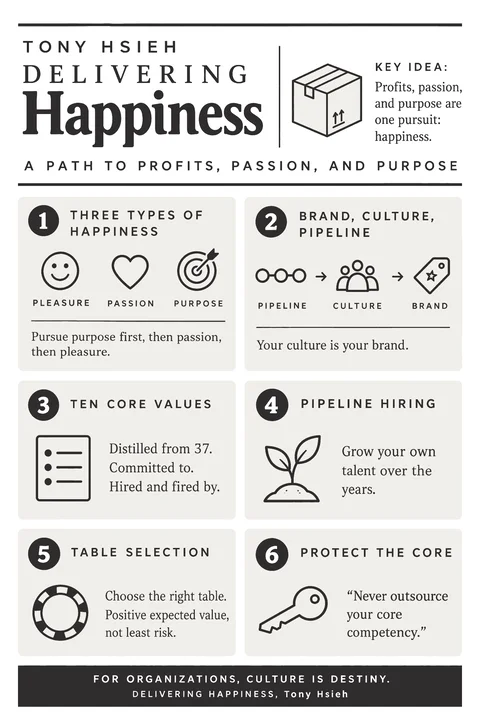
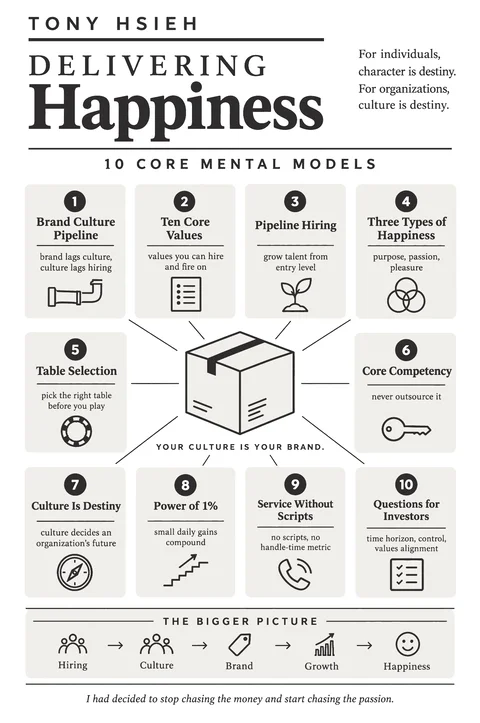
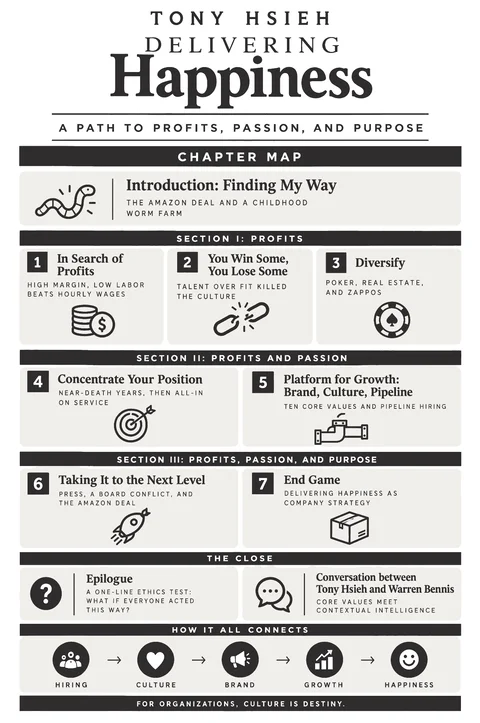
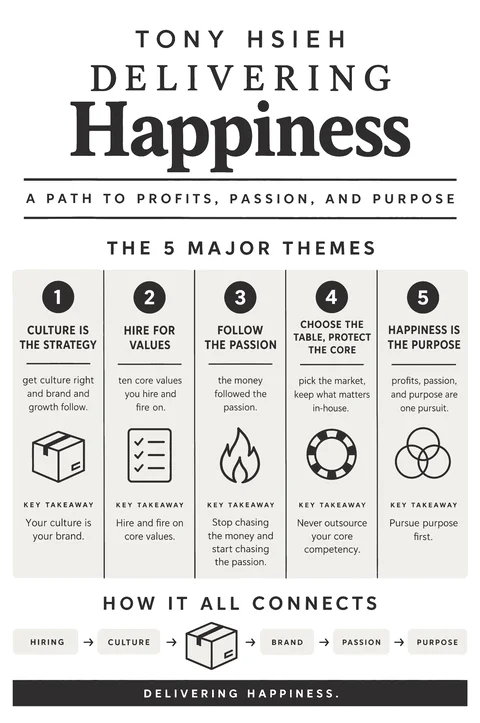
Four printable posters in the cover's colors: big ideas, mental models, a chapter map, and major themes.
Free. You'll also get each new summary by email.
The summaryPreface and Introduction: Finding My Way
Hsieh co-founded LinkExchange in 1996 and sold it to Microsoft in 1998 for $265 million. He got involved with Zappos in 1999 as an advisor and investor, became CEO, and grew it from almost no sales to over a billion dollars in gross merchandise sales a year; in 2009 Amazon acquired Zappos in a deal valued at over $1.2 billion on the day of closing. He wrote the book, without a ghostwriter, to help others avoid his mistakes, and he explains its three sections: Profits, mostly stories of growing up and finding his way to Zappos; Profits and Passion, the philosophies Zappos lives by, with internal emails and documents; and Profits, Passion, and Purpose, the vision for taking things to the next level.
The introduction opens on stage at a Zappos all-hands meeting in July 2009, 48 hours after the Amazon announcement, with 700 employees cheering and some in tears. The press called it a story about money, and both of his exits worked out to about $100 million per year. Hsieh says the people in the room knew they had built a business combining profits, passion and purpose, a lifestyle about delivering happiness to everyone, bonded by 10 core values the way the rave community he had found a decade earlier was bonded by PLUR: peace, love, unity, respect. Tracing back to where his path began, he lands on a worm farm.
"Together, we had built a business that combined profits, passion, and purpose."
Section IProfits
Section I is mostly the story of Hsieh growing up, his early businesses and the lessons that led him to Zappos.
Chapter 1In Search of Profits
On his ninth birthday Hsieh's parents paid $33.45 for a box of mud guaranteed to hold at least 100 earthworms; after 30 days of raw egg yolks, every worm was gone. His parents, immigrants from Taiwan, expected straight A's, allowed one hour of TV a week, started him on practice SAT tests in 6th grade and had him play four instruments; he got up early on weekends and played tape recordings of himself practicing. He wanted his own business because money meant freedom later in life. A paper route paid about $2 an hour; his newsletter, The Gobbler, sold four copies at $5 and one ad to his barber for $20. His first real business came from the book Free Stuff for Kids: for $1 and a photo he made pin-on buttons by mail, at 75 cents profit each, paid back the $100 his parents fronted him within the first month, and brought in a steady $200 a month through middle school. The lesson he took was that a business could run by mail without face-to-face interaction.
High school brought a computer lab, BBSs and, briefly, over 300 calls to 976-SEXY from the lab's phone line. He worked as a video game tester for Lucasfilm at $6 an hour, then programmed at a company called GDI for $15 an hour, where filling his boss's tea cup with ice cubes showed him how a little fun lightens an office. He spent $800, almost two weeks of pay, on a Boys' Life classified ad for a magic trick priced at $10 and got exactly one order, a lesson in humility and hubris. At Harvard, which his parents chose over his first choice, Brown, he skipped every class freshman year, then organized a virtual study group across 100 possible exam topics for a Bible class and sold the bound answers for $20, his first lesson in crowdsourcing. Running the Quincy House Grill, he sold McDonald's burgers bought for $1 at $3, then invested $2,000 in pizza ovens and tripled sales. His best customer, Alfred, bought whole pepperoni pizzas and resold them by the slice upstairs, making about 10 times more per hour than Hsieh did; Alfred later became Zappos's CFO and COO.
Chapter 1 · A business run by mail
"I also learned that it was pretty painful to bet the farm on something that didn't work out."
Chapter 2You Win Some, You Lose Some
Hsieh and his college roommate Sanjay both took jobs at Oracle in 1995; his paid $40,000 a year, which felt like winning the game college was supposed to be about. His job was running automated tests that took about three hours each, nobody tracked his hours, and he was soon bored. The two started a web design business on the side, built the local Chamber of Commerce's site for free and signed the Hillsdale Mall for $2,000. After several comic attempts, Hsieh resigned five months in; his boss assumed he was joining a funded startup. Within a week they realized they had no passion for web design. Out of boredom they built LinkExchange over a weekend: sites showed banner ads and earned half a credit per view, so 1,000 daily visitors earned 500 free ads across the network. They emailed 50 small sites and more than half signed up within 24 hours. They answered customer emails within about 10 minutes.
In August 1996, five months in, a New Yorker named Lenny offered a million dollars in cash and stock; they asked for $2 million cash and he declined, warning that LinkExchange was a once-in-a-lifetime opportunity. By December there were 25 employees, most of them friends, and Jerry Yang of Yahoo offered about $20 million. Hsieh made a list of what he would do with the money, found it short and mostly within reach already, and the partners turned Yahoo down; he told the company there would never be another 1997. Sequoia's Michael Moritz invested $3 million for 20% and was hazed at the monthly new-hire meeting by doing the Macarena. Hsieh's college customer Alfred joined as VP of Finance. Then hiring outran culture: past 25 people they hired smart, motivated people who wanted money or resume lines, and by 1998, with over 100 employees, Hsieh caught himself hitting snooze six times, dreading work at his own company. Microsoft bought LinkExchange for $265 million in November 1998; he could earn close to $40 million by staying 12 months, the practice Silicon Valley calls vesting in peace. After a cruise he owed friends on a bet that he would be a millionaire within 10 years, he listed his happiest moments, found none involved money, and walked away from the rest of the payout.
Chapter 2 · The offers for LinkExchange
"I had decided to stop chasing the money and start chasing the passion."
Chapter 3Diversify
Hsieh and many former LinkExchangers bought lofts above a new 14-screen AMC theater in San Francisco, eventually owning 20% of the units, and he and Alfred raised $27 million from former LinkExchange employees for a fund and incubator they named Venture Frogs. Nick Swinmurn left a voicemail about ShoeSite.com, the Amazon of shoes. Hsieh almost deleted it, then heard that footwear was a $40 billion industry in the United States and 5% of it, $2 billion, already sold through mail order catalogs. Nick was buying shoes from a local store whenever a customer ordered them. He brought in Fred, who had worked at Nordstrom for eight years; Hsieh suggested the name Zappos, from zapatos, with a second P. Venture Frogs funded them, and at their first shoe show they talked to about 80 brands over four days and three agreed to drop ship. Over the next year Venture Frogs made 27 investments.
- You're Already an Impact Business22 to 30
- You're Closer Than You Think14 to 21
- You Have the Foundation7 to 13
- The Starting Line0 to 6
 Printable PDF
"Hsieh got culture right first and the growth followed. Fair enough. But you want to know where your own business stands before you build on it, right? Ten questions, a score out of 30, and the part to fix first. It's free with your email."
 Deven Davis, devendavis.com
- Ten questions about where your business is right now
- A score out of 30
- A four-part breakdown: Impact Clarity, Traction Proof, Model Strength, Founder Credibility
- The part to fix first
- Your tier's next steps
- A printable PDF
Free with your email. Your score and a printable PDF open right on the page.
Bored with investing, Hsieh studied limit hold'em and drew business lessons from it, the biggest being that table selection is the most important decision: an experienced player can make 10 times as much at a table of tired, mediocre players, and in business you can define your own table or make yours bigger, as Southwest did by competing with buses and trains. Among his other poker lessons: go for positive expected value over what is least risky, make sure your bankroll fits the game, hope is not a good plan, and don't play games you don't understand. He also lost money day trading and investing in a movie, learning not to invest in things he did not understand. When Sequoia, which had turned $3 million in LinkExchange into over $50 million, declined to invest in Zappos, the 12 employees went out for margaritas and started cleaning out their desks. Hsieh decided to fund Zappos four months at a time, on condition that the team move into his loft. He describes his tribe of friends, his first rave, where he found a sense of connection and a PLUR culture of approaching strangers as people, and his advice to skip business-card networking and build the number and depth of friendships, since the payoff tends to arrive two to three years later. At his New Year's party a stranger told him, "Envision, create, and believe in your own universe, and the universe will form around you." When the dot-com crash came in April 2000, their attempt to raise a second, $100 million fund raised exactly $0, Zappos was the last company in the incubator, and Hsieh joined Zappos full time to prove LinkExchange had not been a fluke.
Chapter 3 · Table selection
"I learned that the most important decision I could make was which table to sit at."
Section IIProfits and Passion
Section II turns to the business of Zappos: how it survived, the decisions that made customer service its brand, and the philosophies and internal documents it still uses.
Chapter 4Concentrate Your Position
Through the recession, the dot-com crash and 9/11, Zappos focused on survival. Hsieh's October 2000 "9-Month Plan" email told employees the priority was reaching profitability before the cash ran out. After layoffs, his salary was set at $24 a year, and he housed employees rent-free in his party loft and other lofts he owned; productivity held up after the layoffs because the people who stayed were believers. He sold nearly all his real estate to keep funding the company. Over drinks, Fred said sales would at least triple if Zappos carried inventory of the brands customers wanted, which meant a buying team, a warehouse, software changes, $2 million for inventory and a physical store to satisfy brands that only sold to retailers. They turned the office reception area into a shoe store, bought a mom-and-pop store in Willows, about two hours north, and rented an old department store across the street that held 50,000 pairs. Sales went from $1.6 million in 2000 to $8.6 million in 2001.
Moving inventory to an outsourced Kentucky warehouse, eLogistics, went badly: one of the trucks overturned and lost about 20% of the inventory, worth an estimated $500,000 at retail, and new shoes piled up unscanned on the loading dock. Keith flew to Kentucky that day on Fred's instructions and stayed for months. Hsieh climbed Kilimanjaro with his friend Jen while Zappos had less than two months of cash; he dreamed an offer for his party loft came in. The real buyer backed out on a fortune teller's advice, and he finally accepted an offer 40% below what he had paid, buying six more months. Hsieh and Keith drove 36 hours to Kentucky, opened their own warehouse called WHISKEY, moved 10,000 pairs a week out of eLogistics for every week they outperformed it, and learned never to outsource a core competency. Sales reached $32 million in 2002. When Fred asked for book recommendations in February 2003, he suggested a board tracking who had read what, the seed of a Zappos library that five years later held a hundred titles free to employees and visitors. Hsieh and Fred decided Zappos should be about the very best customer service, and in March 2003 they turned off the dropship business, about 25% of projected sales, because vendor inventory feeds were 95% accurate at best. For months they paid about 70% of vendors each week, until Wells Fargo approved a $6 million line of credit in June 2003. Zappos ended 2003 at $70 million in gross merchandise sales.
Chapter 4 · Carrying inventory pays off
"We learned that we should never outsource our core competency."
The Profit + Purpose Playbook
Chapter 5Platform for Growth: Brand, Culture, Pipeline
San Francisco was a hard place to staff a call center, and outsourcing it overseas would break the lesson about core competencies, so at the end of 2003 Zappos decided to move its whole headquarters to Las Vegas, making customer service the job of the entire company. Of about 90 San Francisco employees, 70 chose to move. With no friends outside the company, employees spent their free time together, and culture became the number one priority, ahead even of customer service, on the theory that great service would follow. A bar conversation produced the Zappos Culture Book: each year employees write what the culture means to them, published unedited except for typos, good and bad; an August 2004 email asked for 100 to 500 words. Complaints in the first edition led to Ask Anything, a monthly newsletter answering any anonymous question. Sequoia eventually invested, the credit line grew to $100 million, and Zappos passed $1 billion in gross merchandise sales in 2008, two years ahead of its 2010 goal. Hsieh credits three investments he calls BCP, brand, culture and pipeline, the only competitive advantages he believes cannot be copied.
Brand through customer service: free shipping both ways, a 365-day return policy, the phone number at the top of every page and a call center open 24/7. Hsieh calls the telephone one of the best branding devices, with 5 to 10 minutes of a customer's undivided attention. Zappos runs its warehouse 24/7 and surprises loyal customers with overnight upgrades; it does not measure call times (the longest call was almost six hours), use scripts or upsell, and reps who are out of a style check at least three competitors' sites. A rep once found a Skechers employee the five closest pizza places still delivering in Santa Monica. Hsieh lists ten ways to instill customer service, including making wow a verb and hiring people already passionate about service. Culture: public tours, a single entrance to encourage serendipitous meetings, a face game at login, and his blog post "Your Culture Is Your Brand," which argues that a brand is a lagging indicator of culture. Every headquarters hire takes the same four-week training, including two weeks on the phones, and after the first week Zappos offers $2,000 to quit; less than 1% take it. An initial list of 37 values became the 10 core values: deliver WOW through service; embrace and drive change; create fun and a little weirdness; be adventurous, creative and open-minded; pursue growth and learning; build open and honest relationships with communication; build a positive team and family spirit; do more with less; be passionate and determined; be humble. They are committable, meaning Zappos hires and fires on them, and be humble affects hiring decisions the most. Employee essays illustrate each value, and Fred describes treating vendors as partners, including an extranet that shows them inventory, sales and profitability.
Employee essays bring the values to life. Martha C. paid for a stranger's peanuts at Walgreens and called it "a random act of wow-ness." Krista F., who had burned out in corporate staffing, built a recruiting process around Hsieh's idea of speed dating: candidates met six employees for five minutes each, with dance music and a kitchen timer. Alfred's blog post "The Power of 1%" argued that improving 1% a day compounds to 37 times better in a year. Vanessa L. spent her first Christmas at Zappos alone with two yams and marshmallows picked out of cocoa mix, and says do more with less got her through. In his section on vendor relations, Fred describes treating vendors the way Zappos would want to be treated: shuttles from the airport, calls returned the same day, collaborative negotiations, an extranet that shows them inventory, sales and profitability so the average buyer's 50 brands get 50 more pairs of eyes, and an annual vendor appreciation party for over 1,000 vendors. Zappos entered eyewear after a round of golf with its Oakley rep.
In 2008, months after a bonus of 10% of salary, the slowdown forced Zappos to lay off 8% of staff; Hsieh's November 6, 2008 email, posted publicly, explained the cut plainly and offered pay through the end of the year and up to 6 months of COBRA reimbursement. The pipeline replaces treating individual people as assets: hire mostly at entry level, then train so anyone can become a senior leader within five to seven years, as the three-year merchandising program already does, with a planned 11-year pipeline from four years before joining to seven after.
Chapter 5 · Brand, culture, pipeline
"Your culture is your brand."
Section IIIProfits, Passion, and Purpose
Section III lays out where Hsieh wants Zappos and its readers to go next: from building a company to delivering happiness as a purpose.
"Hsieh decided what Zappos stood for before he scaled it. Here's your version on one page: purpose, opportunity, leverage, model. The same four questions Ivystone uses on deals, done in 47 minutes on average. A dollar. Go do it."
Deven Davis, devendavis.com- The P-O-L-M framework (Purpose, Opportunity, Leverage, Model) used by institutional investors to evaluate early-stage deals
- A fill-in-the-blank worksheet that produces a one-page business gameplan in one sitting
- Bonus: The 48-Hour Quick Start, the exact first 3 steps to take today
One dollar, backed by the Dollar-Back Promise, and done in 47 minutes on average.
Chapter 6Taking It to the Next Level
Media coverage grew without a PR push, often for things Zappos had done years earlier, such as paying new hires to quit, which taught Hsieh that a company that keeps wowing people will be found by the press. His first big speech, at the Footwear News CEO Summit in 2005, was memorized word for word and cost him a night's sleep; a year later he realized nobody knew his script, dropped it and found flow. His three rules: be passionate, tell personal stories, be real. He declines talks on topics he is not passionate about, whatever the fee. Sharing openly at tours and conferences showed Zappos it was changing how other companies ran, which led to Zappos Insights, an online video service, and a two-day seminar.
The board, mostly from technology and manufacturing, called many of these efforts "Tony's social experiments" and wanted a financial exit; Hsieh believes he came close to being fired. He controlled enough votes to block a sale, the board controlled enough seats to replace him, and he saw a new version of the LinkExchange lesson: alignment with shareholders matters as much as alignment with employees. He offers ten questions to ask investors and board members, starting with whether you need investors at all. Zappos planned to raise about $200 million to buy out the board, then reopened talks with Amazon, whose Jeff Bezos had first visited in 2005. Hsieh pushed for an all-stock deal, which he compared to a married couple's joint bank account. His July 22, 2009 announcement email answered whether jobs, culture and leaders would stay (yes) and said he would prefer a headline about Zappos and Amazon sitting in a tree; it included Bezos's video message to obsess over customers, invent, think long term and remember that it is always day one. Within an hour employees went back to work, and at the all-hands meeting before 700 employees, Alfred and Hsieh gave everyone a Kindle and announced an Amazon-funded bonus.
The deal closed on October 31st at 11:59 p.m. Pacific Time, valued at over $1.2 billion for Zappos shareholders; Hsieh, Alfred and Fred toasted by phone, "To infinity and beyond." In January 2010, Zappos ranked number 15 on Fortune's list of the best companies to work for.
Chapter 6 · Alignment
"Getting married to Amazon will allow us to fulfill our vision of delivering happiness to the world that much faster."
Chapter 7End Game
Hsieh asks readers to name their goal in life and then keep asking why; he says most people end up at the same answer, happiness. He began reading the science of happiness, a field he describes as relatively new, in 2007 and realized it had everything to do with Zappos, whose customers described their shipments as happiness in a box. The Zappos brand promise moved from largest selection of shoes in 1999 to customer service in 2003, culture and core values in 2005, personal emotional connection in 2007 and, in 2009, delivering happiness to the world. People are bad at predicting what will make them happy; he cites lottery-winner studies in which happiness reverts within a year, and compares it to marathon training, where research says to run slower than instinct suggests.
He shares three frameworks. First, happiness comes down to perceived control (call center reps now choose which of about 20 skill sets to certify in, each with a small raise), perceived progress (smaller merchandising promotions every six months that add up to the old single promotion at 18 months), connectedness and vision or meaning. Second, Chip Conley's Peak condenses Maslow into three-level pyramids for customers (meets expectations, desires, unrecognized needs), employees (money, recognition, meaning) and investors. Third, there are three types of happiness: pleasure, the shortest lasting, passion or flow, and higher purpose, the longest lasting, so he advises pursuing purpose first and layering the others on top. He sees profits, passion and purpose in great companies as a fractal of pleasure, passion and purpose in people, and says he wrote the book to contribute to a happiness movement.
Chapter 7 · Three types of happiness
"In the end, it turns out that we're all taking different paths in pursuit of the same goal, happiness."
EpilogueJoin the Movement
Hsieh's guiding test for any decision is to ask what would happen if everyone in the world acted the same way, and what the net effect would be on overall happiness: whether to share how Zappos works, get upset at a waitress who got an order wrong, or hold a door for a stranger. Readers can do nothing, or join a movement to make the world happier. He closes with the Buddha's line that happiness never decreases by being shared.
"Or you can be part of a movement to help make the world a happier and better place."
Audiobook bonusConversation between Tony Hsieh and Warren Bennis
The audiobook closes with a conversation recorded at the University of Southern California's Marshall School of Business, introduced by Dave Logan, author of Tribal Leadership. Asked by Bennis when he had been happiest, Hsieh names the all-hands meeting where, on top of the Kindles, Zappos announced a bonus of 40% of each employee's previous 12 months of earnings, spreading what would usually be retention bonuses for the top 10 or 15 people across everyone, and the whole room stood up cheering and crying. He explains why he sold LinkExchange (the culture had stopped being fun and he no longer controlled the company) and how Zappos protects its culture: two sets of interviews, one purely for culture fit, with questions for each core value, such as "on a scale of 1 to 10, how weird are you?" and "how lucky are you in life?" The luck question comes from a study in which self-described lucky people noticed a planted headline offering an extra $100 and unlucky people did not; Hsieh concludes that luck is about being open to opportunity. Zappos, he says, focuses on who people are, hiring those whose personal values already match the core values, which removes the need for scripts and rules; its social media policy is "be real and use your best judgment."
Bennis, at work on his 30th book, a memoir titled Still Surprised, describes his biggest mistake as president of the University of Cincinnati: trying to change a proud culture before understanding it, which he calls a lack of contextual intelligence. He adds that listening is one of the most powerful parts of leadership. Hsieh separates entrepreneurial optimism, which stays in touch with reality, from simply being out of touch; says Zappos made culture its number one priority only about five years in, later finding the same lessons in Good to Great; and describes a project to map triads, three-person relationships, through the face game, because in a triad the third person is responsible for the strength of the other two's relationship. On Amazon, he says the arrangement works like a new board, a management committee of three people from each company, and that Zappos has tested its independence and Amazon has kept its word.
"So the takeaway is that it's not that people are inherently lucky or unlucky, but luck is really more about being open to the opportunity beyond just how the task or situation presents itself."
Delivering Happiness on four pages
Four printable posters in the cover's colors: big ideas, mental models, a chapter map, and major themes.
Free. You'll also get each new summary by email.