Crucial Conversations by Kerry Patterson, Joseph Grenny, Ron McMillan and Al Switzler: Summary and Notes
The full book, section by section.
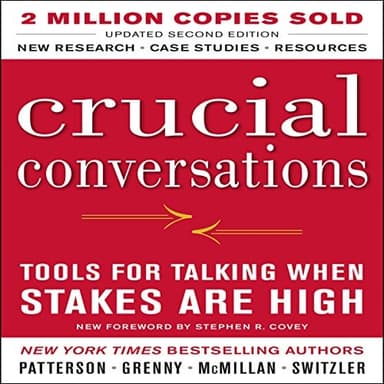
Start hereThe short version
- 1A crucial conversation is one where stakes are high, opinions vary and emotions run strong, and the authors argue that almost every chronic problem in a team, company or marriage sits on one that is going unheld or badly held. Chapters 1 and 2 make the case and define the goal, dialogue: the free flow of meaning into a pool of shared meaning.The claim
- 2The work starts inside. Chapter 3 says start with heart and refuse the fool's choice between honesty and kindness, Chapter 4 teaches you to watch for silence and violence as signs that safety is at risk, Chapter 5 restores safety, and Chapter 6 masters the stories that create your emotions.Work on me first
- 3Then come the tools for talking, listening and acting. Chapter 7 states your path with STATE, Chapter 8 explores others' paths with AMPP and the ABCs, and Chapter 9 decides how to decide and assigns who does what by when. Chapter 10 handles 17 tough cases, Chapter 11 puts it all together, and an afterword gives each author's lessons from ten years.The tools
Crucial Conversations on four pages
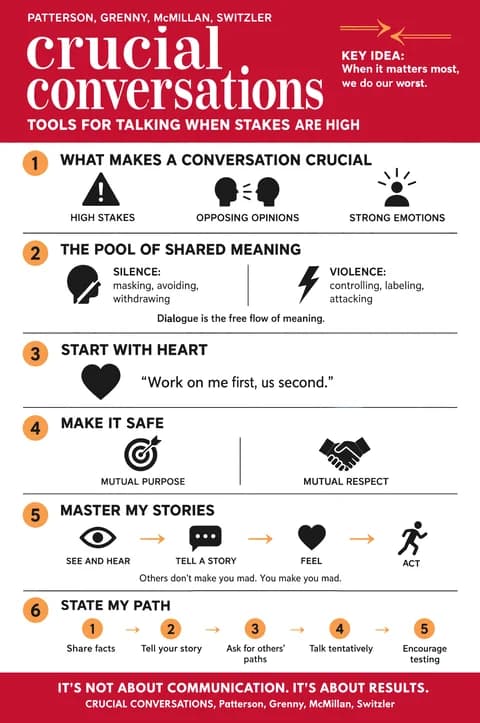
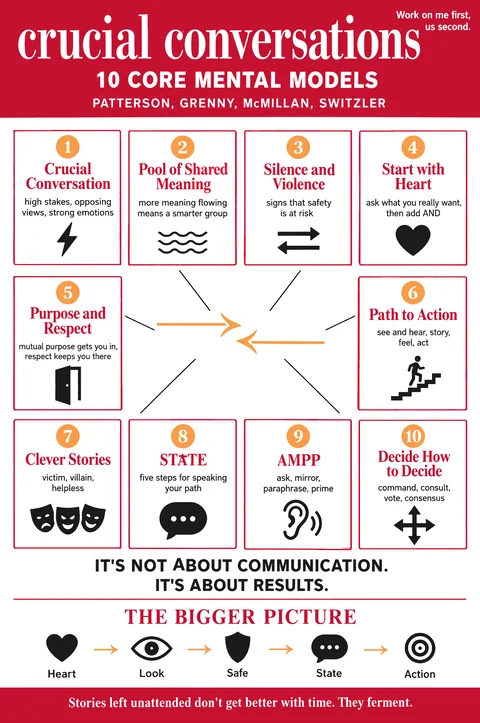
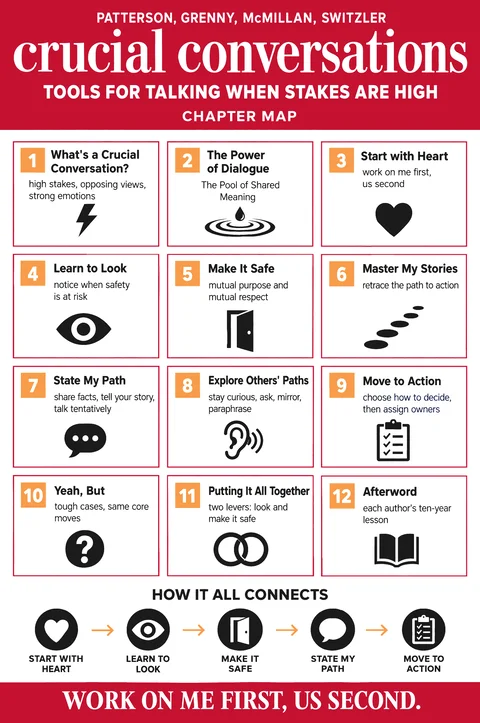
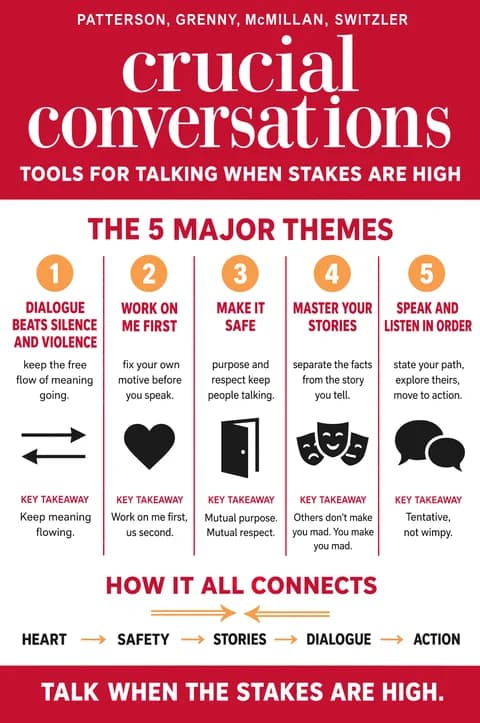
Four printable posters in the cover's colors: big ideas, mental models, a chapter map, and major themes.
Free. You'll also get each new summary by email.
The summaryForeword to the First Edition and Preface
Stephen R. Covey's foreword quotes the historian Arnold Toynbee's four-word summary of history, nothing fails like success: a response that met yesterday's challenge fails when the challenge rises. Covey calls the book's goal a higher middle way, a solution two people create together that is better than either one's starting position, and says genuine dialogue bonds people the way creating something together does. In the preface, dated May 2011, the authors restate the claim they made when the book first came out in 2002: the root cause of many, if not most, human problems lies in how people behave when others disagree with them about high-stakes, emotional issues. They report readers who reunited with an estranged father, saved a patient by speaking up to a defensive doctor, and kept a family together over a will, and they describe this edition's additions: new research, reader stories, videos and an afterword from each author. These notes cover that Second Edition, the edition all three buy links point to.
"Most breakthroughs in life are breakwiths."
Chapter 1What's a Crucial Conversation? And Who Cares?
A crucial conversation is a discussion between two or more people where stakes are high, opinions vary and emotions run strong: a promotion your boss thinks you are not ready for, a marketing strategy your company's annual goals depend on, a spouse upset about the block party, a neighbor threatening a lawsuit over three inches of fence. People can avoid these conversations, face them and handle them poorly, or face them and handle them well, and the authors argue that people usually do their worst exactly when it matters. Adrenaline diverts blood from the reasoning brain to the arms and legs, the conversation arrives without warning, and most people have never watched anyone do it well. The resulting strategies create the very thing people want to avoid, like the partner whose sarcastic remarks make the other spend even less time at home.
The authors' audacious claim is that at the heart of almost all chronic problems in organizations, teams and relationships lie crucial conversations that people are either not holding or not holding well. They report that in a study of over 7,000 doctors and nurses, 84% regularly saw shortcuts, incompetence or broken rules, and the odds of a nurse speaking up were less than 1 in 12. In over 2,200 projects, close to 80% of cross-functional projects ran over budget and under-delivered, and failure could be predicted with nearly 90% accuracy by whether people could hold five specific crucial conversations; where people spoke up, projects were less than half as likely to fail. Skilled companies, they report, respond five times faster to financial downturns and save over $1,500 and an eight-hour workday for every crucial conversation held rather than avoided, and 93% of over 4,000 respondents said bullying or incompetent colleagues were almost always untouchable. They cite Howard Markman's finding that how couples argue predicted nearly 90% of divorces, a study of couples married an average of 42 years in which those who argued constantly had weaker immune systems, and a malignant melanoma study in which 9% of patients taught communication skills died over five years against almost 30% of the untrained group.
Chapter 1 · Why crucial conversations matter
"At the heart of almost all chronic problems in our organizations, our teams, and our relationships lie crucial conversations, ones that we're either not holding or not holding well."
Chapter 2Mastering Crucial Conversations: The Power of Dialogue
The authors began by asking over 20,000 people over 25 years to name colleagues who could really get things done, and studied those named 30 or more times. One was Kevin, the only one of eight vice presidents in his company identified as exceedingly influential. In a meeting about relocating the offices, the CEO, Chris, pushed his own unpopular choice, and people stopped questioning him. Kevin asked, "Hey, Chris, can I check something out with you?" and told him he seemed to be violating his own decision-making guidelines to move the offices to his hometown. Chris agreed and the team chose a far more reasonable location. What set Kevin apart was refusing the fool's choice, the belief that you must choose between telling the truth and keeping a friend, a lesson many people learn when Grandma asks whether they like her Brussels sprout pie.
The authors define dialogue as the free flow of meaning between two or more people. Each person brings a personal pool of meaning, and skilled communicators make it safe for everyone to add to a pool of shared meaning, which the authors call a measure of a group's IQ. When meaning is withheld, individually smart people do collectively stupid things: a woman went in for a tonsillectomy and had part of her foot removed while no less than seven people wondered why and said nothing. People who are not heard comply without commitment. When dialogue fails, people move to silence, withholding meaning, or violence, forcing meaning into the pool. A reader, Bobby R., blew up at his father the night before his first deployment to Iraq in 2004; after five years of silence, and a crucial conversations class before his third tour, he spent three tense hours with his father on a balcony in Houston and rebuilt the relationship. The chapter previews the book: work on yourself, then the tools for talking, listening and acting together, then 17 tough cases.
Chapter 2 · The pool of shared meaning
"The mistake most of us make in our crucial conversations is we believe that we have to choose between telling the truth and keeping a friend."
Chapter 3Start with Heart: How to Stay Focused on What You Really Want
The first principle of dialogue is to start with your own heart. Two sisters back from a hot day at Disneyland fought over a one-person hotel bathroom; their father told them to work it out with one rule, no hitting, and it took them 25 minutes. Both said they wanted to use the bathroom, then behaved in ways that kept them from it. The authors conclude that under pressure our motives degenerate along with our behavior, and that the people best at dialogue follow the principle work on me first, us second, since the only person you can reliably change is the one in the mirror.
Greta, a CEO six months into a cost-cutting campaign, was asked in front of 200 managers why she was building a second office whose furniture was rumored to cost $150,000. Her jaw tightened and her finger rose like a loaded weapon; the authors describe how motives slide toward winning, punishing or keeping the peace. Then Greta asked herself what she really wanted, realized the question gave her the chance to address the belief that she was a hypocrite, thanked the manager and talked it through; the group agreed to cut the project's cost by half or cancel it. The authors' questions for redirecting the heart: what do I really want for myself, for others and for the relationship, and how would I behave if I really wanted these results? Asking them also sends blood back to the thinking brain. The second move is to refuse the fool's choice. Brent, a new teacher, publicly mocked Royce, a chemistry teacher of 33 years who was acting out bayonet drills with a yardstick, then claimed he was the only one with the guts to speak the truth. The authors' alternative is to search for the and: clarify what you want, clarify what you do not want, and combine them, as in "How can I have a candid conversation with my husband about being more dependable and avoid creating bad feelings or wasting our time?"
Chapter 3 · Refuse the fool's choice
"Our problem is not that our behavior degenerates. It's that our motives do, a fact that we usually miss."
Chapter 4Learn to Look: How to Notice When Safety Is at Risk
After a product-timeline meeting turns into a nasty argument, the boss cannot say what went wrong, while two colleagues walking the other way can. One of them explains that he watches both the content of a conversation and its conditions, how people are acting in response. The authors compare it to fly fishing: an experienced angler sees the distorted image of a trout underwater because he knows what to look for. They name three things to watch. First, the moment a conversation turns crucial, signaled by physical cues like a tight stomach, by emotions, or by behavior such as a raised voice. Second, signs that people don't feel safe. The authors argue that defensiveness comes from a loss of safety far more often than from the message itself, so silence and violence should be recoded as signs of fear and met with curiosity.
The authors break each sign into three forms. Silence shows up as masking (sarcasm, sugarcoating, couching), avoiding the real issue, and withdrawing from the conversation or the room. Violence shows up as controlling (cutting people off, speaking in absolutes, overstating facts), labeling people or ideas to dismiss them, and attacking. Third, watch your own style under stress, since most people are poor self-monitors, like the person shouting "I'm not angry!" Readers can take a Style Under Stress survey on the book's website. Tom E., 55 and 17 years at the same company, was placed on three months' probation for his blow-ups after a class taught him that he pushed until others went silent and took silence as agreement. A year later he had mended every fence, and his wife said it was like being married to a different person.
Chapter 4 · Silence and violence
"We're suggesting that people rarely become defensive simply because of what you're saying. They only become defensive when they no longer feel safe."
Chapter 5Make It Safe: How to Make It Safe to Talk about Almost Anything
Yvonne raises the touchy subject of their physical relationship, Jotham answers with sarcasm, and she walks out. The worst at dialogue ignore safety or go silent; the good sugarcoat; the best step out of the content, make it safe, then step back in. First decide which condition is at risk. Mutual purpose is the entrance condition: others must believe you care about their goals and trust your motives, and its absence shows up as debate, defensiveness, hidden agendas and accusations. It cannot be faked as a technique. Mutual respect is the continuance condition. The authors write that respect is like air: nobody notices it until it is gone, and then the conversation is about defending dignity. A manufacturer emerging from a strike of over six months had managers and union leaders each write their goals on flip charts for two hours; the lists were nearly identical, and dialogue replaced silence and violence for the first time in decades.
- You're Already an Impact Business22 to 30
- You're Closer Than You Think14 to 21
- You Have the Foundation7 to 13
- The Starting Line0 to 6
 Printable PDF
"Patterson and the team say most chronic problems sit on a conversation nobody's having. Let's find yours. Ten questions, a score on four parts of your business and the part to fix first. It's free with your email. Go find out."
 Deven Davis, devendavis.com
- Ten questions about where your business is right now
- A score out of 30
- A four-part breakdown: Impact Clarity, Traction Proof, Model Strength, Founder Credibility
- The part to fix first
- Your tier's next steps
- A printable PDF
Free with your email. Your score and a printable PDF open right on the page.
Three skills restore safety. Apologize when you have caused harm, as a manager should have after skipping a promised VIP visit to a team that worked all night. Contrast when someone misreads your purpose or respect: a statement of what you do not intend, followed by what you do, which also puts feedback in proportion and can be used before a hard message. Create a mutual purpose with CRIB when goals truly differ: commit to seek mutual purpose; recognize the purpose behind the strategy, asking "why do you want that?" (a movie out and a quiet night in can both be served by a drive up the canyon); invent a higher purpose, such as the family coming before a promotion; and brainstorm new strategies. Yvonne and Jotham reach "find ways to be together and make both of us feel loved and appreciated." A hospital leader, Dr. Jerry M., used contrasting with a surgeon who suspected the insurance company was behind a discharge request, and the surgeon came in at 7 to discharge the patient.
Chapter 5 · The two conditions of safety
"Because respect is like air. As long as it's present, nobody thinks about it. But if you take it away, it's all that people can think about."
Chapter 6Master My Stories: How to Stay in Dialogue When You're Angry, Scared, or Hurt
The chapter makes two claims: others don't make you mad, you make you mad, and once you have created an emotion you either act on it or are acted on by it. Maria, a copywriter, watched her colleague Louis take over their joint presentation and meet with the boss without her. She decided he was downplaying her because she was the only woman on the team, said nothing and took sarcastic jabs instead. The authors' Path to Action explains how: we see or hear something, tell ourselves a story about it, feel an emotion and then act. Because the story sits between the facts and the feeling, ten people can see the same event and feel ten different things, and telling a different story is the point of control.
The skill is to retrace your path: notice your behavior (am I in silence or violence?), get in touch with your feelings with a richer vocabulary than "bad" or "angry," analyze your story, and get back to the facts. A fact is observable: Louis gave 95% of the presentation and answered all but one question. "He's a male chauvinist pig" is a story, and hot words like "scowled" signal one. Watch for three clever stories, which let us feel good about behaving badly. Victim stories leave out our own role; villain stories turn decent people into villains with labels; helpless stories say there is nothing else we can do. Clever stories usually start with a sellout, acting against our own sense of what's right, such as refusing to let a merging driver in and then deciding he is a jerk. The fix is to tell the rest of the story by asking: Am I pretending not to notice my role in the problem? Why would a reasonable, rational and decent person do what this person is doing? What do I really want? What would I do right now if I really wanted these results? Maria met Louis, who apologized, explained that he talks more when he is nervous, and proposed they each take half the presentation. A reader, Kathy W., who left an abusive marriage after 16 years and eight attempts, used the skills to talk with a daughter who had lost custody of her children.
Chapter 6 · The Path to Action
"No matter how comfortable it might make you feel saying it, others don't make you mad. You make you mad."
Chapter 7State My Path: How to Speak Persuasively, Not Abrasively
When the message is risky, the worst at dialogue either dump it bluntly or say nothing, the good sugarcoat, and the best are both totally frank and completely respectful. That takes a blend of confidence, humility and skill. Brian complains to his wife and his lunch friends that his boss, Fernando, micromanages him; everyone knows it except Fernando. Carol finds a charge from the Goodnight Motel, a mile from home, on the credit card statement, decides Bob is having an affair and opens with an accusation. The authors give five skills under the acronym STATE. The first three say what to do. Share your facts, because facts are the least controversial, most persuasive and least insulting place to start; "yesterday you arrived at work 20 minutes late" invites no dispute, while "you can't be trusted" does. Tell your story as a possible conclusion, without piling on every unflattering judgment; Brian tells Fernando the facts, that he asks to meet twice a day, then says he is beginning to wonder whether Fernando trusts him, and learns Fernando's last report kept leaving out key elements. Ask for others' paths, ready to reshape your story.
The last two say how. Talk tentatively: "in my opinion" in place of "the fact is," and "I'm beginning to wonder if" in place of "it's clear to me," without the opposite error of disclaimers like "this is probably stupid, but." The authors' Goldilocks test lands on lines like "It's starting to look like you're taking this home for your own use. Is that right?" Encourage testing: invite opposing views, mean it, and play devil's advocate if needed. Done well, Carol shares the $48 charge, mentions her sister's experience as a tentative story, contrasts by saying she does not really believe Bob is having an affair, and asks to call the motel together. The owner of a Chinese restaurant they had visited also owned the motel and ran both through the same card machine. The same skills apply when strong belief makes people push too hard with stacked facts, exaggeration and dirty tricks: back off the harsh language and keep the belief. Lori A. used contrasting and STATE to stay connected to a teenage daughter diagnosed as bipolar three years earlier.
Chapter 7 · STATE my path
"The real test of whether your motive is to win a debate or engage in real dialogue is the degree to which you encourage testing."
The Founder Brain Kit
Chapter 8Explore Others' Paths: How to Listen When Others Blow Up or Clam Up
Wendy has started dating a guy who looks, the authors write, about 10 minutes away from a felony arrest, and when her parent raises it she shouts and sulks for hours. You cannot force someone into dialogue, but you can make it safer, and the next skill is to explore others' paths. It starts with heart: be sincere (unlike the clerk who answers a patient's "mostly" with "next!"), be curious about why a reasonable, rational and decent person would say this, and be patient while the other person's adrenaline subsides. When someone is in silence or violence, we are joining their path to action already in progress, so the job is to help them retrace it back to their story and facts.
The four power listening tools spell AMPP. Ask: "What's going on?" Mirror the emotion you see, calmly, when tone and words do not match: "You say you're okay, but by the tone of your voice, you seem upset." Paraphrase the story in your own words. Prime when nothing else works, offering your best guess at what they are thinking. When a plant added a three-to-midnight shift that meant rotating every two weeks, employees sat silent until an executive asked whether they thought the company was doing it only to make money; then the discussion was off and running. Listening this way signals understanding, which is different from agreement. With Wendy, an apology, asking, mirroring, paraphrasing and finally priming lead her to ask, "Why am I so ugly?" and the real conversation begins. When it is your turn to respond, use your ABCs: agree when you agree, since the authors write that most arguments are over the 5 to 10% of facts and stories people disagree on; build when something is missing; compare when you differ, opening with "I think I see things differently." A reader, Daryl K., used the skills in a six-hour meeting at JFK Airport to save a venture deal that came down to one word in a 17-page agreement, settled on a 5 a.m. call.
Chapter 8 · Power listening
"This means that at the very moment when most people become furious, we need to become curious."
Chapter 9Move to Action: How to Turn Crucial Conversations into Action and Results
A full pool of meaning still fails when people are unclear about how decisions will be made or never act on them. After a respectful conversation about vacation plans, Rene booked a three-day cruise and paid a $500 deposit, and Kara was miffed: she had agreed to a cruise in principle and had no say in this particular one. The authors' rule is that dialogue is not decision-making, so decide how to decide. Managers and parents choose the method when authority is clear; when it is unclear, as with whether a school should hold a child back, the parties talk openly about who decides. The four methods offer rising involvement and falling efficiency. Command: decisions handed to us by outside forces or delegated to someone we trust. Consult: decision-makers gather input, then choose and inform. Vote: for efficiency when choosing among good options, with everyone agreeing to support the result. Consensus: talk until everyone honestly agrees, reserved for high-stakes, complex issues or ones everyone must support. Four questions help choose: who cares, who knows, who must agree, and how many people is it worth involving?
"The book says we do our worst when it matters most. Look, how you show up in that moment comes from who you think you are. The Identity Shift is 30 days of working on that: a prompt, a reflection, an intention. Seven bucks, and the first shift shows up in Week 1."
Deven Davis, devendavis.com- 30 days of guided identity reprogramming, rooted in Wattles' Impression of Increase principle
- Each day has a prompt, a reflection and an intention
- Bonus: The Quick Win Guide, your first identity shift result in under 1 hour
- Bonus: a 5-minute video from Deven on why identity precedes strategy
Seven dollars, with the No-Brainer Guarantee: if it doesn't change how you think about yourself and money within the first week, full refund.
Then make assignments: who does what by when, and how you will follow up. There is no "we" in assignments, since we means not me. Vague deliverables fail: Howard Hughes gave engineers almost no direction for a steam-powered car, and they built a giant radiator that would boil passengers alive in a wreck; he had it cut into pieces no larger than three inches. The authors paid a set designer $25,000 for something that would never work, and now point to pictures. Goals without deadlines are merely directions. Build in follow-up, write everything down because one dull pencil is worth six sharp minds, and hold people accountable to their promises.
Chapter 9 · Decide how to decide
"Assignments without deadlines are far better at producing guilt than stimulating action."
Chapter 10Yeah, But: Advice for Tough Cases
To readers who say their situation is harder, the authors answer that the skills apply to almost any problem and walk through 17 tough cases, each with a danger point and a solution. For subtle sexual or other harassment, they write that the vast majority of problems go away when raised privately, respectfully and firmly, describing specific behavior and contacting HR when it crosses the line. With an overly sensitive spouse, catch issues early and state the path. When a teammate breaks an agreement, such as an executive who prepaid six months of consulting the day after the team froze discretionary spending, every team member should speak up immediately, without waiting for the boss. For deference to authority, ask a peer what you do that invites it, reward risk-takers and play devil's advocate. Failed trust is handled around the issue, since trust comes in degrees and in two flavors, motive and ability. A partner who won't talk about anything serious needs safety, patience and eventually a conversation about how you talk. Vague but annoying behavior needs specific facts or no conversation at all. Someone who shows no initiative needs new, higher expectations.
Several cases turn on patterns over instances. When someone keeps showing up late after agreeing to do better, the next conversation is about the broken commitment, or you are stuck in Groundhog Day. Endless excuses call for a commitment to solve the overall problem, being on time, along with the stated cause. Word games call for naming the pattern and holding people to results, and leaders who face constant surprises should set a no surprises rule. If you need time to calm down, a mutually agreed time-out is a healthy part of dialogue. Insubordination gets zero tolerance, raised immediately and respectfully. If you said something horrible, apologize, then state your path. Touchy and personal issues like hygiene call for contrasting, mutual purpose and a tentative description. And with someone who breaks all the rules, eat the elephant one bite at a time, starting where what bothers you most overlaps with what is easiest to change.
Chapter 10 · Talk about the pattern
"Stories left unattended don't get better with time. They ferment."
Chapter 11Putting It All Together: Tools for Preparing and Learning
Readers who feel like an anaconda that just swallowed a warthog get two levers. Learn to look: keep asking whether you are in dialogue or playing games, and say out loud, "I think we've moved away from dialogue." Make it safe: the authors write that if you simply realize your challenge is to make it safer, 9 out of 10 times you will intuitively do something that helps, whether a question, an apology, a smile or a brief time-out. They then walk the whole model through one case: dividing your mother's estate with your sister after caring for your mother for the past four years. The conversation opens badly, then moves through start with heart, contrasting, mastering your story, stating your path, mirroring, priming and paraphrasing her view, building on what you agree with (a new medication during the last 18 months cost twice as much as the old one), and ends with a plan to go over the expenses the next day.
A reader, Afton P., was a 22-year-old student in Geneva in 2004 when a committee preparing a human rights report to a UN subcommission wanted to avoid naming countries. She argued it was possible to be candid and respectful, was invited to rewrite the report, and then presented it. The authors close by saying the book was always about results: the quality of your leadership and your life is a function of how you handle crucial moments, and progress does not require perfection.
Chapter 11 · Make it safer
"It's not about communication. It's about results."
AfterwordWhat We've Learned About Crucial Conversations in the Past Ten Years
Each author steps out of the collective voice. Al Switzler argued again and again with an airport parking attendant over $3 on a ticket that read 29 minutes while his wife elbowed him, and concluded that sometimes we do our worst when it hardly matters at all: there is no cruise control for crucial conversations. A reader who worked in IT, holding the most underlined copy he had ever signed, taught him that crucial conversations belong to the first person who sees them. Joseph Grenny found himself seething at his 15-year-old son, Hiram, then asked what he really wanted and why a reasonable, rational, decent person would do what Hiram had done, and felt his shoulders drop. He learned how true emotions feel in crucial moments and how often they are wrong. Kerry Patterson keeps meeting readers helped by little more than the title and first pages, and advises grabbing one idea and bringing it into the next high-stakes conversation. Ron McMillan writes that the skills have limits and guarantee nothing about how others behave, and that a single crucial conversation is best treated as the start of a dialogue. When his straight-A daughter's grades fell to Cs and Ds and she withdrew, weeks of patient, respectful attempts made it safe enough for her to come to him and ask for help.
"Our emotions are incredibly plastic. In crucial moments, they are almost always wrong."
Crucial Conversations on four pages
Four printable posters in the cover's colors: big ideas, mental models, a chapter map, and major themes.
Free. You'll also get each new summary by email.