Buy Back Your Time by Dan Martell: Summary and Notes
The full book, section by section.
Start hereThe short version
- 1Don't hire to grow your business, hire to buy back your time. Founders who keep grinding hit a pain line, which Martell puts at about 12 direct reports and just over a million in revenue, and then sell, sabotage or stall. The introduction tells his own story, and Chapter 1 sets out the Buyback Principle and the audit, transfer, fill loop.The claim
- 2Chapters 2 to 4 are the diagnosis: the DRIP Matrix sorts every task by money and energy, the Buyback Rate says what you can afford to pay someone else, the five Time Assassins name the habits that keep founders in chaos, and a time and energy audit shows where the hours go.The diagnosis
- 3Chapters 5 to 14 are the system: the Replacement Ladder, an assistant who owns inbox and calendar, playbooks built with the Camcorder Method, the Perfect Week, four time hacks, test-first hiring, transformational leadership, feedback, the 10x vision and the Preloaded Year. The conclusion carries the principle into home life, and a bonus scores the 7 Pillars of Life.The system
Buy Back Your Time on four pages
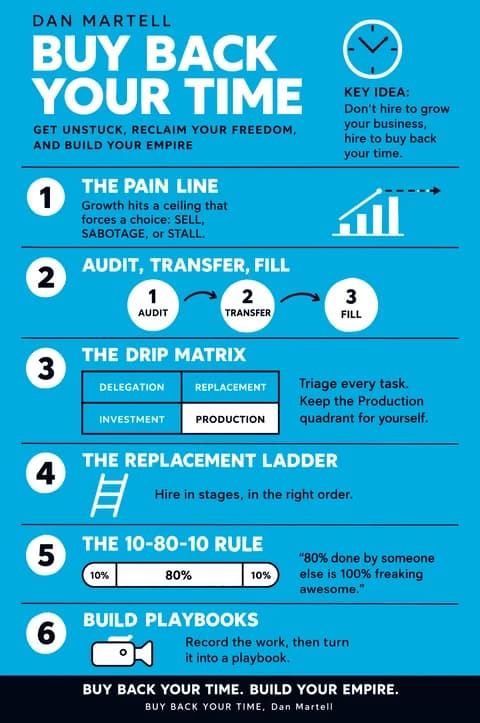
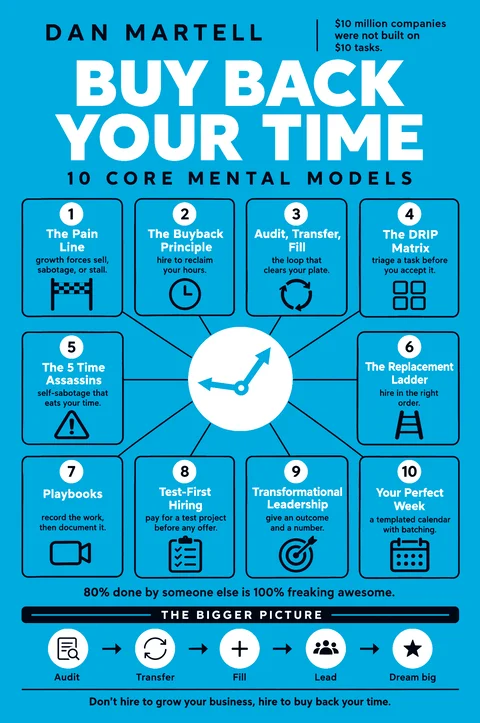
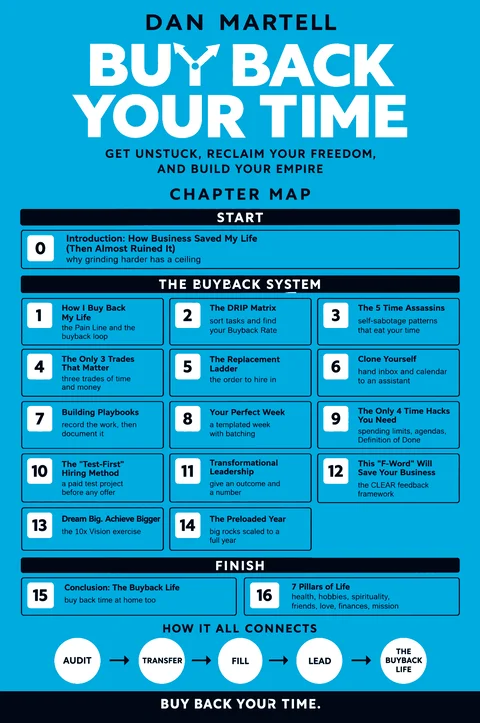
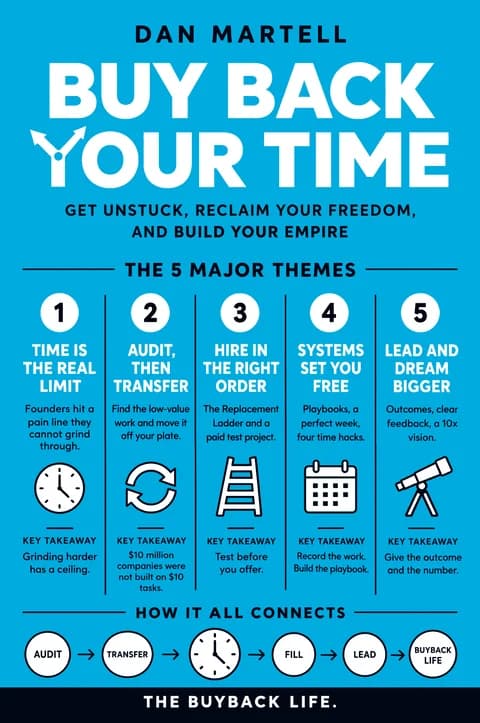
Four printable posters in the cover's colors: big ideas, mental models, a chapter map, and major themes.
Free. You'll also get each new summary by email.
The summaryIntroduction: How Business Saved My Life (Then Almost Ruined It)
Martell opens in a stolen car. After shoplifting in grade school, group homes in middle school and expulsion from high school, he went on the run from his small town of Moncton, New Brunswick, with $63 from his brother Pierre. He crashed into the side of a house after a high-speed chase and reached for a gun in his duffel bag, hoping the police would end his life, but it jammed. He served a six-month sentence in an adult jail. After almost 72 hours in solitary, a guard named Brian asked him why he was there and told him he did not belong. At Portage, a therapeutic facility for teens, he found a book on Java programming in an abandoned cabin, typed in the first exercise and watched the words "Hello, world" appear. Software, he writes, gave him the same reliable result every time, the opposite of the chaos he had grown up in.
He started Maritime Vacation in 1998 at 18 and NB Host at 21, and both failed. His third company, Spheric Technologies, started in 2004, grew 150% year over year while he worked 15 to 18 hours a day, and months before the wedding his fiancée left her engagement ring on the counter. He calls the common thread his GSD mentality: get shit done. Audiobooks such as Love Is a Killer App, How to Win Friends and Influence People and The Seven Habits of Highly Effective People started his search for a better system. He sold Spheric in 2008 and made his first million, moved to San Francisco in 2009 to start Flowtown, which was acquired in 2012, then built Clarity, acquired in 2014, and in 2015 started SaaS Academy. He says the method in the book is drawn from two failed companies, a lost fiancée, reading over 1,200 business and self-help books and running what he calls the largest SaaS training and mentoring group in the world.
The introduction lays out the book's path: the Buyback Principle, the Buyback Loop and the DRIP Matrix first, then the Time Assassins, the Replacement Ladder in Chapter 5, playbooks and the Camcorder Method in Chapter 7, the Perfect Week in Chapter 8, the Definition of Done and the 1-3-1 Rule in Chapter 9, the 10x Vision in Chapter 13 and the Preloaded Year in Chapter 14. Martell describes his own week now: six hours growing his eight-figure businesses, Ironman training, volunteering with inner-city youth and dinner with his family every night.
"Let's build a business you don't grow to hate."
Chapter 1How I Buy Back My Life
Stuart, a 34-year-old founder whose apps had more than 640,000 active daily users and 10 employees, had a panic attack 10 minutes into a family day at Disneyland after months of 14-hour days, 7 days a week. By March 2020 he was in bed most days. He had been his company's bookkeeper, chief engineer, project manager, head of support and his own assistant, working 70-hour weeks and 100-hour weeks when duty called. Martell cites a UC Berkeley study showing entrepreneurs are significantly more likely to report a lifetime history of depression, ADHD, substance abuse and bipolar disorder, and names the trap: the belief that more input means more output.
His alternative is to spend time only on tasks you excel at, truly enjoy and that add the highest value, which he says is likely two to three tasks; someone else should handle about 95% of your current work. His friend Keith hired a commission-only salesperson and now handles 10 to 15% of the most important calls. This is the Buyback Principle: don't hire to grow your business, hire to buy back your time, then fill that time with work that lights you up and makes you more money. When Stuart audited his time, he found his time was worth $100 an hour while he spent it on $10 tasks, a $90 an hour loss. He filmed himself doing every task he wanted to transfer to two new hires. Within two months he freed up more than 30 hours a week, going from 11 hours a day to six; his company's revenue tripled and his income doubled in less than a year.
Martell places the pain line for most entrepreneurs at about 12 direct reports and just over a million in revenue. No entrepreneur, he argues, will grow into pain. At the pain line founders sell (a couple with a $6 million a year business who had lost their health and marriage after 10 years), sabotage (a sudden new product, a website overhaul, replacing key people over small mistakes), or stall, which he calls a decision to slowly die. The way out is a system, following James Clear's line that you fall to the level of your systems: the Buyback Loop of audit, transfer, fill. Tom Clancy, Warren Buffett and Andy Warhol, he argues, each ran the loop. The chapter's exercise is to write down what you would fill your time with if you were not spending all of it at work.
Chapter 1 · The Buyback Loop
"Don't hire to grow your business, hire to buy back your time."
Chapter 2The DRIP Matrix
Oprah Winfrey landed a job as a news anchor in 1977, was demoted the next year and was put on a poorly rated talk show, where she felt she could finally be herself. Martell links her story to what Gay Hendricks, in The Big Leap, calls the genius zone. A client, Miguel, was drowning in support tickets until he hired someone more empathetic to lead support; ratings went through the roof and Miguel said he wanted to operate at the $10,000 an hour level. Martell cites a Columbia and Harvard study finding that passion combined with perseverance predicts higher educational scores. His brother Pierre nearly went bankrupt building homes as a jack of all trades, sleeping on a leaky air mattress with his dog after moving his furniture into a model home. Once he went back to sales, his gift since he sold cold soda beside their dad's fish and chips truck at eight, he redesigned the homes and sold 16 houses in his second year.
Martell cites the Pareto effect and a 95-5 rule: if you work 10 hours today, only 30 minutes may drive results. He plots every task on two axes, money and energy, which gives the DRIP Matrix. Delegation (little money, drains energy) holds admin, billing, travel and email; transfer it as quickly as possible. Replacement (makes money, drains energy) holds selling, marketing, onboarding and managing, which Martell also calls the pitfall quadrant because founders get stuck there. Investment (little money, lights you up) holds health, family, hobbies, industry collaborations and development. Production (lots of money, lights you up) is where to spend as much time as possible. Oprah's 2018 day, as told to Harper's Bazaar, includes two hours on business matters, mainly approving any expenses over $100,000. His friend Chris, a trainer, hired out social media and reached $1.5 million in annual revenue within five years.
Two objections get answers. For "no one does it right," aim for 80%. For "I can't afford it," calculate the Buyback Rate: what your business pays you divided by 2,000 hours, then divided by four, so every hire returns four times the cost. Tina earns $200,000 a year, or $100 an hour, so her buyback rate is $25 an hour; the shortcut is to divide what your company pays you by 8,000. Even $50,000 a year gives a rate of about $6.25 an hour, and Martell notes that assistants and developers can be hired abroad for less than $6 an hour through sites like Upwork.
Chapter 2 · The DRIP Matrix
"80% done by somebody else is 100% freaking awesome."
Chapter 3The 5 Time Assassins
In 2014 Martell went skiing in Verbier, Switzerland, with Richard Branson, whom he counts as founder of 398 other companies beyond Virgin Records and Virgin Atlantic. Branson, with 400 companies and 70,000 employees, laughed on the chairlifts and left work behind, with only his administrative assistant along. On an earlier trip, Martell's friend Lionel, with a $2 million forestry company and 16 employees, barked orders into his phone the whole time. Martell says about 9 out of 10 entrepreneurs he meets tell him they had a chaotic upbringing, and cites a University of Queensland study finding that children with challenging childhoods are more passionate about starting a business, along with Steve Blank's dysfunctional family theory. Comfort with chaos is an advantage, he argues, until it becomes an addiction: calm starts to feel strange, and founders toss what he calls hand grenades, like the client Taylor who planned an unplanned six-week vacation to see whether his team could handle it.
The addiction shows up as five time assassins. The Staller hesitates on big decisions: a client, Saheed, took from September 1st to September 21st to answer a partnership email that could have tripled his reach. The Speed Demon grabs the quickest, cheapest option: Charles fired his brother-in-law as CMO and hired his buddy Darwin with no interviews, and Darwin quit two months later. The Supervisor micromanages or takes over, like Daryl at the bike shop, who fixes every bike himself so his mechanics never learn. The Saver hoards money: Kyle, whose mastermind cost over $40,000 a year to join and had almost 50 members, balked at spending less than $10,000 on a curriculum and asked for a $20 book instead. The Self-Medicator reaches for food, alcohol or other vices to celebrate or escape; at 25, Martell celebrated a Yale contract with sushi and sake and called in sick the next morning. Tom, a client who binged every weekend, opened up in one of Martell's boardroom sessions, finished 75 Hard, lost almost 50 pounds from 230 and expected just shy of 900 employees in 2022. The exercise: list your last 10 major decisions and mark which were hand grenades.
Chapter 3 · The five time assassins
"We do not learn from experience, we learn from reflecting on experience."
Chapter 4The Only 3 Trades That Matter
Martell's friend Simon talked a manufacturing owner, Andre, out of hiring an operations manager. Andre spent 80% of his time on computer-aided drafting, so Simon told him to hire a CAD designer instead and get 80% of his time back. Martell says Andre was still an employee, only an employee of his own company. There are three trades. A level one trader, the employee, trades time for money and gets income. A level two trader, the entrepreneur, trades money for time and gets leverage, asking of every hire or purchase how it buys back time. A level three trader, the empire builder, trades money for money and gets freedom, as Branson and Oprah do. Nobody reaches level three without going through levels one and two.
The first quick wins come from a time and energy audit, because your calendar can't lie. Miranda, newly promoted at SaaS Academy and overwhelmed, was asked to log every 15 minutes for two weeks; four days later she texted that she had figured it out. Martell has seen leaders worth billions spend upward of 20 hours a week on tasks they could outsource for one-tenth of what they are worth. Dana, making roughly $2,500 per hour, only handed over his inbox when he asked whether email stressed him more than other tasks; he hired an assistant and deleted email from his phone. The four steps: determine your buyback rate; log every 15 minutes of your workday for two weeks; mark each task with one to four dollar signs; highlight what gives you energy green and what drains you red. Then delete unnecessary work, hand tasks to current team members and get creative with freelancers, overtime or interns for the rest. If your buyback rate is $100 an hour and you spend 20 draining hours a week onboarding clients, Martell argues you are robbing someone of a job they would enjoy.
Chapter 4 · The three trades
"$10 million companies were not built on $10 tasks."
- You're Already an Impact Business22 to 30
- You're Closer Than You Think14 to 21
- You Have the Foundation7 to 13
- The Starting Line0 to 6
 Printable PDF
"Martell's loop starts with an audit. Here's a quick one for the business itself: ten questions, a score out of 30, and the part to fix first, so you know where your hours should go. It's free with your email. Go find out."
 Deven Davis, devendavis.com
- Ten questions about where your business is right now
- A score out of 30
- A four-part breakdown: Impact Clarity, Traction Proof, Model Strength, Founder Credibility
- The part to fix first
- Your tier's next steps
- A printable PDF
Free with your email. Your score and a printable PDF open right on the page.
Chapter 5The Replacement Ladder
The chapter opens with Michael E. Gerber's line that if your business depends on you, you have a job, and it's the worst job in the world. Andy Warhol, Martell writes, put as much effort into his process as into any single piece. Through silkscreen, which he began to use in 1962, studio assistants and a studio he called The Factory, 85,000 pieces of art and 500 films carry his name, and in 2014 his work accounted for about 15% of the world's art trade. Warhol said he painted that way because he wanted to be a machine. Martell's point is that Warhol never got stuck in the replacement quadrant: he built the machine and kept himself on what he did best.
The Replacement Ladder is the order in which to transfer the business, each rung with a key hire, a feeling and an area of ownership. Rung 1, admin: feeling stuck, hire an admin assistant who owns inbox and calendar. Rung 2, delivery: feeling stalled, a head of delivery owns onboarding and support. Rung 3, marketing: feeling friction, the cycle of marketing in the first quarter, delivering through the third and fourth and slowing down, a head of marketing owns campaigns and traffic. Rung 4, sales: feeling freedom, a sales rep owns calls and follow-up. Rung 5, leadership: feeling flow, leaders own strategy and outcomes. What counts is ownership of the outcomes. Even with $2 million in revenue and 50 salespeople, if no one person owns a rung's outcomes, you do. When Martell bought a software automation company with 12 employees and no assistant for the CEO, he hired the assistant first.
For work founders love, such as the core product, he gives the 10-80-10 Rule: you do the first 10% of ideation, your team executes the middle 80%, and you come back for the final 10%. Sales comes late on the ladder because the founder is usually the best salesperson and funds the earlier hires. Martell was taking 20 to 25 sales calls a week when he hired Michael, expecting half the calls and a third of the close rate; Michael handled more calls in less time and outsold him. His head of product engineering, Raul, told him to back off a programming decision. The quadrants also change: Martell loved sorting mail at 18, but years later it took three hours every Sunday when his buyback rate was 100 times higher, so Lisa has handled his mail since 2006.
Chapter 5 · The Replacement Ladder
"Follow the steps in order, and you can climb the Eiffel Tower. Do them out of order and you won't get anywhere."
Chapter 6Clone Yourself
Most entrepreneurs, Martell writes, let their inbox work like an office door onto Times Square that anyone can walk through with a sticky note; the inbox becomes a public to-do list. On the Verbier trip, the one employee with Branson was his administrative assistant, Hannah, who managed his life by his rules and gave anyone demanding his attention a gentle block and tackle. Martell calls the assistant non-negotiable, the first hire every entrepreneur should make, and answers the usual excuses. You are already doing the job yourself, so give the assistant several of the red, low-dollar tasks from your audit. An assistant executes without your emotional baggage, such as paying a big invoice or scheduling a hard meeting. An assistant follows your rules: if you do not take projects under $10,000, the assistant will turn down the $6,000 one you would have accepted. And an assistant keeps the ball from dropping while you are on vacation.
His brother Pierre hired an assistant around 2017 and saw no difference, because he had not handed over the two responsibilities that matter: all of the calendar and all of the inbox. The founder should never be the first person to touch either. Give the assistant guidelines for when you work, which slots are for meetings, calls and one-on-ones, and which are for deep work; Martell's assistant books important meetings on Tuesday or Thursday between 1 and 4 p.m. without asking. To hand over email, he uses Email GPS, a set of labels that lets an assistant route 90% of email: !Your Name for the few emails only you can answer, 1-To Respond, 2-Review (which he and his assistant clear in about 15 minutes each morning), 3-Responded, 4-Waiting On, 5-Receipts/Financials and 6-Newsletters. His assistant replies as "This is Lauren, Dan's assistant." His friend Jonathan, selling a company for nine figures, was told to negotiate to keep the assistant he had worked with for nine years. Martell quotes Keith Ferrazzi's Never Eat Alone: assistants are associates and lifelines.
Chapter 6 · Email GPS
"I am no longer ever, ever allowed to touch an email that wasn't first checked by my assistant."
Chapter 7Building Playbooks
In the film The Founder, Ray Kroc gets his order seconds after paying and discovers the McDonald brothers' Speedy Service System, a kitchen and crew choreographed down to five dots of mustard and two pickles. The real genius, Martell writes, was that it could be copied anywhere: the brothers started with one store in 1937, and by 2020 there were almost 40,000. Companies that scale run on documented processes, which Martell calls playbooks, because in the long run unlimited predictability is more valuable than intermittent quality. A playbook can cover one task or a whole department. Peter, a plumber who forgot to invoice clients for four months, filmed himself doing the billing on a Sunday and had his first playbook. Martell's financial management playbook for SaaS Academy is about 8 pages. Start with the area causing the most pain.
Every playbook has the Four Cs. The Camcorder Method came from Martell's years running Spheric: at 26, with $1.6 million in revenue and 12 employees, he drove six and a half hours to the Bangor, Maine, office so he could train recruits on the way, with a 50-pound server in the trunk wired to a laptop in the passenger seat. After half a dozen trips he realized he could record the training once. Now he records himself doing the real task, talks while he does it, and records three times to capture the variations. The course is the short list of high-level steps, such as opening a coffee shop: clock in, turn on the espresso machine, start the coffee, write the coffee of the day, wait 10 minutes, turn on the open sign. The cadence records how often each task happens. The checklist holds the non-negotiables; a pilot friend's preflight checklist caught a flat tire with Martell's sons, then four and five, in the plane. His friend Mark, who was the only person hiring at his software company, recorded how he hires and now only does the final interview. Martell's last move is to have the person taking over the task watch the videos and write the playbook, which shows whether they understood it and exposes missing steps.
Chapter 7 · The Four Cs of a playbook
"They know that in the long run, unlimited predictability is more valuable than intermittent quality."
Chapter 8Your Perfect Week
Martell tests clients by texting to ask whether they have time for a call in the next hour. Reactive people say sure; proactive people offer Thursday from 2 p.m. to 3 p.m. or next Monday from 1 to 2, because their calendar already has blocks for each kind of activity. He compares a planned week to an airport: in 2019, almost 80% of flights arrived on time despite weather and mechanical failures. An unplanned morning loses time three ways. Buffer time: a sample day has 90 minutes of 15- and 30-minute gaps by 1:30 p.m. Context switching: Martell cites research by Catalog and Cornell University finding that switching between software applications costs almost 10 minutes to get back to a high level of productivity. Bleed time: meetings and lunches that run over cost one to two hours a day.
The Founder Brain Kit
His friend Marcel, a founder with a fiancée and a CrossFit coaching role, built the Perfect Week, a templated weekly calendar that removes buffer time, fits tasks to energy, eliminates bleed time and spots what Tony Robbins calls net time, such as listening to podcasts while commuting. Dale Beaumont proved the case for batching on stage in Boston: writing one sentence took the room about seven seconds, but alternating letters between two sentences left half the room unfinished after 90 seconds, at least six times longer than it should have taken. Martell once did 14 podcast interviews in one day. A friend, Rachel, attempting 75 Hard, needed a planned week to see what she was saying no to each time she said yes to a distraction. Martell now blocks his mornings for creative work, works out at lunch and batches meetings in the afternoon; Michael Hyatt, as CEO of Thomas Nelson, took meetings only on certain days. His tips: iterate for two or three weeks, honor the week once it is set, optimize for energy, put important work in first, following Covey's advice to schedule your priorities, and batch the rest. He cites research that small business owners waste on average about 22 hours a week.
Chapter 8 · The Perfect Week
"When you design your week ahead of time and account for all your time, you'll understand exactly what you must say no to in order to say yes to something that comes up sporadically."
Chapter 9The Only 4 Time Hacks You Need
Martell says he hates the word hacks, then offers four that he says do not over-promise. The $50 Magic Pill works like bowling bumpers for his eight-year-old: anyone on his team can spend up to $500 to fix a problem without permission, the CEOs who run his companies up to $5,000, and his editor friend Paul gives his assistant $50. The amount matters less than the rule, plus one condition: tell him about the expense at the next meeting.
Sync meetings with a repeat agenda come from Branson's daily breakfast with Hannah. Martell and his assistant meet for 30 minutes every other day on a seven-point agenda: offload his list, review the next two weeks of calendar, past meetings and their action items, his own action items with links, a feedback loop on projects, emails for him to review, and questions for Dan, such as how he is decompressing. Over time the emails and questions shrink while the feedback loop grows; when a new assistant started, she said she had a good handle on everything after two weeks. A definition of done, or DOD, borrowed from Scrum, spells out finished: a whiteboard is done when it hangs in his office with red, green, blue and black markers and an eraser. Larger tasks need facts, feelings and functionality, such as a financial report submitted by January 1st, accurate enough that he is confident in it, and easy for everyone to pull data from. The 1-3-1 Rule, from Brad Pedersen, co-founder of Pela, stops upward delegation: define one problem, offer three solutions, recommend one.
Each hack asks the founder to give up the ego that enjoys being the one with the answers. In return Martell lists four gains: empowerment, exploration, equity distribution and effective productivity.
Chapter 9 · The 1-3-1 Rule
"But every time you solve a problem on your own, you're eliminating the chance for someone else to learn."
Chapter 10The "Test-First" Hiring Method
Over vegan ice cream in New York City, Seth Godin gave Martell his hiring rule: "I can't work with you until I work with you." Martell learned the cost of skipping it at Spheric. In his early 20s he landed a dream project with Procter & Gamble, including the rights to resell the technology, and handed it to Chase, an older developer, with little oversight. Four months later P&G called to say Chase was embarrassing the company. Martell lost the job, the IP and the client, and still paid Chase a large salary on the way out.
His hiring principles follow. Be clear about what you are hiring for, using the ownership column of the Replacement Ladder, because entrepreneurs see the solution they need in whoever is in front of them. Cast a wide net: ask your top performers who they would want to work with, post to job banks, and approach the best people at companies you admire by asking for five minutes of advice. Give them a chance to shine with a video of three minutes at most answering five questions: why this position, what they know about the company, their ideal work environment, their strengths, and where they see themselves in five years; most candidates filter themselves out here. Use profile assessments as one data point, run first on your current team; Martell is an advisor at SuccessFinder and also names the Kolbe A, DISC and Myers-Briggs. Test first: a paid project that represents the real work, with few instructions, such as "Send a thoughtful gift to Kyle at Proposify." A candidate who sends 14 emails with questions is not a match. Sell the future: once the right person emerges, find out what they want, as Gary Vaynerchuk does in interviews, and sell hard.
Chapter 10 · The Test-First hiring method
"If you want to save time, you hire the right person to buy that time back."
Chapter 11Transformational Leadership
In 2021 Martell's head of people, Adam, needed to hire 11 people in a quarter and came to him for help. Martell offered support and told him this was why he had been hired; Adam never came back with the problem, and two months later they had 11 new team members. Ken Blanchard calls these problems other people's monkeys. Martell says nine out of ten entrepreneurs fall into transactional management, tell, check, next, which hits a ceiling; he hit it at Spheric at 12 reports, then read Andy Grove's High Output Management and built what he calls transformational leadership: outcome, measure, coach.
"Martell says buy back your time so you can spend it on what only you can do. If that's building something on the side, the Part-Time Startup System replaces willpower with a system: six modules toward $1K of side income in 30 days, without quitting your job. Seven bucks at the launch price."
Deven Davis, devendavis.com- 6 modules: Operator Reset, Validation Gate, 90-Minute Block, Pre-Sale Protocol, Outcome-Anchored Offer, First 10
- The System Map, printable and digital: the six-sprint sequence on one page
- The Stranger Test Diagnostic: a one-page protocol to run on yourself every Sunday
- The Daily 60-Second Sermon: a daily inbox prompt for your first 30 days
- Bonuses: How To Tell Your Own Way (the Hero's Journey Workshop) and The Science of Becoming (Audio)
Seven dollars at the launch price. Finish the six modules with no first customer and you get a refund and keep the materials.
Outcome replaces telling someone how. Martell quotes Steve Jobs: we hire smart people so they can tell us what to do. "Bethany, please spellcheck blog posts" becomes "the blog post must always be error free," and Bethany finds an inexpensive AI tool and hands final edits to a junior who wants to learn. "James, you need to make more sales calls" becomes "you need to hit $100,000 in sales by the end of the quarter." "Maloney, increase the menu prices" becomes "we need to make 10% more per square foot," and Maloney adds seasonal offerings that lift revenue more than 10%. He cites research on financial analysts whose forecast accuracy declined as they issued more forecasts through the day, as evidence of decision fatigue. Measure replaces checking: give every person one number they can move, like the absorption rate at a car dealership or the average daily rate at a hotel. Coach replaces next: John Wooden took UCLA's job in 1948 and by 1975 had 10 national titles, seven of them consecutive. Martell's COACH framework for one-on-ones covers the core issue, an actual story from his own life, and change, asking for commitment; he used it with Corey after she punted on a decision that cost her team a few days.
Chapter 11 · Transformational leadership
"You build the people, and the people build the business."
Chapter 12This "F-Word" Will Save Your Business
Martell tells a story about "Neil," who stewed for three months over the performance of Jacob, an automation expert, then complained about him on a Zoom call without noticing Jacob was on it: "Hey, it's me, Jacob. I'm on the call." Neil, he then admits, was Martell. Earlier, in 2012, he had promoted Alexis, an excellent contractor, to lead marketing full time, said nothing when results did not move, and let her go after six months without ever asking what was wrong. The missing F-word in both cases was feedback. He cites the Great Resignation of 2021, when 4 million people quit in July alone, a McKinsey & Company study finding that 70% of employees find their life's purpose inside their job, and a PwC study listing meaning in day-to-day work as the top reason frontline employees want to work somewhere. Kim Scott, in Radical Candor, notes that dissension is encouraged at Alphabet.
The method comes from Matt Mochary, author of The Great CEO Within, who ran a feedback session live with Martell on a coaching call: first one thing Martell liked, then one thing to improve, held silently before it was said. Martell named it a clearing conversation and turned it into CLEAR: Create a warm environment by asking for positive feedback first; Lead them to the critical feedback; Emphasize, repeating it back in your own words, which Martell says is 80% of the value; Ask if there's more; then Reject or accept it, committing to a change if you accept. At every other quarterly off-site, his executive team gives each person one thing they do well and one thing to improve. Michael heard six people say his reports were confusing, studied communication and became, in Martell's words, a communication all-star.
Chapter 12 · The CLEAR conversation
"Giving feedback is way easier. Asking for honest and critical feedback, regardless of the reason, takes guts. That is where the magic is."
Chapter 13Dream Big. Achieve Bigger
In 2003, Lane Merrifield and Lance Priebe pitched their boss, Dave Krysko, for two hours on a safe online world for kids with no advertising, paid by subscription. Dave said he had no idea what they were talking about but had never seen them this passionate, and backed it inside his agency. They hoped for about 4,000 beta accounts; 20,000 people signed up in five weeks, so they launched in October 2005. IBM consultants returned their fee, saying the machines were performing in ways they did not know were possible. By 2007 almost 30 million kids were using Club Penguin, and 22 months after launch Disney bought it for $350 million plus an additional $300 million in payouts if goals were met.
The chapter turns to the fill step. A client, Carl, told Martell that his 30-minute call was the only thing he had to do all day; Martell told him he had not helped him buy back his time to sit and do nothing. Bought-back time needs a 10x vision, built in two phases. Phase one, limitless dreaming: focus on the what and leave the how for later. Martell gives four reasons big dreams matter: they drive innovation, they put fire in people's bellies (as when Steve Jobs asked John Sculley whether he wanted to sell sugar water for the rest of his life), they crush distractions, and they make decisions simple; he quotes Dan Sullivan, 10x is easier than 2x. Phase two, clear vision: a nonprofit CEO, Denise, described her future vaguely but her present precisely, with four cities, 13 shelters, 12 staff and 10 volunteers. Martell's test is to describe the future with the same detail as the present. Joseph Schooling met Michael Phelps at 13 in 2008 and beat him in the 100-meter butterfly at Rio in 2016. A clear vision covers four elements: team, one business to become world-class in first, empire (Brian Scudamore grew 1-800-GOT-JUNK to a $300 million business before building more brands), and lifestyle. Martell put his own vision into a PDF styled as a New York Times front page; Kyle, a software founder, made his his desktop background.
Chapter 13 · Bigger than the plan
"When you can describe your future with the same level of detail as your present, you'll have a compelling vision."
Chapter 14The Preloaded Year
Stephen Covey's big rocks demonstration opens the chapter: pebbles poured in first leave no room for the rocks labeled vacation and family, while rocks placed first leave room for everything. Martell once dropped by his parents' house and realized from his mother's question that he had forgotten his dad's birthday. The Preloaded Year scales the Perfect Week to twelve months, and it starts by turning the 10x vision into steps. Create checkpoints by working backward from the vision to five years, three and one, across team, one business, empire and lifestyle; his colleague Randall, who wants a media company with books and animated films, would need at least 10 books and five graphic novels at the three-year mark. List tactics for the next checkpoint, 10 or 20 of them. Score them with ICE, rating impact (money today), confidence and ease from 1 to 10 for up to 30 points; Randall's LinkedIn outreach scores 23, a Los Angeles conference 20 and cold calls to studio executives 16. The top two or three become big rocks.
Each December, borrowing from Taki Moore and Dale Beaumont, Martell builds the year: place the big rocks first (birthdays, anniversaries, family vacations, three to five business activities that drive outsized results, and the ICE tactics); batch pebbles into rocks, such as every VIP client touch in a two-day stretch every six months; add maintenance before you need it, the way athletes drink before thirst costs them 20% of capacity, including two days off after his biggest events; insert the pebbles, at which point the calendar is about 90% full; and stress test, never placing a family vacation right before a big conference. The final question is whether the plan would make you say it was an amazing year. When something unplanned comes up, he and his wife ask whether it is a "hell yeah" opportunity, and they change course about 5-10% of the time. Planning, he argues, creates room for spontaneity. In 2007 he drew a digital meeting room with a waiting line of companies on his vision board, years before Zoom built virtual waiting rooms.
Chapter 14 · Big rocks first
"Counterintuitively, the more planned and scheduled you are, the more spontaneity you can enjoy."
ConclusionThe Buyback Life
Martell's own buyback started with laundry. Living in Parsippany, New Jersey, while running Spheric in his 20s, he paid someone to clean his townhome and a wash and fold service to do his laundry, and got a couple of hours back each day. The cleaner and the laundry service each gained a customer, a ripple he says spreads through every trade. He now has a house manager, Betty, who runs the house, fills the gas tank, picks the kids up from school, hands him a protein shake at 4 p.m. and flies ahead to set up family trips; she does not clean up after his two sons, because they need to learn personal responsibility. He tries to do only two things: spend time with people he loves, or create within businesses. Not paying someone you can afford to pay, he argues, robs them of a paycheck.
The principle is a philosophy for life, which is why Martell rejects retirement. He cites a 2013 BBC article by Brian Borzykowski, "Can Retirement Kill You?", reporting that retirees are 40% more likely to experience depression, 60% more likely to start taking a prescription drug and 60% more likely to be diagnosed with at least one physical ailment. When his wife asked what retirement looks like for him, he answered that she was looking at it. He plans to live past 100, which gives him about 60 years from 2022, and asks readers to stop planning to clock out at 65. When Pierre had a few homes built and about $27 in the bank, Martell had him put a logo on every major city on a map of Canada; his company now has offices in four cities. The book closes with a visualization: watch the movie of your 10x vision from a theater seat, step into the screen and live it, and answer each doubt with "thank you, not necessary." The whole exercise takes less than 10 minutes.
"The moment you stop living, you start dying"
Bonus7 Pillars of Life
The closing cheat sheet starts with Austin, a client who told his wife he would miss mornings and dinners for four years and said he was doing it for his family. Martell pointed out that his family never asked for that. Investment-quadrant time, he writes, is something you always want to be depositing into. He scores himself every week on seven pillars: health, since without it you have nothing; hobbies, for decompression; spirituality, which can mean meditation, yoga or church; friends, because friendships fade like unused muscles; love, going all in on every relationship; finances, because avoided money drains energy elsewhere; and mission, knowing why you are trying. He used to dismiss balance and put everything outside the business into maintenance mode; now he takes his two lowest scores each week and plans small fixes, such as a date night added to his Perfect Week when love scores low.
"Friendships are like muscles. If you don't invest in them, they fade away."
Buy Back Your Time on four pages
Four printable posters in the cover's colors: big ideas, mental models, a chapter map, and major themes.
Free. You'll also get each new summary by email.