Business Made Simple by Donald Miller: Summary and Notes
The full book, section by section.
Start hereThe short version
- 1A professional's economic value rises when they give the people who invest in them a great return, and the skills that do that can be learned in 60 short daily entries. The introduction sets this up with two candidates for one promotion, and Chapter 1 starts with character: the 10 characteristics of a value-driven professional.The claim
- 2A business works like an airplane: overhead is the body, products are the wings, marketing and sales are the two engines and cash is the fuel, and it crashes when overhead grows faster than sales can cover. Chapters 2 to 4 cover leading with a mission, personal productivity and this business strategy model.The model
- 3The remaining competencies are taught one framework at a time: messaging and marketing in Chapters 5 and 6, communication, sales and negotiation in Chapters 7 to 9, and management and execution in Chapters 10 and 11, ending with a launch meeting, one-pagers, weekly speed checks, a scoreboard and celebrated wins.The skills
Business Made Simple on four pages
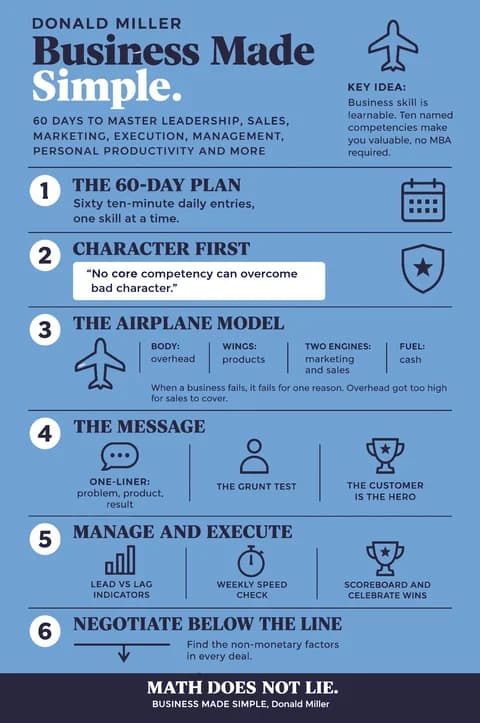
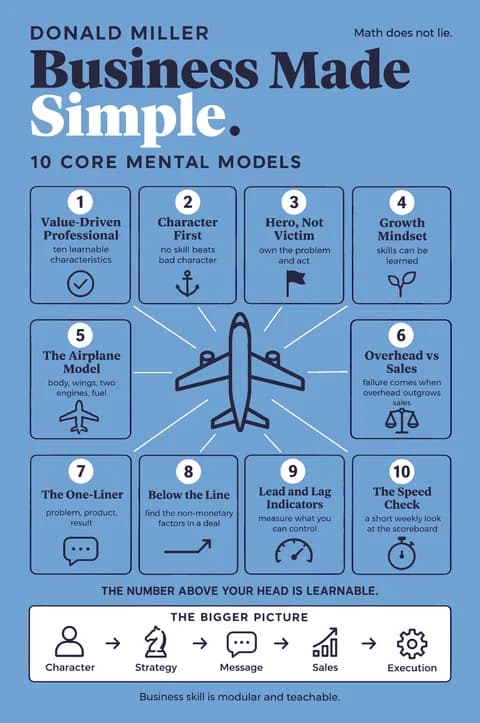
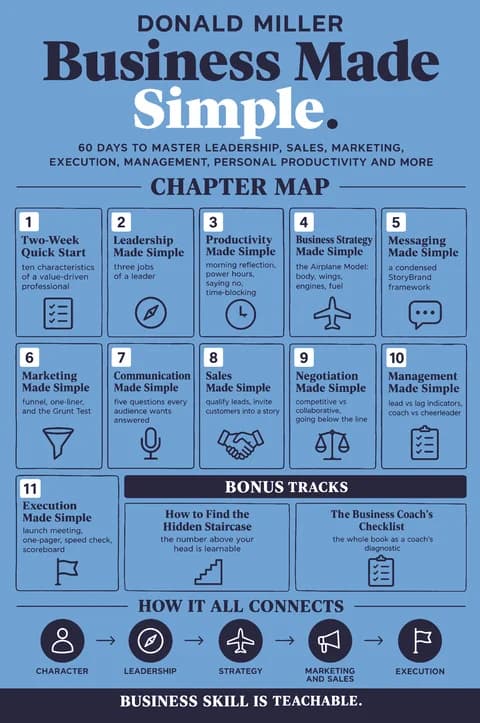
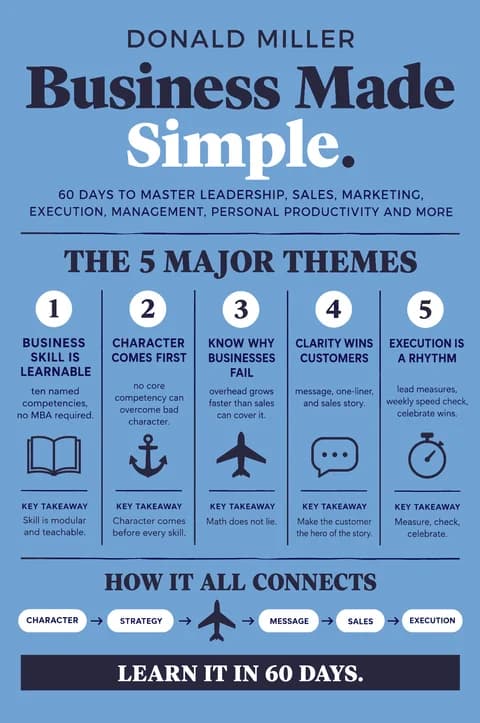
Four printable posters in the cover's colors: big ideas, mental models, a chapter map, and major themes.
Free. You'll also get each new summary by email.
The summaryAuthor's Note and Introduction
The book is built as 60 daily entries, one per workday, each paired with a free video, which Miller calls micro learning. Its promise is that a practical business education should not cost tens of thousands of dollars, and that its readers will become what he calls value-driven professionals: people who get more done in less time, create less stress and more clarity, and earn more for themselves and those they represent.
The introduction compares two candidates for a promotion. Candidate 1 has a degree from a prestigious university and offers passion, a good attitude and team spirit. Candidate 2 offers a set of character traits and 10 core competencies: knowing how a business really works, leading clearly, being personally productive, clarifying a message, building a marketing campaign, selling, communicating, negotiating, managing and running an execution system. Candidate 2 gets the promotion, then a raise, then another of each. Miller says even he, as the owner of his company, has to be a good investment every day, and that few of these frameworks are taught in college, where students might instead study a toothpaste ad from the 1970s.
"If you want to succeed in work, love, friendship, and life, give the people around you a great return on whatever it is they invest in you."
Chapter 1Two-Week Quick Start
The first ten days cover the 10 characteristics of a value-driven professional, because character is the foundation the skills sit on. Day 1: See yourself as an economic product on the open market. Miller separates intrinsic human worth from economic value and says a dream team member tries to give the employer a 5x or greater return; someone paid $50,000 should aim to make the company at least $250,000. He cites Andrew Grove of Intel telling workers they are each a business with one employee. In an added note he describes a number floating above every professional's head, from about $12 an hour for dropping fries into oil, to $25 or $30 for uniting a team, $35 to $45 for clarifying a message, and perhaps $100 an hour for running an execution framework, and says each entry in the book is meant to raise that number.
Day 2: See yourself as a hero, not a victim. Miller grew up in government housing; his father left, and his mother went back to school in her late 50s to earn bachelor's and master's degrees so her children would not inherit a victim legacy. He acknowledges real victims and his own privilege, then argues that playing the victim when you have a way out ends personal growth, while people rally to a hero on a mission. Day 3: De-escalate drama. Rate a situation's drama on a scale of 1 to 10 and respond at or below it, as Neil Armstrong did. Day 4: Accept feedback as a gift, through a recurring meeting with trusted people and a routine set of questions. Day 5: Engage conflict the right way: expect it, control your emotions, affirm the person and remember you could be wrong.
Day 6: Want to be trusted and respected more than liked, by setting clear expectations, keeping people accountable (is Brad expected to make 15 sales calls a day?) and rewarding good performance. Day 7: Have a bias toward action. At Miller's office they call it getting the ball in the end zone. Day 8: Do not choose to be confused. His business coach, Doug Keim, told him to stop choosing to be confused about an employee who had underperformed for over a year; Miller says confusion usually masks people-pleasing, fear of losing face or fear of consequences. Day 9: Be relentlessly optimistic. Pete Carroll told Miller he is shocked every time he loses, and his Seahawks won the Super Bowl the next year. Day 10: Have a growth mindset, drawing on Stanford professor Carol Dweck's research: embrace challenges, persist through obstacles, see effort as the path to mastery, learn from criticism and be inspired by others' success.
Chapter 1 · The number over your head
"No core competency can overcome bad character."
Chapter 2Leadership Made Simple
Leadership in a nutshell, Miller writes, is inviting a team into a story, explaining why the story matters and giving every member a role in it. Over five days he builds a one-page set of guiding principles, which he has written for his personal life, his marriage, his home, his company and a political advocacy effort.
Day 11: Write a mission statement that William Wallace could shout from horseback: short, interesting, inspirational, framed against an injustice, using the formula "We will accomplish blank by blank because of blank." A plumbing company might commit to 10,000 customers within five years because everybody deserves plumbing that works. He recalls executives who spent a 48-hour retreat on a mission statement their CFO could not recite. Day 12: Define key characteristics that are aspirational and instructive, such as a busy fried chicken restaurant's "fun under pressure," which also tells it whom to hire. Day 13: Determine three critical actions everyone can take daily; his own are getting up early, writing and saying after you. Day 14: Tell a story pitch instead of a history: name the problem, agitate it, position the product as the resolution and describe the happy ending, as in his sample for a pet boarding business. Day 15: Define your theme, the why, by adding because to the mission; Business Made Simple's is that everybody deserves a life-changing business education.
Chapter 2 · One page of guiding principles
"Great leaders become great because their mission makes them great."
Chapter 3Productivity Made Simple
Many professionals work hard and get little done because their lives lack focus. This chapter walks through the Business Made Simple Daily Planner. Day 16: Make wise daily decisions by asking Viktor Frankl's question each morning: if this were the second time I were living this day, what would I do differently? Day 17: Prioritize your primary tasks with two lists: three highest-return tasks to do first, and everything else. Miller's three are usually content, such as a book or course, before calls and meetings, and he warns against urgent distractions.
- You're Already an Impact Business22 to 30
- You're Closer Than You Think14 to 21
- You Have the Foundation7 to 13
- The Starting Line0 to 6
 Printable PDF
"Miller breaks business into skills you can learn one at a time. So which one do you learn first? Ten questions, a score on four parts of your business and the part to fix first. It's free with your email. Go find out."
 Deven Davis, devendavis.com
- Ten questions about where your business is right now
- A score out of 30
- A four-part breakdown: Impact Clarity, Traction Proof, Model Strength, Founder Credibility
- The part to fix first
- Your tier's next steps
- A printable PDF
Free with your email. Your score and a printable PDF open right on the page.
Day 18: Maximize your power hours. Miller says the brain burns between 600 and 800 calories a day and recharges in sleep, so for most people over 25 the morning is when the best work gets done. Day 19: Say no to distractions. Early in his career he turned down paid speaking to write; within two years he had another bestseller and could charge four times his old fee. Stephen King, he notes, takes hardly any speaking events and writes his daily quota of words. Day 20: Block your time. Bill Gates is never late because time is the one resource he cannot buy more of. Miller blocks Monday and the mornings of Tuesday and Wednesday for writing, early afternoons for meetings, Thursdays and half of Fridays for recordings, and Friday afternoons, evenings and weekends for personal time.
Chapter 3 · Block your time
"Time is worth much more than money."
Chapter 4Business Strategy Made Simple
Many people think of a business as a community group, when it is a for-profit entity that solves problems for paying customers. Day 21: Understand how a business really works through the airplane. The body is overhead. The wings are products and services, which give lift. The right engine is marketing, which should come first because it is cheaper and gives sales a clear message. The left engine is sales. The fuel is capital and cash flow. Every part must stay in proportion; moving into an expensive office without strong products makes the body heavier without adding lift. Good leaders resist adding recurring overhead, get daily or weekly sales and marketing reports, keep margins high enough to cover overhead and obsess over the activity-to-output ratio.
Day 22: Keep overhead down. Miller defines overhead as anything not involved in product creation, marketing or sales, and asks four questions before any launch about time, new hires, added overhead and cuts. Day 23: Make and sell the right products, ones that are light (profitable) and strong (in demand); a product sold for $500 that costs $425 to make leaves a $75 profit too thin to cover overhead. Day 24: Prioritize marketing. Field of Dreams is the only place "if you build it, they will come" works, so Miller has a real landing page with a join the waitlist button built before a product exists. Day 25: Run a sales system, a step-by-step path from qualifying a lead to the closing sequence with every lead tracked. Day 26: Protect cash flow. A pilot checks the fuel tank by hand; Miller offers seven financial questions and a fuel filter: how will this affect cash?
Chapter 4 · The airplane model
"When a business fails, it fails for one reason. Overhead got too high for sales to cover."
Chapter 5Messaging Made Simple
Disciplined marketers, Miller writes, take the world through an exercise in memorization by repeating sound bites. This chapter condenses his StoryBrand framework. Day 27: Use story to engage customers. He says the average person spends 30% of their time daydreaming, a survival mechanism to save energy. His story formula: a character who wants something encounters a problem, meets a guide who gives them a plan and calls them to action, and the stakes are defined as success and failure. His example is 8th Street Bakery selling wedding cakes that look gorgeous and actually taste good.
Day 28: Position your customer as the hero and yourself as the guide, with empathy and authority: I know what you are struggling with, and I can help you get out of it. Day 29: Talk about your customer's problem, because the problem is the hook; Frodo could not toss the ring in the kitchen trash. Day 30: Create a clear call to action. Miller once marched 200 business leaders out of a workshop to the curb, climbed on a box with a bullhorn and told them people will go where you tell them to go. Day 31: Define the stakes. As a poor kid at the dollar theater, he stood on his seat throwing popcorn at the end of The Karate Kid when he was 11 years old, because the stakes were clear.
Chapter 5 · Story stops the daydream
"The only tool known to man that can stop people from daydreaming is story."
Chapter 6Marketing Made Simple
A sales funnel, Miller says, is the foundation of any marketing plan, and in March of 2020, when the pandemic closed businesses, those with funnels could reach their customers and pivot. Day 32: Understand a sales funnel. Relationships move through curiosity (can this help me survive?), enlightenment (how does it work?) and commitment (the order), and asking for commitment too early fails. Day 33: Write a one-liner with three parts: a problem, your product as the solution and the result. An at-home chef who says families rarely eat together or eat healthy, then explains the service, gets all the business. Day 34: Wireframe a website that passes the grunt test: within five seconds a caveman should know what you offer, how it makes life better and how to buy it.
Day 35: Collect email addresses by offering a lead generator, since Miller says people value their email address at about $10 or $20 and nobody wants a newsletter. Make it short, give it a cover and make it solve a specific problem, such as how to get your dog to stop jumping on people. Day 36: Email your customers. Early in their dating, his wife, Betsy, told him he was a quality time guy and she was a quantity time girl. Years later his data showed customers bought only after months of valuable emails, and he realized they were quantity time customers too.
Chapter 6 · The sales funnel
"If you are growing a business, a sales funnel should be the first thing you create in your marketing plan."
The Profit + Purpose Playbook
Chapter 7Communication Made Simple
A good presentation answers five questions every audience wants answered: what problem you will help solve, your solution, what life looks like if they take it, what they should do next and what they should remember. Day 37: Open with the problem, never with small talk or an introduction; for example, the decline in fourth quarter revenue the team has seen for five years. Day 38: Create sub-points as subplots within one controlling plot. Miller drafted a governor's State of the State address around the problem of party division, which let it cover budget details, and he recommends no more than three sub-points.
Day 39: Foreshadow a climactic scene, as Kennedy did with an astronaut on the moon and Churchill did with broad and sunlit uplands. Day 40: Challenge the audience to take action with something specific, like calling a representative whose number is on the screen. Day 41: End with the theme. A speech coach told Miller that people remember the last thing you say more than anything else, so he now rehearses a final line that states what the talk was about.
Chapter 7 · The shape of a talk
"Start your presentation with a problem."
Chapter 8Sales Made Simple
Selling is explaining how a product solves someone's problem and guiding them to a purchase; coercion sells once and loses the customer. Day 42: Qualify the lead, the way a director casts the right actor rather than the best one: does the lead have the problem, can they afford the solution and do they have the authority to buy? Miller's company has a full-time team member who only qualifies leads. Day 43: Invite customers into a story with a five-part arc: I see you are struggling with X, X is causing Y frustration, our product resolves it, here are results from clients like you, let's build a plan.
Day 44: Repeat your talking points. The guide reminds the customer what the story is about, gives a plan and foreshadows the climactic scene, as in his playground equipment pitch to a church; about 80% of time can go to building the relationship if 20% reinforces the story. Day 45: Create a great proposal in story order: the problem, the product, the plan, price and options, and the climactic scene, because a customer who says they will think about it is usually still confused. Day 46: Close with confidence. A high school friend who dated with ease told Miller, "Just don't make it heavy." If you do not believe in your product, Miller says, find a mission you do believe in.
Chapter 8 · Qualify the lead
"A good salesperson makes the customer the hero and helps the hero win the day."
"Miller teaches the skills. Here's the page that tells you where to point them: purpose, opportunity, leverage, model. Ivystone runs deals through the same four. One sitting, one page, a dollar. Go do it this afternoon."
Deven Davis, devendavis.com- The P-O-L-M framework (Purpose, Opportunity, Leverage, Model) used by institutional investors to evaluate early-stage deals
- A fill-in-the-blank worksheet that produces a one-page business gameplan in one sitting
- Bonus: The 48-Hour Quick Start, the exact first 3 steps to take today
One dollar, backed by the Dollar-Back Promise, and done in 47 minutes on average.
Chapter 9Negotiation Made Simple
Every professional negotiates, and Miller says less than 10% of working professionals have taken a negotiation course. The chapter draws on John Lowry, who teaches Business Made Simple's negotiation course and teaches at Pepperdine Law; Miller has taken his class three times. Day 47: Know the two types of negotiation. Competitive (win-lose) beats collaborative (win-win) nearly always, so switch when the other side is competitive. Buying a commercial property, Miller reached his number but told the sellers it was a real sacrifice, because a competitive negotiator needs you to lose. Day 48: Go below the line to find nonmonetary factors, which is how Miller recruited strong talent to a small company: a meaningful mission, a platform, working from home.
Day 49: Make the initial offer to anchor the negotiation. A sticker of $35,000 negotiated to $34,000 feels like a deal, but it may sit $5,000 above what the dealer would take. A friend shown a $90,000 price produced a report that the dealer paid $60,000, proposed $70,000 and bought the car for $72,000. Day 50: Don't get emotionally hooked. Miller, who hosts more than 200 overnight guests a year, wanted his neighbor's overpriced house badly, so he split his interest with a low offer on 15 acres down the street and closed on them at two-thirds of the asking price.
Chapter 9 · The anchor
"When negotiating, do not trust your gut. Trust a proven process."
Chapter 10Management Made Simple
Management is helping people win so the team wins, and every team member who can improve their job is a manager. Day 51: Establish clear priorities by defining what the division produces in a form that is measurable, profitable and scalable: a customer service team that aims at 100% of tickets completed within 30 minutes, an events team that produces profitable events. Day 52: Identify key performance indicators. Lag indicators, such as 1,000 sales in January, measure results; lead indicators, such as 15 calls per day, cause them. In his example, a new sales director might find that the CEO calling to back up a proposal closes 70% more top-tier business, and would add that call as a lead measure. Each indicator needs a standard, so 75 calls against a goal of 100 prompts a look at the machine.
Day 53: Create streamlined processes that raise the activity-to-output ratio, as Ray Kroc did by chalking out stations in McDonald's restaurants, and ask what the limiting factor is. Day 54: Give valuable feedback. At a Seattle Seahawks practice that ran every play for the coming game in 45 minutes, Pete Carroll still gathered the team at the end to celebrate. Critical feedback should be given soon, explored together, rewritten into a better approach and paired with a reminder that you are for the person. Day 55: Be more than a cheerleader; a coach teaches frameworks, assesses each person honestly and affirms their growth.
Chapter 10 · Lead and lag
"A good manager is a good coach."
Chapter 11Execution Made Simple
Miller values execution above any other trait, and the highest-paid person on his staff runs the execution system. Day 56: Hold a launch meeting and fill out a project scope worksheet: a clear, measurable view of success, a leader for every component, the resources needed and a public timeline of milestones, then announce that the project is officially launched. Day 57: Instill the one-pager, listing the top five department priorities and top five personal priorities; his company laminates them and hangs them by every desk.
Day 58: Hold weekly speed checks, standing meetings of no more than 20 minutes, like a football huddle, that review the view of success and priorities and ask what each person got done, what they will do next and what is blocking them. Day 59: Keep score on a public scoreboard of lead measures, no more than three per person. Day 60: Celebrate wins by noticing them, memorializing them in words and acknowledging those responsible, the way Mr. Miyagi affirms Daniel at the end of The Karate Kid. Celebrating near misses dilutes real wins; as Miller puts it, spiking the ball at the five-yard line is called a fumble.
Chapter 11 · Speed check and scoreboard
"Clarity is a prerequisite for commitment."
ClosingCongratulations
Miller tells readers who finished that they have learned 60 business strategies college rarely teaches, and suggests starting over to reinforce them. He criticizes a system in which students pay $50,000 a year, graduate in debt and cannot buy a first home until their 30s, which he says costs them a decade of equity.
"Now, let's put this knowledge to work solving the world's problems."
Audiobook onlyAudiobook Bonus Tracks
The audiobook adds two tracks that Miller says come only with the audio edition. How to Find the Hidden Staircase is a keynote written for teams whose employers bought them the book. College, Miller argues, gets you to the bottom rung of the ladder, and the hidden staircase is learning the character and skills that raise the number above your head. He lists people who succeeded without finishing college, including Bill Gates, Steve Jobs and Oprah Winfrey, while noting that the list of those who finished is even longer, and he invites listeners to imagine being given a raise early because the company now has to compete to keep them.
The Business Coach's Checklist organizes the whole book around six parts of the airplane for certified coaches. The cockpit covers leadership: a personal life plan (Otterbox founder Kurt Richardson requires one of every CEO he hires), the mission framework, a digital dashboard of revenue, profit, profit per team member and leads, talent management and an execution rhythm of daily stand-ups, weekly speed checks and quarterly reviews. The engines cover messaging, sales funnels and a sales pipeline with administrators who free reps to sell. The wings cover product profitability and a seven-meeting product creation process. The body covers overhead, with the rule to stop spending and start investing. The fuel covers cash, including five checking accounts (operating expenses, the owner's pay, business profit, taxes and investment holding), an operating account with a floor of about 150% of payroll, a profit account holding six months of total expenses, and bonuses of 4% or 5% of salary tied to company goals and individual performance.
"Business is a game, and it's a really fun game in which you get to solve clients' problems and make their lives better."
Business Made Simple on four pages
Four printable posters in the cover's colors: big ideas, mental models, a chapter map, and major themes.
Free. You'll also get each new summary by email.