Building a StoryBrand by Donald Miller: Summary and Notes
The full book, section by section.
Start hereThe short version
- 1Most marketing wastes money because the message is confusing, and the brain tunes out anything that makes it burn calories or fails to help it survive. Section 1, Why Most Marketing Is a Money Pit, makes the case in Chapters 1 to 3 and introduces the grunt test.The claim
- 2Story organizes information, so Miller compresses it into the SB7 framework: a character who wants something has a problem, meets a guide who gives them a plan and calls them to action, which helps them avoid failure and end in success. Section 2, Building Your StoryBrand, gives each part its own chapter, 4 to 10, and Chapter 11 adds the customer's transformation.The framework
- 3The BrandScript only works when it is used. Section 3 applies it to a website in Chapter 12 and to company culture in Chapter 13, and the StoryBrand Marketing Roadmap adds five almost free steps: a one-liner, a lead generator, an email drip campaign, stories of transformation and a referral system.The method
Building a StoryBrand on four pages
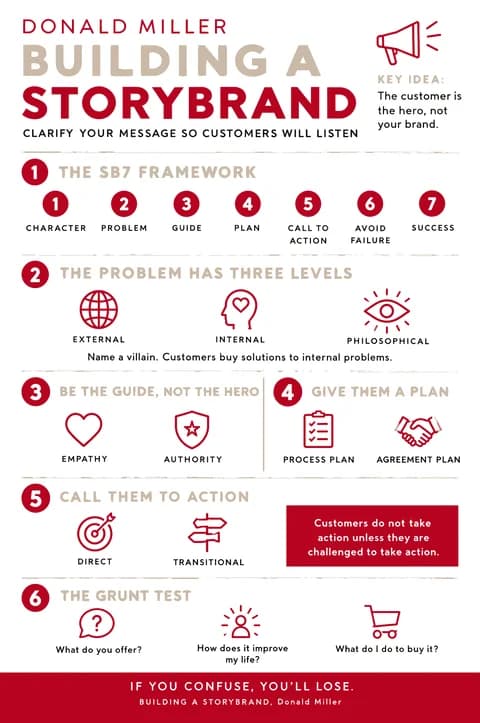
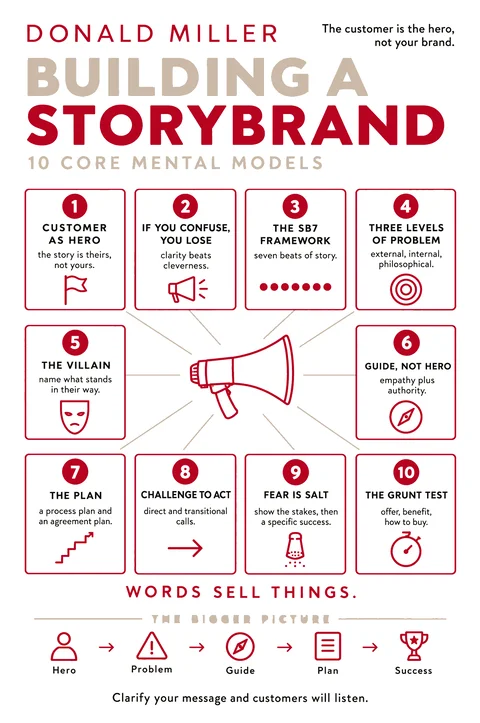
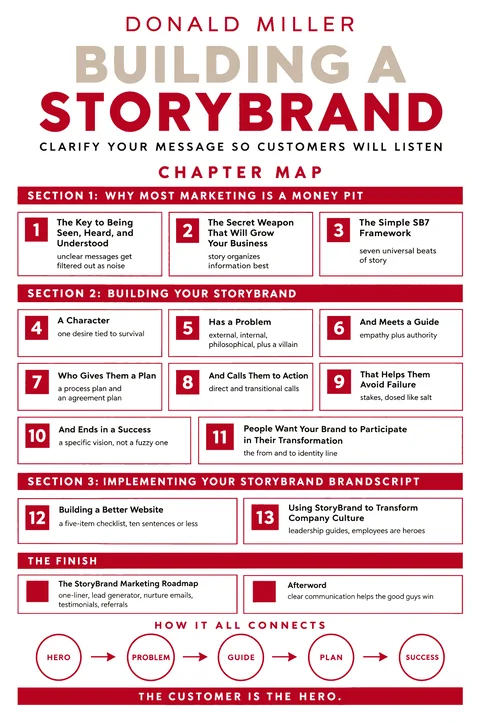
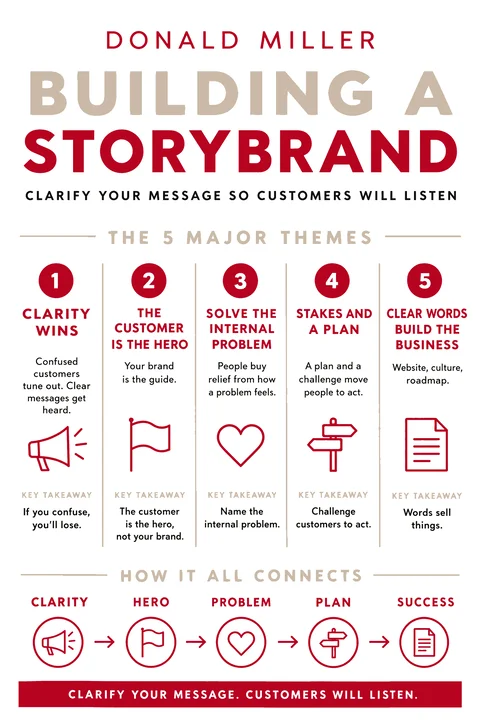
Four printable posters in the cover's colors: big ideas, mental models, a chapter map, and major themes.
Free. You'll also get each new summary by email.
The summaryIntroduction
Miller opens by saying this is a book about the customer's story. The customer should be the hero, the brand should play a supporting role, and the book lays out a seven-part framework for talking about a business that way. He says StoryBrand helps more than 3,000 businesses a year clarify their message, and he asks readers to do three things: understand the SB7 framework, filter their message through it, and clarify the message so customers listen.
"Customers don't generally care about your story. They care about their own."
Section 1Why Most Marketing Is a Money Pit
The first three chapters explain why marketing money is wasted: the problem is usually the way a company talks about its product, and story is the cure.
Chapter 1The Key to Being Seen, Heard, and Understood
Companies hire designers who know Photoshop but have never read a book on sales copy, and pay for beautiful marketing that says nothing clear. Miller, a writer before he started StoryBrand, built his framework from the power of story, used it on his own books, then used it on his small company's marketing, which doubled in revenue for four consecutive years. Customers, he argues, will choose an inferior product if a competitor communicates more clearly.
To understand why, he brought Mike McHarg, known as Science Mike, to a workshop in Nashville. McHarg spent 15 years using science-based methods to learn how customers think, and left advertising when a client wanted to sell junk food to diabetics. On Miller's back porch he named two mistakes. The first is failing to show how an offer helps people survive and thrive, since the brain is constantly scanning for what helps it eat, stay safe, find love and belong to a tribe. In a ballroom, he said, you never count the chairs, but you always know where the exits are. The second is making customers burn too many calories to understand the offer, which leads them to tune it out. Story, McHarg said, is a sense-making device.
Miller's example is an industrial painting company with three divisions whose website looked like an Italian restaurant's and answered a hundred questions nobody asked. The workshop agreed that a picture of a painter in a lab coat, the line "We paint all kinds of crap" and a Get a Quote button would grow the business. StoryBrand's mantra: if you confuse, you'll lose.
Chapter 1 · If you confuse, you'll lose
"The fact is, pretty websites don't sell things. Words sell things."
Chapter 2The Secret Weapon That Will Grow Your Business
Story holds attention like nothing else, and Miller says neuroscientists claim people spend more than 30% of their time daydreaming unless a story is doing the daydreaming for them. Music is noise submitted to rules, and story makes music out of noise. A screenplay about Jason Bourne that also had him losing weight, passing the bar exam and adopting a cat would lose the audience.
His case study is Apple. In 1983 Steve Jobs launched the Lisa with a nine-page New York Times ad full of technical features, and the computer bombed. After running Pixar, Jobs came back and Apple's first campaign was two words, Think Different. Apple identified what customers wanted (to be seen and heard), named their challenge (people did not recognize their hidden genius), and offered a tool to express themselves. Apple plays the role of Q in a James Bond movie.
Miller reduces story to one sentence: a character who wants something encounters a problem before they can get it; at the peak of their despair, a guide steps into their lives, gives them a plan and calls them to action; that action helps them avoid failure and end in success. Every story, he says, must let the audience answer what the hero wants, who or what opposes them, and what life will look like if they do or do not get it, and if those questions are unanswered in the first 15 to 20 minutes the movie fails. Brands face the grunt test: within five seconds, could a caveman look at your website and grunt what you offer, how it makes life better and what to do to buy it? Cal Schultz, an Ohio fireman, sold $25,000 of an online photography course for parents. Before his next launch he cut 90% of the text on his sales page, dropped jargon like F-stop for plain phrases, and used fewer than 300 words. Sent to the same list he had emailed six months before, the course sold $103,000, and he later quit his job.
Chapter 2 · Clear beats clever
"People don't buy the best products. They buy the products they can understand the fastest."
Chapter 3The Simple SB7 Framework
This chapter flies over the seven parts, each with a StoryBrand principle. A character: the customer is the hero, a shift Nancy Duarte describes as positioning yourself as Yoda and your audience as Luke Skywalker. Has a problem: companies tend to sell solutions to external problems, but customers buy solutions to internal problems. And meets a guide: customers are looking for a guide, as King George VI found Lionel Logue in The King's Speech. Who gives them a plan: customers trust a guide who has a plan. And calls them to action: customers do not act unless challenged, the way a story about a man who decides on his own to lose 30 pounds would lose its audience. That helps them avoid failure: every human being is trying to avoid a tragic ending, as Wendy's showed by asking where's the beef. And ends in a success: never assume people understand how your brand can change their lives, so tell them, the way Ronald Reagan described a shining city on a hill.
Failure, he cautions, is like salt in a loaf of bread: too much ruins it, none leaves it bland. The tool for applying the framework is the StoryBrand BrandScript, free with the book, completed first for the overall brand, then for each division, product or customer segment. He urges readers to work through every chapter before filling it out, as amateur screenwriters who skip the rules end up with boring stories.
Chapter 3 · A story in a nutshell
"Every human being is already speaking the language of story."
Section 2Building Your StoryBrand
Section 2 spends one chapter on each part of the BrandScript, then adds the foundation underneath it all, the customer's transformation. Each chapter ends with exercises: brainstorm, decide, and fill in that module.
Chapter 4A Character
A story starts when the hero wants something. A high-end resort that featured photos of its restaurant and front desk switched to images of a warm bath, robes and a massage under the line "Find the luxury and rest you've been looking for," which every staff member, from the sous-chef to the groundskeeper, could repeat. Other examples include a hassle-free MBA you can complete after work and a yard that looks better than your neighbor's. Defining a desire opens a story gap, the space between a character and what they want, which Miller finds in Jason Bourne, in sonatas and in the unfinished last note of Twinkle Twinkle Little Star.
Two mistakes follow. Brands list everything they offer (one leader insisted on 27 things) instead of paring the desire to a single focus, and they choose a desire unconnected to survival. A leadership expert's tagline, "Inhale knowledge, exhale excellence," became "Helping you become the leader everybody loves." Desires that count as survival include conserving money (Walmart's Save Money, Live Better), conserving time, building social networks, gaining status, accumulating resources, the desire to be generous and the desire for meaning, which Miller ties to Viktor Frankl. The customer is a hitchhiker whose only question is where you are going.
Chapter 4 · The story gap
"When we fail to define something our customer wants, we fail to open a story gap."
Chapter 5Has a Problem
The problem is the hook of a story, and the more a brand talks about its customers' problems, the more interest they have. Problems start with a villain, which should be a root source, relatable, singular and real. Advertisers personify villains as dust-bunny gangs and talking plaque; time management software might vilify distractions.
- You're Already an Impact Business22 to 30
- You're Closer Than You Think14 to 21
- You Have the Foundation7 to 13
- The Starting Line0 to 6
 Printable PDF
"Miller says a confused message loses the customer. Look, a confused founder loses the business. Ten questions, a score on four parts of yours and the part to fix first, so you know what to clarify. It's free with your email."
 Deven Davis, devendavis.com
- Ten questions about where your business is right now
- A score out of 30
- A four-part breakdown: Impact Clarity, Traction Proof, Model Strength, Founder Credibility
- The part to fix first
- Your tier's next steps
- A printable PDF
Free with your email. Your score and a printable PDF open right on the page.
Villains cause three levels of problems. External problems are tangible, such as hunger for a restaurant or a leaky pipe for a plumber. Internal problems are the frustration the external problem creates, and Miller says they are what actually motivate a purchase. National won his rental business by showing a man walking past the counter without small talk. CarMax barely advertises cars; it removed the fear of haggling and lemons and, Miller writes, built a $15 billion franchise. Starbucks turned a product people paid 50 cents for into one they pay three or four dollars for by selling a feeling of sophistication and belonging. Philosophical problems answer why the story matters, using words like ought and shouldn't; Tower Records' No Music, No Life helped it sell more than a billion dollars in records a year. The brand promise resolves all three at once, the way Luke's shot at the Death Star does. His examples include Tesla (villain: gas-guzzling technology), Nespresso and Edward Jones.
Chapter 5 · Three levels of problems
"Companies tend to sell solutions to external problems, but customers buy solutions to internal problems."
Chapter 6And Meets a Guide
Every hero needs a guide, from Gandalf to Haymitch to Yoda. Brands that cast themselves as the hero compete with their customers for attention. Miller's cautionary tale is Tidal, which Jay-Z founded with a $56 million personal investment and launched with 16 well-known musicians who owned equity. At the press conference Jay-Z said water is free and music costs money, social media mocked it, and the service positioned artists as the heroes when customers wanted someone to help them win the day.
A guide shows two things. Empathy, as Bill Clinton showed with "I feel your pain" in 1992 and by asking a voter whether she knew anyone who had lost their job; Oprah Winfrey says people want to be seen, heard and understood. And authority, meaning competence: a nutritionist who answers your goal of losing 30 pounds with "Me too" is the wrong guide. Authority can be shown with a few brief testimonials (three is a good start, while 10 to 20 risks making you the hero), statistics such as Infusionsoft's 125,000 users, awards and client logos. Amy Cuddy's research, Miller notes, says people decide whether they can trust someone and whether they can respect them, which map to empathy and authority.
Chapter 6 · Empathy and authority
"Customers aren't looking for another hero, they are looking for a guide."
A note on editions: the Kindle and Audible links go to Building a StoryBrand 2.0 (2025). This summary covers the original 2017 edition, which the print link sells.
Chapter 7Who Gives Them a Plan
Trust is not a purchase. A customer about to buy stands at the edge of a rushing creek and hears a waterfall downstream, and a plan places stones to step on. A process plan lays out steps before or after purchase (schedule an appointment, get a customized plan, execute it together; or test drive, purchase, enjoy free maintenance), and Miller recommends at least three steps and no more than six, grouped into phases if needed. An agreement plan lists promises that remove fears: CarMax's four-point agreement says customers will never haggle and every car passes its certification, and Miller reports CarMax now sells more cars than its next three competitors combined. Newt Gingrich's Contract with America worked the same way, with more than 300 legislators signing on. Naming the plan, such as the Easy Installation Plan, raises its perceived value.
Chapter 7 · Stones in the creek
"Placing stones in the creek greatly increases the chance they will cross the creek."
The Founder Brain Kit
Chapter 8And Calls Them to Action
Characters only act when something outside challenges them, and customers are the same. Miller says customers are bombarded with more than 3,000 commercial messages a day, so soft calls to action go unnoticed. A friend who has bought and sold nearly 100 companies grows them mostly by making the calls to action clear. Miller tells how he got together with his wife, Betsy: she had a boyfriend, he told her how he felt and said he would call in 30 days, and by then she was single. Selling passively, he argues, signals that you do not believe in your product.
Brands need two kinds of calls to action. Direct ones (buy now, schedule an appointment, call today) are the marriage proposal and belong in one obvious button repeated down the page. Transitional ones (a free PDF, webinar, testimonials, samples or a free trial) are the date: they stake a claim to your territory, create reciprocity and position you as the guide. When Miller needed a keynote designed, he skipped the beautiful site with no clear next step and hired the plainer competitor that offered a PDF called Five Things Great Presenters Get Right. StoryBrand's own PDF, Five Things Your Website Should Include, carried an ad for its workshop, and Miller says the company doubled revenue in the next 12 months without spending a dollar on marketing. A health clinic replaced its waiting-room magazines with a Healthy Body Checklist that fed an automated email campaign.
Chapter 8 · Direct and transitional
"Customers do not take action unless they are challenged to take action."
Chapter 9That Helps Them Avoid Failure
Stories run on the question of whether the hero will succeed or fail, and brands that never say what is at stake fail to answer the customer's so what. Allstate's Mayhem campaign took this furthest in 2015 at the Sugar Bowl: it recreated a real couple's home on a soundstage and auctioned their belongings on national television to warn against sharing your whereabouts on social media. Miller reports MayhemSale.com got 6,000 to 10,000 hits per second after each commercial and more than 18 million during the game.
Fear mongering, he says, is rarely the problem; 99.9% of business leaders struggle with the opposite. He cites Daniel Kahneman's prospect theory, published in 1979, which holds that people hate losing $100 more than they like winning $100, and that in certain situations people are two to three times more motivated to avoid a loss than to achieve a gain. Lyndon Johnson moved George Wallace on the Civil Rights Act of 1964 by spelling out his legacy. Dominic Infante, Andrew Rancer and Deanna Womack's four-step fear appeal makes the reader aware of a threat (Miller's example: nearly 30% of all homes have evidence of termite infestation), says they should act, offers a specific action and challenges them to take it. Moderate fear works best. The BrandScript asks for at least 3 negative consequences.
Chapter 9 · What is at stake
"Remember, if there are no stakes, there is no story."
Chapter 10And Ends in a Success
A friend once told Miller that people want to be taken somewhere. Leaders and brands do this with a specific vision: Kennedy said we are going to put a man on the moon instead of describing a productive space program. The success module should list resolutions to the customer's external, internal and philosophical problems and show happy people using the product.
Stories usually end in one of three ways, which Miller treats as three deep desires. Winning power and position, the need for status, which brands offer through access, scarcity (Jeep's Limited badge), a premium tier (most companies, he says, earn 70% or more of revenue from a small share of clients) and identity association. Union with something that makes the hero whole, offered as reduced anxiety, a reduced workload or more time. Ultimate self-realization or acceptance, which Dove's 2013 sketch films, American Eagle's unretouched Aerie campaign, and transcendent brands like TOMS (sold for more than $700 million at less than 10 years old) and FUBU tap into.
Chapter 10 · Three ways stories end
"If we don't tell people where we're taking them, they won't follow."
Chapter 11People Want Your Brand to Participate in Their Transformation
The foundation of the BrandScript is the customer's desire to transform. Heroes start out flawed and full of doubt and end competent. Miller stood in Home Depot wanting a Gerber knife he did not need, because Gerber's Hello Trouble campaign sells an aspirational identity: tough, adventurous and competent. When a friend later gave him one engraved with his name, he decided the $40 was money well spent. The way to find the identity is to ask how customers want their friends to describe them.
"Once your message is clear, you have to put it in front of someone who matters. The Pitch Kit gives you 5 Sequoia-style deck templates for an investor, a partner or a big client, in Canva and Google Slides. Seven bucks, and you'll have a first draft in 60 minutes."
Deven Davis, devendavis.com- 5 Sequoia-style deck templates in Canva and Google Slides
- Covers the essential pitch deck, the one-pager and early-stage variations
- Bonus: The Deck Doctor, Deven's 5-minute video on the 3 slides people skip to first
- Bonus: The Quick Win Guide, to have your first draft in 60 minutes
Seven dollars, with the No-Brainer Guarantee: if the templates don't save you at least 10 hours of work, full refund.
Dave Ramsey, whose radio show has more than 8 million daily listeners, is Miller's model guide: he gives listeners a narrative map, a new status symbol in the paid-off home, and a climactic scene, the debt-free scream, after which he affirms how they have changed, as Obi-Wan does for Luke. The BrandScript captures this as a from and to line, such as from passive dog owner to every dog's hero.
Chapter 11 · From and to
"Great brands obsess about the transformation of their customers."
Section 3Implementing Your StoryBrand BrandScript
A BrandScript only produces results when it shows up in websites, emails, pitches and sales scripts. Section 3 starts with the website, then turns the framework inward.
Chapter 12Building a Better Website
A website should be an elevator pitch, a first date. Miller lists five things it needs. An offer above the fold that promises an aspirational identity, solves a problem or states exactly what you do: a cooking membership his wife was given hid its point until she said "We will make you a pro in the kitchen," and a shop called Local Honey clears up its name with "We sell clothes, we do hair." Obvious calls to action, a direct button at the top right and in the center, repeated as the eye moves in a Z pattern. Images of success, meaning smiling customers. A bite-sized breakdown of revenue streams under one umbrella message, as he did for a company selling life plans, strategy sessions and facilitator certification under "The key to success is a customized plan." And very few words: some of the most effective sites he has reviewed used 10 sentences or less on the whole page.
Chapter 12 · A website in a Z
"The fewer words you use, the more likely it is that people will read them."
Chapter 13Using StoryBrand to Transform Company Culture
Employees get confused too. Miller calls the absence of a shared story the narrative void and says mission statements rarely lead a company on a mission. He cites Gallup, which since the 1990s has found that about one out of every five employees is truly excited about their work, and which estimated in 2012 that disengagement cost the United States $450 billion to $550 billion each year.
He contrasts two hires: one onboarded with a harassment video and a mission plaque who leaves for a headhunter's offer after a few years, and one who hears the company's story on the street, in every interview and at a CEO luncheon and stays. Ben Ortlip, director of the StoryBrand Culture Program, worked with a billion-dollar fast food chain growing about 5% that had lost its plot. Using video curriculum, regional meetings, a convention and casual CEO updates to improve its "thoughtmosphere," the chain went to nearly 30% growth in less than three years with the same people. The program creates a BrandScript with leadership, audits the culture, builds an implementation plan, optimizes internal communications and installs a team to sustain it. Internally, the employees are the hero and leadership is the guide.
Chapter 13 · A story for the team
"Where there's no story, there's no engagement."
RoadmapThe StoryBrand Marketing Roadmap
After the website, Miller gives five almost free things to do, treated as a checklist. Create a one-liner. Like a movie logline, it names the character, the problem, the plan and the success: "We provide busy moms with a short, meaningful workout they can use to stay healthy and have renewed energy," in place of "I run a gym." Memorize it, have the team memorize it (he suggests handing out $5 bills to anyone who can recite it, which might cost $1,000), and put it everywhere, repeating it like James Taylor singing Fire and Rain.
Create a lead generator and collect email addresses. Nobody wants your newsletter, so offer something valuable. StoryBrand's first PDF, 5 Things Your Website Should Include, was downloaded more than 40,000 times, and Miller credits it with taking the company past the $2 million mark. Good forms are downloadable guides, online courses or webinars, software demos or free trials, free samples and live events. Keep a PDF to about three pages and be generous. A business making less than $5 million a year, he says, should see results with as few as 250 qualified email addresses; a pop-up after about 10 seconds works.
Create an automated email drip campaign. Miller learned the power of reminders running a publishing warehouse, sending about 200 form letters a month to top customers who mostly threw them away. A nurturing campaign sends weekly emails that talk about a problem, explain a plan and describe life after it is solved, with every third or fourth email making a direct offer. A 20% open rate is industry standard. His sample emails are for Crest Hill, a dog boarding business, including an offer of three nights at half price.
Collect and tell stories of transformation. Ask customers five questions: what problem they had, how it felt, what was different about your product, the moment they realized it was working, and what life looks like now. Create a system that generates referrals. Identify your ideal customers, give them something worth sharing such as a video for their friends, and offer a reward or a 10% affiliate commission. He cites the American Marketing Association as finding referrals up to 2.5 times more responsive than other channels, and gives examples: a test-prep academy that refunded 100% of tuition for three referrals, golf coupons that brought a 40% increase in lessons, and an open house party that filled a contractor's schedule for 12 months. A chess player who knows a few openings, he says, wins more games, and the roadmap is a business's opening.
"It's never cost me to be generous with my customers."
A note on editions: the Kindle and Audible links go to Building a StoryBrand 2.0 (2025). This summary covers the original 2017 edition, which the print link sells.
ClosingAfterword
The people who communicate most clearly, Miller observes, are often not the ones with the best products or the best qualifications to lead. StoryBrand wants the good guys holding the microphone, because businesses that invite customers into a better story create jobs, community and products that solve problems. The framework was built to reduce the stress of growing a company.
"It's true, if you confuse, you'll lose. But if you clarify your message, customers will listen."
Building a StoryBrand on four pages
Four printable posters in the cover's colors: big ideas, mental models, a chapter map, and major themes.
Free. You'll also get each new summary by email.