Breaking the Habit of Being Yourself by Joe Dispenza: Summary and Notes
The full book, section by section.
Start hereThe short version
- 1Repeated thought, feeling and action make up a personality, and Dispenza argues that the personality creates the personal reality. Part I, The Science of You, builds the case in Chapters 1 to 5: the quantum observer, then the Big Three a person must become greater than, the environment, the body and time.The claim
- 2Thought makes chemistry, chemistry makes feeling, and feeling drives more of the same thought until the body has memorized the old self. Part II, Your Brain and Meditation, explains in Chapters 6 to 8 how three brains move a person from thinking to doing to being, the gap between how we appear and who we are, and how meditation slows brainwaves to reach the subconscious.The brain
- 3The way out is a seven-step meditation learned over four weeks: Induction, Recognizing, Admitting and Declaring, Surrendering, Observing and Reminding, Redirecting, and Creating and Rehearsing. Part III, Stepping Toward Your New Destiny, teaches it in Chapters 9 to 13, and Chapter 14 asks the reader to live the new self all day.The method
Breaking the Habit of Being Yourself on four pages
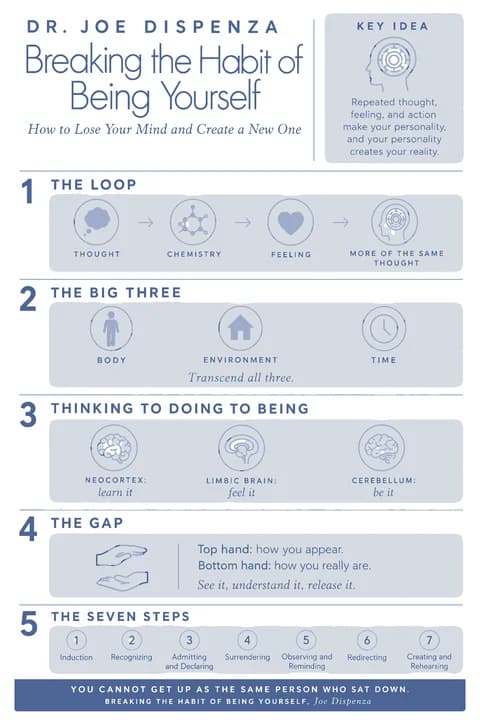
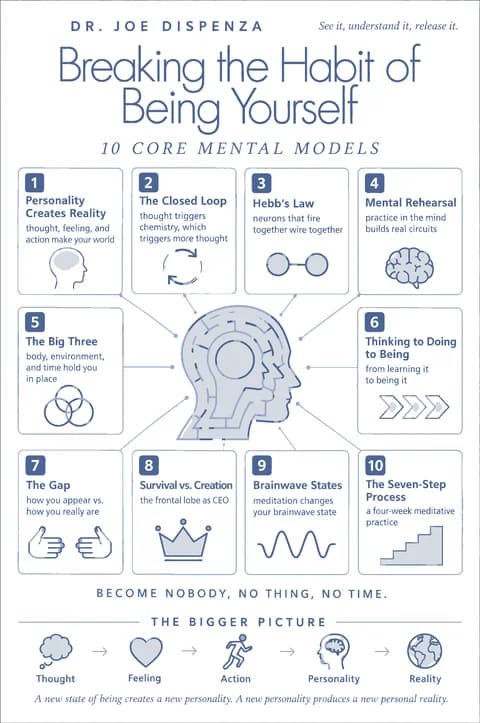
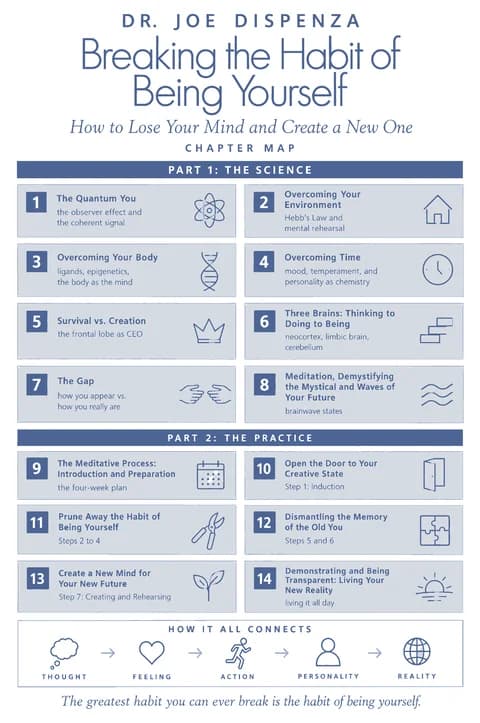
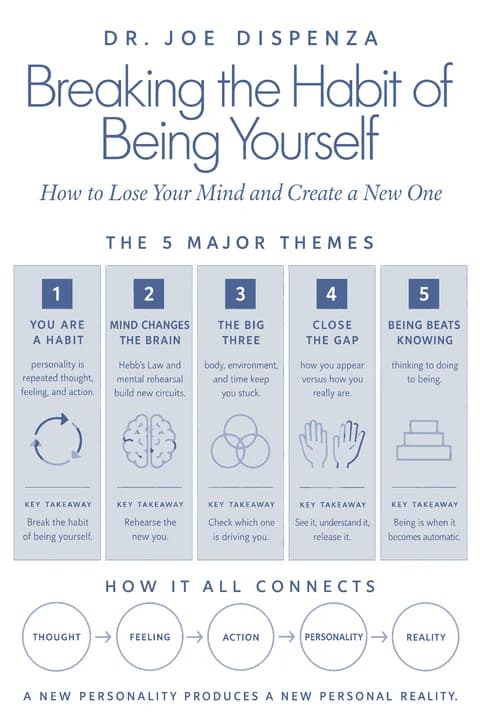
Four printable posters in the cover's colors: big ideas, mental models, a chapter map, and major themes.
Free. You'll also get each new summary by email.
The summaryIntroduction
Dispenza opens with the line the book is named for: the greatest habit you can ever break is the habit of being yourself. He writes as a chiropractor who runs an integrated health clinic and as an educator in neuroscience and brain chemistry. Over several years he interviewed people who recovered from conditions considered terminal or permanent, recoveries medicine labeled spontaneous remissions, and concluded that a strong element of mind was involved. That led him to postgraduate study in brain imaging, neuroplasticity, epigenetics and psychoneuroimmunology.
Readers of his first book, Evolve Your Brain, kept asking him how to actually do it, so he wrote this one as a practical, how-to companion. He asks readers to treat the material as an experiment: change your inner world of thoughts and feelings, then watch whether the outer world gives you feedback. Most people, he observes, wait for crisis, trauma, loss or disease before they change. His question is why wait.
The book is built in three parts. Parts 1 and 2 supply the knowledge, deliberately repeated so the circuits stick. Part 3 supplies a step-by-step meditation that, like the many separate actions of driving a car, starts as a sequence and becomes one smooth process. He asks readers to resist skipping ahead, because each step of the meditation rests on something explained earlier.
"We can learn and change in a state of pain and suffering, or we can evolve in a state of joy and inspiration."
Part IThe Science of You
Part I covers the nature of reality, who you are, why change has been so hard, and what is possible. Dispenza promises it will be an easy read. It starts with quantum physics, then spends three chapters on the three things a person has to become greater than, which he calls the Big Three: the environment, the body and time. It closes on the difference between living in survival and living in creation.
Chapter 1The Quantum You
Dispenza traces how Descartes split mind from matter, giving matter to science and mind to religion, and how Newton's mechanical universe left people believing reality was predetermined and that they were mostly victims of it. Einstein's work showed that energy and matter are interchangeable, and the puzzle of light behaving as both a wave and a particle gave rise to quantum physics. Atoms, he writes, are mostly empty space, and he describes an atom as 99.99999% energy. The observer effect, as he presents it, says a particle exists as a wave of possibilities until someone observes it, so mind and matter can no longer be considered separate. If an observer can collapse an electron into existence, he reasons, a future you can imagine already exists as a possibility in the quantum field, waiting to be observed.
He gives two studies. In July 2000, Israeli doctor Leonard Leibovici ran a double-blind, randomized, controlled trial with 3,393 hospital patients who had sepsis. The prayed-for group had shorter fevers and shorter hospital stays, and Dispenza points out that the patients prayed for had been in the hospital from 1990 to 1996, years before the prayers were said. He concludes that intention can affect the past. At the HeartMath Research Center, cellular biologist Glen Rein had trained groups hold vials of DNA. A group of 10 that generated only elevated emotion produced no change, a group that held only intention produced no change, and the group that combined elevated emotion with a clear intention wound or unwound the DNA by as much as 25% in some cases. Dispenza reads this as proof that the field responds only to a coherent signal: thoughts as the electrical charge, feelings as the magnetic charge, together a state of being.
Two more ideas run through the rest of the book. If you can predict how a result will arrive, Dispenza says, you have gone Newtonian and are trying to control it; real creation should surprise you, so you hold the intention and leave the how to the field. And gratitude comes before the fact: you feel the emotion of an event before it happens so the body believes it already has. To enter the field you must become no body, no thing, no time, which he describes as entering as a nobody. He closes with his daughter, an art student, who in March pictured a summer working in Italy, visiting at least six Italian cities and spending a week in Florence. After trying to steer it into a $7,000 summer course she could get down to $4,000, she went back to living as if it had happened. A teacher then offered her a job teaching Italian to American students: paid, expenses covered, six cities in six weeks, the last week in Florence.
Chapter 1 · A coherent signal
"The quantum field responds not to what we want, it responds to who we are being."
Chapter 2Overcoming Your Environment
Most people, Dispenza writes, think equal to the three things they focus on most: their environment, their bodies and time. The brain is organized to reflect everything we know in our environment, so each morning the senses plug us back into the same reality. We wake on the same side of the bed, drink from the same mug, drive the same route and see the same people who push the same emotional buttons. The same input produces the same output, and the person reproduces the same level of mind every day.
Hebb's Law, nerve cells that fire together wire together, explains how repetition hardwires the pattern until it becomes an automatic habit and the person's personality. He calls that person the creator of the loop, which also means the person can end it. To change is to think greater than your environment, as Martin Luther King Jr., William Wallace, Marie Curie, Gandhi, Thomas Edison and Joan of Arc did. Gandhi believed in a free India he could not yet see and lived as if it were already real, without needing feedback from the environment.
The evidence he offers that thought alone changes the brain is a study he described in Evolve Your Brain: people who mentally rehearsed one-handed piano exercises for two hours a day for five days, without touching the keys, showed almost the same brain changes as people who physically played. He lists four ingredients for changing the brain: learning knowledge, receiving hands-on instruction, paying attention and repetition. Through mental rehearsal the brain stops being a record of the past and becomes a map to the future.
Chapter 2 · Habitat becomes habit
"When your environment is influencing your mind to that extent, your habitat becomes your habit."
Chapter 3Overcoming Your Body
Every thought makes a chemical. Dispenza explains three kinds of ligands: neurotransmitters, which carry messages between nerve cells; neuropeptides, made mostly in the hypothalamus, which signal the body; and hormones, which produce feelings in the body. The brain makes you feel the way you think, the body reports back, and then you begin to think the way you feel. Years of that cycle create a memorized state of being, and people start to describe themselves with it: I am an anxious person, I have always been lazy. He walks through a driver who replays a fight with a coworker until he arrives at work enraged, all from a single thought.
Psychologists, he writes, say identity is formed by the mid-thirties, and he states that by age 35 about 95% of who we are is a set of subconscious programs, leaving 5% of the mind conscious. The body has become the mind, which is why fingers can dial a phone number the conscious mind cannot recall. The servant has become the master. He uses guilt as the worked example: after 20 years of feeling guilty, cells adapt their receptor sites, need a stronger hit, and the body becomes addicted to guilt as it would to a drug. When the person decides to stop, the body pushes back on a fast track up the spinal cord and a slow track through the hypothalamus, producing chatter such as you can start tomorrow. He adds that positive thinking by itself never works, because the conscious mind is thinking one way while the body is being another.
On health, he states that less than 5% of diseases come from single gene disorders and around 95% relate to lifestyle, chronic stress and toxic factors. Epigenetics, the control of gene expression from outside the cell, means emotion can signal genes. In a study in Japan, insulin-dependent type 2 diabetics who watched a comedy show for an hour before a meal had blood sugar rise about half as much as a group that watched a boring lecture, whose levels rose 123 mg per deciliter, and researchers found the laughing group had altered 23 different gene expressions. In a study in the 1992 Journal of Neurophysiology, a group that physically exercised one finger gained 30% in strength over a control group, and a group that only mentally rehearsed the exercise gained 22%.
Chapter 3 · The body becomes the mind
"Feelings and emotions are a chemical record of past experiences."
Chapter 4Overcoming Time
In the present, all potentials exist; in the past, none of the new ones do. Dispenza explains how a memory merges thought and emotion until reliving the past becomes subconscious, then turns to Pavlov, who in the 1890s conditioned dogs to salivate at a bell. The body responds autonomically to a cue from the past while the conscious mind believes it is in the present.
He maps how an emotion hardens. A bad morning (no hazelnut coffee, someone in your parking spot, every elevator button pressed) produces a reaction whose chemical effect lingers. He calls that the refractory period. When it lasts hours to days it is a mood, weeks to months a temperament, and months to years a personality trait, so that people come to be described as bitter or resentful.
The body can also be conditioned to live in a future built from the past. Someone asked to speak to 350 people, who remembers earlier disasters on stage, tenses and sweats as if the talk were happening now. A guest who drives to a coworker's 4th of July barbecue certain it will be miserable runs a stop sign, gets beer spilled on him and is served a nearly raw burger. Dispenza suggests writing down your thoughts to see how often you are either looking back or thinking ahead. He calls the moments when environment, body and time all disappear being in the flow, describes how they happen to him while writing, and says he has learned to produce them more often on purpose.
Chapter 4 · From reaction to personality
"Most of the time, personality, how we think, act and feel, is anchored in the past."
Chapter 5Survival vs. Creation
A deer chased by coyotes turns on its fight-or-flight response, escapes, and after perhaps 15 to 20 minutes returns to grazing. Humans can turn the same response on by thought alone, by anticipating a future event or replaying a memory, and so turn short-term stress into a long-term state. That drains energy from growth and repair, which Dispenza connects to illness, and it locks attention onto the body, the environment and time. The survival emotions, he writes, are lower-frequency energy that makes us more matter and less mind, and people become addicted to the rush of their own problems because the problems remind them who they are as a somebody.
- You're Already an Impact Business22 to 30
- You're Closer Than You Think14 to 21
- You Have the Foundation7 to 13
- The Starting Line0 to 6
 Printable PDF
"Dispenza says the same thoughts keep producing the same life. Same goes for a business, right? Ten questions, a score on four parts of yours and the part to fix first. It's free with your email. Go find out."
 Deven Davis, devendavis.com
- Ten questions about where your business is right now
- A score out of 30
- A four-part breakdown: Impact Clarity, Traction Proof, Model Strength, Founder Credibility
- The part to fix first
- Your tier's next steps
- A printable PDF
Free with your email. Your score and a printable PDF open right on the page.
His central story is Bill, 57, a roofing contractor whose melanoma came back on his face, neck, side and calf despite surgery, radiation and chemotherapy. Bill realized he had lived in resentment for more than 30 years, since giving up a career in music to join the family roofing company after his father was injured. He went to Baja, Mexico, for two weeks. In the first week he observed his resentful thoughts and stopped every thought, behavior or emotion that was unloving toward himself. In the second he designed a new self, deciding for instance to meet his family's requests with kindness. Shortly after he returned, the tumor on his calf fell off, and his doctor found him cancer-free.
Creation, by contrast, means forgetting yourself. Dispenza assigns the frontal lobe three functions in that state. The first is metacognition, observing your own thoughts and beliefs so you can stop being the old self. The second is creating a new mind by asking open questions such as what would it be like to be this person. The third is making thought more real than anything else, as the frontal lobe turns down the volume on the circuits that process the body, the environment and time. When the old emotional self stops being fed, its energy rises toward the heart and is felt as joy, love or gratitude.
Chapter 5 · Survival mode
"Living in creation is living as a nobody."
Part IIYour Brain and Meditation
Part II gives the reader the working knowledge of the brain needed to operate it well, using the comparison of two identical computers, one in a novice's hands and one in an expert's. It explains the three brains, the gap between who we are and who we appear to be, and what happens in the brain during meditation.
Chapter 6Three Brains: Thinking to Doing to Being
Learning to drive is Dispenza's model: first you think about every action, then you do it with conscious attention, and finally you are a driver and the subconscious takes the wheel. Three brain areas carry that progression. The neocortex, the thinking brain, processes knowledge; its motto might be knowledge is for the mind. The limbic brain, the chemical or emotional brain, turns a new experience into a new emotion and a long-term memory; its motto might be experience is for the body. The cerebellum, which he calls the seat of the subconscious, stores what has been memorized so thoroughly that it runs automatically; each of its neurons can connect with at least 200,000 other cells.
His extended example is a reader who has studied books on compassion by the Dalai Lama, about Mother Teresa and about Saint Francis of Assisi, then learns there will be dinner with a mother-in-law he has disliked since she hurt his feelings years ago. Before the dinner he decides who he no longer wants to be and rehearsing a new response. At dinner he listens, stays present, and actually feels compassion: the knowledge has become an experience, and the word has become flesh. Doing it once moves him from thinking to doing. Doing it until no person or circumstance can move him from it is being, and Dispenza defines mastery as an internal chemical state that is greater than anything in the external world.
Meditation, he argues, lets a person go from thinking straight to being without the physical experience, as the piano and finger studies showed. You put yourself in the equation of qualities you admire, generate the emotion of having them, and give thanks before anything has happened. The test is simple: if you get up feeling exactly as you did when you sat down, nothing has changed. This, he says, requires dropping about 10 inches out of the head into the heart.
Chapter 6 · Thinking to doing to being
"A new state of being creates a new personality. A new personality produces a new personal reality."
Chapter 7The Gap
Dispenza tells of sitting on his couch, outwardly successful after appearing in What the Bleep Do We Know?, lecturing in city after city, and realizing that all his happiness came from outside him. He pictured two hands, one above the other. The top hand is how we appear to the world; the bottom is how we really are when nothing is distracting us. Memorized emotions such as guilt, shame, anger, fear and unworthiness create the gap between them, and people spend enormous energy keeping up the top hand.
By the mid-thirties or forties, he writes, people can predict how most experiences will feel, and the external world stops covering the feeling underneath. That is the midlife crisis: the sports car, the boat, the trip, the plastic surgery, the remodel. Addictions follow the same logic, since overstimulated receptors need more each time, a $5,000 shopping spree giving way to two maxed-out credit cards. Relationships are often bonds of shared emotion, so when someone starts telling the truth about how they feel, friends and family pull them back toward the old self. He also notes that advertising sells to this sense of lack.
His remedy is to unmemorize the emotion rather than analyze the event that caused it, because analyzing within the old emotion only reproduces it. Pamela, a seminar participant, had been angry for two years that her unemployed ex-husband had not paid child support. During a workshop meditation she let go of the victimhood, resentment and lack. That evening she found her internet promotion had earned nearly $10,000 that day, and three days later her caseworker called to say her ex had paid the full $12,000 in back support. Dispenza ends the chapter with his own response to the couch moment: he canceled his lectures for about six months, kept up some of his clinical practice, and meditated daily until he felt joy for no outside reason.
Chapter 7 · The identity gap
"A memory, without the emotional charge, is called wisdom."
Chapter 8Meditation, Demystifying the Mystical and Waves of Your Future
In Tibetan, Dispenza notes, to meditate means to become familiar with, and in Sanskrit, to cultivate self. He uses the term for self-observation, the move from being the old self to watching it, like an athlete studying video of their own technique. Cultivation is his garden metaphor: clearing last season's plants, pulling unnoticed weeds and removing rocks before planting. He recommends choosing one trait, such as anger, and studying it closely: what you think, say and do when you feel it, and where you feel it in the body.
He then explains brainwaves. Children move from delta (0.5 to 4 cycles per second) through theta (4 to 8) and alpha (8 to 13) into beta, which above 13 cycles per second marks analytical thinking, and after age 12 the door between the conscious and subconscious minds usually closes. Beta has three ranges: low (13 to 15 Hz), mid (16 to 22 Hz) and high (22 to 50 Hz). High beta, the state of stress, is the one most people overuse, and it produces an incoherent signal because attention is split among the body, the environment and time. Closing the eyes cuts out the sense that he says supplies 80% of sensory information, and the brain slows toward alpha. The purpose of meditation is to get beyond the analytical mind, which he describes as a barrier between the 5% conscious mind and the 95% subconscious. The easiest times to slip through are just after waking and just before sleep.
The Right to Be Rich
His stories here are José, who before bed did a simple meditation and woke to find the ten olive-sized warts on his left hand gone, and Monique, a therapist from Montreal who had memorized a state of lack. She decided to live as a woman with plenty of money, energy and time, bought a lottery ticket on impulse, and won $53,000, exactly the amount she and her husband owed in credit card and auto loan debt. He also cites Buddhist monks studied at the University of Wisconsin at Madison whose coherent brainwave patterns from a morning meditation on compassion persisted through a day out in town. He ends Part II comparing the reader to climbers resting at Camp Muir before the summit of Mount Rainier.
Chapter 8 · Waves of your future
"To know thyself is to meditate."
Part IIIStepping Toward Your New Destiny
Part III is the how-to: a seven-step meditation learned over four weeks, each step tied to something explained in Parts 1 and 2 so nothing is left to conjecture.
Chapter 9The Meditative Process: Introduction and Preparation
Dispenza compares learning the meditation to learning a golf swing or a French recipe: one step at a time until the steps merge into one motion. The program runs Week 1 (Chapter 10), Step 1, Induction; Week 2 (Chapter 11), Steps 2 to 4, Recognizing, Admitting and Declaring, and Surrendering; Week 3 (Chapter 12), Steps 5 and 6, Observing and Reminding, and Redirecting; and Week 4 (Chapter 13), Step 7, Creating and Rehearsing. Each session begins with the steps already learned. Guided recordings and written scripts in the appendices are both offered, and he recommends keeping a notebook for the writing prompts.
Preparation covers each of the Big Three. For the environment, he advises choosing a private place used every day for this purpose. One participant kept falling asleep because she meditated in bed, a place her brain had wired to sleep by association and repetition. Turn off the phone and computer; use a blindfold, earplugs or music without lyrics. For the body, sit upright in a regular chair with limbs uncrossed, use the restroom, wear loose clothes and remove your watch; head nodding means the brainwaves are slowing. For time, meditate in the morning or at night, allow 10 to 20 minutes for induction plus 10 to 15 minutes for each added step, expect a full session to run 40 to 50 minutes, and set a timer 10 minutes before you must finish. When the mind or body fights for control, he advises settling it back into the present, gently and persistently.
Chapter 9 · Four weeks, seven steps
"Finding the right environment in which to meditate, one with a minimum of distractions, will really give you a leg up on defeating the first of the big three."
Chapter 10Open the Door to Your Creative State (Week 1)
Dispenza learned and taught hypnosis and self-hypnosis early in his career, and Step 1 borrows its induction: moving from beta into a relaxed, coherent alpha or theta state. Induction leads off every session and takes up to the first 20 minutes.
He gives two techniques. In the body part induction you rest attention on the location of each part of the body in space, from the top of the head down to the soles of the feet, sensing its density and volume, then the space around the body, then the space the whole room occupies. Because the cerebellum handles the body's awareness of position, this route enters the subconscious and moves the mind from thinking to sensing, a broad attention Buddhists call open focus. In the water rising induction you imagine water entering the room and rising from the feet until it fills the room. He suggests lingering 20 to 30 seconds or more on each part, and about 20 minutes in all.
Chapter 10 · Induction
"By mastering induction, you will build a solid foundation for the meditative practices you will learn in upcoming steps."
Chapter 11Prune Away the Habit of Being Yourself (Week 2)
Step 2, Recognizing, is a daily life review, modeled on what people describe after near-death experiences. Writing prompts ask what kind of person you have been, what each side of your gap is like, and what feeling you struggle with every day. You then pick one survival emotion to unmemorize, such as insecurity, guilt, anger, resentment or lack, observe where it lives in the body without running from it, and name the state of mind it drives, for example controlling, self-pitying or overwhelmed. One emotion at a time is enough, he says, because they are chemically linked: as anger decreases, frustration, hatred and judgment decrease with it.
Step 3, Admitting and Declaring, has two halves. Admitting is telling the greater intelligence, which he describes as a consciousness of unconditional love that cannot judge or punish, who you have been and what you have been hiding. Declaring is saying the emotion out loud, softly, during the meditation, which he says breaks the energetic bonds to the people and places tied to it. In his workshops it is the hardest step.
"Dispenza says you break the habit of being yourself by running the loop the other direction, on purpose, every day. The Identity Shift is 30 days of exactly that: a prompt, a reflection and an intention each morning. Seven bucks, and the first shift shows up in Week 1."
Deven Davis, devendavis.com- 30 days of guided identity reprogramming, rooted in Wattles' Impression of Increase principle
- Each day has a prompt, a reflection and an intention
- Bonus: The Quick Win Guide, your first identity shift result in under 1 hour
- Bonus: a 5-minute video from Deven on why identity precedes strategy
Seven dollars, with the No-Brainer Guarantee: if it doesn't change how you think about yourself and money within the first week, full refund.
Step 4, Surrendering, rests on Einstein's line that no problem can be solved from the level of consciousness that created it. You hand the emotion to a greater mind without bargaining, begging or dictating how it should be resolved, then trust and get out of the way. Some people imagine passing it through a door or into a box that dissolves. The step ends with giving thanks ahead of the result.
Chapter 11 · Recognize, declare, surrender
"Thankfulness is the supreme state of receivership."
Chapter 12Dismantling the Memory of the Old You (Week 3)
Step 5, Observing and Reminding, asks you to write down and memorize the automatic thoughts and actions that come with your chosen emotion. His sample thoughts include I'll never get a new job, everyone uses me, and I am just like my mother. His sample behaviors include sulking, complaining by phone, overspending, picking fights, procrastinating and talking too much about the past. Most thoughts, he notes, are old circuits, so the useful question is whether a thought is true or simply what you think while feeling this way. Knowing the old self this well lets you catch it before it starts, and since every neural connection is a memory, pruning the circuits dismantles the memory of the old you.
Step 6, Redirecting, is what he calls the change game. In meditation, picture situations where you would fall into the old pattern and say "change" out loud; during the day, say it whenever you catch the old thought or behavior. Over time your own voice becomes the loudest one in your head. He ties this back to Pavlov: when the bell kept ringing without food, the dogs stopped salivating, and repeated exposure without the old response weakens your associations in the same way. He adds a second line he uses himself.
Chapter 12 · The change game
"After I say change, I like to say this is not loving to me."
Chapter 13Create a New Mind for Your New Future (Week 4)
Step 7, Creating and Rehearsing, turns from pruning to planting. You answer questions that turn on the frontal lobe: what is the greatest ideal of myself, who in history do I admire, how would this new person think, act and feel. Then you rehearse that self until you can call it up at will. Boredom, Dispenza says, is a good sign that the new self is becoming automatic, and the keys are frequency, intensity and duration. His example is Kathy, a corporate trainer whose stroke damaged the language center of her brain. Doctors said she would probably never speak again; she mentally rehearsed speaking to groups every day for months and regained her ability to speak, and today addresses audiences fluently.
From that new state of being, the meditation moves to creating. You picture what you want, whether healing, a relationship, a career, a paid-up mortgage or freedom from an addiction, hold each image for a few seconds, then release it to the quantum field without deciding how, when or where it will arrive. A woman in California once demanded to know why she was not living in Santa Fe; he told her the personality asking was the one living in Los Angeles. He recommends working on one aspect of yourself for four to six weeks, then reviewing your life for feedback and choosing the next layer.
Chapter 13 · Create and release
"You cannot get up as the same person you were when you sat down."
Chapter 14Demonstrating and Being Transparent: Living Your New Reality
Demonstration is living all day in the same energy you created with. Creating a new self in meditation and then living as the old self, Dispenza writes, is like eating a healthy breakfast and snacking on junk food the rest of the day. He suggests placing reminders through the day, such as giving thanks in the shower and staying joyful on the drive to work, and asking at night: how did I do today, when did I go unconscious, and how would I handle it next time.
The feedback to expect includes synchronicities, opportunities, better health, insights and new relationships, and each correlation between what you did inside and what happened outside encourages you to do it again. Transparency is when how you appear is who you are and your life reflects your mind. He describes a paradox: in that state of wholeness it becomes hard to want anything, since desire comes from lack. He ends his own daily meditation by asking the intelligence for a sign, delivered in a way he least expects, that it noticed his efforts, and he encourages readers to keep asking bigger questions, such as whether healing yourself might lead to healing someone else.
Chapter 14 · Demonstrating the new self
"In a nutshell, demonstration is living as if your prayers have already been answered."
AfterwordInhabit Self
Dispenza calls one of the biggest lies people believe the idea that they are only physical beings, separate from God, living a linear life without real meaning. He describes a moment between the old life and the new that holds nothing familiar, which most people rush back from, and which the maverick, the mystic and the saint treat as fertile ground. He argues that the emotions billions of people live by, such as anxiety, depression, anger, guilt and worry, are the real altered states, and that the states reached in meditation may be the natural ones. Since humans are wired to form habits, he asks readers to make greatness, compassion, love, generosity and healing their new ones.
"So the greatest habit you will ever break is the habit of being yourself."
Breaking the Habit of Being Yourself on four pages
Four printable posters in the cover's colors: big ideas, mental models, a chapter map, and major themes.
Free. You'll also get each new summary by email.