Brainfluence by Roger Dooley: Summary and Notes
The full book, section by section.
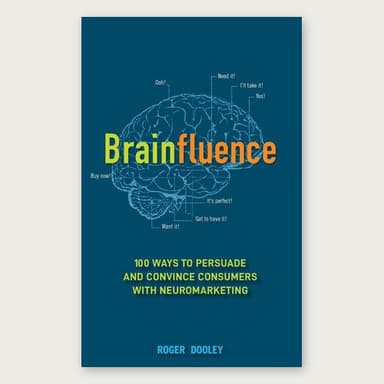
Start hereThe short version
- 1Dooley starts from the estimate that 95% of thought and decision-making is subconscious, so asking customers why they buy is close to useless. Chapter 1 sets that premise and calls it the book's most important takeaway.The claim
- 2The book is 100 short, independent chapters, each turning one study into one marketing tactic. Sections One to Five cover price and product, the senses, branding, print and pictures, from the pain of paying and decoy pricing to scent, fonts and baby faces.The format
- 3Sections Six to Fourteen apply the research to loyalty and trust, selling in person, fundraising, copywriting, consumer types, gender, shoppers, video and the web, ending with an afterword on where neuromarketing goes next.The applications
Brainfluence on four pages
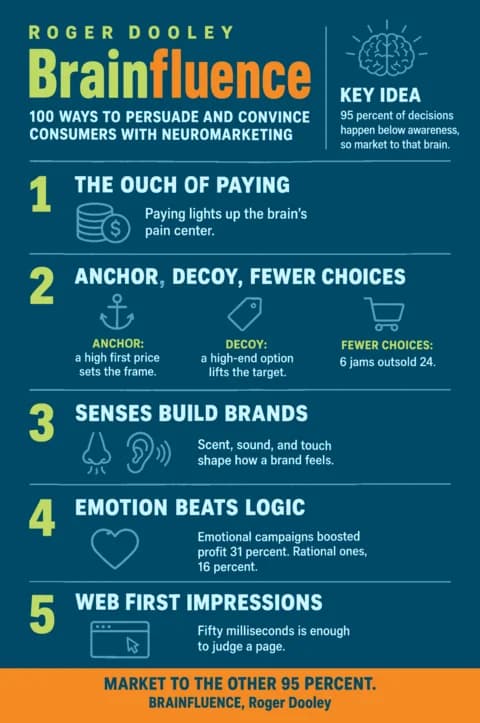
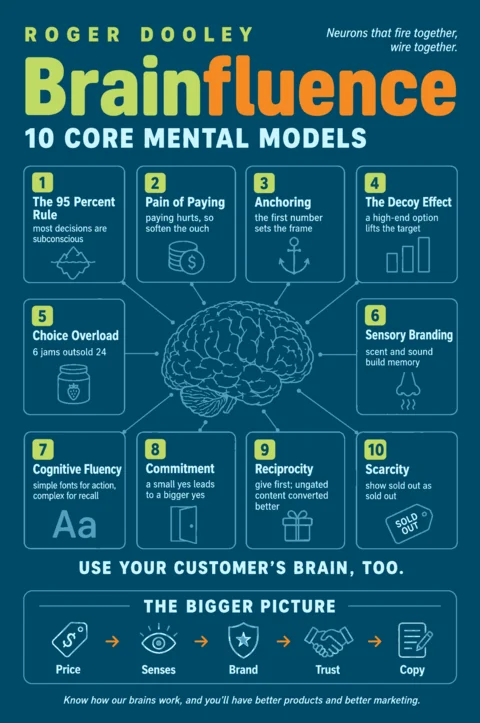
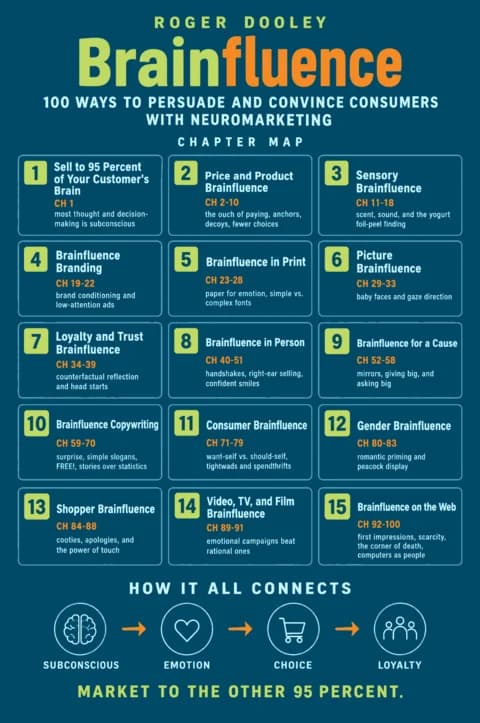
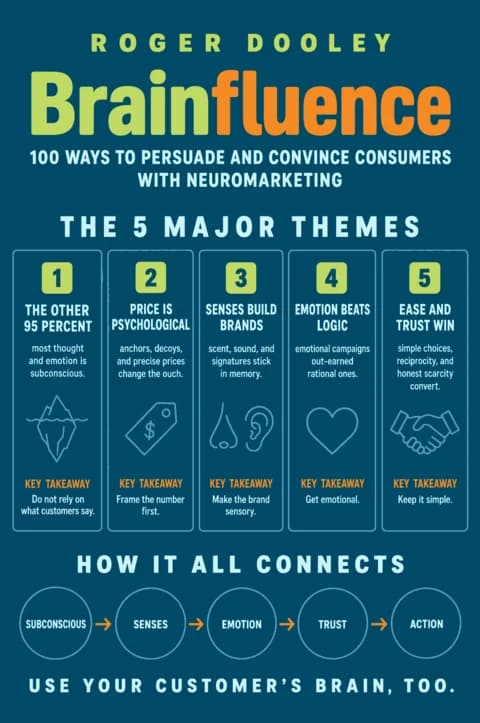
Four printable posters in the cover's colors: big ideas, mental models, a chapter map, and major themes.
Free. You'll also get each new summary by email.
The summaryPreface: Why Brainfluence?
Dooley opens with the marketer's challenge of getting better results with less money, and argues that the answer is understanding how customers' brains work. What has changed since the Mad Men era is modern neuroscience: fMRI scans show, for example, that the brain's response to a price that is too high looks very much like getting pinched, and EEG is bringing down the cost of measuring brain activity. He has written the Neuromarketing blog since 2005 and uses a broad definition of neuromarketing that includes behavioral research as well as brain scans. He rejects the charge that it is manipulative, arguing that used properly it produces better ads, better products and happier customers.
He also says what the book is not: a science primer or a single big idea. It is a compilation of 100 bite-sized ideas, each based on neuroscience or behavior research, each standing on its own and each usable by organizations of any size, nonprofits included.
"Neuromarketing is all about understanding how our brains work, regardless of the science used, and employing that understanding to improve both our marketing and our products."
Chapter 1Sell to 95 Percent of Your Customer's Brain
Dooley reports Harvard professor Gerald Zaltman's estimate that 95% of thought, emotion and learning occurs without conscious awareness; A.K. Pradeep puts it at 99.999%. One study found subjects solved a puzzle as much as 8 seconds before they were aware of it. Customers therefore cannot accurately explain their choices, and marketing built on their self-reports is doomed to failure. The takeaway, which he calls the most important in the book: stop selling to 5% of the customer's brain, appeal first to emotions and unconscious needs, and use facts only to help the logical brain justify the decision.
Chapter 1 · Sell to the other 95%
Section OnePrice and Product Brainfluence
A small pricing difference can make a big difference in profits, and the section collects what neuromarketing says about pricing and product lines.
Chapter 2The "Ouch!" of Paying
Carnegie Mellon and Stanford researchers found that buying can light up the brain's pain center, and that brain scans predicted purchases almost as well as stated intentions. George Loewenstein told Dooley the pain is relative to context. Bundles such as car luxury packages dull it, perceived fairness drives it (Richard Thaler found beachgoers would pay nearly twice as much for a beer from a resort hotel), and credit cards act as a painkiller. Takeaway: minimum pain, maximum sales.
Chapter 2 · The ouch of paying
Chapter 3Don't Sell Like a Sushi Chef
Per-piece pricing, like sushi or a taxi meter, causes the most pain because every bite carries a price. AOL got a flood of subscribers when it moved to monthly pricing, and Netflix and cruises win with flat prices; some buyers will even pay a premium to avoid the pain. Takeaway: avoid multiple pain points.
Chapter 4Picturing Money
Kathleen Vohs found that money cues make people more self-reliant and selfish: primed subjects took 70% longer to ask for help and spent half as much time helping someone else. That fits ads for self-interested products and undercuts gift or charity appeals, which is why the "A diamond is forever" campaign avoids money entirely. A Cornell study found diners spent significantly more when menu prices had no dollar signs. Takeaway: use money cues wisely.
Chapter 5Anchors Aweigh!
People judge fairness against stored anchor prices. Gas prices re-anchor constantly, while home buyers take about a year to adjust after moving. Dan Ariely showed even irrational anchors work: the last two digits of a Social Security number moved what subjects would pay for a cordless keyboard from $16.09 to $55.64. Apple launched the iPhone at $499 to $599, dropped it by $200, and later sold one million iPhone 3G phones in three days at $199. Infomercials set high anchors before revealing the offer. Takeaway: be careful where you drop your anchor.
Chapter 6Wine, Prices, and Expectations
Stanford and Caltech researchers found that the same wine produced more pleasure in the brain when subjects believed it cost $45 instead of $5. In another study, 85% of subjects reported pain relief from a placebo priced at $2.50 a dose versus 61% at $0.10. Takeaway: be careful with discounts, since price is part of the experience for premium brands.
Chapter 7Be Precise With Prices
Dooley priced catalog items just under round numbers and turns out to have been right for the wrong reason. Buyers shown a $5,000 starting price estimated a much lower wholesale value than those shown $4,988 or $5,012, because precise prices create a finer mental measuring stick. Houses listed at odd prices such as $494,500 sold closer to asking. Takeaway: use precise pricing and avoid round numbers.
Chapter 8Decoy Products and Pricing
Dooley grabbed a taller can of shaving gel at the same price as the regular cans, which served as accidental decoys. In Ariely's Economist test, adding a $125 print-only option nobody chose raised the share picking the $125 print-and-internet bundle from 32 to 84 and predicted revenue by 43%. Real estate agents show a weaker comparable house before the one they want to sell, and brain scans show an inferior option makes choosing easier. Takeaway: try a not-so-good decoy to push your top product.
Chapter 8 · The decoy nobody chose
Chapter 9How About a Compromise?
When Williams-Sonoma added a larger bread maker at a 50% premium over its $275 model, few sold, but sales of the cheaper one doubled. A Stanford camera study found the same compromise effect. Restaurants use expensive menu items and $100 wines the same way. Takeaway: add a high-end product.
- You're Already an Impact Business22 to 30
- You're Closer Than You Think14 to 21
- You Have the Foundation7 to 13
- The Starting Line0 to 6
 Printable PDF
"Dooley says customers can't tell you why they buy. Your own gut can't always tell you what's broken, either. Ten questions, a score on four parts of your business and the part to fix first. It's free with your email. Go find out."
 Deven Davis, devendavis.com
- Ten questions about where your business is right now
- A score out of 30
- A four-part breakdown: Impact Clarity, Traction Proof, Model Strength, Founder Credibility
- The part to fix first
- Your tier's next steps
- A printable PDF
Free with your email. Your score and a printable PDF open right on the page.
Chapter 10Cut Choices; Boost Sales
In a Columbia study, a display of 24 jams drew more shoppers (60% versus 40%) but only 3% bought, against 30% for 6 jams, so the small selection sold 10 times as much. Choosing tires the brain, as voters lower on long ballots show. Walmart and Procter & Gamble raised sales by cutting options. Takeaway: find your choice sweet spot and guide customers through it.
Chapter 10 · Cut choices, boost sales
"Relativity is the key element in decoy marketing."
Section TwoSensory Brainfluence
The senses connect directly to emotion and memory, and Dooley argues that marketing to all five can turn weak brands into powerhouses.
Chapter 11Use All the Senses
Martin Lindstrom argues that brands appealing to more senses succeed more, holding up Singapore Airlines, which uses one scent in attendants' perfume and hot towels. A brand should survive being smashed into fragments, recognizable even without its logo. Takeaway: appeal to all five senses, consistently.
Chapter 11 · All five senses
Chapter 12Does Your Marketing Smell?
Lindstrom estimates 75% of emotions are generated by smell. In one test, 84% of subjects rated identical Nike shoes better in a floral-scented room; in a casino, slot players gambled 45% more with a pleasant scent. Bad smells stick too: a third of U.S. McDonald's customers, and 42% in Britain, said the restaurants smelled of stale oil. Takeaway: own your smell, keep it consistent and never overdo it.
Chapter 13Learn From Coffee
Starbucks pulled breakfast sandwiches whose egg smell overpowered the coffee aroma. Nespresso found 60% of the espresso experience comes from the retail environment, so it opened boutiques and re-engineered its home machines to release more aroma. Takeaway: give your product a sensory tweak.
Chapter 14Sounds Like Changed Behavior
A U.K. wine shop sold more French wine on days it played French music and more German wine with German music. Classical music raised bank customers' sense that the bank was inspiring by 233%. Takeaway: find background music that fits the products you want to sell.
Chapter 15The Sound of Your Brand
United Airlines made Rhapsody in Blue its own across ads and airports, and Nextel's walkie-talkie chirp was instantly recognizable. Takeaway: find and keep your key audio branding elements, since repetition, more than the sound itself, builds recognition.
Chapter 16Exploit the Brut Effect
John Medina sprayed Brut cologne in one class before each lecture and again at the final exam; that class performed significantly better. Takeaway: use scent to be memorable, since a consistent scent can trigger recall even when unrelated to the subject.
Chapter 17Smelly but Memorable
Subjects remembered scented pencils, and the claims made about them, better than unscented ones, and an uncommon tea tree scent worked best. In a bar, pumping a drink's aroma near its ad nearly doubled purchases. Takeaway: unique scents boost memorability, and in the U.S. scents can be trademarked.
Chapter 18Learn From Yogurt
NeuroFocus found that the most engaging moment of eating yogurt is peeling off the foil lid, which it calls a neurological iconic signature, like Rice Krispies' snap, crackle, pop. Takeaway: important product characteristics may not be obvious.
"Smell may be the most potent and direct sensory path to the brain."
Section ThreeBrainfluence Branding
A German fMRI study found strong brands activate areas linked to reward and self-identification while weak ones activate memory and negative emotion. When Read Montague repeated the Pepsi Challenge in a scanner, blind tasters' brains favored Pepsi, but once they saw the labels nearly all preferred Coke.
Chapter 19Neurons That Fire Together . . .
Repeated associations rewire the brain: monkeys' brain maps merged for two fingers bound together, and tobacco warning labels came to trigger craving. Subjects conditioned to like a fictitious brand still preferred it after learning facts showing it was inferior. Takeaway: keep your brand associations consistent.
Chapter 20Who Needs Attention?
Robert Heath argued that ads work even without attention. Ipsos tests covering 97,000 subjects and 512 commercials found brand shifts of 7.3% among attentive viewers, 2.7% among low-attention viewers and 1.2% among those who could not recall the ad. Fast-forwarded ads still raised recall, and the mere exposure effect makes familiar symbols more liked. Takeaway: no attention does not mean no results, so keep your brand visible.
Chapter 20 · Ads work without attention
Chapter 21Passion for Hire
Kate Newlin argues passion brands need passionate employees. When Dooley hired IT staff, he asked about their home computer setups and hired those whose faces lit up. Takeaway: feel the passion, and look for it beyond the resume.
Chapter 22Create an Enemy
Henri Tajfel showed people form group loyalty over trivial distinctions, which underlies social identity theory. Apple's ads from 1984 to I'm a Mac compare people more than products, Etsy's founder sides with crafters against big business, and Seth Godin calls it tribe management. Subtle cues amplify belief: undecided voters asked to record their race rated a false claim about Obama 62% likely to be true, up from 25%. Takeaway: make your customers feel like members of a group.
"Neurons that fire together, wire together."
Section FourBrainfluence in Print
Print is under pressure from digital, but Dooley expects it to last and shows how it differs; some lessons, such as font effects, apply on screens too.
Chapter 23Use Paper for Emotion
A Millward Brown fMRI study found paper ads produced more emotional processing and engaged spatial memory. Dooley cautions that digital can target and use rich media. Takeaway: paper means emotion, so use tactile stock and emotional messages.
Chapter 24Vivid Print Images Change Memory
Subjects who saw a vivid ad for a nonexistent popcorn were as likely to report having tried it as those who actually ate samples. Takeaway: use vivid images in print.
Chapter 25Paper Outweighs Digital
People holding a heavy clipboard judged a job applicant as more serious. Takeaway: bulk up for impact with heavier stock and texture.
Chapter 26Use Simple Fonts
Hyunjin Song and Norbert Schwarz found that exercise instructions in a hard-to-read font were estimated to take 15.1 minutes against 8.2 minutes in Arial, and fewer people committed. A sushi recipe showed the same effect. Takeaway: simple fonts spur action.
Chapter 26 · Simple fonts spur action
Chapter 27When to Get Complicated
Menu items described in a harder font led readers to rate the chef's skill higher. Takeaway: use complex fonts and big words to signal effort and skill, with caution.
Chapter 28Memorable Complexity
A Princeton study found students retained material better in disfluent fonts than in Arial. Takeaway: boost recall of a tagline or phone number with a complex font, but not for long copy.
"Paper means emotion."
Section FivePicture Brainfluence
People readily read photos as reality, which makes pictures powerful companions to copy.
Chapter 29Just Add Babies!
A baby's face activates an emotion area of the brain within 150 milliseconds, while adult faces have little effect. Takeaway: baby pictures draw the eye.
Chapter 30Focus, Baby!
James Breeze's eye tracking showed that when a baby looks out at the viewer, readers stare at the face; when the baby looks toward the headline, the headline and copy get far more attention. Takeaway: use the gaze to direct attention.
Chapter 30 · Follow the baby's gaze
Chapter 31Pretty Woman
A South African bank mailed loan offers to 50,000 customers with rates from 3.25% to 11.75%. For male customers, a photo of a woman raised response as much as a 4.5% drop in the interest rate; women were mostly unaffected. Takeaway: test people photos.
Chapter 32Itsy, Bitsy, Teeny, Weeny . . .
Men who watched bikini videos accepted smaller, quicker payouts, such as $7 for waiting a month while controls held out for twice that. Loewenstein and Ariely found arousal shifts men toward short-term choices, and men rated women with dilated pupils as more attractive. Takeaway: sexy images affect male decisions, mainly at the point of sale, and can reduce brand recall.
The Founder Brain Kit
Chapter 33Photos Increase Empathy
Radiologists were more meticulous when a patient's photo was attached to the file. Takeaway: include a photo when empathy helps, as nonprofits do with named recipients.
"In advertising, we will look at what the person we see in an ad is looking at."
Section SixLoyalty and Trust Brainfluence
Dooley argues loyalty and trust apply to brands as much as to people, and that a loyal customer is cheaper to keep than a new one is to win.
Chapter 34Build Loyalty Like George Bailey
Hal Hershfield's team found that imagining the world without one's country, or without a company, raised patriotism and positive feelings toward the firm. FedEx's near-death, when Fred Smith reportedly won payroll at blackjack, is the kind of story to retell. Takeaway: use counterfactual scenarios, subtly, to boost loyalty.
Chapter 35Reward Loyalty
A Singapore study of credit cards found attractive rewards won a larger share of wallet, and even near-worthless points swayed choices. Takeaway: offer loyalty rewards for frequently bought products and let customers see their progress.
Chapter 36Loyalty, Rats, and Your Customers
Rats run faster near the food, and Columbia researchers found coffee buyers do too. A 12-space card with two stamps already filled drove faster purchases than an empty 10-space card. Takeaway: give a head start.
Chapter 36 · Give a head start
Chapter 37Time Builds Trust and Loyalty
Felons rated their trials fairer when their lawyers spent more time with them, venture capitalists trusted entrepreneurs who updated them, and injured patients rarely sued doctors who did not rush them. Takeaway: quality contact time counts.
Chapter 38Ten Words That Build Trust
Ending an auto service ad with "You can trust us to do the job for you" raised trust scores as much as 33%, including competency up 33% and quality up 30%. Takeaway: tell them to trust you.
Chapter 39Trust Your Customer
Paul Zak links trust to oxytocin and notes a con man won him over by trusting him first. Takeaway: show trust to get trust, with easy trials and light paperwork.
"If you want your customers to trust you, remind them that they can trust you."
Section SevenBrainfluence in Person
Face-to-face contact engages more senses than any rich media, and this section covers how to use it.
Chapter 40It Pays to Schmooze
In Al Roth's version of the ultimatum game, chatting first raised fair offers to 83% and cut failures to 5%. Takeaway: schmooze first, bargain later.
Chapter 41Shake Hands Like a Pro
Iowa job applicants with good handshakes were rated more employable. After a 15-minute massage, Zak's subjects returned two and a half times as much money to a stranger. Takeaway: touch is important, starting with a firm handshake.
Chapter 42Right Ear Selling
Italian researchers found nightclub patrons were more likely to give a cigarette when asked in the right ear. Takeaway: favor your prospect's right ear.
Chapter 43Smile!
Smiling faces flashed for 16 milliseconds led thirsty subjects to pour and drink more and to pay about twice as much. Takeaway: smiles, even smiling images, help sales.
Chapter 44Confidence Sells
Don Moore found advisers who expressed confidence sold more advice even after their accuracy was known. Jim Cramer is his example. Takeaway: demonstrate confidence built on real mastery.
Chapter 45Small Favors, Big Results
Only 17% of homeowners agreed to a large yard sign, but 76% agreed after first displaying a small window sign; a phone survey raised agreement to a home inspection from 22% to 56%. Takeaway: ask for a small favor first.
Chapter 45 · Small favors, big results
Chapter 46Hire Articulate Salespeople
A Wellesley study found advanced language skills improve the ability to predict what others think. Takeaway: hire articulate people.
Chapter 47You're the Best!
Hong Kong researchers found even insincere flattery leaves a lasting positive impression. Takeaway: use ethical flattery grounded in truth.
Chapter 48Coffee, Anyone?
John Bargh found people holding hot coffee rated others as warmer and became more generous themselves. Takeaway: serve hot beverages.
Chapter 49Candy Is Dandy
Subjects who ate one chocolate truffle valued luxury goods such as computers and cruises more, until they were sated. Takeaway: try the truffle strategy for indulgent products, but only one treat.
Chapter 50Selling Secrets of Magicians
Six lessons: people focus on only one thing, motion attracts attention, big motions beat little ones, the unexpected attracts us, mirror neurons engage us with familiar actions, and chatter distracts. Takeaway: learn from magicians.
Chapter 51Soften Up Your Prospects
Car buyers in soft chairs raised their second offers by nearly 40% more than those in hard chairs. Takeaway: soft seats, soft objects and warm drinks.
"Salespeople should be trained not just what to say but when to say it and when not to say anything at all."
Section EightBrainfluence for a Cause
These chapters target nonprofits, though businesses also need generosity and cooperation at times.
Chapter 52Mirror, Mirror on the Wall
Trick-or-treaters took extra candy 34% of the time, but only 9% with a mirror behind the bowl. Takeaway: let donors see themselves.
Chapter 53Get Closer to Heaven
Shoppers gave 16% of the time after riding an escalator up, 7% going down and 11% on level ground. Climbing steps made people help 68% longer, and aerial video made them 60% more cooperative. Takeaway: control altitude, change attitude.
Chapter 54Child Labor
In Edinburgh, 88% of lost wallets holding a baby photo came back, against 53% with a puppy, 48% with a family, 28% with an elderly couple and one in seven with no photo. Takeaway: use babies to boost altruism.
Chapter 54 · The baby in the wallet
Chapter 55Give Big, Get Bigger
Armin Falk's mailing of 10,000 requests found a small gift raised donations 17% and a larger gift of four postcards raised them 75%. Takeaway: gift your prospects and test gift size.
Chapter 56Make It Personal
Paul Slovic found two pictured children drew 15% less than one, and eight drew 50% less. ChildFund's sponsor-one-child model applies this. Takeaway: make it personal.
Chapter 57Lose the Briefcase!
Business images cut even splits in the ultimatum game from 91% to 33%, and a real briefcase cut them from 100% to 50%. Takeaway: avoid business and financial cues when asking for generosity.
Chapter 58Ask Big!
Girl Scout Markita Andrews set her sales record by first asking for a $30,000 donation, then for a box of cookies. Takeaway: start with a big number.
"Reciprocity is a potent force, and it makes sense to try varying gifts to accompany your appeal."
Section NineBrainfluence Copywriting
Words still pack a punch, and the research explains why some copy techniques outperform others.
Chapter 59Surprise the Brain
The brain predicts what comes next and reacts when the prediction fails. Takeaway: surprise the audience with an unexpected word in a familiar phrase.
Chapter 60Use a Simple Slogan
Subjects exposed to savings slogans planned to spend $184 against $94 for those shown the brand names alone. Takeaway: a value brand should use a simple savings slogan.
Chapter 61Write Like Shakespeare
Liverpool researchers found Shakespeare's functional shifts, such as turning a noun into a verb, spike brain activity. Takeaway: "misuse" a word.
Chapter 62A Muffin by Any Other Name . . .
The same dish rated healthier when called salad instead of pasta, and people ate more fruit chews than candy chews. Prunes became dried plums. Takeaway: rename your category, without misrepresenting it.
Chapter 63Why Percentages Don't Add Up
Jason Zweig reports 79% of psychiatrists would release a patient with a 20% risk of violence, but only 59% when told 20 out of 100. Takeaway: use real numbers for positive messages and percentages for negative ones.
Chapter 64Magic Word #1: FREE!
Ariely's subjects chose a 15-cent truffle over a 1-cent kiss, but when both prices fell by a cent, more than two-thirds took the free kiss. Amazon's French free-shipping offer, set at one franc, produced no sales jump until it became free. Takeaway: tap into the power of free, except when you want to filter out casual samplers.
Chapter 65Magic Word #2: NEW!
Novel choices activate the brain's reward center. Takeaway: make it new, while protecting long-term brand familiarity.
Chapter 66Adjectives That Work
Brian Wansink found descriptive menu labels raised sales by as much as 27%. Takeaway: season your copy with vivid adjectives, sparingly.
"Dooley's book is a toolbox for selling to the brain. Tools need a business to work on, right? The Shortlist gives you 12 paths to your first thousand a month, each with startup costs and time to first dollar, plus 15 AI prompts to write your first offer. Seven bucks. Pick a path this week."
Deven Davis, devendavis.com- 12 paths to your first $1K a month, each with startup costs, time to first dollar, difficulty and first steps
- The Skill Audit: what you already have that people will pay for
- 15 ready-to-use AI prompts by stage: Discovery, Launch, First Client, Scale
- The $1K Action Plan: your path, your first offer and a 48-hour deadline
Seven dollars, with the No-Brainer Guarantee: if it doesn't save you 10+ hours of research in the first week, full refund.
Chapter 67Your Brain on Stories
Readers' brains simulate story actions, and a listener's brain activity couples with the storyteller's. Takeaway: tell a vivid story, as the long-running ads They Laughed When I Sat Down at the Piano and the Wall Street Journal's two young men letter did.
Chapter 67 · Your brain on stories
Chapter 68Use Story Testimonials
One friend's anecdote outweighs a star rating, and stories beat statistics. Takeaway: go beyond short testimonials to named, detailed stories.
Chapter 69When Words Are Worth a Thousand Pictures
Google's all-text Parisian Love Super Bowl ad in 2010 ranked fourth for neuroengagement among the game's ads. Takeaway: text beats richer media when it tells a story.
Chapter 70The Million-Dollar Pickle
A speaker's story of a store mistreating him over a $1.50 jar of pickles is the only thing Dooley remembers from the talk. Takeaway: don't create negative stories; resolve problems fast.
"Individual examples lodge in our minds, but statistics and averages do not."
Section TenConsumer Brainfluence
A catch-all of techniques that apply across media.
Chapter 71Simple Marketing for Complex Products
University of Amsterdam research found complex decisions went better with less deliberation, and IKEA buyers who decided quickly were happiest. Takeaway: give buyers a simple reason to buy a complex product.
Chapter 72Sell to the Inner Infovore
Irving Biederman found the brain rewards new information. Takeaway: show them something new, as Absolut's bottle ads did.
Chapter 73Want Versus Should: Time Your Pitch
People choose want items for now and should items for later, renting documentaries first and returning them last. Takeaway: time your pitch to wants and shoulds.
Chapter 74Sell to Tightwads
A survey of more than 13,000 people found 24% tightwads, 60% unconflicted and 15% spendthrifts. Calling a fee a small $5 fee raised tightwad response 20%. Takeaway: minimize the pain for tightwads and everyone else.
Chapter 74 · Tightwads and spendthrifts
Chapter 75Sell to Spendthrifts
Almost half of spendthrifts bought a massage pitched as pleasure, against about 22% of tightwads. Takeaway: push the free-spending hot buttons: utility and pleasure, credit, instant gratification and options.
Chapter 76Take a Chance on a Contest
The brain responds to the size of a prize far more than its odds. Pepsi insured a $1 billion sweepstakes, and the finalist won a million. Takeaway: keep your eye on the prize and concentrate the budget on one big one.
Chapter 77Unconventional Personalization
Implicit egotism leads people to favor their own initials, and people named Louis are more common in St. Louis. Takeaway: try going beyond simple personalization.
Chapter 78Expect More, and Get It!
Expectations change the actual experience. When Microsoft disguised Vista as Mojave, 94% rated it higher, scoring it 8.5 against 4.4. Takeaway: set high but achievable expectations.
Chapter 79Surprise Your Customers!
Norbert Schwarz found people who found a dime reported higher life satisfaction. Zappos surprised customers with shipping upgrades. Takeaway: create positive feelings with a small surprise.
"If they believe a product is better, it will be better."
Section ElevenGender Brainfluence
Men and women use their brains differently, with implications for marketers.
Chapter 80Mating on the Mind
Geoffrey Miller found romantically primed men spent conspicuously from a budget of $5,000 and 60 hours, while primed women volunteered in public. Takeaway: use romantic priming if your product or service project is conspicuous.
Chapter 81Guys Like It Simple
Research on 9- to 15-year-olds found boys process language more through the senses and girls more abstractly; Dooley cautions that adult effects are speculative. J. Peterman's narrative catalog draws women by more than 2 to 1. Takeaway: use simple copy for guys.
Chapter 82Are Women Better at Sales?
Dooley weighs access and people skills, then suggests a peacock display: an attractive saleswoman may prime male buyers to show off by ordering. Takeaway: exploit the peacock effect with male buyers through low-key appeals to their authority.
Chapter 83Do Women Make Men Crazy?
Margo Wilson and Martin Daly found photos of attractive women made men discount the future more steeply. Takeaway: such photos shorten male time horizons, which hurts products like life insurance.
Chapter 83 · Shorter time horizons
"Wordy copy is rarely a good idea, but especially if you are aiming at a male audience, in which case, keep the prose simple."
Section TwelveShopper Brainfluence
Megastores put unrelated products side by side, and that has costs.
Chapter 84Cooties in Every Bag
Food touching a disgust product such as cat litter became less appealing, though not when an inch or more apart; rice cakes in clear packaging seemed fattier next to lard. Takeaway: watch your pairings and consider opaque packaging.
Chapter 84 · Cooties in every bag
Chapter 85Customer Replies Change Minds
A Harris survey found 18% of negative reviewers who got a reply became loyal, and nearly 70% reversed their review. Takeaway: engage problem customers quickly.
Chapter 86It's Wise to Apologize
After a rude 12-second phone call, only 14% of Ariely's subjects returned an overpayment, against 45% normally; an apology restored the rate. United Breaks Guitars drew more than 10 million views. Takeaway: don't be afraid to apologize.
Chapter 87The Power of Touch
Joann Peck and Suzanne Shu found touching an item raises perceived ownership and liking. Takeaway: let customers touch your product.
Chapter 88When Difficulty Sells
Cognitive dissonance makes hard-won purchases more prized, from Ferrari waiting lists to iPhone lines. Takeaway: easy isn't always best for sought-after products.
"Get your product into your customers' hands, and it's more likely they'll leave with it."
Section ThirteenVideo, TV, and Film Brainfluence
Three chapters on what moving pictures add and what they can undermine.
Chapter 89Don't Put the CEO on TV
Spencer Kelly found mismatched gestures trigger the same N400 brain response as a wrong word. Takeaway: physical actions outweigh words.
Chapter 90Get the Order Right!
Frank Luntz found focus groups who saw Ross Perot's speech before his biography and testimonials were far more negative. Takeaway: credibility before claims.
Chapter 91Emotion Beats Logic
In the IPA's databank of 1,400 campaigns, purely emotional campaigns raised profitability 31% against 16% for purely rational ones and 26% for mixed. Takeaway: get emotional, though lesser-known brands may need some facts.
Chapter 91 · Emotion beats logic
"Emotion-based ads may be more difficult to create, but the statistics say it's worth the effort."
Section FourteenBrainfluence on the Web
The final section applies the research to websites and online selling.
Chapter 92First Impressions Count, Really!
Carleton researchers found a 50-millisecond glimpse produced appeal ratings that held up with longer viewing, and confirmation bias makes them stick. Takeaway: test your site's first impression, including entry pages.
Chapter 93Make Your Website Golden
Sculptures in golden mean proportions, about 1.618, activated the insula. Takeaway: use the golden mean where appropriate.
Chapter 94Rich Media Boost Engagement
Image and video results made search pages more engaging. Takeaway: add and optimize other media.
Chapter 95Reward Versus Reciprocity
Italian researchers found twice as many visitors gave contact data when they saw the content first. Takeaway: test the reciprocity approach.
Chapter 96Exploit Scarcity on the Fly
Amazon's only-a-few-left notes, Expedia's last-seat warnings and Overstock's sellout flags create urgency. Takeaway: use scarcity and be specific.
Chapter 97Target Boomers With Simplicity
Adam Gazzaley found older brains are worse at suppressing distractions. Takeaway: keep it simple.
Chapter 98Use Your Customer's Imagination
Even without touch, 60 seconds of imagining ownership raised perceived ownership and willingness to pay; Tire Rack shows wheels on the buyer's own car. Takeaway: help customers imagine ownership.
Chapter 99Avoid the Corner of Death
Dan Hill calls the lower right corner, where most logos go, the corner of death. Takeaway: put your brand front and center, in the lower middle.
Chapter 99 · Avoid the corner of death
Chapter 100Computers as People
Clifford Nass found people treat computers as social partners: team framing, a Clippy that took the user's side, and specialization all raised ratings. Takeaway: it's not a computer; it's a person.
"Simplicity is an ongoing theme of mine."
AfterwordWhat's Next?
Dooley expects neuromarketing to add the missing science to marketing. It is no panacea, he writes, but it can catch problem products and weak ads before costly launches and give marketers who understand their customers objective support, while behavioral research informs decisions where brain studies are unaffordable.
Afterword · Before the costly launch
"Know how our brains work, and you'll have better products and better marketing."
Brainfluence on four pages
Four printable posters in the cover's colors: big ideas, mental models, a chapter map, and major themes.
Free. You'll also get each new summary by email.