BE 2.0 (Beyond Entrepreneurship 2.0) by Jim Collins and Bill Lazier: Summary and Notes
The full book, section by section.
Start hereThe short version
- 1Collins and Lazier's 1992 primer returns with nearly half its text new. Chapters 1 and 2 open with Collins's tribute to Lazier and the case for first who: the right people matter more than any business idea.The claim
- 2The original core runs through leadership style, the vision framework of core values, purpose and the BHAG, strategy, innovation and tactical excellence in Chapters 3, 4 and 7 to 9, each extended by Jim's View from 2020 essays.The framework
- 3Two new chapters tie it to Collins's later research. Chapter 5 shows that great companies earn a higher return on luck, and Chapter 6 maps 12 principles in four stages of discipline, from Level 5 leadership to preserving the core and stimulating progress.The research
BE 2.0 (Beyond Entrepreneurship 2.0) on four pages
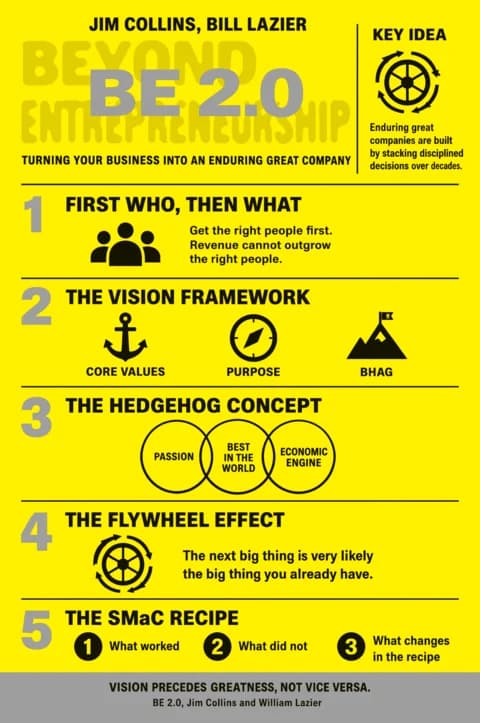
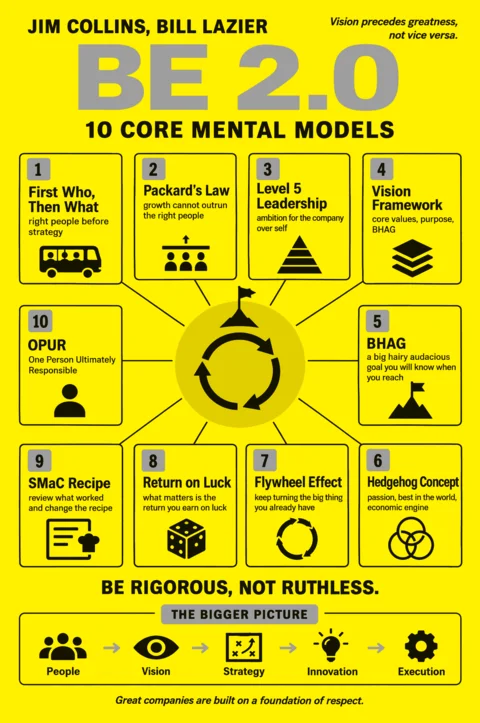
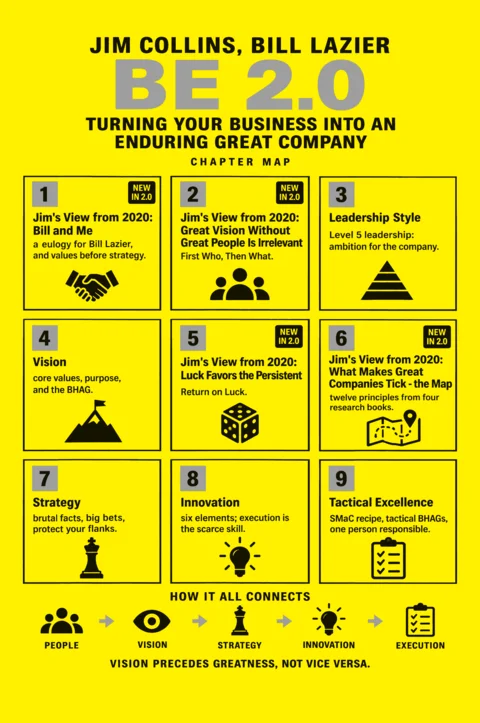
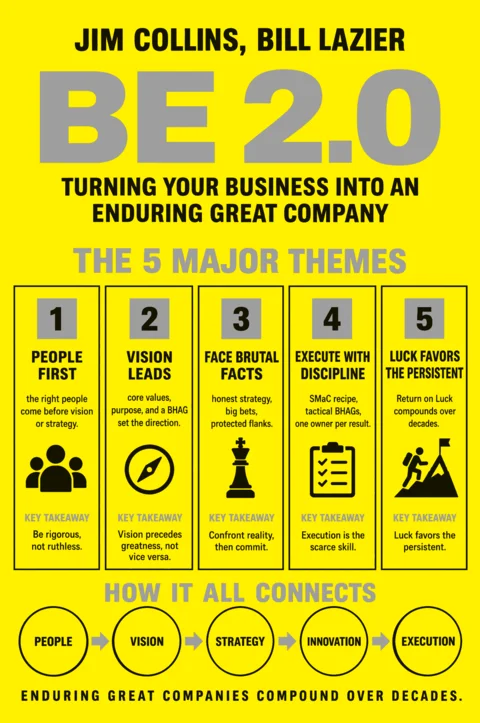
Four printable posters in the cover's colors: big ideas, mental models, a chapter map, and major themes.
Free. You'll also get each new summary by email.
The summaryIntroduction: What Is BE 2.0?
Jim Collins and Bill Lazier wrote the original Beyond Entrepreneurship in 1992 from the course they both taught at Stanford Graduate School of Business, as a roadmap for leaders of small to mid-sized enterprises who want to build enduring great companies. Collins recounts that Reed Hastings, co-founder of Netflix, said he had read it six times as a young entrepreneur and later advised aspiring CEOs to memorize its first 86 pages.
Collins gives three reasons for the re-release. He remains most passionate about entrepreneurs and leaders of small to mid-sized companies, and points out that every company he later studied for Built to Last, Good to Great and Great by Choice was once a small startup. He had substantial new material on people decisions, leadership, vision, strategy and luck. And he wanted to honor Lazier, the greatest mentor in his life, who died in 2004. Nearly half the text is new; the original chapters stay intact, and the new material appears as whole chapters and inserted essays headed "Jim's View from 2020." Four of the nine chapters (1, 2, 5 and 6) carry that header in their titles. In the audio edition Collins reads the new material and a second narrator reads the 1992 text.
"Through Beyond Entrepreneurship, Bill became a mentor to entrepreneurs whom he'd never meet, inspiring them to strive to build truly great companies that can long endure."
Chapter 1Jim's View from 2020: Bill and Me
Collins calls Lazier the closest thing to a father he ever had. His own father died when Collins was 23 and never taught him about core values or character. Shortly before his 25th birthday, a random course lottery at Stanford placed him in Lazier's first-ever class, a stroke of what he calls who luck. In 1988, when a star professor left unexpectedly, Lazier persuaded skeptical deans to let the 30-year-old Collins take over a section of the course, promising to coach him. Collins compares it to a minor league pitcher handed the ball at Yankee Stadium; he taught there for the next seven seasons.
The chapter is a set of life lessons from Lazier. Never stifle a generous impulse, Bill Hewlett's motto, which Lazier lived out, once shipping Collins and his wife Joanne crates of fine wine and claiming his cellar had an inventory problem. Know when to make the irreversible leap: Lazier resigned from his accounting firm just before being made partner so that comfort would not trap him, and Collins later left Stanford to become a self-employed professor, a move he and Joanne called their Thelma and Louise moment. Make the trust wager: Lazier chose to assume people are trustworthy until proven otherwise, reasoning that mistrust drives away the very best people, while separating a well-intentioned incompetent from someone who deliberately abuses trust. Build a meaningful life by building relationships, where each person feels they benefit more. Start with values, as Leon Bean did, whom Lazier loved to quote: "I'm already eating three meals a day, and I couldn't eat a fourth." Commitments are sacred; Collins drove through the aftermath of Hurricane Wilma in 2005 to deliver a keynote on time.
The last lesson is put the butter on your waffles. After quintuple bypass surgery, Lazier told Collins that heading into the operating room he knew he had already had a great life, so everything after was a bonus. He died on December 23, 2004, after waking from a nap, and more than a thousand people attended his memorial service at Stanford.
Chapter 1 · Lessons from a mentor
"If you define success by money, you always lose. Always."
Chapter 2Jim's View from 2020: Great Vision Without Great People Is Irrelevant
In October of 2007, Steve Jobs called Collins about creating Apple University. Asked what he had built on when he returned to a nearly dead Apple in 1997, Jobs answered with people: the passionate believers he found hidden in the woodwork. Collins says that if he could add one chapter to the original book, it would be this one, placed first, because first who is the principle above all others that leaders must not get wrong. Any specific business idea is likely to fail, and Ed Catmull built Pixar on betting on great people over great stories, which Collins credits with 14 number one movies in a row. In a world where uncertainty is chronic, the best hedge is the right partners on the other end of the rope.
The number one metric, Collins writes, is the percentage of key seats filled with the right people, and the target is 90%. A seat is key if its holder makes significant people decisions, if failure in it could expose the company to catastrophe, or if success in it has outsized impact. Among great leaders he finds about a 50-50 split between those who tilt toward developing a struggling person and those who tilt toward replacing them, and most executives admit they more often wait too long. He offers seven questions for the decision, including whether keeping the person is costing you other people, whether the issue is values, will or skills, whether the person points out the window or in the mirror, whether they see a job or a responsibility, and how you would feel if they quit. Once the decision is made: be rigorous, not ruthless.
Chapter 2 · 90% of the key seats
Collins argues that most great leaders grow into the role. Ann Baker inherited Telecare at 29 after her father's death and grew through version 2.0 and 3.0 of herself as the company expanded to 85 programs in eight states. Dwight Eisenhower was an undistinguished major in 1936 and Supreme Commander eight years later. Steve Jobs 1.0 should not be confused with Steve Jobs 2.0, and founders should reject the myth that they must be replaced by a real CEO. Katharine Graham, who risked the Washington Post on the Pentagon Papers, and Leon Gorman, who grew L.L. Bean more than 40 times in inflation-adjusted dollars, show that heirs can measure up.
- You're Already an Impact Business22 to 30
- You're Closer Than You Think14 to 21
- You Have the Foundation7 to 13
- The Starting Line0 to 6
 Printable PDF
"Collins builds great companies one disciplined decision at a time. Fair enough. But you can't decide well about a business you've never scored, right? Ten questions, a score out of 30, and your tier's next steps. It's free with your email. Go find out."
 Deven Davis, devendavis.com
- Ten questions about where your business is right now
- A score out of 30
- A four-part breakdown: Impact Clarity, Traction Proof, Model Strength, Founder Credibility
- The part to fix first
- Your tier's next steps
- A printable PDF
Free with your email. Your score and a printable PDF open right on the page.
The chapter ends with practices. Make the most of who luck: Collins recruited a top researcher, a restaurant server working 40 to 50 hours a week with straight A's, and got engaged to Joanne four days after their first date. Take care of your people and your unit, as Anne Mulcahy at Xerox and General Lloyd Austin III did. Embrace the Jorge Paulo dilemma: Jorge Paulo Lemann's partners built a machine of driven young leaders and then had to keep finding bigger things for them to do. Do not rely on financial incentives, which Collins found no systematic link to good-to-great transitions; the Cleveland Clinic, Navy SEALs and the military run on other motives, and Wells Fargo's sales incentives led to accounts opened without customers' authorization. Build a culture where people depend upon people, as William Manchester and Fred Smith learned in combat.
"Be rigorous, not ruthless."
Chapter 3Leadership Style
The original chapter opens with the M syndrome: a CEO with an IQ of over 150, a PhD and an MBA, 20 years of experience and a market growing at over 30% per year, whose oppressive style stalled his company at about $15 million in revenues and 75 employees. Because a leader's style is a multiplier, Collins and Lazier argue, style can kill a company. Effective styles vary widely, from Gandhi to Churchill, and leaders should never imitate another's. Leadership has two parts: a universal function, to catalyze a clear and shared vision and secure commitment to it, and a personal style. Across effective styles they find seven common elements.
Authenticity: live the values, as Sam Walton did by flying coach and driving an old pickup, and as Yvon Chouinard did by moving climbers from pitons to chocks. Decisiveness: analysis rarely settles a question, so combine it with intuition, accept that mistakes build strength, use participative decision-making on important calls, and encourage disagreement before deciding. Focus: no more than three priorities, and manage your time, since work is infinite. Personal touch: build relationships, write handwritten notes, stay accessible as Thomas Watson Jr. did with IBM's open door, and use symbolic details, such as Debbie Fields throwing out a tray of cookies a quarter of an inch too thin, while avoiding micromanagement. Hard, soft people skills: high standards combined with positive feedback, in the tradition of coaches John Wooden and Bill Walsh. Communication: repeat the vision constantly (Jim Burke spent 40 percent of his time on the Johnson & Johnson credo), use vivid analogies, and call a duck a duck. Ever forward: hard work without workaholism, constant self-improvement, energy, optimism and tenacity.
Chapter 3 · Seven elements of style
Five 2020 essays sit inside the chapter. Just What Exactly Is "Leadership"? draws on Collins's two years in the leadership chair at West Point. There is no such thing as a leadership personality; the soft-spoken Wendy Kopp built Teach for America without formal power. True leadership exists only when people follow who are free not to, and Collins defines it as "the art of getting people to want to do what must be done." What Cause Do You Serve? introduces Level 5 leadership, a blend of personal humility and indomitable will in service of a cause, illustrated by George Marshall stepping aside so Eisenhower could command D-Day. Good Decisions, Right Timeline argues for debate before decisions and unity after them; Kennedy's questions-to-statements ratio was highest on the first day of the Cuban Missile Crisis, while the FAA's Ben Sliney had minutes on September 11, 2001, and ordered 4,556 flights to land. The key question is how much time you have before your risks change. Don't Confuse Empowerment with Detachment holds that leaders such as George Rathman at Amgen stay hands-on with strategic imperatives while getting out of their people's way.
"Leadership is the art of getting people to want to do what must be done."
Chapter 4Vision
The authors argue that the founders of great companies, from IBM and Merck to Hewlett-Packard and McKinsey, instilled a vision while their companies were still small. A company can make money without a vision, but vision is essential to greatness, and even a company that wants to stay small needs one; they tell of a ten-person company whose owner cut a promising product after realizing growth was contrary to what she wanted. Vision brings four benefits: a basis for extraordinary effort, a context for decisions, cohesion and community, and independence from a few key individuals. They cite a survey in which almost 70% of generals who commanded in Vietnam were uncertain of United States objectives, as an example of tactics without a clear aim.
The vision framework, developed with Jerry Porras, has three parts. Core values and beliefs are authentic to the leaders and are not set from above; L.L. Bean's founder refunded a shirt bought 32 years earlier. Profit is a necessity and not the ultimate goal. Purpose is the fundamental reason for existing, like a guiding star that is pursued and never reached, and should guide a company for at least 100 years; the five whys turn "we make outdoor clothing" into Patagonia's aim to be a role model and tool for social change. Mission is a clear, compelling goal with a finish line and a time frame, risky enough to sit in a zone of discomfort, like Kennedy's moon goal of 1961. The authors reject bland mission statements and describe four types: targeting, common enemy, role model and internal transformation, with a horizon of roughly 10 to 25 years. When a mission is reached, a new one is needed, or the company falls into the we've arrived syndrome, which they illustrate with Strategic Software's decline after moving into lavish offices.
Three 2020 essays extend the chapter. Purpose Beyond Profits argues that young people's demand for purpose confuses what is rare with what is new. BHAGs, BHAGs Everywhere explains how mission became the big, hairy, audacious goal, and restates the framework as core values (never change), purpose (about once a century) and a BHAG (every 10 to 25 years). Putting It All Together follows DPR Construction, whose founders held a constitutional convention at a winery, settled on the purpose "We exist to build great things," and set a goal to become a truly great construction company by the year 2000. Collins reports DPR reached $1 billion in revenues in 1998 and later set a new BHAG for 2030.
Chapter 4 · Values, purpose and BHAG
"Vision precedes greatness, not vice versa."
The Profit + Purpose Playbook
Chapter 5Jim's View from 2020: Luck Favors the Persistent
On May 15, 2007, the climber Tommy Caldwell asked Collins whether a BHAG has to be achievable while they looked at the Dawn Wall of El Capitan. Collins answered that if you know for certain you will achieve it, it is not a BHAG. Caldwell spent seven years on the climb, taking falls of up to 50 feet, losing an index finger earlier in a table saw accident and suffering a rib injury in 2013. He told West Point cadets that he was growing, not failing. With Kevin Jorgeson he finished on January 14, 2015, after 19 days on the wall, 2,801 days after that first conversation. Collins notes the good luck of dry weather and press coverage, and that Caldwell received it only because he stayed in the game.
Chapter 5 · 2,801 days on the Dawn Wall
Collins sets Caldwell beside Steve Jobs, who came to his Stanford class during his wilderness years after being pushed out of Apple, and beside Churchill, who persisted through his own wilderness years and won the Nobel Prize in literature. In Great by Choice, Collins and Morten Hansen defined a luck event by three tests: you did not cause it, it has significant consequences, and it involves surprise. They found that the great companies did not get more luck than their comparisons; they got a higher return on luck. Collins estimates that about 50% of great leadership is what you do with the unexpected, and reports that visionary companies were more likely to overcome early setbacks than to start with a big hit. The chapter closes with Built to Last's advice to persist with the company and never with a single idea.
"Luck favors the persistent."
Chapter 6Jim's View from 2020: What Makes Great Companies Tick: The Map
Collins condenses research drawing on more than 6,000 years of combined corporate history, done by matched pairs of great and comparison companies, into one map of 12 principles. Inputs run through four stages of discipline. Disciplined people: Level 5 leadership, and first who, then what, including Packard's Law, that no company can consistently grow revenues faster than its ability to get enough of the right people. Disciplined thought: the genius of the and over the tyranny of the or; the Stockdale Paradox of unwavering faith combined with confronting brutal facts; and the Hedgehog Concept, the intersection of passion, what you can be best in the world at, and what drives your economic engine. Disciplined action: turning the flywheel, the 20-mile march (some companies hit theirs for more than 40 consecutive years), and fire bullets, then cannonballs. Building to last: productive paranoia and avoiding the five stages of decline, clock building over time telling, and preserving the core while stimulating progress. Return on luck multiplies all of them.
Chapter 6 · The flywheel
The outputs that define a great company are superior results, distinctive impact and lasting endurance. Collins cites data he assembled for a 2008 Fortune essay: of the 500 companies on the first list in 1955, less than 15% still held a place in 2008. Greatness, he concludes, is a dynamic process with no end point.
"Greatness is an inherently dynamic process. It is not an endpoint."
Chapter 7Strategy
The original chapter sets out to demystify strategy, defined as the methodology for achieving the current mission. Four principles apply: strategy descends from vision, leverages strengths, is realistic, and is set with the people who will carry it out. The process runs through an internal assessment (strengths and weaknesses, resources, innovations) and an external one (industry trends, technology, competitors, regulation, demographics, international threats and opportunities). The authors stress confronting reality, citing Chamberlain's refusal to see the facts before World War II. The written strategy should fit on three pages, and companies should hold an annual off-site and set no more than five strategic priorities, each with one responsible person.
"Collins asks for core values, purpose and a big goal on paper. Here's the one page underneath all of it: purpose, opportunity, leverage, model. The same four questions Ivystone uses on deals, as a worksheet that takes 47 minutes on average. A dollar. Go do it."
Deven Davis, devendavis.com- The P-O-L-M framework (Purpose, Opportunity, Leverage, Model) used by institutional investors to evaluate early-stage deals
- A fill-in-the-blank worksheet that produces a one-page business gameplan in one sitting
- Bonus: The 48-Hour Quick Start, the exact first 3 steps to take today
One dollar, backed by the Dollar-Back Promise, and done in 47 minutes on average.
Two 2020 essays sharpen it. The Essence of Strategy reduces strategy to three questions: where to place big bets, how to protect your flanks, and how to extend your victories. Big bets should be empirically validated, as Intel's founders did by firing three bullets on memory chip designs before betting on the 1103. Protecting flanks means keeping reserves, as Churchill held back 25 squadrons of fighters during the fall of France. Extending victories means turning the flywheel, unlike the Union army letting Lee escape after Gettysburg. If You Cannot Control Prices, You Must Control Costs cites Warren Buffett's test of a great business and the low-cost strategies of Southwest Airlines and Nucor.
Chapter 7 · The essence of strategy
The original text then takes up four issues for growing companies. How fast to grow should be an explicit choice tied to vision, since growth eats cash; the authors write that roughly half of all bankruptcies occur after a year of record sales, and Lightcraft lost its edge after new owners pushed for 50% growth. Focus versus diversification favors focus and phased diversification over GFP's slide into unrelated businesses. Whether to go public weighs capital against cost, scrutiny and short-term pressure. Whether to lead or follow cites Robinson and Fornell's study of 1,853 businesses in which pioneers averaged a 29% market share, while warning that being first protects no one who fails to execute.
"Never forget, the next big thing is very likely the big thing you already have."
Chapter 8Innovation
The authors argue there is no shortage of good ideas, only a shortage of receptivity, and that the challenge is to become an innovative company rather than one dependent on an innovative founder. They list six elements. Receptivity to ideas from everywhere, inside and outside, supported by a list of wet blankets who dismissed the telephone, Federal Express and Apple. Being the customer: many breakthroughs came from inventors solving their own problems, which produces the woodwork factor, where customers no market research found come out of the woodwork, as with the Band-Aid and Tagamet. Experimentation and mistakes, from Edison's 9,000 attempts at the light bulb to PowerBar's kitchen trials, with small projects that are easy to end. People being creative, which means hiring unusual people, designers and some wild ducks, and training creativity. Autonomy and decentralization, slicing up the diamond into small units. Rewards, including recognition and paths that let creative contributors advance without becoming managers.
Chapter 8 · The woodwork factor
The chapter also weighs idea push against market pull, concluding that companies need both, and ends with techniques for managers: encourage rather than nitpick, avoid harsh judgment, draw out shy people, stimulate curiosity, use constraints, allow time away from the fray, and require fun. The 2020 essay Creativity Is the Easy Part argues that creativity is natural and abundant while discipline is rare, and that the real strength lies in scaling innovation.
"In the long run, best beats first."
Chapter 9Tactical Excellence
The final original chapter compares tactics to the individual moves on a climb up El Capitan: vision and strategy matter only if the details are executed. Compaq won by executing the IBM-compatible strategy better than IBM. The authors' central tenet, borrowed in spirit from W. Edwards Deming, is that poor execution is the leader's fault. People execute well when they are clear on what to do, have the tools, are appreciated and see why their work matters, as in Drucker's account of aircraft parts workers whose morale recovered once they met the crews who flew their bombers. They describe a six-part process for consistent tactical excellence: hiring for values, enculturating, training, goal setting, measuring, and appreciating. L.L. Bean, which they report measured 99.89% flawless shipments in 1987, illustrates several, including the employees who resoled a customer's 30-year-old boots. Values standards are absolute; performance standards are high.
Chapter 9 · A six-part, never-ending process
The 2020 essays add tools. Deadlines: Freedom in a Framework describes a contractor who set his own March 31 deadline and hit it with 15 minutes to spare. SMaC Mindset defines a recipe that is specific, methodical and consistent, improved through a three-question after-action review, and recounts a rappel Collins nearly took off the end of his rope. Expectations contrasts two planes in a storm delay to show how honest expectations shape satisfaction. Tactical BHAGs describes Collins's team pursuing 100 consecutive on-time event briefings, reached on March 22, 2018. Make People OPURs asks for One Person Ultimately Responsible for every critical task. The book closes on respect: great companies respect their customers, their relationships and above all their people, which is why they expect high performance.
"Great companies are built on a foundation of respect."
Back matterNote on the Original Preface to Beyond Entrepreneurship
Collins moves the 1992 preface to the end because the new structure differs from the original. It opens with Jim Gentes of Giro Sport Design sleeping with his inventory in a one-bedroom apartment in San Jose, then looking out the window and saying he wanted Giro to be a great company, which the authors credit as the spark for the book. The preface states that the book is about turning an existing enterprise into an enduring great company, since the foundation of greatness is laid while a company is small, and it defines a great company by performance, impact, reputation and longevity. In the acknowledgments, Collins thanks Joanne for pushing him to revise and rewrite.
"This book is about how to turn an existing enterprise into an enduring great company."
BE 2.0 (Beyond Entrepreneurship 2.0) on four pages
Four printable posters in the cover's colors: big ideas, mental models, a chapter map, and major themes.
Free. You'll also get each new summary by email.