Awaken the Giant Within by Tony Robbins: Summary and Notes
The full book, section by section.
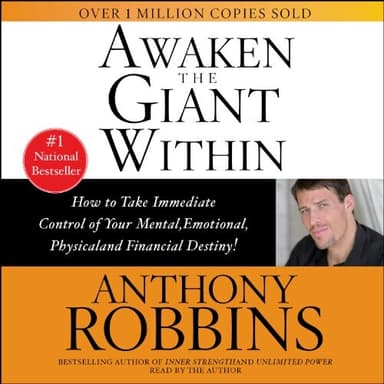
Start hereThe short version
- 1Robbins argues that decisions, and the three made constantly about focus, meaning and action, shape destiny more than conditions do. The program opens with his janitor-to-helicopter story, then the section on decisions lays out the ultimate success formula through the Soichiro Honda story.The claim
- 2Underneath every decision is what the nervous system links to pain and pleasure. The pain-pleasure principle and beliefs sections explain how those links, and the beliefs built on them, form and how to change them.The mechanism
- 3Neuro-associative conditioning turns this into six master steps for lasting change, and the magnificent obsession exercise sets four one-year goals rehearsed twice a day. These notes follow the 1 h 31 m abridged audio program, which covers part of the print book.The method
Awaken the Giant Within on four pages
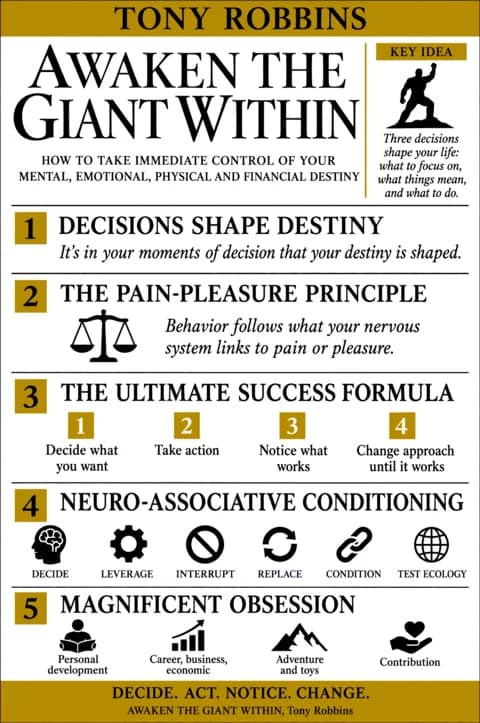
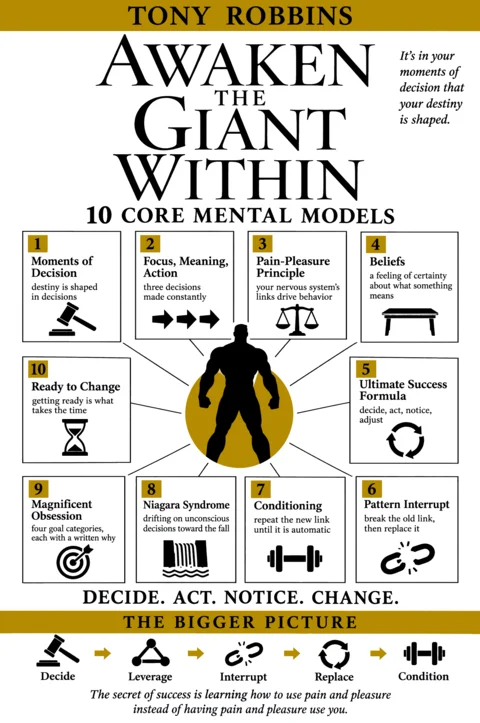
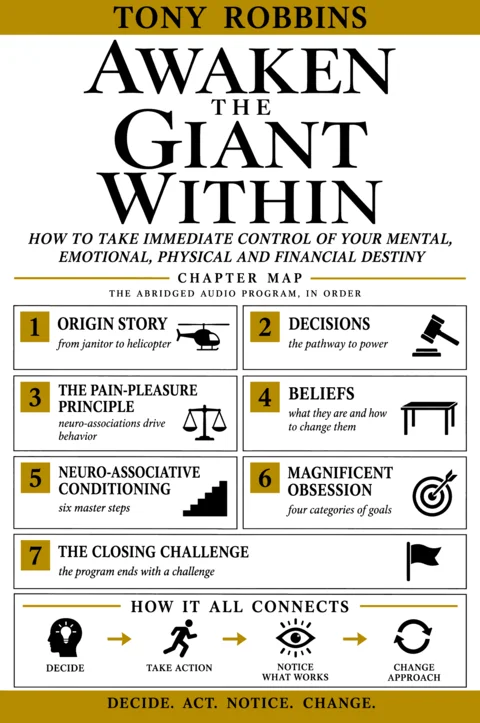
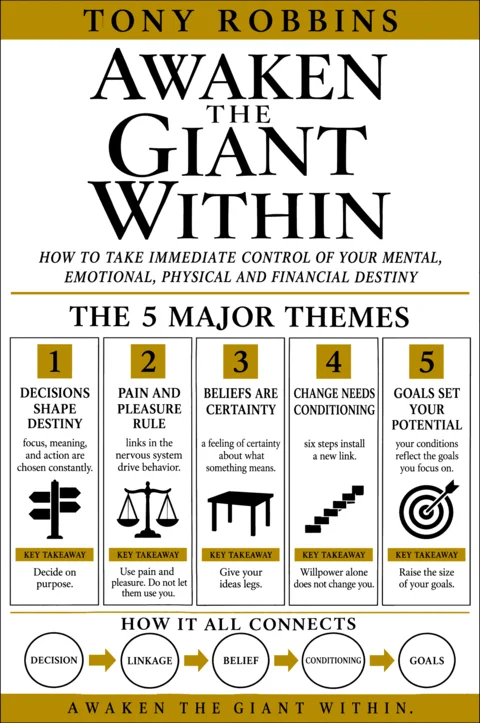
Four printable posters in the cover's colors: big ideas, mental models, a chapter map, and major themes.
Free. You'll also get each new summary by email.
The summaryAwaken the Giant: The Abridged Program
These notes follow the abridged audio edition of Awaken the Giant Within, a program of about an hour and a half read by Robbins (credited as Anthony Robbins) that runs as one continuous chapter. The print book is far longer and covers ground this recording leaves out, so the sections below track the audio program in the order Robbins presents it: his own story, the power of decisions, the pain-pleasure principle, beliefs, his method for change, a goal-setting exercise and a closing challenge.
The program opens with quotations from Helen Keller ("Life is either a daring adventure or nothing"), Thomas Edison and Orison Swett Marden, then Robbins thanks the listener and states his premise: everyone has dreams, most people have let them fade into the frustrations and routines of daily life, and his life's quest has been to restore that dream. He promises simple, specific strategies for addressing the cause of any challenge, and lists the forces the program will teach: decisions, belief systems and associations.
The program opensOrigin Story: From Janitor to Helicopter
Robbins recalls the day it hit him that he was living his dream. Flying his jet helicopter from a business meeting in Los Angeles to one of his seminars in Orange County, he recognized a building in Glendale and hovered above it: it was the building where he had worked as a janitor a mere 12 years earlier, worried whether his 1960 Volkswagen would last the 30-minute trip to work. Further south he saw dolphins playing with the surfers, a sight he and his wife Becky treasure. Over Irvine the off-ramp to his seminar was jammed for more than a mile, and as he descended he saw that the traffic was people coming to his event. The organizers had expected only 2,000 people; over 7,000 came to an auditorium that held 5,000. He was so moved he could not speak at first.
Section 1 · Over 7,000 came
A memory followed. Only a few years before, he had sat alone and crying in a 400-square-foot bachelor apartment in Venice, California, listening to a Neil Diamond song, feeling his life did not matter. The change came in one moment, when he said he had had it and knew he was more than his life was showing. He decided to change virtually every aspect of his life and never again to settle for less than he could be. Robbins credits a principle he calls concentration of power: focusing all of one's resources on mastering a single area, which he compares to a laser beam.
He then makes two assertions: the listener wants more, whatever their current situation, and a listener who accepts the challenge and uses the techniques will achieve their dreams. He says his own magnificent obsession began with simple questions about how to take immediate control of his life, and reports that he has personally worked with over a quarter of a million people in the last few years, from members of Congress and CEOs to athletes, phobics and the clinically depressed. His conclusion from all of it: people have the power to change virtually anything in their lives in an instant.
"I made a decision in that moment which was to alter my life forever."
Section twoDecisions: The Pathway to Power
Robbins builds the argument in a chain. Different actions produce different results, and what shapes a life is what people do consistently. What precedes every action is a decision, so decisions are the father of all action. He grants that some people are born with genetic, environmental or family advantages, then points to people who exploded beyond their conditions by making new decisions. Not deciding is itself a decision, he says, to be directed by the environment instead of shaping your own destiny.
His own life changed the day he decided what he was committed to having and being, which he separates from stating a preference. A committed decision includes standards for acceptable behavior, held even when the stock market crashes or a lover leaves. Most people make excuses instead: a dysfunctional family, a lack of opportunities or education, being too young or too old. Robbins calls these conditions and insists that decisions determine destiny. His example is Rosa Parks, who in 1955 refused to give up her bus seat in Montgomery, Alabama, a committed decision that became a symbol for generations.
The word decision, he explains, comes from a Latin root meaning to cut off: a true decision cuts off every other possibility. Most people have flabby decision-making muscles, and the way to strengthen them is to make more decisions and learn from each one. He names three decisions that control destiny: what to focus on, what things mean, and what to do. Anyone enjoying greater success in an area, he says, is making these three decisions differently. People who leave them to chance live by what he calls the Niagara syndrome: they jump into the river of life without choosing a destination, drift with the current, and wake up five feet from the falls in a boat with no oars. Better decisions upstream could have prevented the fall.
Section 2 · The Niagara syndrome
From his first book, Unlimited Power, he restates a four-step process he calls the ultimate success formula: decide what you want, take massive action, notice what is working and what is not, and change your approach until it works. His case study is Soichiro Honda. In 1938, still in school, Honda put everything he owned into a workshop to develop a piston ring for Toyota, even pawning his wife's jewelry, and was told the rings did not meet Toyota's standards. After two more years Toyota gave him the contract. The government refused him concrete for a factory, so his team invented a way to make their own. The factory was bombed twice, and Honda had his teams collect the gasoline cans that U.S. fighters had discarded, calling them gifts from President Truman. An earthquake then leveled the factory, and he sold his piston operation to Toyota.
- You're Already an Impact Business22 to 30
- You're Closer Than You Think14 to 21
- You Have the Foundation7 to 13
- The Starting Line0 to 6
 Printable PDF
"Robbins says every result comes back to three decisions: what you focus on, what it means, what you do. Let's start with the first one. Ten questions, a score on four parts of your business and the part to fix first. It's free with your email."
 Deven Davis, devendavis.com
- Ten questions about where your business is right now
- A score out of 30
- A four-part breakdown: Impact Clarity, Traction Proof, Model Strength, Founder Credibility
- The part to fix first
- Your tier's next steps
- A printable PDF
Free with your email. Your score and a printable PDF open right on the page.
After the war, a gasoline shortage left him unable to drive for food, so he attached a small motor to his bicycle. Neighbors wanted one too. Short of capital for a motor plant, he wrote a personal letter to each of the 18,000 bicycle shop owners in Japan and convinced 5,000 of them to advance the money. When the first motorbike proved too big and bulky, he made a lighter version, the Super Cub, which earned him the Emperor's Award. Robbins reports that Honda Corporation now employs more than 100,000 people in the United States and Japan.
He closes the section with six keys: remember that a decision is a tool you can use in any moment, and that a real decision is measured by new action; make decisions intelligently but quickly, and never leave the scene of a decision without taking a specific action toward it; make decisions often; learn from your decisions by asking what is good about a setback; stay committed to your decisions but flexible in your approach; and enjoy making decisions, since the next person, phone call or book could open the floodgates.
"It is in your moments of decision that your destiny is shaped."
Section threeThe Pain-Pleasure Principle
After quotations from Jeremy Bentham on the two sovereign masters, pain and pleasure, Robbins states the driving force behind all human behavior: everything we do, we do out of the need to avoid pain or the desire to gain pleasure. He calls it the triple P, the pain-pleasure principle, and says it governs choices from what to wear to whom to marry. Procrastination is his first example. People put off an action because they link more pain to doing it than to delaying it, until the balance flips, as it does for taxes around April 14th. People leave a destructive relationship when they link pain to its past, present and future at once.
Section 3 · Pain and pleasure
Two complications follow. Most people decide based on short-term pain and pleasure, while most things worth having require breaking through short-term pain for long-term pleasure. And people are driven by their perceptions: the fear that something will lead to pain and the belief that something will lead to pleasure. That is why willpower alone fails. Someone who links pain to eating the foods that support them will diet, push and discipline themselves, and stay overweight. Robbins calls these linkages neuro-associations and says people can condition themselves to link pain or pleasure to whatever they choose.
His own example: growing up, his family sometimes could not afford the foods everyone wanted, so as an adult with a substantial income he overate, gaining and then losing 38 pounds. He realized he linked pain to leaving food on his plate. He cranked up his favorite music, worked himself into a peak state and pushed the plate away again and again until it felt great to leave food on it.
The brain forms these links automatically, searching for a cause whenever it feels significant pain or pleasure, and it can link the wrong cause. A baby who falls off the edge of a couch may decide that couches cause pain. An artist Robbins knew had avoided relationships for 12 years because her brain linked a painful breakup to her own passion, when the real cause was that she and her partner had different values and rules. A first failed speech can create a lifelong link between public speaking and pain. Robbins rejects the idea that people are purely conditioned, but argues that conditioning takes over by default unless people override it. He says his own decision to link incredible pleasure to learning shaped his destiny.
His advice: become aware of when neuro-associations form, and watch your focus in those moments. Someone who comes home angry and keeps looking at a spouse's face while still steamed creates a false link between that face and anger. Question false associations, and change what you link pain and pleasure to by focusing on the price of inaction and the pleasure of acting now.
"The secret of success is learning how to use pain and pleasure instead of having pain and pleasure use you."
Section fourBeliefs: The Power to Create and to Destroy
Beliefs, Robbins says, separate a Mother Teresa from a Charles Manson and can change the body in moments. He reports an interview with Dr. Bernie Siegel, the Yale professor, who shared research on people with multiple personality disorders whose eye color changed from brown to blue as their personalities changed, whose physical markings disappeared and reappeared, and whose diabetes or high blood pressure came and went with the personality. Robbins presents this as Siegel's research and gives no further source.
He defines a belief as a feeling of certainty about what something means, supported by references, the life experiences that hold it up. His image is a tabletop: an idea is a tabletop with no legs, and it becomes a belief once references give it legs. Someone who believes they are sexy has legs such as a mate's compliments and a body kept in shape. A person who sees themselves as a failure will mold the life they predict; a person who believes in their capacity to learn, change and adapt has unlimited possibilities.
Section 4 · Legs under the tabletop
To change a belief, Robbins returns to the pain-pleasure principle: link massive pain to the old belief, in the past, present and future, and tremendous pleasure to a new one. Create doubt, the way people once came to doubt beliefs they now find embarrassing, such as meeting Russians and finding them people just like themselves. A belief reinforced by stronger references becomes a conviction. His example is a decision to stop eating meat, strengthened by talking to vegetarians and studying the effect of animal protein, and turned into a conviction by a visit to a slaughterhouse. He suggests visiting a shelter to build a conviction against drugs, or an intensive care wing to quit smoking, and then taking action, since each action raises emotional intensity.
The Right to Be Rich
The section ends with an exercise. Take five minutes to list every empowering belief, then an equal amount of time for every disempowering one. Circle the three most empowering and ask how each strengthens your life. Circle the two most limiting and knock their legs out with questions: how is this belief ridiculous or absurd, was the person I learned it from worth modeling, and what keeping it will cost emotionally, physically, financially and in relationships. Then write replacements. When results fall short, ask what you would have to believe to succeed, and when you feel bad, ask what you would have to believe to feel this way.
"Beliefs have the awesome potential to create or to destroy."
Section fiveNeuro-Associative Conditioning: The Six Master Steps
Robbins opens with a joke: how many psychiatrists does it take to change a light bulb? One, but it is very expensive, it takes a long time, and the light bulb has to want to change. He uses it to attack the cultural myth that change must be slow and costly, and argues that every change happens in a moment; what takes time is getting ready. His method is neuro-associative conditioning, or NAC, a step-by-step process for linking massive pleasure to what you want and pain to what you need to avoid, so the nervous system runs on automatic pilot without constant willpower. He calls it a syntax, an order and sequence for using any technique for change, and illustrates syntax with the difference between "the dog bit Johnny" and "Johnny bit the dog."
Two beliefs come first: that you can change right now, and that you are responsible for your own change. Then the six steps.
Step one: decide what you really want and what is preventing you from having it now. In private counseling, Robbins says, many people spend 15 minutes describing what they do not want. You get what you focus on, so specify what you want, and find the disempowering beliefs in the way.
Step two: get leverage. Change is a question of motivation, and he notes that anyone with a gun to their head could find a way to change their state. Ask pain-inducing questions about what not changing will cost mentally, emotionally, physically, financially and spiritually, then pleasure-associating questions about how changing would feel and what momentum it could create.
Step three: interrupt the limiting pattern. When clients began crying in his office, he would stand up and shout "Excuse me" and add that they had not started yet, and they would regain control at once. He suggests yelling "Hallelujah, my feet don't stink today" when depressed. For a memory of a boss yelling, run it as a movie, turn it into a cartoon, play it backward fast, add rainbow colors, Mickey Mouse ears, a Pinocchio nose and goofy music, and repeat at least a dozen times, like scratching a needle across a record.
Step four: create a new empowering alternative. Robbins calls the lack of a replacement probably the major reason changes stay temporary. Someone who quits smoking needs new ways to relax; worry can be replaced with massive action and a plan. Model people who have made lasting changes.
Step five: condition the new pattern until it is consistent. Rehearse the new behavior with emotional intensity until the brain carves a pathway. He says he read that Larry Bird, filming a soft drink commercial in which he had to miss a jump shot, made nine baskets in a row before he could miss. Reward small milestones immediately: a day without smoking, a plate pushed away.
"Robbins says change the linkage and the behavior changes for good. Look, that takes daily reps, right? The Identity Shift is 30 days of them: a prompt, a reflection, an intention. Seven bucks, and the first shift shows up in Week 1."
Deven Davis, devendavis.com- 30 days of guided identity reprogramming, rooted in Wattles' Impression of Increase principle
- Each day has a prompt, a reflection and an intention
- Bonus: The Quick Win Guide, your first identity shift result in under 1 hour
- Bonus: a 5-minute video from Deven on why identity precedes strategy
Seven dollars, with the No-Brainer Guarantee: if it doesn't change how you think about yourself and money within the first week, full refund.
Step six: test the new pattern for ecology and effectiveness. The new behavior must keep the benefits the old one provided and fit your values. Robbins gives a five-point check: pain is linked to the old pattern, pleasure to the new one, the new pattern aligns with your values, beliefs and rules, the original benefits are maintained, and when you imagine the old trigger you feel certain you will use the new pattern.
Section 5 · The six master steps
"Every change you've ever made in your life actually happened in a moment, didn't it?"
Section sixYour Magnificent Obsession
The final exercise, introduced with quotations from Carl Sandburg, Donald Curtis and Victor Hugo, is designed to build a compelling future. Robbins argues that everyone already has goals, since the mind always pursues something, but most people's goals are to pay the bills, get by or make it through the day: caught in the trap of "making a living rather than designing a life." Current conditions, he says, reflect the size and quality of the goals people focus on, and every goal must be followed by a plan and massive, consistent action. Many people stop setting goals to avoid the pain of disappointment; champions keep their vision and change their approach as often as necessary.
The exercise covers four areas: personal development goals; career, business and economic goals; adventure or toy goals; and contribution goals. For each, brainstorm for at least five minutes without stopping, asking what you would want if you could not fail and skipping detail ("Dream House Big Garden SF" will do). Then give every goal a timeline of one, three, five, ten or 20 years, since goals are dreams with a deadline. Finally pick the single most important one-year goal in the category and spend two minutes writing a paragraph about why you are absolutely committed to it. His toy examples include a castle, a helicopter, racing camels between the pyramids and beating Michael Jordan one-on-one; his contribution examples include building a homeless shelter and helping clean up the oceans.
Section 6 · Four areas, one deadline each
The result is four master one-year goals. The assignment is to rehearse and emotionally enjoy achieving each of them at least twice a day. Robbins says he did this himself: while living in the 400-square-foot apartment he pictured, in detail, a home he now owns, the Del Mar Castle, built in 1925, 10,000 square feet overlooking the ocean, down to a circular office he had never seen.
"Having a powerful and irresistible why will provide you with the necessary how."
Robbins adds that absolute confidence in these goals attracts the coaches and role models who can save years of trial and error, and tells the listener to start the process that day.
The program closesThe Closing Challenge
Robbins ends by repeating the challenge he issued at the start: take the skills from the program and use them. Ideas, techniques and skills are only as effective as the listener makes them, and he says there are no limits to how effective that can be. He asks the listener to claim this moment to make their own dreams real, says he hopes to meet them one day and hear their story, and signs off with "Till then, remember to live with passion."
Section 7 · Awaken the giant
"I challenge you to awaken that giant within you and discover how rich, how truly precious and passionate and fulfilling life can be."
Awaken the Giant Within on four pages
Four printable posters in the cover's colors: big ideas, mental models, a chapter map, and major themes.
Free. You'll also get each new summary by email.