A Changed Mind by David Bayer: Summary and Notes
The full book, section by section.
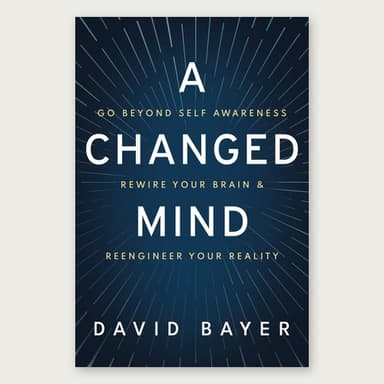
Start hereThe short version
- 1Limiting beliefs are programs installed in childhood, and they run a loop: beliefs drive thoughts, thoughts drive feelings, feelings drive actions, and results reinforce the belief. Part I, Becoming Aware, tells Bayer's story from a second-grade school project through addiction, recovery and years in self-help, in Chapters 1 to 6.The problem
- 2Beliefs are decisions, so you can make a new one: the Decision Matrix notices a bad-feeling thought, decides its opposite and gathers evidence that the new decision is true. Part II, Rewiring the Brain, adds the Mind Hack Method, the two states of being and the four stages of consciousness, in Chapters 7 to 13.The method
- 3Thoughts emit a vibration that a loving, law-based field answers, so the moment you meet an experience you dislike is the moment to change the belief behind it. Part III, Reengineering Your Reality, covers the law of attraction, the higher power system and a 20 to 30 minute morning ritual, in Chapters 14 to 18.The system
A Changed Mind on four pages
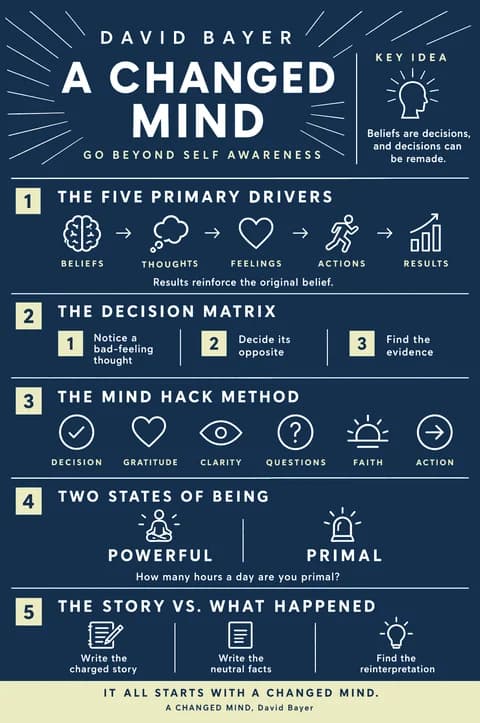
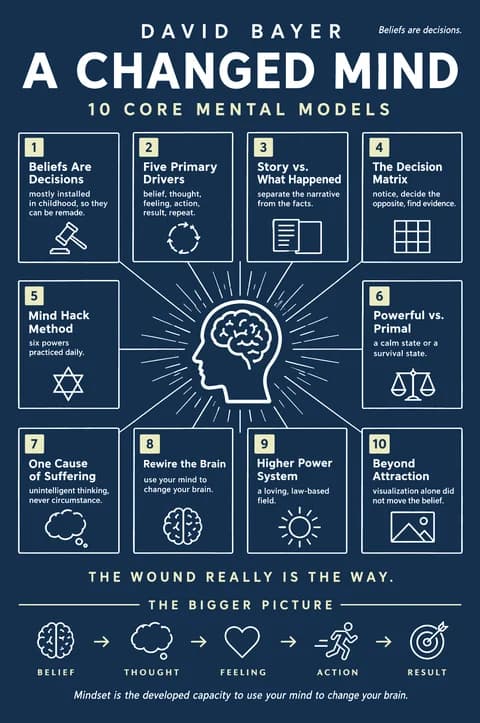
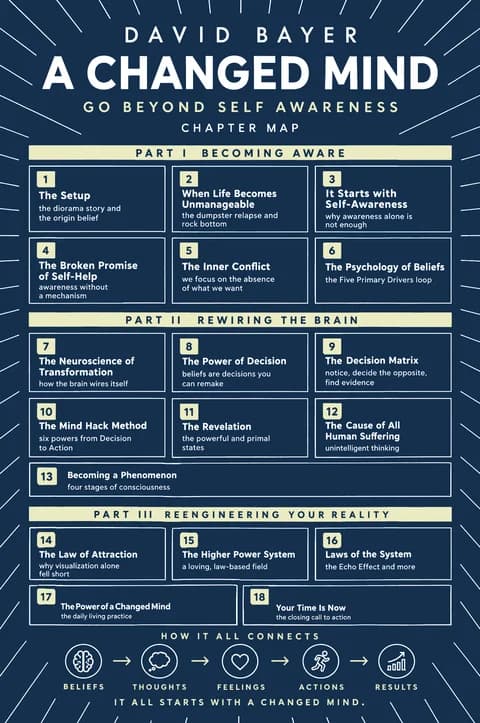
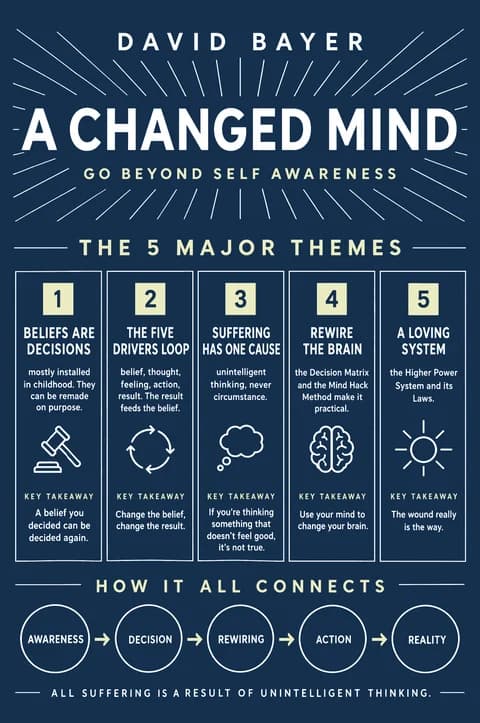
Four printable posters in the cover's colors: big ideas, mental models, a chapter map, and major themes.
Free. You'll also get each new summary by email.
The summaryForeword and Introduction
The foreword is written by a friend of Bayer's, an entrepreneur, comedian and bestselling author who heard him speak in Colorado Springs, invited him to his home in Tuscany and later became best man at his wedding. He calls the condition the book addresses the consumer condition, a disease of the mind in which people take more than they give and believe they must work hard and sacrifice before they can be happy. He says Bayer earns trust by describing his own porn, drug and alcohol addiction before giving a clear process.
In the introduction, Bayer says the principles have changed the lives of tens of thousands of people and that he was the first of his own case studies. At 33 he was addicted to drugs, alcohol and porn, running a failed business and single for more than a decade. He describes clients who applied the method: Jennifer, whose $10 million a year manufacturing company had lost money for three years, sold it for over $20 million within a few months; Allison moved from a decade of depression to clarity on her purpose; Nathan, a 42-year-old stockbroker, rebuilt his family life and started a coaching company. His promise is an operating manual for the mind.
"Not a plan to create what you want, but a plan to change your mind."
Part IBecoming Aware
Part I is mostly Bayer's own story, from the childhood belief that shaped him through addiction, recovery and years of personal development, and it ends by laying out the mechanism by which beliefs produce results.
Chapter 1The Setup
After graduating from Columbia University with a degree in comparative literature, Bayer pitched the owner of a Soho poster store on selling online and built a business with over 300 student reps on college campuses. At 25 he ran web strategy for an Italian motorcycle brand that he says generated over 70 million in sales in two years, and by 30 he had raised over 4 million for a lead generation company. Inside, he felt like a failure, driven by an inner critic he quieted with drugs, alcohol and pornography.
He traces the critic to age seven. Building a model of Mission San Juan Capistrano for school, he moved the monks' quarters near the garden, and his father, a 6'7 lawyer who believed there was a right way to do things, moved them back to match the picture. In that moment Bayer thought, "I don't know how to do it right." His mother, raised by a mother who made her feel never good enough, communicated love through worry. These experiences, he argues, become programs: performance became the measure of his lovability, and the world felt unsafe. The programs are the same across people, which is good news, because a way to transform the program for one person works for everyone. He tells of a woman in her 60s who had done decades of personal growth, from est to Tony Robbins, and was still not happy until his talk gave her what she called the missing piece.
Chapter 1 · How a program gets installed
"Your mind is a system very much like software that operates based on the programs that are written or installed on it."
Chapter 2When Life Becomes Unmanageable
At 33, alone on a Sunday overlooking a golf course in Florida, Bayer broke weeks of abstinence with $100 of marijuana and two hours of internet porn. Ashamed, he soaked the bag in water and threw it into a grocery store dumpster, then, as the self-criticism returned, drove back, climbed into the dumpster, retrieved it and dried it in the microwave. That night he asked the question that started the book's journey: is this it? His therapist, Dan, an addiction specialist, told him he was an addict who had used pornography since 13 to cope, and laid out the plan: no porn, cigarettes, alcohol, marijuana or masturbation for 90 days, three 12-step meetings a week, a sponsor, weekly therapy and a men's group, and at least 18 months to rewire his brain.
Chapter 2 · The plan to rewire
"Is this it? Is this all there is?"
Chapter 3It Starts with Self-Awareness
Bayer spent three years in Sex Addicts Anonymous, picking up a white chip for a broken bottom line nearly every week for his first 18 months. He writes that 40 million Americans regularly visit porn sites. What struck him in the rooms was people's ability to observe their thoughts without acting on them, and by working the steps with his sponsor he learned to see his own thoughts earlier and earlier. Around 18 months in, synchronicities began to appear.
Three books arrived in quick succession. In an airport he picked up Awakening the Buddha Within by Lama Surya Das, whose back cover listed the four noble truths; the core idea, that suffering comes from the meaning we give experience, was groundbreaking for him. The next day an employee, Brian Mickley, left Myles Munroe's Kingdom Principles on his desk, and he read it until three in the morning. Then, on the floor of a bookstore's self-help aisle, he found Think and Grow Rich. He concluded that the 12 steps, the Buddha and the teachings of Christ pointed to one truth, and he notes that personal development grew into a $40 billion industry by the early 2000s.
Chapter 3 · Three paths, one truth
"Every aspect of your outer experience is a manifestation or projection of your inner world."
Chapter 4The Broken Promise of "Self-Help"
Bayer read the foundational self-help books, attended Landmark and a Tony Robbins event with 10,000 attendees, and each time slipped back within weeks to the same emotional patterns, because he came home with the same brain. With his girlfriend Carol, now his wife, he built a home meditation room, spent three weeks in an Indian ashram and 10 days in Tibet, and then three weeks in Sedona, where he spent a weekend in a high school gym hearing Amazonian tribal leaders. He estimates he spent over a hundred thousand dollars and thousands of hours.
He calls the result self-help purgatory: acutely aware of his limiting beliefs and still without a tool to change them. Personal Development 1.0, in his framing, builds the understanding and the desire; Personal Development 2.0 provides practical tools to use the mind to rewire the brain. He ends the chapter with the claim that creating what you want comes from identifying and removing resistance rather than figuring out how.
Chapter 4 · Self-help purgatory
"I was noticing that my suffering was increasing in tandem with my awareness."
Chapter 5The Inner Conflict
Asked what they want, most people list what they do not want or the reasons they cannot have it. Bayer explains this as the nervous system's bias toward danger. He asks readers to name their one thing, the desire whose absence causes the most suffering, and then to listen to the inner dialogue that explains why it has not happened. That explanation reveals the unconscious belief: you lack money because you believe money is hard to make. An inner conflict is wanting something while believing it is not possible, and stress, anxiety and overwhelm are its symptoms.
Chapter 5 · The inner conflict
"The problem is not the problem. The problem is what you think about the problem."
- You're Already an Impact Business22 to 30
- You're Closer Than You Think14 to 21
- You Have the Foundation7 to 13
- The Starting Line0 to 6
 Printable PDF
"Here's the thing about a belief you've never looked at. It runs the business too. Ten questions, a score on four parts of yours and the part to fix first, so you can see where you actually stand. It's free with your email. Go find out."
 Deven Davis, devendavis.com
- Ten questions about where your business is right now
- A score out of 30
- A four-part breakdown: Impact Clarity, Traction Proof, Model Strength, Founder Credibility
- The part to fix first
- Your tier's next steps
- A printable PDF
Free with your email. Your score and a printable PDF open right on the page.
Chapter 6The Psychology of Beliefs
The chapter introduces the five primary drivers: beliefs dictate thoughts, thoughts create feelings, feelings drive actions, actions produce results, and results reinforce the original belief. Bayer suggests completing the sentence "when I was growing up, money was" and says about 90% of people relive their parents' experience while about 10% rebel. His own example is avoiding sales calls with trips to Starbucks while hearing that he did not know how to do it right, then concluding six months later that he was not cut out for sales. Clients Jennifer, Nina and Alex, a former Olympic gold medalist, each changed results after changing a belief. He calls for radical responsibility, accepting that every experience results from what you believe, and says he has catalogued over 1,000 limiting beliefs, fewer than a hundred of them common.
Chapter 6 · The five primary drivers
"Change your beliefs and you change the results."
Part IIRewiring the Brain
Part II gives the mechanism and the tools: how beliefs are stored, why beliefs are decisions, the Decision Matrix, the Mind Hack Method, the two states of being, and the four stages of consciousness.
Chapter 7The Neuroscience of Transformation
Bayer writes that we are born with about 100 billion neurons and 25 billion synaptic connections, and by age seven have over a quadrillion connections, each memory stored with the meaning we gave it. A friend bitten by a dog at three still panics at a five-pound chihuahua. The brain matches each new moment to an old one and runs the old story, which sounds like your own voice. Bayer saw this when a truck cut him off on the highway and he realized the angry narrative was untrue. He cites William James in 1890 on the brain's capacity to change, and defines mindset as the capacity to use the mind to change the brain. At his first workshop, at Rollins College with 23 people, he had attendees separate the story from what happened; a teenager, Madison, realized she had nearly broken up with her boyfriend CJ because he declined the ALS ice bucket challenge.
Chapter 7 · Wired by age seven
"Mindset is the developed capacity to use your mind to change your brain and it is the single most important skill you must learn if you want to achieve your full potential and live an extraordinary life."
Chapter 8The Power of Decision
On Christmas Day 2012, single for almost a decade, Bayer made a digital vision board and decided he would meet a beautiful Colombian woman and marry her. Days later, at a Sarasota restaurant with his doctor, Zane, he introduced himself to three women at the bar; Carol answered that she was from Colombia, and seven years later she was his wife. On a walk on Siesta Key Beach he arrived at the book's central distinction: beliefs are decisions, usually unconscious ones made in childhood, so they can be remade. A new decision should be the opposite of the limiting belief, and you do not need to know the how first. He cites a 2009 Harvard Medical School study of pianists as showing the brain does not distinguish imagined from real practice. A new decision brings new thoughts, a changed perception through the reticular activating system, which he says filters out about 90% of experience, and new synchronicities, which he explains through a vibrational view of reality.
Chapter 8 · What a decision lets you see
"Beliefs are actually decisions."
Chapter 9The Decision Matrix
The Decision Matrix has three steps. First, notice a feeling that does not feel good and identify the limiting belief behind it. Second, make a new decision, some form of the opposite: there is plenty of time to get it all done. Third, ask repeatedly what evidence you have that the new decision is true, and let memories surface until the old belief is seen as untrue. Bayer argues this works where affirmations fail because it removes the old belief rather than planting a new one in a bed of weeds.
Chapter 9 · The Decision Matrix
His example is a domain business partner who accused him of falsifying revenue and threatened to sue. Bayer traced a lifetime pattern of bullies, from two teenagers who threatened him at five to classmates who stabbed his shins with pens at 15. Working the matrix, he decided he could not be bullied and saw that it takes two to bully. He stopped answering the partner's emails and calls, the harassment stopped within two weeks, and within 90 days he sold the license to a former employee, adding half a million dollars. Analyzing that experience produced the system in the next chapter.
"Once you're able to see that your limiting belief is untrue, there's no going back."
The Right to Be Rich
Chapter 10The Mind Hack Method
The ordinary model of thinking runs from limiting beliefs to problems, confusion, disempowering questions, fear and reactions, and it drains energy. The Mind Hack Method runs through six powers that build it. Decision unlocks the energy trapped in limiting beliefs. Gratitude assigns empowering meaning, as a great shooter treats every miss as one shot closer to a make. Clarity, available only from a high-energy state, is a form of imagination. Questions work like a search engine; a CEO client replaced "what if this is the wrong move" with a question about the three to five metrics to watch. Faith comes from seeing that failure does not exist, only four blessings: learning, redirection, reflection and the setup. Action, taken from that state, completes the method.
Chapter 10 · The Mind Hack Method
"It is the fear of failure that causes most people to fail, not the size, scope, or complexity of the dream itself."
Chapter 11The Revelation
Working with thousands of clients, Bayer's team noticed that after a completed Decision Matrix, every client said the limiting belief had never been true. That led to the two states of being: powerful states, which feel good and run on the parasympathetic nervous system, and primal states, which feel bad and run on the sympathetic system. All change comes from a powerful state. He asks audiences how many hours a day they spend in a primal state; he reports the average answer from tens of thousands of people is six, which he calculates as 2,190 hours a year and $109,500 of lost income at $50 an hour. He argues suffering is separate from experience, that nature shows little emotional suffering, and that two people losing their jobs can be in opposite states because of the meaning each gives it.
Chapter 11 · The cost of a primal state
"You don't have to actually do anything to be in a powerful state because you naturally operate from it when you're not in a primal state."
Chapter 12The Cause of All Human Suffering
Bayer describes a single field that traditions name differently, from the Hindu akasha to the force in Star Wars, and calls it intelligence: law-based, loving and always working for your growth. Your emotions are a guidance system. Thoughts aligned with that intelligence feel good; limiting beliefs are dissonant and feel bad. Autumn, 15 years into a marriage she said was to the wrong man, saw that thought put her in a primal state, decided she had married the perfect man, and broke down when she found the evidence. Brian, a 29-year-old Arab Muslim entrepreneur, felt he did not belong at a private Miami gathering of top figures until Bayer asked how an all-knowing God could have put him somewhere he did not belong; he saw that he belonged everywhere he was. The single moment of transformation, Bayer concludes, is seeing your unintelligent thinking as unintelligent.
Chapter 12 · Emotions as a guidance system
"All suffering is caused by one thing and one thing only, unintelligent thinking."
Chapter 13Becoming a Phenomenon
Bayer lays out four stages of consciousness measured by hours a day in a primal state. Asleep is six or more hours. Aware is one to six hours, where the tools are in use and relationships and health begin to improve. Awake is less than one hour, where life's difficulties are seen as part of a loving design and miracles occur. Phenomenon is the stage where energy no longer spent on fight-or-flight shows up as intuition, health, creativity and luck that look supernatural to others. A powerful living experience has two steps: transform your limiting beliefs, then understand the principles that govern creation, which is the subject of Part III.
Chapter 13 · Four stages of consciousness
"Feelings of loneliness and self-pity slip away as dramatic change begins to unfold simply by shaving a few hours of suffering off of each day."
Part IIIReengineering Your Reality
Part III turns from the mind to reality itself: why the law of attraction disappointed so many people, the higher power system that Bayer says governs how thoughts become things, and the daily practice that applies it.
Chapter 14The Law of Attraction
Broke in his late 20s, Bayer walked under South Beach penthouses asking what was wrong with him. Two years later, after vision boards featuring a $1.65 million Lamborghini and an $8.5 million penthouse and daily recorded incantations, he walked the same route and felt exactly the same. He explains why The Secret, which he says sold over 35 million copies, failed most people: they were unaware of the beliefs beneath their wishes, and impatience sent them back to old beliefs before change arrived.
"The book says the moment you see a belief as untrue, you can replace it. Great. Now you need a new one that sticks. The Identity Shift gives you 30 days of prompts, reflections and intentions built on Wattles. Seven bucks, and the Quick Win Guide gets you a first result in under an hour."
Deven Davis, devendavis.com- 30 days of guided identity reprogramming, rooted in Wattles' Impression of Increase principle
- Each day has a prompt, a reflection and an intention
- Bonus: The Quick Win Guide, your first identity shift result in under 1 hour
- Bonus: a 5-minute video from Deven on why identity precedes strategy
Seven dollars, with the No-Brainer Guarantee: if it doesn't change how you think about yourself and money within the first week, full refund.
He then builds a picture of reality as energy: the atom as mostly space, the senses as interpreters of vibration, and the observer effect, which he illustrates with Thomas Young's double-slit experiment, dating it to 1802. He describes a mystical experience in 2013, an eight-hour lucid dream of the universe beginning as a light that expanded from love and curiosity, and pairs it with Yuval Noah Harari's account in Sapiens of physics, chemistry and biology emerging. His conclusion is that each person is an individual expression of the same creative intelligence, as Moses learned at the burning bush.
Chapter 14 · Wishing over unchanged beliefs
"What you make matter in your life becomes matter."
Chapter 15The Higher Power System
On April 1, 2014, with about $20,000 in the bank and upside down on his home and two rentals, Bayer decided he would earn an additional $60,000 by year's end from outside his business. Two weeks later a friend introduced him to Roland, a Tampa entrepreneur, who later stopped drinking after hearing Bayer's recovery story and invited him to lunch. Roland offered him half of a $40,000 stake in an online marketing business for $20,000, everything Bayer had. The partners were difficult, and in late October they offered to buy him out. On December 27 he received his $20,000 back plus $60,000.
The higher power system is his diagram of how this works. Thoughts emit vibrations into a collective field; aligned thoughts feel good and materialize as preferred experiences, while dissonant thoughts feel bad and materialize as contrast. The moment you meet an experience you dislike is the one moment of transformation. The steps: notice the primal state, identify the thinking, acknowledge that if it does not feel good it is not true, work the Decision Matrix, and find the evidence. A medical bill, children who will not get ready and chronic pain are his worked examples.
Chapter 15 · The $60,000 decision
"You don't become an abundant, calm, peaceful person by trying to control the uncontrollable experiences around you."
Chapter 16Laws of the System
Bayer describes the present as the manifestation of a memory, and gratitude as the way to strengthen empowering beliefs: want a life you love, love the life you have. The system is a spiritual practice and is agnostic, giving you what you think and feel rather than what you wish for, which he reads into Matthew 13:12. The Echo Effect explains why old experiences keep arriving after a new decision; long-held beliefs take longer to rewire, and the key is to hold the decision. A story of Susan and Stephen, whose beliefs about unfairness and short-lived good fortune meet in a car accident that costs Stephen his job, illustrates co-creation. He reads even tragedy, including the 2016 Pulse nightclub shooting in Orlando, as a loving system awakening consciousness. The chapter ends with the death of his chihuahua Dexter after 14 years: working the matrix on "I'm never going to see Dexter again" led him to near-death accounts and a belief that loss expands love.
Chapter 16 · The Echo Effect
"The wound really is the way."
Chapter 17The Power of a Changed Mind
You do not need a perfect mindset, Bayer writes; small shifts are enough, as with faith the size of a mustard seed. The method is meant to be practiced in real time. After months of fighting with Carol over shoes kicked off in the entryway, he worked a matrix on the belief that she should not be angry with him, decided she should be, and came home to put his shoes on the rack and apologize. The Mind Hack Method living practice has four steps: notice the primal state, identify the thinking and acknowledge it is untrue, make a new decision, and find the evidence. The Mind Hack Morning Ritual takes 20 to 30 minutes: a morning Decision Matrix on three to five beliefs, five minutes listing 10 to 20 things you are grateful for, five minutes of visualization, and mindfulness meditation that builds from five minutes toward 20. He recommends doing it for 30 days with a partner.
Chapter 17 · The morning ritual
"The system does not require perfection of you."
Chapter 18Your Time Is Now
Bayer closes by arguing that humanity is undergoing a radical transformation and that the world's problems were created by people operating from primal states. People who learn to manage their minds become examples for others, and he invites readers into a movement to end human suffering, listing his free trainings, coaching and certification programs, the Powerful Living Experience event and his podcast. He ends by saying change mostly happens in small daily shifts, and that everything you want is one thought away.
Chapter 18 · It starts with a changed mind
"It all starts with a changed mind."
A Changed Mind on four pages
Four printable posters in the cover's colors: big ideas, mental models, a chapter map, and major themes.
Free. You'll also get each new summary by email.