12 Months to $1 Million by Ryan Daniel Moran: Summary and Notes
The full book, section by section.
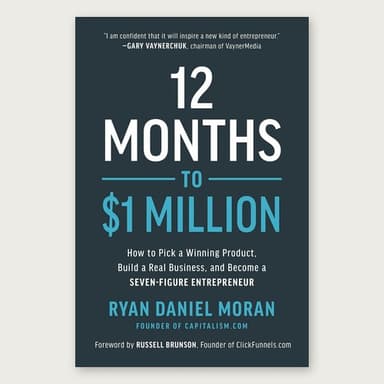
Start hereThe short version
- 1A million-dollar product business reduces to one formula: a brand of three to five products for the same customer, each at 25 sales a day at about $30. Moran built it with his partner Matt and sold a majority stake in Sheer Strength for $10 million. The Preface warns off the casual reader, the Introduction gives the formula, and Chapters 1 and 2 cover the opportunity and the mindset.The formula
- 2The method runs in ten steps over 12 months, grouped as the grind, the growth and the gold. Chapters 3 to 8 cover the grind and the growth: choose your customer with seven foundational questions, develop a gateway product, fund inventory, stack the deck before launch, launch, and grow to 25 sales a day.The grind and the growth
- 3Chapters 9 to 12 are the gold: a second product that serves the customer's next need, mid-tier influencers and audiences to reach $100,000 a month, the full checklist, and selling the business. The Conclusion warns that founders who plan only up to the goal hit a slump after it.The gold
12 Months to $1 Million on four pages
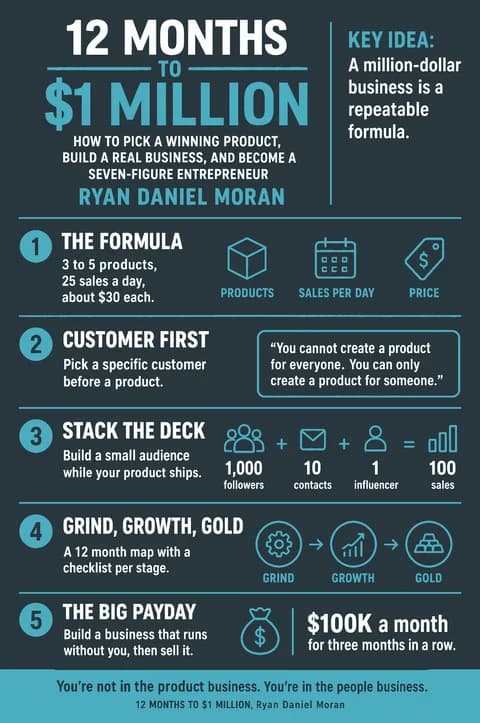
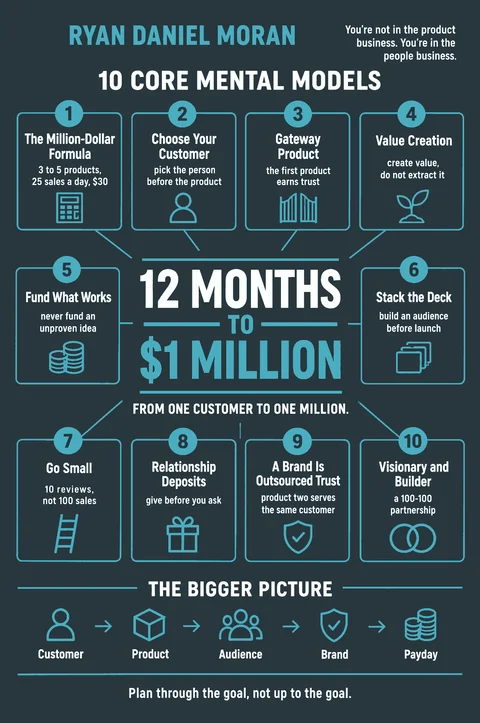
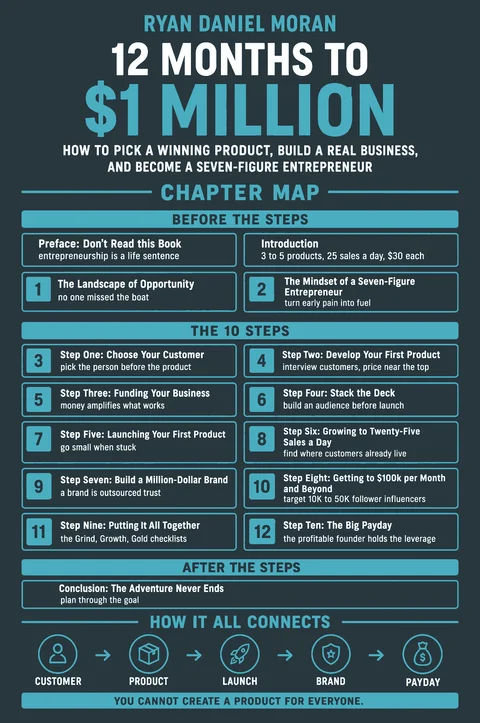
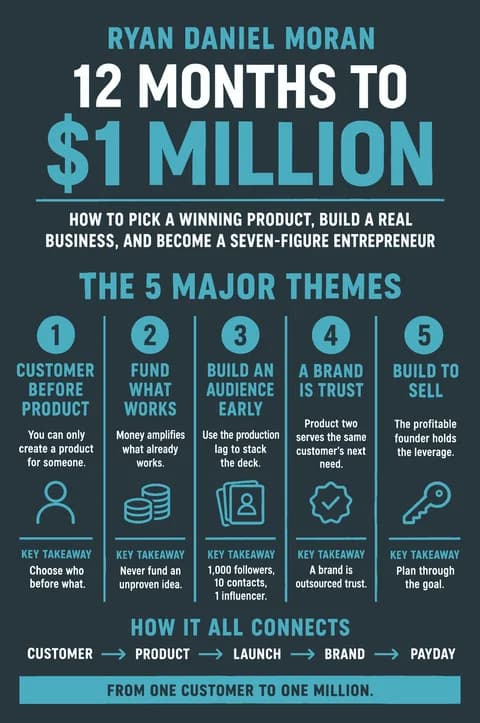
Four printable posters in the cover's colors: big ideas, mental models, a chapter map, and major themes.
Free. You'll also get each new summary by email.
The summaryPreface: Don't Read This Book
Moran opens by warning off anyone drawn by the short-term goal of a million dollars in 12 months. He quotes Dan Sullivan that being an entrepreneur is a life sentence, and describes the road as long and uneven, with losses, self-doubt and episodes of depression before the freedom at the end. He says the roadmap has worked for single moms, bankrupt families and young people, and that it works well enough to make even a casual reader responsible for a million-dollar business, which is why he does not wish it on anyone who is not committed. He cites Dan Pena saying he would never do it all over again because of the missed days with his children.
"This is a warning, not a sales pitch."
IntroductionIntroduction
As a kid, Moran asked his father, a middle school teacher for more than 30 years, how much a million dollars was. His father said he would have about a million if he worked his whole career and never spent a dime, which Moran calculates at about $40,000 a year for 25 years. At 12, Moran concluded a business was the only way to get there on his own terms. At 29, his business partner Matt called to say the wire had landed: they had sold a majority stake in their fitness supplement company, Sheer Strength, and $10 million was in the account. It had taken six years to be ready, another year to find the method and four years to build the model. He says that following the method, it should take 12 months.
The book's central formula is repeated throughout: a brand is a group of three to five products that each serve the same customer, and four products at 25 sales a day at an average price of $30 make a million-dollar business. Moran lists six things he wishes someone had told him. It is harder than you think, like parenting. Value creation beats value extraction: for every slice of pie you take, you bake a whole other pie. Growth compounds, as in Jeff Olson's The Slight Edge. Your business affects far more than your bank account, because big brands want to buy what you build. Partnerships are 100-100 rather than 50-50, and work best pairing a visionary with a builder, as he and his yoga partner Sean were. And the chips stay on the table: reinvest everything for at least a year.
"If you have four products selling 25 sales a day at an average price point of $30, you have a million-dollar business."
He splits the year into three stages: the grind, months 1 to 4, until you take sales daily on the first product; the growth, months 5 to 8, maintaining 25 sales a day while releasing products for the same customer; and the gold, months 9 to 12, experimenting with advertising and finally considering paying yourself. He also describes The Backroom, his accelerator for founders past a million, where he usually takes 20 to 40% as a minority partner.
Chapter 1The Landscape of Opportunity
To the question "am I too late," Moran answers that platform changes keep opening new openings. Amazon's FBA program let anyone open a store on the internet's Fifth Avenue, and his mentor Travis said it was so wide open that idiots got rich, until a correction swallowed those who never built real brands. Big companies such as Kimberly Clark and Procter & Gamble buy small brands because they cannot innovate as fast. Peter Rahal founded RX Bar in 2013 in his parents' basement for CrossFit athletes, and three years later Kellogg's paid $600 million for it. Kylie Jenner's first product sold out for $19 million in revenue on day one, and her company was valued at $1 billion within two years, which Moran reads as the same process with a large audience.
The chapter's second idea is identity marketing. Black Rifle Coffee and a coffee brand for moms may use the same beans and target completely different people. Michael Dubin, a comedian, launched Dollar Shave Club with a video aimed at younger men tired of paying too much for blades, and Unilever bought it for $1 billion in 2016. Moran describes the diffusion theory of marketing from a college professor, where innovators bring in early adopters and then the masses, and concludes that a few hundred loyal customers are enough to start the model. Going very micro is the key to fast growth.
Chapter 1 · Same beans, different person
"Products make a little bit of money for a short amount of time. Brands get acquired for millions of dollars."
Chapter 2The Mindset of a Seven-Figure Entrepreneur
Moran's parents separated when he was 11. In middle school a friend he had followed for a year and a half told him he only stayed friends out of pity. Moran hid in the computer lab for the rest of the year, and that is where he learned to build websites, drive traffic and write. When he confronted the friend four years later, the friend did not remember saying it. Moran says most entrepreneurs he meets recognize the story, many are children of divorce, and the pain can be turned into fuel.
He defines an entrepreneur as someone who takes responsibility for a problem and does something about it, and notes that beliefs about money being scarce or making money being selfish keep people out. His rule is to take care of yourself first, because businesses reflect their leaders, and he quotes Peter Shallard that the primary goal of an entrepreneur is to stay in the mode where work is easy. After the $10 million sale left him no happier, Tim Ferriss told him over dinner that even if the thing is not worth it, the pursuit is. Moran expects the business to show liftoff four to six months in, which is the time to go all in.
Chapter 2 · Take responsibility for a problem
"An entrepreneur is someone who takes responsibility for a problem and does something about it."
Chapter 3Step One: Choose Your Customer
Suzy Batiz went bankrupt at 20 and again at 30 before, in her mid-40s, she created Poo-Pourri, a before-you-go toilet spray. Sales were slow until she identified her customer: women like her tired of embarrassing situations. A video of a prim English-accented woman on a toilet made the brand a sensation, and Moran writes that it did more than $400 million in sales within a few years.
Moran's own path ran from a dorm-room web business to moving to Austin, where a positive pregnancy test pushed him to commit to one business model. His core point is to build around people. A brand is trust, a group of products that serve the same person. Matt and he built Sheer Strength around themselves: men who wanted a clean pre-workout. A friend named James sold blue-blocker glasses for insomnia sufferers at a premium over the roughly $8 competition, then flopped with a second style of glasses until he realized he was a sleep company. Dave Asprey launched Bulletproof Coffee as a gateway product and followed it with MCT oil and ghee for the same high performer.
Chapter 3 · A brand serves one person
"People are what make you money, not products."
- You're Already an Impact Business22 to 30
- You're Closer Than You Think14 to 21
- You Have the Foundation7 to 13
- The Starting Line0 to 6
 Printable PDF
"Moran's whole formula starts with knowing exactly who you're building for. Before you pick products, you want to know where your business really stands, right? Ten questions, a score out of 30 and the part to fix first. It's free with your email. Go find out."
 Deven Davis, devendavis.com
- Ten questions about where your business is right now
- A score out of 30
- A four-part breakdown: Impact Clarity, Traction Proof, Model Strength, Founder Credibility
- The part to fix first
- Your tier's next steps
- A printable PDF
Free with your email. Your score and a printable PDF open right on the page.
The chapter's seven foundational questions: to whom will you sell; what do they already buy, at least three to five products; which product will you focus on; what does your group think of similar products; where does your person hang out; how will you get predictable sales; and what will products two, three and four be. Moiz Ali asked forums about natural deodorant, made a $500 round of prototypes and sold out, the start of Native, which Procter & Gamble later bought for $100 million. The spotlight is Jared Springer, who started from a walker after nerve surgery, built a Facebook following of 60,000, and with 15 friends packed 5,000 Christmas orders in six hours in a Wisconsin snowstorm. His Happy Puppin brand reached a million dollars in revenue a year later.
Chapter 4Step Two: Develop Your First Product
Native launched on Product Hunt in 2015 and sold one bar on day one, then 50 the next after a friend helped. A 20% repurchase rate and 4-star reviews led Moiz to ask customers why; the answer was application, and a year of reformulation took reviews to 4.7 stars and doubled repeat purchases. He turned down retailers to stay on his website, then ran a sale process with 16 of 100 possible buyers and chose Procter & Gamble.
At six, Moran learned from his aunt's boyfriend Don that companies would make any product idea for you. Today those contract manufacturers are on Alibaba. For the yoga brand, Moran and Sean read Amazon reviews, ordered samples for about 50 bucks, interviewed young women at Starbucks and tested mats in yoga classes before ordering their Zen Active mat. His advice is to refine rather than revolutionize, ignore packaging until money is flowing, price near the top of the market, and never run out of stock: a price cut on the yoga mats sold them out and cost a four-week wait and months of momentum. A student settled with one supplier and won a 20% discount. Travis Killian's team split-tests products against competitors and grew from four to five thousand a month to about two million a month within two years. The spotlight, Hany Sunarto of Neat Pack, launched a toiletry bag from a sketch, flopped on her second product and grew her list from 3,000 to 10,000.
Chapter 4 · Refine, do not reinvent
"Don't waste time trying to come up with a new wheel. Simply give your person what they already want."
Chapter 5Step Three: Funding Your Business
Dollar Shave Club's famous video cost $5,000, and Dubin raised a first round of $100,000 in January 2012 only after proving sales. Moran's first Sheer Strength order was 100 units at $6 each, sold at $32, for $600 from savings; they reinvested into 500 units, then 1,000. The real problem, he says, is staying in stock, and price can control the speed of sales. Kevin Nations's pricing rule is to charge a little less than solving the problem is worth. Drew Canole charged $70 for Organifi's 30-day supply against competitors at $19 or $29, which paid for podcast advertising. A competitor outsold Sheer Strength two to one at twice the price because it targeted an older demographic.
Moran recommends having access to $5,000 to $10,000, telling founders to think like a movie producer who raises money rather than spends his own. Robert Herjavec told him the number one use of Shark Tank money is inventory. Investors fund what is already working, so ask for advice rather than money. His student Sophie raised more than $25,000 on Kickstarter for a reusable lunchbox against a $5,000 goal, using a phone video, 10 contacts and one Facebook group of 20,000 members, and her business later neared $10 million in sales. Good debt produces a return: Moran will borrow at 20% to buy inventory at $10 and sell at $50, but never to fund an unproven idea. The spotlight, AJ Patel, borrowed $40,000 for his skincare line and passed a million a year 13 months after his first argan oil sale.
Chapter 5 · Fund it with sales
"Money is an amplifier, not a magic wand."
Chapter 6Step Four: Stack the Deck
Gary Vaynerchuk told Moran he expects no conversions from his audience, yet that audience was the first spark for his Empathy Wines. In the grind, Moran says, the only job is to take a sale. When his yoga mats were eight weeks away on a boat, he and Sean built an I Love Yoga Facebook page with $10 a day in ads, reached about 3,000 likes in 30 days and documented the product's development, including a thicker strap their followers asked for. Close to launch they announced only 500 mats; they took 50 sales out of the gate, then 50 more, and soon 50 a day.
The Profit + Purpose Playbook
His formula for launch day: 1,000 followers, 10 personal contacts and one micro-influencer with at least 10,000 followers. He recommends documenting the build, entering the community's conversations, answering common questions and approaching influencers with a give. A hot list of people who comment that they want one turns honest scarcity into first-day buyers. Two optometrists, Jenna and Travis, built a Facebook group of a few hundred dry-eye sufferers against Moran's advice, and their dry-eye spray changed their business. Zach, co-founder of The Flexible Dieting Lifestyle, sold 10,000 units of a protein cookie butter in a week with zero ad spend. Marvin Lee put $80,000 on a credit card at 18% to stock up for Christmas.
Chapter 6 · Stack the deck
"1,000 followers, 10 personal contacts, and one influencer equals 100 sales."
Chapter 7Step Five: Launching Your First Product
At a fitness convention Moran found a line wrapped around the hall for Quest Nutrition. Tom Bilyeu had cut bars by hand and given them to athletes, and the fans became Team Quest, who got every launch first. Moran writes that Quest did $500 million in sales by its fourth year and sold for $1 billion in 2019. Expect a dip about two weeks after launch. His advice when stuck is to go small: he told a student named Ken to come back with 10 reviews, and Ken returned getting seven to 10 sales a day from strangers.
Calling a repeat buyer taught Moran that building a business is a people game. Amazon rewards momentum with badges, frequently-bought-together placement and free traffic, but he cringes at the phrase Amazon business. Reorder early: 500 units at five sales a day is 100 days only until reviews lift sales to 10. Reviews should confirm a purchase rather than be the reason for it. Catherine Lavery's Best Self Co. funded its Kickstarter in 22 hours using $1 reward levels and early-bird rewards that needed only 200 backers, then went from mid-six figures to a million in seven months. Nested Naturals did a million in its first year on its Luna sleep aid, paid each founder $2,000 a month, and later lost $10,000 on influencers that returned maybe $100 in sales.
Chapter 7 · Reorder early
"You don't have an Amazon business. You have a business that takes sales on Amazon.com."
Chapter 8Step Six: Growing to Twenty-Five Sales a Day
Aubrey Marcus promised Joe Rogan the best nootropic in the world without knowing what one was, created AlphaBrain, and with Rogan as partner built Onnit from one product into a human optimization brand. Moran's goal for this stage is a machine that produces a steady 25 sales a day. Early on, Sheer Strength was at five a day and he and Matt called customers by hand. He reports bumps in sales at 25 positive reviews and at 100. His first product took about three months to reach 25 a day; now he can do it in about 14 to 30 days.
The follow-up he recommends is a deposit: ask whether the order arrived on time, credit $10 as thanks, ask what to release next, and only then mention a review. If stuck around 10 sales a day, go micro, run Amazon pay-per-click even at zero profit, test customer-testimonial video ads, and return to the community. A student selling to gardeners built a Facebook group of 14,000 that grows by hundreds a week. Once you reach 25 a day, repeat the process for product two, and expect every happy first customer back. Jason Franciosa's Element 26 weight belt replaced failing Velcro with a self-locking buckle and reached a million in 24 months while he and his partner kept their jobs.
Chapter 8 · Four products, 25 sales a day
"Always go for the give."
Chapter 9Step Seven: Build a Million-Dollar Brand
When Sheer Strength's second product hit 25 sales a day, the first jumped from its plateau to 50 a day, and by the time they sold the company that product did more than 300 a day. Moran attributes the jump to repeat buyers, bundles, followers who had been waiting and Amazon's cross-recommendations. This is the gold. Systems break here because you are the systems, so the shift is from one-to-one to one-to-many: share reviews and testimonials, and turn customer posts into ads.
"Moran picks the customer before the product. If you don't know which business to build yet, the Shortlist gives you 12 paths to your first thousand a month, each with startup costs and time to first dollar, plus 15 AI prompts to find your niche. Seven bucks. Pick a path this week."
Deven Davis, devendavis.com- 12 paths to your first $1K a month, each with startup costs, time to first dollar, difficulty and first steps
- The Skill Audit: what you already have that people will pay for
- 15 ready-to-use AI prompts by stage: Discovery, Launch, First Client, Scale
- The $1K Action Plan: your path, your first offer and a 48-hour deadline
Seven dollars, with the No-Brainer Guarantee: if it doesn't save you 10+ hours of research in the first week, full refund.
The second product answers one question: what is the next thing the first customer would want to buy? The yoga brand went from mat to towel to block to foam roller. Extra colors, sizes and accessories are not new products. Best Self Co. got stuck until it decided it was a productivity company, and released Tempo, an adjustable hourglass. A student named Jonathan selling about a million a year in makeup bags realized his brand was about decluttering chaotic brains. Launch one product at a time. Tom Bilyeu told Moran a new product has about 18 months before copycats, and that Quest's mission is to end metabolic disease. Paul Miller's CozyPhones found unexpected audiences in children and in kids with sensory processing disorder, and did over $4.5 million within three years.
Chapter 9 · The second product lifts the first
"A brand is outsourced trust."
Chapter 10Step Eight: Getting to $100k per Month and Beyond
Joel Marion and Josh Bezoni's BioTrust did more than a hundred million dollars in its first 12 months, mostly through email. Marion's secret was being willing to lose money: if he will make $30 from a customer after 90 days, he will spend $25 up front. That logic only works once you have several products. Moran names three needs: a place to take sales, a stacked deck, and a way to reach new audiences. The best platforms, in his order of sales impact, are podcasts, blogs and email lists, YouTube and social media. He points to how the podcasters around Sam Harris and Joe Rogan lifted Jordan Peterson's 12 Rules for Life past three million copies.
The hack is mid-tier influencers with around 10,000 followers; make a list of 10 with 10,000 to 50,000 followers. Approach with deposits, starting with the smallest yes, which is often paying for an ad. Moran has sent tacos via Postmates, and John Ruhlin's Giftology sent him a signed Cleveland Indians bat and ball. Celebrity spokespeople rarely work unless they are owners or users; a cricket protein company spiked with every big mention and still failed. Capture influencer traffic to your own email list with a tracked discount link. Four relationships at 25,000 followers put you in front of 100,000 people. Sheer Strength reached $100,000 a month almost exactly 12 months from startup, and Moran says it felt like just a number. At that point you can pay yourself; he and Matt replaced Matt's $68,000 salary. Three months averaging $100,000 means a million-dollar business. Jeremiah Klingman built Tribe Fitness from an armband, collected reviews from 4% of customers and sold it for a multi-million dollar check at 21.
Chapter 10 · Be willing to lose money first
"If you go for the ask, you're an ask hole. Don't be an ask hole."
Chapter 11Step Nine: Putting It All Together
The process is simple and hard, and the work is resisting the urge to overcomplicate it. Moran restates the three stages as checklists. The grind: define your core customer to avoid the golden turd, a polished product no one is known to want; outline three to five products they buy; choose the first; pick a place to document the journey; order prototypes and, all else equal, choose the supplier with the best communication; stack the deck, even with $10 a day in ads; and take an order. The growth: get to a consistent 25 sales a day by checking whether the audience wants the product, thinking small, cultivating a core group of buyers like Team Quest, and using pay-per-click and video ads. The gold: launch only multiplier products, advertise through influencers and other people's audiences, build relationships over transactions, pay yourself around $100,000 a month in revenue, and take strategic risks once past the million. Moran adds that the idea of a lifetime comes around every six months.
Chapter 11 · The grind, the growth, the gold
"You cannot create a product for everyone. You can only create a product for someone."
Chapter 12Step Ten: The Big Payday
Mark Sisson started blogging in his early 50s, launched Primal Kitchen paleo condiments in his early 60s, and in early 2019 Heinz wrote him a check for $200 million. Moran says you really make your money when you sell, and that small brands built this way can outrun big companies that only think big. He has watched acquirers professionalize what they bought, swapping audience building for magazine ads and executive salaries, and he once advised a buyer for a year that ignored him and lost millions. He tried to buy businesses back more than once.
A business is only a business if it can grow without you, so his first hire after the million was someone who organizes the chaos. He warns against three mistakes: optimizing for vanity metrics, forgetting you are in the people business, and making decisions from algorithms. A profitable brand holds the negotiating power, and sellers usually sell a majority stake, about 60%, and stay on as advisors. On the day he got his check, his apartment was empty of furniture after a separation. Money, he writes, is like alcohol: it brings what is true to the surface, so cultivate a great life before the money arrives.
Chapter 12 · The big payday
"You're not in the product business. You're in the people business."
He closes the chapter by pointing to a podcast he recorded with Suzy Batiz about doing personal discovery work while growing a company, which he links to her building a nine-figure business.
ConclusionThe Adventure Never Ends
Sheer Strength reached the million-dollar mark in December, almost six months to the day from its first sale, and Moran spent the winter in a funk, as he did again after his first Capitalism Conference. Todd Herman explained why: he had planned up to the goal and not through it. Moran then tells how, at 19 and in ministry school, he slipped into a San Diego bar to meet Travis Sago, who became his mentor for a decade and the next morning introduced him to Matt, the other person under 21 at the conference. Five years later, two positive pregnancy tests a few months apart pushed both men all in. He closes by saying 12 months to a million is only the first year of a longer journey, and that who you become along the way is what matters most.
"Because you planned up to the goal, but not through the goal."
12 Months to $1 Million on four pages
Four printable posters in the cover's colors: big ideas, mental models, a chapter map, and major themes.
Free. You'll also get each new summary by email.