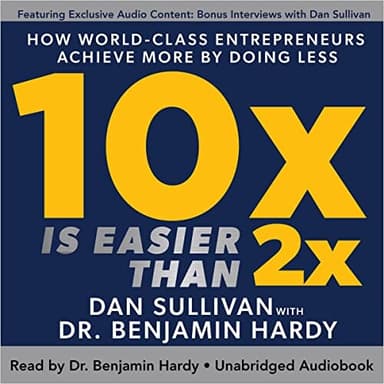
10x Is Easier Than 2x by Dan Sullivan and Benjamin Hardy: Summary and Notes
The full book, section by section.
Start hereThe short version
- 12x is linear: more effort applied to the same life. 10x is a qualitative jump, and a goal that big forces you to find the few paths that work and drop the rest. The Introduction makes the case through Michelangelo's escalating commissions and names the end goal, Dan Sullivan's four freedoms of time, money, relationship and purpose.The claim
- 2Part 1, 10x Principles, covers Chapters 1 to 3: the 80/20 model, where 2x keeps 80% of your current life and 10x lets it go; raising your minimum standards through the Four Cs of commitment, courage, capability and confidence; and living as a wanter with a unique ability rather than a needer.The principles
- 3Part 2, 10x Applications, covers Chapters 4 to 6: measuring your past in the gain, fitness function and the dream check; a time system of free days, focus days and buffer days; and the four levels of entrepreneurship up to a self-managing company. The Conclusion ends on the bottleneck being yourself.The applications
10x Is Easier Than 2x on four pages
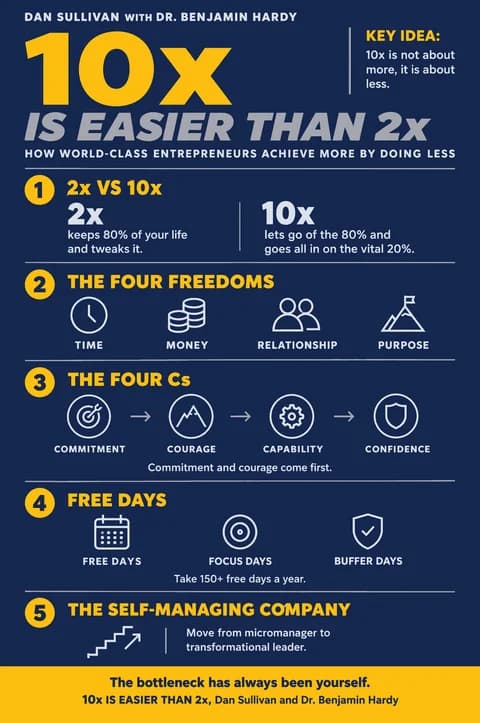
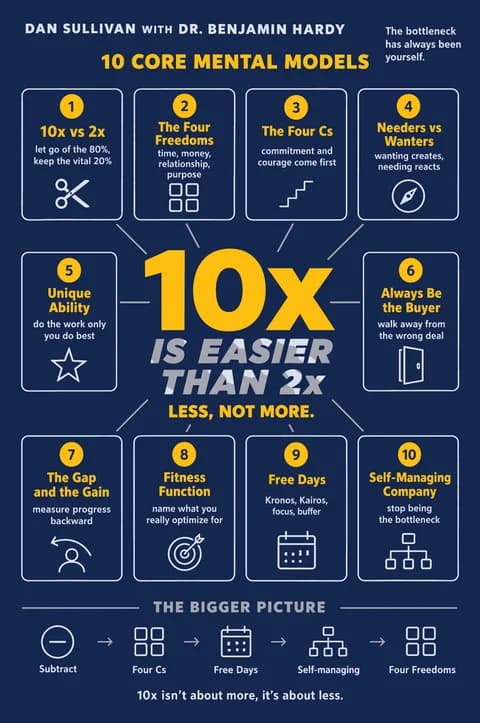
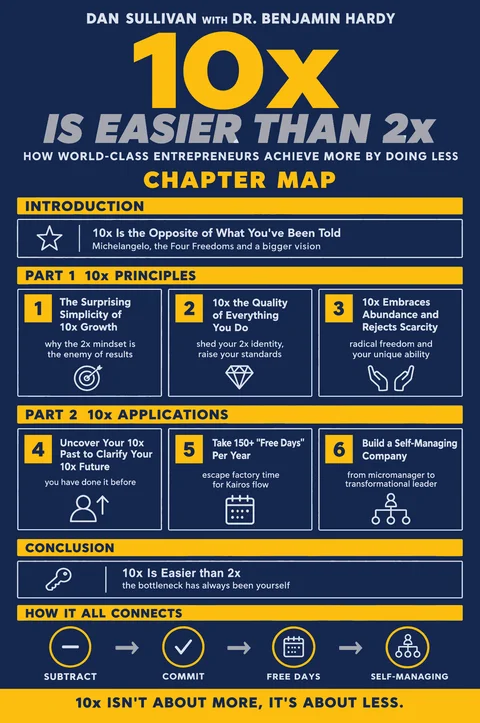
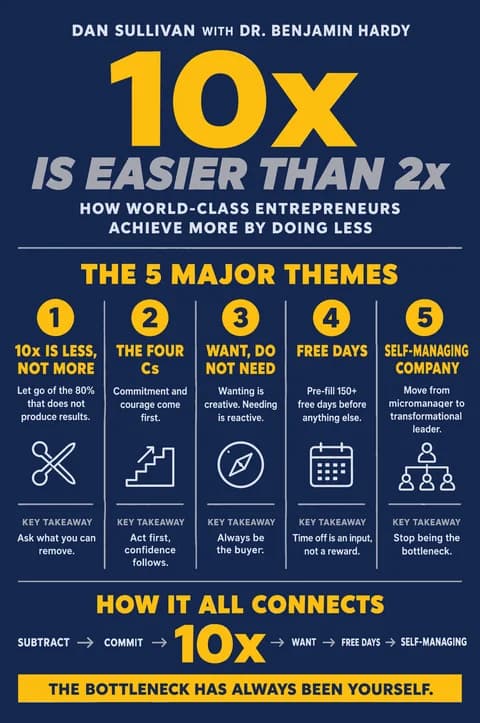
Four printable posters in the cover's colors: big ideas, mental models, a chapter map, and major themes.
Free. You'll also get each new summary by email.
The summaryIntroduction: 10x Is the Opposite of What You've Been Told
The book opens with an epigraph from Astro Teller, CEO of X: aiming 10% higher puts your people in a smartness contest with everyone else in the world, while aiming 10 times bigger is almost never 100 times harder and the payoff is 100 times. Benjamin Hardy, who wrote the book from his own perspective with Dan Sullivan as his collaborator, then tells the story of Michelangelo. At 17, in Florence in 1493, Michelangelo set out to carve his first life-sized, three-dimensional sculpture, a nine-foot Hercules. He spent five golden florins of savings on an old block of marble, lied to his father that the work was commissioned, and dissected dozens of corpses in the morgue of the Santo Spirito hospital at night to learn anatomy, a crime that could carry a death sentence. When Hercules was finished in the spring of 1494, the Strozzi family offered 100 golden florins for it. He was 19.
Each project after that was a jump of the same kind. A small Cupid sold for 200 florins to Cardinal Raffaele Riario and brought him to Rome at 21. The Bacchus and then the Pieta followed, and Hardy calls the two statues incomparable in quality. In 1501 he took on the abandoned 17-foot block that had sat in the Florence cathedral courtyard for more than 40 years, and finished the David in early 1504 at 29 for 400 florins, his biggest fee to that point. Pope Julius II then commissioned his tomb, and in 1508 the Sistine Chapel, which he completed in 1512 at 37. Asked the secret of the David, Michelangelo said he simply removed everything that was not David.
Hardy uses the story to define the book's terms. 2x is linear: doubling output by doubling effort, doing more of what you already do, letting the past dictate the future. 10x is so big it forces you out of your current approach, and it is a qualitative change, like going from a horse and buggy to a car. He draws on the psychological idea of seeing yourself as a context rather than the content of your thoughts and emotions, which lets you expand to handle bigger obstacles. 10x is a process with five parts: expanding vision and standards, simplifying focus, removing non-essentials, developing mastery in unique areas, and leading others who share the vision. Its end is freedom, which Sullivan breaks into four freedoms: time, money, relationship and purpose.
Hardy introduces himself: a PhD in organizational psychology studying entrepreneurial courage, blog posts read by over 100 million people, the most-read writer on Medium from 2015 to 2018, and a family that went from zero to five children in 2018 through adoption and twins. He reports that Sullivan's Strategic Coach has had more than 25,000 entrepreneurs over the past 35 years, and that the goal they stated in Who Not How, their first book, of leading over 500 entrepreneurs into the program was reached in less than two years. The audio edition closes the introduction and each chapter with a conversation between the two authors. In the first, Sullivan describes asking clients to look back to when they were one-tenth of where they are now, and tells Viktor Frankl's Auschwitz story as the clearest case of a transformational life over a transactional one.
"10x isn't about more, it's about less."
Part 110x Principles
Part 1 lays out the principles in three chapters: why a 10x goal is simpler than a 2x goal, how raising standards changes identity, and why 10x runs on wanting rather than needing.
Chapter 1The Surprising Simplicity of 10x Growth: Why the 2x Mindset Is the Enemy of Results
At Joe Polish's mastermind, Dr. Alan Bernard, an expert on constraint theory, called the question of how to grow profits by 10% a bad one, because infinite paths lead there. Asking how to grow profits 10 times leaves very few paths, and almost nothing you are doing now would get you there. Bernard asks entrepreneurs whether a goal is possible, raises it until they say no, then asks what would have to be true for the impossible goal to become possible. Those unless conditions are where to focus. Hardy applies it to his son Caleb, a tennis player aiming for college: a pro goal would change the coaching, the training and how picky they are about everything, and is the surest route even to the college goal.
The core of the chapter is Sullivan's 10x versus 2x framework, built on the 80/20 rule. Going for 2x lets you keep 80% of your current life and tweak it. Going for 10x means letting go of 80% of your current clients, activities, habits and mindsets and going all in on the 20% that produces most of your results. Only a big enough goal makes the 80% obvious. Sullivan asks entrepreneurs what would happen if they dropped the bottom 80% of their clients and how long it would take to regain their revenue; a common answer is two to three years.
Carson Holmquist founded Stream Logistics in 2012 and grew it from three to 30 team members by 2017 while working 50 hours a week as its bottleneck. He spent 18 to 24 months building a leadership team, then studied his clients and found two kinds. Routine freight made up 95% of clients and competed on price. High-stakes freight, complex oversized loads that had to be exact, made up 5% of clients but 15% of profits. He moved the whole company onto high-stakes freight; the sales reps resisted because their call lists fell from 300 or 400 prospects to 30 or 40, and the shift took six months. Profit per shipment was $260 to $280 on routine freight and $700 or more on high-stakes freight. Revenue grew from $22 million in 2019 to over $36 million in 2022, and the company became over four times more profitable with the same team of about 40.
Chapter 1 · Keep the 20%, let go of the 80%
"Almost everything is noise. Almost everything you're now doing is a distraction from 10X."
Linda McKissick and her husband Jimmy took out a loan in 1983 to start a restaurant and were $600,000 in debt when it failed. She got her real estate license and grossed $3,000 her first year. She became the first agent in her city with an assistant, at $350 a week, and Hardy reports that each assistant she hired doubled the business the next year. She handed buyers to a buyer's agent to focus on listings, and by 1992 was the top agent in her city, doing over $500,000 in commission revenue. Her brokerage took 20% and would not let her use her own name on signs, which Hardy describes as a rate buster boxed in by a 2x organization. She moved to Keller Williams, became its top agent nationally, then a franchise owner in 1998, then a regional owner across Ohio, Indiana and Kentucky. At each jump her old 20% became her new 80%, handed to people such as her brother-in-law Brad. Hardy writes that by 2021 her organization did over $14 billion in revenue across 28 offices and over 5,000 agents.
In the conversation that closes the chapter, Sullivan explains his Four Cs: commitment and courage come first, and capability and confidence follow. He also describes giving up the roughly 15 hours a week he spent watching television, which he counts as 4,000 hours regained over five years.
Chapter 210x the Quality of Everything You Do: Shed Your 2x Identity and Relentlessly Raise Your Standards
Chad Willardson entered Merrill Lynch's advisor training at 24, one of 100 trainees in Southern California and one of two who finished. Told it was impossible, he set a minimum of $100,000 per client. After six months of rejection, his first client brought $600,000. He raised his minimum to $250,000, had $30 million under management by 2005 and added $280 million over the next seven years. In 2011 he started over with his own firm, Pacific Capital, taking only entrepreneurs with $1 million or more. He raised the minimum to $2.5 million in 2021, $5 million in 2022 and $10 million in 2023, and Hardy writes that he now manages over $1 billion. He went from over 200 days a year in the office to about 30, with an executive assistant and a team handling meetings and operations. Some legacy clients objected; Hardy reads their objection as 2x people wanting him to stay the same.
- You're Already an Impact Business22 to 30
- You're Closer Than You Think14 to 21
- You Have the Foundation7 to 13
- The Starting Line0 to 6
 Printable PDF
"Look, Sullivan and Hardy say 10x starts when you find the 20% that actually produces results. Fair enough. So which 20% is it in your business? Ten questions, a score on four parts of it and the part to fix first. It's free with your email. Go find out."
 Deven Davis, devendavis.com
- Ten questions about where your business is right now
- A score out of 30
- A four-part breakdown: Impact Clarity, Traction Proof, Model Strength, Founder Credibility
- The part to fix first
- Your tier's next steps
- A printable PDF
Free with your email. Your score and a printable PDF open right on the page.
Hardy defines identity as the story you tell about yourself plus the standards you are committed to. Raising standards runs through Sullivan's 4Cs Formula: commitment, courage, capability, then confidence. Loss aversion fights it in three forms: sunk cost bias, the endowment effect and the consistency principle. His example is a speaker who raises the fee from $25,000 to $50,000 and gets one yes out of 12, a yes he values more for identity than 12 yeses at the old fee.
Jimmy Donaldson, MrBeast, went from mediocre bedroom videos at 17 in 2015 to a team of over 150 people by 2022. On Joe Rogan's podcast he described a creator he mentored going from 4.6 million monthly views, making 24 grand, to 45 million views and a $400,000 month. His explanation: one video can get more views than 100 mediocre ones, and a video people click 10% more and watch 10% longer gets about four times the views. Hardy distills three steps: think exponentially, hyper-focus on quality over quantity, and build a team so you can focus on the craft. He cites Naval Ravikant's line that outliers come from 10,000 iterations rather than 10,000 hours, and Alan Bernard's point that a single $30 million problem is easier than 100 problems at $100,000, because you can miss by two-thirds and still reach $10 million.
Chapter 2 · Raise the standard
"To go 10x bigger, you focus on getting 10x better."
James Clear's annual reviews trace the same pattern: blogging until 2014, a book deal in 2015, a 2016 he called the worst year of writing of his career as he moved from 1,500-word articles to a book of 50,000 words or more, and a 2017 spent finishing the manuscript while his assistant ran the business. Hardy writes that Atomic Habits sold nearly 10 million copies by October 2022. His point is that Clear's results came from finishing to an unusually high standard, and that a product 10 to 20% better and different can get many times the results. Seth Godin's The Dip supplies the claim that number one gets 10 times the benefit of number 10, and Jim Collins's Good to Great supplies Darwin Smith, the Kimberly-Clark CEO who sold the company's paper mills to go all in on consumer products and, 25 years later, beat Procter & Gamble in 6 out of 8 categories.
Chapter 310x Embraces Abundance and Rejects Scarcity: Get Exactly What You Want, Experience Radical Freedom, and Realize Your Unique Ability
On August 15, 1978, at 34, Sullivan got divorced and went bankrupt on the same day. He began writing down every day what he wanted, and on New Year's Eve 2003 told friends he had done it on every day but 12 out of 9,131. From this comes the chapter's split between needers and wanters. Needing is extrinsic, security-driven, scarcity-minded and reactive. Wanting is intrinsic, freedom-driven, abundance-minded and creative. Needers must justify what they need because they compete for scarce resources; wanters create something new and owe no one a justification.
Chapter 3 · Needers and wanters
"There is no justification of wants."
Hardy draws on Paul Graham's essay How to Make Wealth: money moves wealth, wealth is what people want, and restoring an old car makes you richer without making anyone poorer, so there is no fixed pie. He tells how Coinbase CEO Brian Armstrong, after first issuing a political statement, declared the company mission-driven and offered severance to anyone who disagreed; 5% left, and Armstrong told Tim Ferriss it was one of the best things he had done for the company. Hardy calls freedom from external constraints the lesser freedom and freedom to choose what you want the greater one.
The Founder Brain Kit
The second half introduces Sullivan's unique ability, the few activities where you have superior skill, intrinsic energy and endless room to improve. Paul Rodriguez, P-Rod, turned down a Nike deal at 21 in 2005 because it had no signature shoe. Nike came back with one; by 2022 he had released his 10th signature shoe over a 17-year partnership, and Nike told him in 2014 he was one of four athletes with eight signature shoes, with Kobe Bryant, Michael Jordan and LeBron James. Hardy cites Robert Greene's Mastery on the inclination behind mastery and the X factor of forging your own route, Peter Drucker's refusal of an interview request on the grounds that productivity means doing only the work one is fitted for, and research linking a sense of calling to career and life satisfaction. He warns against tying unique ability to one skill, since each 10x jump can change it.
The chapter ends on Sullivan's idea to always be the buyer. A seller lowers standards to be accepted; a buyer has clear standards and can walk away, as P-Rod did. Transformational relationships are ones where every party is a buyer and the payoffs are uneven but exciting to each. Hardy closes with James Carse's distinction between finite and infinite games and Naval Ravikant's advice to play long-term games with long-term people.
Part 210x Applications
Part 2 turns the principles into practices: reading your past as a record of 10x jumps, choosing what to optimize for, structuring time, and building a company that runs without you.
Chapter 4Uncover Your 10x Past to Clarify Your 10x Future: You've Done It Before and You'll Do It Again
Hardy opens with two early readers: a friend who preferred 2x as a way of life, which Hardy accepts, and a Fortune 500 middle manager who found the idea inspiring and his job too bureaucratic to apply it. Hardy says the book was written for high-level entrepreneurs, then explains why 10x requires the mindset from his and Sullivan's earlier book, The Gap and the Gain. Sullivan created the model in the mid-1990s after a client insisted nothing positive had happened in the previous 90 days despite a new client and new projects.
The gap measures where you are against an ideal, and ideals move like a horizon in the desert. The gain measures only backward, against where you were before. Hardy describes being in the gap about his own children, and quotes Matthew Perry's memoir on chasing fame to fill a spiritual hole. He cites research that confidence is more the byproduct of past success than its cause, and that high-hope people turn every outcome into feedback. The practice is simple: write three wins at the end of each day, and reflect on growth over the past three years, 12 months, 90 days and seven days. Letting go of the 80% then reads as a gain.
Chapter 4 · The gap and the gain
"Ideals are like a horizon in the desert."
He then asks readers to map five past 10x jumps, each with its 20% and the 80% let go. His own: getting on a church mission in 2008, getting into Brigham Young University after barely graduating high school, being rejected by 15 graduate programs and then entering Clemson's organizational psychology PhD after submitting over 15 papers with Dr. Nate Lambert, and a $220,000 book deal from Hachette in February 2017 after growing an email list to over 100,000 people.
Two tools look forward. Fitness function, a term from computer and evolutionary science, means naming what you are optimizing for. Hardy illustrates the stakes of small direction errors with the 1979 Antarctica crash that killed 257 people after coordinates were changed by two degrees, and illustrates finer distinctions through Josh Waitzkin, who says a grandmaster looks at less and sees more. The dream check comes from Jim Carrey, who in 1990 wrote himself a $10 million check dated Thanksgiving 1995 and was paid $10 million for Dumb and Dumber just before that date. Readers set a check about 10 times their best past unique-ability fee, then ask what value would make it a bargain for the payer. Hardy's own is $15 million to write one book, which he calculates would need to create 75 to 150 million in value.
Chapter 5Take 150+ "Free Days" Per Year: Escape Factory Time and Open Your Schedule for "Kairos" Flow, Fun, and Transformation
The nine-to-five model, Hardy argues, comes from early 20th century factories and trains people to fill time with effort. He contrasts Newtonian time, fixed and the same for everyone, with Einstein's relative time, and the Greek words chronos, sequential time, and kairos, the opportune moment where significant change happens. Progress slows time down; busyness speeds it up.
Sullivan, an actor in his 20s, noticed entertainers use three kinds of days: performance, rehearsal and rejuvenation. He renamed them free days, focus days and buffer days. Each January Babs fills in all of Sullivan's free days, 180 days, before anything else, and the team does not contact them on those days, a practice they kept even with three employees. Today Sullivan has around 150 focus days and around 35 buffer days a year. Hardy compares Nikola Jokic, who kept improving, with Anthony Davis, who he says declined after winning a championship, and cites LeBron James's trainer on recovery never stopping across more than 50,000 career minutes.
Chapter 5 · Take 150+ free days per year
"Advancement is Kairos. Busy is Kronos."
He cites research on psychological detachment from work, which links it to less fatigue, more engagement, greater marital satisfaction, better quality of life and mental health, and a study where only 16% of people reported creative insights at work. Free days are for exploring and focus days for exploiting. Bill Gates's think weeks are his example of the first, and the Eagles quarterback Jalen Hurts, whose offseason "lonely work" Trent Dilfer describes, of the second. Hardy's practices: stack meetings on one or two days (his are on Fridays), keep Paul Graham's maker schedule with blocks of four hours or more, set no more than three important objectives a day, and in the final hour put the phone on airplane mode 30 to 60 minutes before bed and write three wins and tomorrow's three goals.
"Sullivan and Hardy say 10x means letting go of part of who you were. That's identity work, and identity work takes reps. The Identity Shift is 30 days of it: a prompt, a reflection and an intention every day. Seven bucks, and the first shift shows up in Week 1."
Deven Davis, devendavis.com- 30 days of guided identity reprogramming, rooted in Wattles' Impression of Increase principle
- Each day has a prompt, a reflection and an intention
- Bonus: The Quick Win Guide, your first identity shift result in under 1 hour
- Bonus: a 5-minute video from Deven on why identity precedes strategy
Seven dollars, with the No-Brainer Guarantee: if it doesn't change how you think about yourself and money within the first week, full refund.
Chapter 6Build a Self-Managing Company: Evolve from Micromanager to Transformational Leader
Susan Kitchick was on a sabbatical in 2017 after nearly 30 years of work when a headhunter offered her the CEO role at Targeted Strategies Limited, a life insurance brokerage. Its founder, Garnett Morris, was its only salesperson. She took the business through four steps: stabilize, optimize, grow and transform. She systemized processes the banks and insurers had hated dealing with, and recruited principals at accounting firms to sell Morris's policy designs. After four years the company had gone 10x, and Hardy writes that it now sells more life insurance than any other company in Canada by a factor of 10.
Hardy lays out four levels of entrepreneurship: the rugged individual who does everything or micromanages; the leader who applies who not how; the owner of a self-managing company run by better-fit leaders; and self-multiplying unique ability teamwork, where every team member refines a role to their own 20% and hires someone for their 80%.
Chapter 6 · Four levels of entrepreneurship
Tim Schmidt's engineering firm stayed at three employees and about $300,000 in revenue from 1997 to 2007. In 2003 he started the U.S. Concealed Carry Association from his kitchen table, mailing 30,000 magazines on a $100,000 credit line and signing up 1,000 members at $47 a year. He controlled everything himself until he went all in on it, sold his engineering company and got coaching through EOS; from 2007 to 2011 revenue went from just under 1 million to 4 million. In 2011 he added self-defense liability insurance and raised membership to about $200 a year. Members fell from 50,000 to 25,000 in a single day, and the business made more than double. Hardy writes that USCCA has grown from three to four million to over 250 million in revenue, with over 700,000 renewing members. Schmidt's seven principles for psychographic alignment are a story, an ideology, a symbol, shared rituals, an enemy, a language and a leader who serves the member as the hero.
A question-and-answer section covers who not how: the first who is an administrative assistant, available for less than $15 per hour; a who is an investment rather than a cost; wrong hires are a gain to learn from. Hardy connects this to transformational leadership research, trust in the leader, Stephen M. R. Covey's point that trust is given, and self-determination theory's autonomy, mastery and relatedness. Joseph Smith, asked how he governed a city of about 20,000, said he taught correct principles. Hardy's assistant Chelsea, overloaded, kept her 20% and hired Caitlin for her 80%. The risk Sullivan names is that people become so good they are irreplaceable; the bigger risk is losing the 10x vision, because the best people leave.
"I teach them correct principles and they govern themselves."
The chapter's core applications are three: get whos now for 80% of your tasks, train leadership to replace you before you feel ready, and create a culture where every team member is encouraged to clarify and expand their own unique ability.
Conclusion10x Is Easier than 2x
Hardy uses David Hawkins's map of consciousness, from shame at 20 to enlightenment at 1,000, as a metaphor for leverage: Hawkins claims most people rise only five points in a lifetime and that over 80% of people operate between fear and anger. Hardy says the exact numbers matter less than the message that a more focused person creates bigger ripples. A fictional consultant bills $50,000 for marking an X on one gauge: $1 for the X and the rest for knowing where to put it.
His last story is a training for a church mission in Fort Lauderdale of about 200 missionaries who had baptized around 430 people in 12 months. Working with members produced 40% of baptisms, their own finding 34% (including referrals from people already being taught at 13%), and social media 26%. The missionaries spent about 1.5 of their eight daily hours on members and social media, which Hardy calculates as 18.75% of their time producing 66% of baptisms. He told them that to double baptisms they would need half the dots on their map. When one asked about keeping all lines in the water, he asked what if there were no fish where they were fishing. The mission leader set a new standard of 100 baptisms a month, up from 50. The book ends on the claim that the bottleneck has always been yourself.
"Not all dots are created equal. Not all activities are created equal."
10x Is Easier Than 2x on four pages
Four printable posters in the cover's colors: big ideas, mental models, a chapter map, and major themes.
Free. You'll also get each new summary by email.