$100M Leads by Alex Hormozi: Summary and Notes
The full book, section by section.
Start hereThe short version
- 1Leads alone are not enough. A business needs engaged leads, people who show interest in the stuff you sell, and a strong offer or lead magnet is how you get them. Section I opens on the $150,000 refund crisis that led to Gym Launch, and Section II defines the engaged lead and gives seven steps to a lead magnet.The claim
- 2There are only four ways one person can let others know about anything: warm outreach, posting free content, cold outreach and paid ads. Section III gives them Chapters 5 to 10, then Chapter 11 scales them with More, Better, New.The Core Four
- 3The biggest leverage comes from other people running the Core Four for you: customers who refer, employees, agencies and affiliates. That is Section IV, Chapters 12 to 16. Section V closes with the Rule of 100, Open to Goal, a one-page advertising checklist and a seven-level roadmap.The lead getters
$100M Leads on four pages
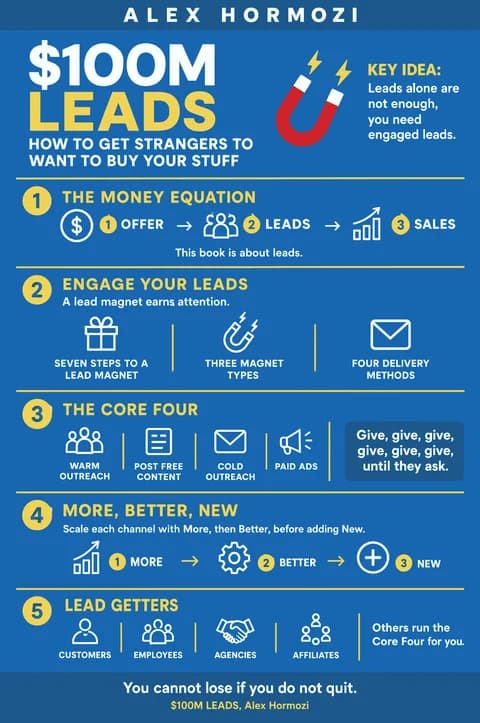
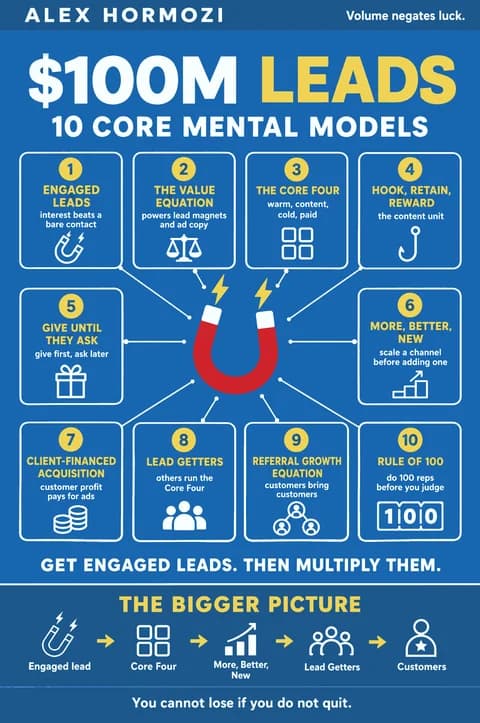
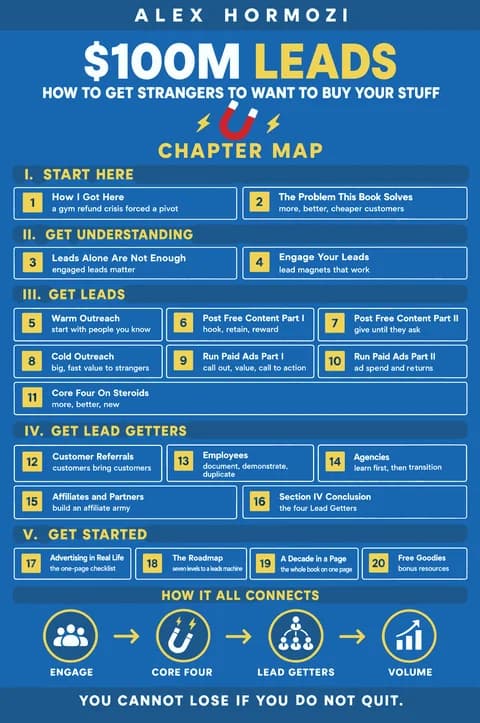
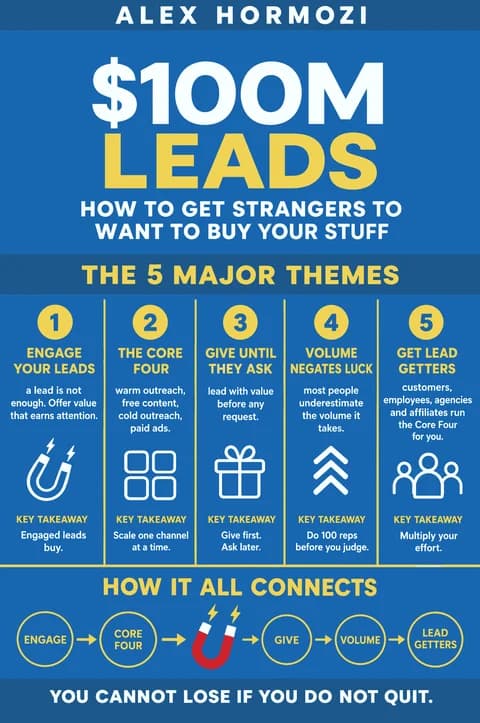
Four printable posters in the cover's colors: big ideas, mental models, a chapter map, and major themes.
Free. You'll also get each new summary by email.
Section IStart Here
Hormozi opens with a three-part equation for making money: you need an offer to sell, leads to sell it to, and sales to get those leads to buy. His first book, $100M Offers, covered the offer. This one covers leads. He defines advertising as the process of making known and argues it is the skill that buys second chances, since a business with plenty of leads can survive a weak product, weak selling and many mistakes. The book explains how advertising works, reveals the four core ways to get leads, shows how to get other people to do it for you, and ends with a one-page advertising plan.
His stated track record: the companies under his holding company, Acquisition.com, make $250 million a year from 20,000 plus leads a day, selling offers from $1 to $1 million plus, and his own lifetime average return on advertising is 36 to 1. He surpassed $100 million in net worth at age 32. He recommends reading and listening to the book at the same time, and finishing each chapter before stopping.
"It's hard to be poor with leads banging down your door."
Chapter 1How I Got Here
March 2017. Leila, his girlfriend and business partner, shows him a screen of refunds from two gyms they launched the month before. One gym owner told his new members to refund and go home; the other offered them half price if they refunded and paid him instead. The total is $150,000, and they are out of money. Hormozi backs up to explain how he got there. He had scaled to five gyms in three years by filling each one on day one, spoke at a conference about his method, and over 100 people left him their numbers. He started Gym Launch with a simple offer: he would fill a gym in 30 days for free and keep the first six weeks of membership fees. He sold his gyms, put his life savings into a 50-50 partnership, and woke up to find the account empty; the partner had been indicted for fraud a few years earlier.
Starting over, he put $3,300 a day on a credit card to fly out six sales reps. The first month brought in $100,117 against a $100,000 card bill; the next brought $177,399 with $30,000 to $40,000 in profit. Then came the refunds. At 3 a.m. he could find no way to make $150,000 in profit in 30 days. Leila's online coaching, $3,600 the month before at $300 a month, gave him the idea to sell online programs directly. He worked 38 hours straight to launch it and it reached $1,000 a day. While calling gyms to cancel their launches, a Boise gym owner begged to be shown how to do it himself. Hormozi named $6,000 to get him off the phone, and he said yes. The next two said yes at $8,000 and $10,000. All eight gyms agreed to license the system, and he collected $60,000 in a day.
In the next 30 days they made $215,000 in profit. The company finished 2017 at $6,820,000 in revenue, then did $25.9 million in revenue and $17 million in profit the next year, and now serves 4,500 plus gym locations. Prestige Labs followed in 2018, ALAN in 2019 and Acquisition.com in 2020. In 2021 they sold 75% of ALAN and sold 66% of the supplement and gym licensing business at a $46.2 million valuation, after taking $42 million in owner pay over the first four years.
Chapter 1 · The licensing breakthrough
"All of this was because of a girl who believed in me, a credit card, and the ability to get leads."
Chapter 2The Problem This Book Solves
The reader's problem, as Hormozi states it, is too few leads from too little advertising. A business can grow in only two ways: get more customers, or make each one worth more. This book addresses the first, through more leads, better leads, cheaper leads and leads that come reliably. He gives the book away for free or at cost to earn trust, aimed at two kinds of entrepreneurs: those under $1 million a year in profit, whom he wants to help get there, and those above it, whose companies Acquisition.com may invest in. He notes the investment threshold changed from $3 million in revenue to $1 million in profit.
He reports that the average portfolio company grows revenue 1.8x and profit 3.01x in its first 12 months with them, and 2.3x revenue and 4.7x profit between 12 and 24 months. The book is ordered from zero clients and zero skills to the most complex, highest-leverage methods, so the basics come first.
Chapter 2 · How portfolio companies grow
"Bottom line, all else being equal, when you double your leads, you double your business."
Section IIGet Understanding
Section II settles three things before any tactics: what a lead actually is, how to separate the leads that make money from the ones that waste time, and the best way to get the right leads to show interest in what you sell.
Chapter 3Leads Alone Are Not Enough
The book began, Hormozi says, when someone asked him what a lead was and he could not give a straight answer, even after six months of trying. His definition: a lead is a person you can contact. A bought email list, the numbers in your phone and people on the street all count. What he wants are engaged leads, people who show interest in the stuff you sell, such as someone who fills in a form, follows you and can be contacted, or replies to an email.
Chapter 3 · Leads and engaged leads
"Engaged leads are the true output of advertising."
Chapter 4Engage Your Leads
In April 2016 Hormozi paid $25,000 to join a group where everyone told him to run webinars. After eight Sundays of building one and spending $150 a day on ads, he had spent $450 in three days for 80 leads and zero sales. Then he saw an ad for a free case study, recorded his own in about 13 minutes walking through a gym's ad account and results, and ran it with the headline "Free case study. How we added 213 members and $112,000 in revenue to a small gym in San Diego." The next morning Leila's calendar was booked solid. The lesson: give people something they want.
You can advertise your core offer directly, or use a lead magnet, a free or low-cost offer that solves a narrow problem and reveals another one your core offer solves, like salty pretzels at a bar. He gives seven steps: pick the problem and who to solve it for; choose how to solve it (reveal their problem, give a sample or trial, or give one step of a multi-step process); pick a delivery mechanism (software, information, services or physical products, which makes up to 12 versions); test the name; make it easy to consume; make it very good; and make it easy to ask for more. His title tests had advertising beat promotion 69 to 31, then leads beat advertising 58 to 42 and marketing 54 to 46. A good call to action says what to do and gives reasons to do it now, such as scarcity, urgency or any reason at all.
Chapter 4 · The lead magnet
The math: with $10,000 profit per sale, $1,000 in ads per call and a one-in-three close, a customer costs $3,000. A $25 lead magnet that brings the ad cost down to $75 per call makes each call $100, and if one in 10 buys, the customer costs $1,000, a 10 to 1 return on the same budget.
"A lead magnet is a complete solution to a narrow problem."
- You're Already an Impact Business22 to 30
- You're Closer Than You Think14 to 21
- You Have the Foundation7 to 13
- The Starting Line0 to 6
 Printable PDF
"Hormozi wrote a whole book on getting more leads. Fair enough. But before you send more people to your business, you want to know what's holding it back, right? Ten questions, a score on four parts of your business and the first thing to fix. It's free with your email. Go find out."
 Deven Davis, devendavis.com
- Ten questions about where your business is right now
- A score out of 30
- A four-part breakdown: Impact Clarity, Traction Proof, Model Strength, Founder Credibility
- The part to fix first
- Your tier's next steps
- A printable PDF
Free with your email. Your score and a printable PDF open right on the page.
Section IIIGet Leads
Hormozi splits audiences into warm (people who gave you permission to contact them) and cold (people who did not), and communication into one-to-one and one-to-many. The combinations make the Core Four: warm outreach, posting content, cold outreach and paid ads. If you are not getting the leads you want, he says, you are not doing the Core Four with enough skill or enough volume.
Section III · The Core Four
"These are the only four things you can do to let other people know about the stuff you sell."
Chapter 5Warm Outreach
In May 2013, with $51,128.13 in savings, Hormozi weighed business school against starting a business and could not explain how $150,000 in loans would help. He quit his job, messaged people he knew offering 12 weeks of free training in exchange for a charity donation and a testimonial, and got six yeses. When they got results he started charging, they referred friends, and the business reached about $4,000 a month.
His 10 steps: get your list from every contact you have; pick the platform with the most contacts; personalize each greeting; reach out to 100 people a day, up to three times each; reply with ACA (acknowledge, compliment, ask); make an offer built on the Value Equation by asking whether they know anyone who might want it; make it free for the first five; start back at the top on the next platform; start charging once referrals come, at 80% off for the next five, then 60% off, then 40%; and keep the list warm, including with Dean Jackson's nine-word email. He offers a guarantee twist: pay less today, $2,000 a month for three months, or pay $6,000 up front with a guarantee. His benchmarks: about one in five contacts reply, one in five of those take the free offer, and one of those converts, so roughly one customer per 100 reach-outs. At 500 reach-outs a week and a $400 offer, that is $104,000 a year.
Chapter 5 · Warm outreach benchmarks
"If you treat them well, your audience will feed you forever."
Chapter 6Post Free Content Part I
Hormozi once called content a waste of time. Watching Kylie Jenner, Huda Kattan, Conor McGregor and Dwayne Johnson build companies worth hundreds of millions to billions changed his mind, as did a famous friend who said hate from strangers was a price worth paying for the impact. He concluded that the audience is the compounding asset: content disappears in time, and the audience keeps growing. Leila paid 120 grand for four calls with a large influencer, whose advice was to post more everywhere. After 12 months his audience had grown by more than 200,000, and after six months of 10 times the content it grew by 1.2 million.
All audience-growing content is built from a content unit: hook, retain, reward. Hooks come from topics (far past, recent past, present, trending and manufactured experiences), headlines that use components like recency, relevancy, celebrity, proximity, conflict, the unusual and the ongoing, and formats that match the platform. Retention comes from curiosity, embedded through lists, steps and stories. Reward means satisfying the reason they started, measured by whether the audience grows. Short and long content differ only in how many units are linked together. His pro tip is to make every piece for strangers.
Chapter 6 · The content unit
"Building an audience is the most valuable thing I've ever done."
Chapter 7Post Free Content Part II
To monetize an audience, Hormozi compares give-to-ask ratios. Television runs 13 minutes of ads per 60 minutes, about 3.5 to 1, and mature platforms ask more because they care less about growth. Growing platforms over-give. His preferred strategy is to give until they ask: give in public, ask in private, and let buyers come to you. If you do ask, use integrated asks, such as three 30-second ads in an hour-long podcast, or intermittent asks, such as an offer on every 11th post, and advertise either a lead magnet or the core offer. To scale, go depth then width (maximize one platform first) or width then depth (get on every platform, then maximize). He records 30 or so short clips twice a month, uses one call to action at a time, and learned in January 2020 that 78% of clients had consumed at least two long-form pieces before booking a call.
Chapter 7 · The give-to-ask ratio
Seven lessons follow: say "how I" instead of "how to"; people need reminding more than teaching; start in a puddle before the ocean; content becomes a tool for salespeople; free content retains paying customers; what looks like a short attention span is really a higher standard; and avoid pre-scheduling posts. He measures audience size and monthly growth rate, notes he posted a podcast twice a week for four years before it reached the top 100, and commits to 100 minutes a day of content. A short interlude after this chapter, Free Goodwill, asks readers to leave a review for entrepreneurs they have never met.
"Give, give, give, give, give, give, until they ask."
The Profit + Purpose Playbook
Chapter 8Cold Outreach
In July 2020, during COVID, 30% of his customers went out of business and his paid ads were crippled. A sales candidate whose offer had been pulled told Hormozi he came from a gym software company doing about 10 million a month from cold outreach with a team of about 30. Hormozi gave him the runway. Results by month: zero sales in September, then 2 sales and $32,000, 4 and $64,000, 6 and $96,000, 10 and $160,000, 14 and $224,000, 20 and $320,000, and 30 sales and $480,000 in May. It took almost a year, and two earlier attempts had failed.
Chapter 8 · Cold outreach, month by month
Strangers create three problems: you cannot contact them, they ignore you, and they are not interested. The fixes: build a list using software, then list brokers, then manual work; personalize with a few facts a friend would know, followed by big, fast value; and make up for low response with volume, through automated delivery, automated distribution and more follow-ups in more ways, then retry the list in three to six months. Rewriting his template below a third-grade reading level got 50% more responses. Swapping a game-plan session for real free service tripled take rates. His cost example: reps paid $15 an hour plus $50 per show, calling 200 leads a day at 10 cents each, produce shows at $120 each, and a 33% close puts customer cost at $360 against $3,600 in profit, a 10 to 1 return. He commits to 100 reach-outs a day for 100 days and lists seven benefits, including privacy from competitors, reliability and a business that can sell without a spokesperson.
"Volume negates luck."
Chapter 9Run Paid Ads Part I
In July 2013 a gym owner named Sam gave Hormozi $1,000 to test Facebook ads. He ran an all-caps, text-only ad looking for five Chino Hills residents for a free six-week challenge, sold 19 people at $299 each and made just under $5,700. The six-week challenge went on to drive at least $1.5 billion in revenue, and he taught it to over 4,500 gyms. With paid ads the reach is guaranteed and the return is uncertain, so the game is efficiency: find the needles in the haystack, profit in a puddle, then expand.
He works through four problems. Where to advertise: a platform you use, where you can target your audience, whose ad format you know and whose minimum spend you can afford. Who sees it: lookalike audiences built from your best lists, plus filters. What the ad says: a call-out, value and a call to action. Focusing most effort on the first five seconds made his ads 20 times more efficient. Call-outs use labels, yes questions, if-then statements and ridiculous results, plus nonverbal contrast, likeness and scene; recording 30 call-outs for 10 ads yields 300 variations. Value comes from his What, Who, When framework: the four value elements and their opposites, shown from the perspective of the people who give the customer status, across past, present and future. Permission to contact: a simple landing page that matches the ad.
Chapter 9 · The three parts of an ad
"Advertising is the only casino where with enough skill, you become the house."
Chapter 10Run Paid Ads Part II
Ad spending moves through three phases: track money, lose money and print money. In his example, nine of 10 ads lose their $100 and one returns $500; spending $10,000 on that winner returns $50,000. He budgets two times the cash a customer pays in the first 30 days to test an ad. Once ads are profitable, he works backward from the customers he can handle: 100 customers at $100 each is $10,000, padded by 20% to $12,000, or $400 a day.
He measures efficiency as LTGP to CAC, lifetime gross profit against the cost to acquire a customer, and observes that every business he invested in that struggled to scale was below 3 to 1. If CAC is within 3x the industry average, the fix is the business model. His answer to cash flow is client-financed acquisition: make back the cost to get and serve a customer within 30 days. A $15 membership costing $5 to deliver, kept for 10 months, has $100 of LTGP; at a $30 CAC, a $100 upsell taken by one in five customers adds $20 and covers the cost in the first month. He says this is how he has scaled every company for the past seven years past a million dollars a month without outside funding. Lessons: do not confuse sales problems with advertising problems (one company quit after spending $150,000 over 12 weeks), turn your best free content into ads, stop saying you are bad at tech, and place a $100 ad today.
Chapter 10 · Client-financed acquisition
"Costs can only approach zero, but how much you make can go up to infinity."
Chapter 11Core Four on Steroids
A chiropractor business owner doing $2 million a year said he had saturated his market while spending 30 grand a month on one platform in a $15.1 billion industry. Hormozi's framework for growth is More, Better, New. More comes first, through the Rule of 100: 100 primary actions a day for 100 days, whether reach-outs, minutes of content or minutes making ads. He writes that Facebook found the top 0.1% of advertisers split test 11 times more creative.
Chapter 11 · More, better, new
Better means testing at the constraint, the step where the most leads drop off. He runs one split test per platform per week, logs every result, and moves to the next constraint if he cannot beat the current version in four tries or one month. Under $1 million a year in profit he advises more first; above it, better first. New comes last because of the size of the pie fallacy, the mistaken belief that the slice you advertise to is the whole market. The order is new placements, then new platforms, then a new Core Four activity.
"Thousands of these tiny tests separate the winners from the beginners."
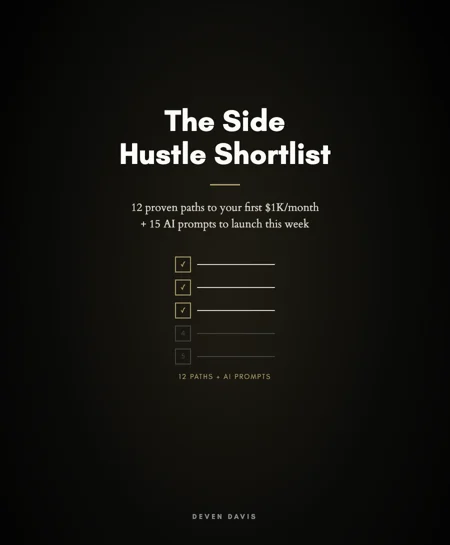
"Look, the Core Four gets your offer in front of people. If you don't have an offer yet, the Shortlist gives you 12 paths to your first thousand a month, each with startup costs and time to first dollar, plus 15 AI prompts to find your niche and write your first offer. A thousand a month is $33 a day. Seven bucks. Pick a path this week."
Deven Davis, devendavis.com- 12 paths to your first $1K a month, each with startup costs, time to first dollar, difficulty and first steps
- The Skill Audit: what you already have that people will pay for
- 15 ready-to-use AI prompts by stage: Discovery, Launch, First Client, Scale
- The $1K Action Plan: your path, your first offer and a 48-hour deadline
Seven dollars, with the No-Brainer Guarantee: if it doesn't save you 10+ hours of research in the first week, full refund.
Section IVGet Lead Getters
Section IV is about leverage, how much you get for the time you spend. Hormozi walks through four scenarios, ending with a lead getter who recruits other lead getters. Lead getters are people who run the Core Four on your behalf: customers, employees, agencies and affiliates. You use the Core Four to get them, and then they do it for you.
"Building a $100 million lead machine is all about leverage."
Chapter 12Customer Referrals
In October 2019 Hormozi discovered Facebook had shut off his ads two weeks earlier and the business was still doing $500,000 a week from word of mouth. At an event for 700 plus gym owners, nearly the whole room raised their hands when he asked who had heard about Gym Launch from another gym owner. Referrals are worth more and cost less: if each customer brings two more, an LTGP to CAC of 4 to 1 becomes 12 to 1. His referral growth equation: percentage of customers referred monthly minus percentage churned monthly equals compounding monthly growth.
Chapter 12 · Three customers for the price of one
Most businesses get few referrals because the product is not as good as they think and they never ask. He defines goodwill as the gap between price and value and gives six ways to build it: sell better customers (one portfolio company refocused on the 15% of customers who churned least and broke a years-long plateau), set lower expectations, get more people better results (gym owners who ran ads and made a sale in the first seven days had triple the LTGP), deliver wins faster, keep improving the product, and tell customers what to buy next. Then ask. Hormozi credits two-sided rewards for Dropbox growing 39x in 15 months, and PayPal's $10 for both sides with helping it reach a million users in two years. His seven ways to ask range from one-sided and two-sided rewards to asking at checkout, using referrals as a negotiation chip, referral events lasting one to four weeks, ongoing programs and unlockable bonuses.
"Nothing scales like word of mouth."
Chapter 13Employees
In June 2021 a team missed its cold outreach goal for a second quarter. The cause turned out to be hiring: it took 40 screening interviews to hire one frontline rep, and a rep left every four weeks. Switching to group interviews let hiring outpace churn within six weeks, and cold outreach sales doubled by the end of the quarter. Hormozi argues employees make you wealthy because a business that runs without you becomes an asset; a business with $2 million a year in profit that runs on its own could be worth $10 million. He had to drop the belief that no one could do the work like him.
You find employees with the same Core Four, and he maps each method to its hiring equivalent. He trains with the 3D's: document the task as a checklist, demonstrate it while they watch, then have them duplicate it while you watch, fixing the checklist until a stranger could get your results. He cuts properly trained people who are below expectations after three weeks. Returns are payroll divided by engaged leads; at Acquisition.com he reports about 30,000 leads a month from a content team costing about $100,000 a month, or roughly $3.33 per lead.
Chapter 13 · The 3D's of training
"Everyone is replaceable, especially me."
Chapter 14Agencies
In summer 2016, unable to make sense of new Facebook ad features, Hormozi asked an agency owner to teach him on his own account by the hour. He paid for the first four hours up front, $3,000, and met weekly: the owner drove for two calls, Hormozi drove for two, it clicked by calls five and six, and by seven and eight he no longer needed help. The 10 plus agencies he hired the conventional way after that followed the same cycle: the senior rep onboarded him, moved to the next client, a junior rep took over and results slid.
Chapter 14 · Learning from an agency
His approach now is to hire agencies to learn new methods and new platforms. He tells the agency he wants to work with them for six months, will pay extra to understand their decisions, will train his team, and then wants to move to a lower-cost consulting arrangement. For YouTube he hired one agency to keep him producing and a second at four times the price to teach depth. His checklist for picking one includes a referral from someone he knows, results with recognizable companies, a waiting list, realistic expectations, no short-term hacks and a good offer. He now gets his team as good as an agency in six months or less.
"All good agencies are expensive, but not all expensive agencies are good."
Chapter 15Affiliates and Partners
The Prestige Labs launch on December 1st, 2018 followed over a million dollars in affiliate software and training and $3 million in inventory. Three weeks in, total sales were $150,000. The fourth week brought over 450,000 in sales, and the following weeks ran 429,000, 383,000, 411,000 and 452,000, with more than 300 orders a day across 400 plus affiliates and no ads. An affiliate is an independent business that tells its audience to buy your stuff. Selling 10 customers a month at $10,000 each makes $1.2 million in a year; selling 10 affiliates a month who each bring one such customer a month makes $7.8 million. He reports that ALAN and Prestige Labs together did more than $75 million in revenue from 5,000 affiliates.
Chapter 15 · Customers versus affiliates
His six steps to an affiliate army: find businesses whose customers look like yours; make them a money-making offer; qualify them by making them a customer (bulk purchases) and an expert (charging 10 to 20% of what an average affiliate makes in a year for certification); pay them from your maximum allowable CAC on three tiers, 25%, 50% and 100%, which in his example lowers the blended payout from $40 to $30; launch with Whisper, Tease, Shout, moving from curiosity to value to calls to action on a set schedule; and integrate by having them give away your lead magnet, sell your lead magnet, or sell your core offer. Case studies include a $50 million tax preparation firm that offers affiliates' customers a free LLC setup, Prestige Labs selling through gym nutrition orientations, and chiropractors running workshops at gyms. In his widget example, an affiliate costing $4,000 to acquire leaves $54,000 of gross profit, about 12 and a half to 1.
"Treat affiliates like customers."
Chapter 16Section IV Conclusion
Hormozi summarizes the four lead getters: customer referrals offer low-cost exponential growth, employees run the business on your behalf, agencies teach skills you keep, and affiliates can run entirely on their own. They tend to arrive in that order. He warns against expecting it to work the first time and says he expects to crack a new lead source in three to six months.
Chapter 16 · The four lead getters
"Once you find something that works for you, stick with what you pick."
Section VGet Started
In June 2017 Hormozi and Leila paid to attend a private event limited to 10 people. One speaker, doing three million a month, said he no longer learned from courses; he set aside a percentage of his advertising budget, 1%, 5% or 10%, to test new ideas without expecting a return. The next week Hormozi tripled his budget. Revenue went from 400,000 in June to 780,000 in July, then past a million as new audiences hit, to 1.8 million after adding text follow-up, past 2.5 million with more ads and past 4 million a month after the affiliate program.
"So from now on, you either win or you learn."
Chapter 17Advertising in Real Life
In June 2014 Hormozi put out 300 flyers for his gym and got one call, from a man whose Mercedes he had scratched. His mentor tested with 5,000 flyers, then put out 5,000 a day for a month when he found a winner, and counted half a percent response as decent. The lesson was volume. He describes Open to Goal, from a gym chain whose sales managers could set their own hours as long as they signed five new members a day, and his own habits: wake up early, get straight to work, no meetings until noon. The one-page advertising checklist has five steps: pick the type of engaged lead, choose the Rule of 100 or Open to Goal, fill out the checklist for that daily action, do it until you can pay someone else to, then make employees your next target.
Chapter 17 · Volume
"Most people dramatically underestimate the volume it takes to make advertising work."
Chapter 18The Roadmap
Hormozi lays out the levels Acquisition.com uses to scale portfolio companies. Level one: your friends know about your stuff. Level two: you consistently tell everyone you know, through warm outreach and content. Level three: you hire people to advertise for you. Level four: the product is good enough that 25% or more of customers come from referrals. Level five: you advertise in more places in more ways with more people. Level six: you hire experienced executives to run departments. Level seven he will write once he crosses a billion. In the finished $100 million leads machine, a third of customers bring more customers. He estimates five to 10 years for owners who do not yet know what to do.
Chapter 18 · The seven levels
"Hire experience, not potential."
Chapter 19A Decade in a Page
The chapter compresses the book into one list: engaged leads, lead magnets, the Core Four, More Better New, the four lead getters, the Rule of 100 and Open to Goal, and the seven levels. It closes with the parable of the many-sided die. Two players each roll a die with one green side, one with 20 sides and one with 200, and every green roll turns another side green. The player who keeps rolling eventually rolls green most of the time. The one who quits loses.
Chapter 19 · The many-sided die
"You cannot lose if you do not quit."
Chapter 20Free Goodies
Hormozi reports that he and his editor spent over 3,500 hours on the book across 19 drafts and 127 pages of hand-drawn models. He lists free resources at Acquisition.com, points readers who need an offer to $100M Offers, says his next book will be on sales and persuasion, and repeats that Acquisition.com invests in companies with over 1 million in EBITDA.
Chapter 20 · What went into the book
"May your desire be greater than your obstacles."
$100M Leads on four pages
Four printable posters in the cover's colors: big ideas, mental models, a chapter map, and major themes.
Free. You'll also get each new summary by email.